HomeAuto Indonesia Breaks Smoke Inversion With Dry Ice Where Cloud Seeding Cannot Reach
Indonesia Breaks Smoke Inversion With Dry Ice Where Cloud Seeding Cannot Reach
October 20, 2026:
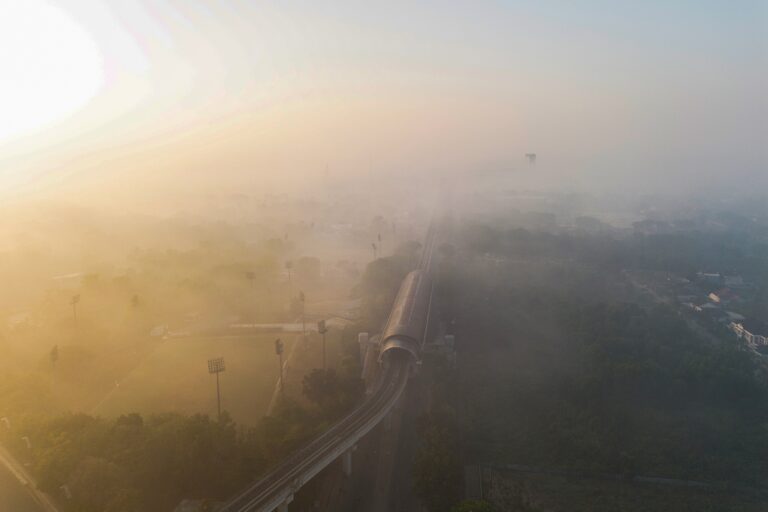
AL ZULKIFLI/gettyimages.com
When wildfire smoke is at its most lethal in South Sumatra — visibility near zero, helicopters grounded, skies too cloudless to seed — Indonesian authorities have found that conventional weather-modification tools vanish along with the horizon. The same atmospheric inversion layer that traps smoke at ground level also eliminates every standard intervention: no rain clouds form for cloud seeding to work on, and near-zero visibility makes water-bombing unsafe. Indonesia’s response this week is an 80-year-old solution to that specific atmospheric trap: dry ice dropped from a Cessna Caravan at 4,500 feet (1,372 meters), creating its own buoyant updraft by a physical mechanism that needs neither clouds nor clear skies. A trial launched October 15 improved visibility around the seeding area near Sultan Mahmud Badaruddin II International Airport in Palembang from 650 meters (2,133 feet) to 2,800 meters (9,186 feet) in a single operation.
The campaign, conducted jointly by the National Disaster Management Agency (BNPB), the national meteorological agency BMKG, and Indonesian military units, is running through late October as the country confronts what independent analysts are calling its worst wildfire season in a decade.
Inversions Trap Smoke, Blocking Every Tool Designed to Fight It
To understand why dry ice is being loaded into a single-engine Cessna over a burning Indonesian province, it helps to know what has kept millions of people choking for months.
In normal atmospheric conditions, air temperature falls with altitude at a predictable rate, allowing warm surface air — and the smoke and particulates it carries — to rise and disperse. When a mass of stable, warmer air settles above cooler surface air, the normal lapse rate inverts. The warm layer acts as a physical lid, suppressing vertical mixing and trapping whatever is beneath it at the surface.
That inversion creates a cascade of failure for emergency response. Cloud seeding, which works by dispersing silver iodide or sodium chloride particles into existing clouds to stimulate rainfall, requires clouds — and inversions typically form during clear, high-pressure conditions that produce no clouds. Indonesia has conducted 252 cloud-seeding operations since 2021, up from 85 in the preceding decade, but these work by inducing rainfall from clouds, not by busting inversions. Water-bombing helicopters, meanwhile, require pilots to see where they are flying; BNPB stated explicitly on October 15 that ground operations prioritized over aerial “because poor visibility has restricted water-bombing helicopter operations.” In Palembang, visibility had fallen to visibility as low as 400 metres on the worst days — below the minimum safe operating floor for water-bombing crews.
One atmospheric inversion, in other words, simultaneously cancels cloud seeding, water-bombing, and accurate aerial reconnaissance. That is the specific problem dry ice is designed to solve.
How Dry Ice Breaks Through Where Nothing Else Can
Dry ice — solid carbon dioxide — sublimates at -78.5°C (-109.3°F), meaning it transitions directly from solid to gas without passing through liquid form. When pellets of dry ice roughly 3 millimeters in diameter are dispensed from altitude into moist air, the rapid sublimation chills the surrounding air so drastically that water vapor condenses and freezes immediately without any foreign nuclei — a process called homogeneous nucleation. A single gram of dry ice generates at least 30 billion ice crystals by this mechanism.
This is distinct from silver iodide or salt seeding in a critical engineering respect: those techniques require existing cloud moisture and specific temperature windows, and they work by providing a foreign surface for ice crystals to form on (heterogeneous nucleation). Dry ice’s homogeneous nucleation is “almost independent of temperature” as physicist Norihiko Fukuta of the University of Utah wrote in Physics World — an advantage when trying to generate ice crystals in the cloudless, stable conditions that accompany inversions.
The phase change from water vapor to ice releases latent heat making air buoyant. That buoyancy generates an updraft — a rising column of warmer air — that, if sufficiently energetic, can physically punch through the inversion lid. The updraft carries the trapped smoke above the inversion layer, where upper-atmosphere winds disperse it.
Research into this technique goes back to November 13 1946 dry ice discovery, when Vincent Schaefer, a chemist at General Electric’s research laboratory, dropped about 1.5 kilograms (3.3 pounds) of crushed dry ice from a small aircraft into supercooled stratocumulus clouds over western Massachusetts and observed that snow crystals formed and fell from the cloud. Indonesia’s BNPB is applying this eight-decade-old discovery to a modern public health emergency — but with a key operational adaptation. Rather than targeting existing clouds to stimulate precipitation, the Indonesian operation targets the inversion structure itself, using dry ice’s self-contained thermodynamic mechanism to generate lift where standard cloud-seeding material cannot work.
The Cessna Caravan departing Raden Inten II Airport in neighboring Lampung province disperses the dry ice at approximately 4,500 feet (1,372 meters) altitude over the area surrounding Sultan Mahmud Badaruddin II International Airport in Palembang. Unlike sodium chloride (NaCl) cloud seeding, which is delivered in fine powder, the dry ice used in the Indonesian operation takes the form of granules approximately three millimeters in diameter.
South Sumatra, a Season of Records, and a Technical Failure Cascade
The context for deploying what amounts to an atmospheric physics experiment over a city of 1.7 million people is a wildfire disaster of unusual magnitude. Indonesia has recorded hotspot detections surpassing 2019 record — 1,061,746 wildfire hotspot detections as of October 14, surpassing the 885,037 recorded across the entire catastrophic season of 2019, which had previously been the worst comparable year. The total area burned reached approximately 895,657 hectares burned by August 2026 according to Nusantara Atlas, the independent wildfire monitoring platform. South Sumatra led national hotspot counts for much of the season; on October 8 alone, 354 hotspots and 390 hectares burning were documented in the province, with 354 high-confidence hotspots detected alongside 92 active fire spots.
The scale of the health crisis has been severe. Indonesia’s Health Ministry reported that wildfire respiratory illnesses reached 113,336 as of September 9, with more than 12.5 million people exposed to wildfire haze across seven provinces — nearly doubling in just over a week. In West Kalimantan, 165,000 respiratory cases in West Kalimantan had been recorded by August. Across the region, Malaysia’s health authorities reported that asthma cases jumped 259 percent in a single week in late August, with upper respiratory tract infections rising 124 percent. Singapore activated clinical healthcare subsidies — a measure last used in 2015 — with 1,000 of 1,370 PHPC clinics mobilized for haze-related treatment.
The proximate driver is a “Super El Niño” — described by some forecasters as potentially strongest El Nino on record. El Niño extends Indonesia’s dry season, desiccating the country’s vast peatlands. Peat fires are the dominant haze source and are structurally different from surface blazes: they smolder underground for weeks or months, cannot be extinguished by water-bombing, and release continuous high-particulate smoke from fire fronts that may be meters deep rather than at the surface.
By October 15, the operational reality had become acute: poor visibility had grounded the aerial water-bombing fleet across the most affected provinces, and no rain clouds were forming over South Sumatra for conventional cloud seeding to target. That is the technical failure cascade that made dry ice the next option.
What the Dry Ice Trial Showed and What It Cannot Fix
The October 15 trial produced measurable results. BNPB’s acting head of disaster data, Berton Panjaitan, confirmed that two flights improving visibility fourfold — each carrying 800 kilograms (1,764 pounds) of dry ice — improved visibility in the seeding area from approximately 650 meters (2,133 feet) to 2,800 meters (9,186 feet).
Experts received the results with cautious realism. Rick McRae, Adjunct Professor with the Bushfire Research Group at UNSW Canberra, assessed the technique shortly after the initial trial: potential for local temporary relief — “It’s got some potential for local relief that might work for a while.” He noted the central structural limitation: fires across the region are continuously generating smoke, and prevailing winds are driving that smoke over the same urban areas. “So if you’re in a town under that and you clear the smoke, there’s gonna be more blowing all the time,” McRae said. “It’s not going to be a permanent fix in any way.”
Budi Harsoyo, BMKG’s weather modification director, has consistently described cloud seeding and allied interventions as a “mitigation effort not a permanent solution”. His own research found a 12-day seeding doubled rainfall in 2023 and eliminated fire hotspots over that area during its operation.
The distinction matters. Dry ice cannot extinguish peat fires burning underground. It cannot remove the smoke source. Its effect is local and temporary: it improves visibility in the immediate vicinity of the operation for a period that depends on how quickly new smoke drifts in. BMKG must identify optimal atmospheric windows — conditions in which the inversion is strong enough to trap smoke (the problem they’re solving) but not so entrenched that the dry ice updraft cannot penetrate it. Wind direction, local thermal conditions, and the altitude of the inversion lid all affect whether any given morning’s flight will produce a measurable result.
Is There a Reason Indonesia Keeps Burning?
Environmental researchers and advocates have consistently argued that atmospheric interventions — sophisticated or otherwise — address a symptom while the structural cause operates unimpeded. Independent spatial analysis has found that approximately 74 percent of hotspots in concessions in Kalimantan fall within business concession areas — land designated for palm oil cultivation, timber plantations, or mining. The economics are stark: burning costs half the mechanical rate, with small-scale operators spending about 3.5 million rupiah ($195) per hectare clearing land with fire, compared with 7.7 million rupiah ($430) mechanically.
The price differential makes fire-based land clearing persistent despite Indonesia’s zero-burning policy. Police named 89 suspects in 189 fire cases of deliberate fire-setting after investigating 189 reports. In West Kalimantan, officials found land burned then prepared for cultivation with adjacent fires still burning.
A class action lawsuit filed at the District Court in Pontianak, West Kalimantan, filed a gross negligence lawsuit naming Prabowo, with plaintiffs accusing the Indonesian government — naming President Prabowo Subianto among ten defendants — of “gross negligence, omission, and failure” in allowing the annual crisis to recur. The no defendant appeared at first hearing on October 7, which proceeded without any defendant present. The government said it respects the suit, telling AFP it “respects” the legal action and said many concerns were already being addressed through ongoing efforts.
How Long Does the Emergency Last?
South Sumatra’s provincial governor has declared a smoke-disaster emergency alert through November 30. Nine district-level emergency decrees are in force across the province. Indonesia has deployed 17,000 firefighting personnel deployed across provinces in South Sumatra and Central Kalimantan combined — 12,285 in South Sumatra, 4,686 in Central Kalimantan — making this the most intensively staffed firefighting mobilization of the season.
Japan sent three CH-47 Chinooks, and Malaysia obtained Indonesian permission to fly cloud-seeding aircraft into Indonesian airspace along the Borneo border. El Niño conditions are expected to sustain dry weather across Sumatra into November, meaning the fire risk and its associated atmospheric inversions are unlikely to ease before the dry season’s natural end.
Dry ice is buying time and visibility. BMKG will identify windows, flights will run, and smoke will lift temporarily over Palembang’s airport approach paths and neighborhoods. The technique works precisely where others fail — in the cloudless, near-zero visibility conditions that an inversion creates — and that is its real contribution to a situation that has no short-term technical solution.
(Currency conversions in this article — rupiah figures to US dollars — are approximate, based on a mid-market rate of approximately 17,921 Indonesian rupiah per US dollar as of October 19, 2026.)
Frequently Asked Questions
Why can’t conventional cloud seeding clear the wildfire smoke over Palembang?
Conventional cloud seeding — which disperses silver iodide or sodium chloride particles to stimulate rainfall from existing clouds — requires clouds to target. Atmospheric inversions, which trap smoke near the ground, typically form during stable, clear-sky conditions. When an inversion is in place and visibility is near zero, there are no rain clouds available for seeding. Dry ice works through homogeneous nucleation: the sublimating solid CO₂ chills surrounding air so rapidly that water vapor freezes into ice crystals without any pre-existing clouds, generating a buoyant thermal updraft that can push through the inversion layer.
What does the 2026 Indonesia wildfire season tell us about why peat fires keep happening?
Indonesia’s 2026 season — the worst in at least a decade, with more than 1 million hotspot detections surpassing the catastrophic 2019 season — reflects a structural economic reality: burning is cheaper than mechanical land clearing, roughly half the cost per hectare. Independent analysis has found around 74 percent of Kalimantan’s fire hotspots fall within business concessions. Indonesia’s zero-burning policy exists on paper; enforcement has been insufficient to change the economic calculus that drives deliberate burning. The El Niño has made this year’s fires worse, but the underlying incentive structure is a chronic governance problem that atmospheric interventions cannot address.
How long does a dry ice operation actually keep the air clear?
The relief is local and temporary. Once the Cessna Caravan’s dry ice generates a buoyant updraft and lifts trapped smoke above the inversion lid, prevailing winds continue bringing smoke from still-burning peatlands and forests. Rick McRae, Adjunct Professor with the Bushfire Research Group at UNSW Canberra, summarized the limitation: clear the smoke over a town, and more blows in continuously. The technique improves visibility around the seeding zone for long enough to matter — opening an airport approach path, reducing particulate concentrations in a neighborhood for hours — but it does not address the fire source and requires repeated daily flights whenever atmospheric conditions permit.
Is Indonesia’s wildfire smoke dangerous for people in other countries?
Yes. The 2026 haze spread across Malaysia, Singapore, Brunei, the Philippines, and Timor-Leste. Singapore activated clinical healthcare subsidies not used since 2015, mobilizing roughly 1,000 primary care clinics for haze-related conditions. Malaysia recorded a 259 percent weekly jump in asthma cases during the worst weeks. Researchers estimate Indonesia’s wildfire emissions accounted for approximately 46 million tonnes of carbon released between August and September — roughly equivalent to the annual output of 45 coal-fired power plants.