Come to My Party! Drops Hand-Drawn Demo as Korean Solo Dev Rejects AI Art

October 18, 2026:

Come to My Party! Drops Hand-Drawn Demo as Korean Solo Dev Rejects AI Art
Come. to. my. Party
Cometomyparty.line.games

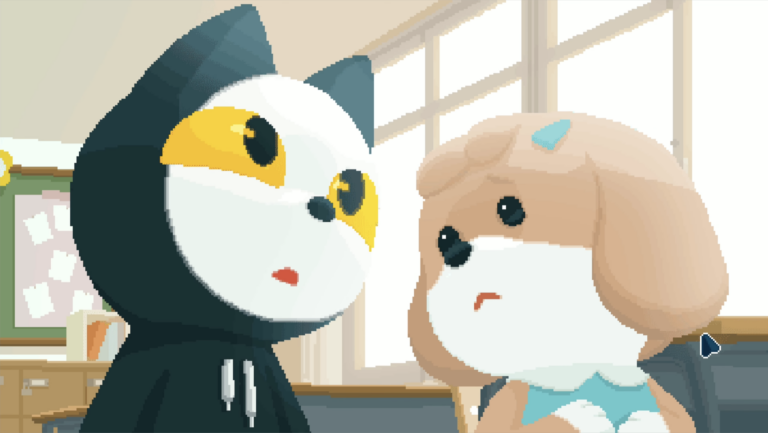
A solo developer in South Korea has just dropped a free demo of what may be the indie gaming world’s most deliberate rebuttal to AI-generated art: Come to My Party!, a darkly funny visual novel set inside a 1999 elementary school where every character sprite, every background, and every hand-drawn expression was created entirely without generative AI. That demo — Demo 2.0, rebuilt from player feedback — launched on Steam October 16, the same day the game appeared in The MIX Fall Game Showcase 2026. It is now available to download for free, and Steam Next Fest — one of Steam’s highest-traffic discovery events of the year — begins October 19.

That no-AI commitment matters more than it might appear. Visual novels — the precise genre Come to My Party! belongs to — are living through an accelerating AI reckoning. Genre veterans including Danganronpa creator Kazutaka Kodaka reflected on his previous release as potentially “the last grand story written entirely without AI,” as indie developers increasingly adopt generative tools to offset the prohibitive cost of hand-drawn assets. Solo developers face this pressure acutely: without a team, the labor cost of original pixel art can consume a project entirely. SIMSANG YOON, the solo developer behind Come to My Party!, chose the labor-intensive route anyway — and publisher LINE Games, the Seoul-based indie publisher behind Buried Stars and Ember and Blade, is betting on that choice.

What Come to My Party! Is Actually About

Ten-year-old Lee Jimin has never had anything she could call her own. Sandwiched between an honor-student older sister and an adorable younger sibling in a family that isn’t wealthy, she goes mostly unnoticed — wearing hand-me-down clothes, sharing food from her own bowl. Her mother makes an offer: become class president, and she’ll throw Jimin a real birthday party, all her own.

That premise sounds gentle. The game is not. Come to My Party! is classified by its developer as black comedy, and a hands-on preview from InvenGlobal’s YoungSeok “Lavii” Yang — who played the original demo at LINE Games’ booth at Korea’s PlayX4 expo in May 2026 — described it as “cold-bloodedly realistic” in ways that games about childhood innocence rarely are. To win the class president campaign, Jimin must build friendships with classmates who each carry hidden struggles — the shy Eunji, the mysterious Daeun — and every choice the player makes shapes which of those friendships holds, which fractures, and which of the game’s branching endings Jimin reaches.

Yang’s verdict after playing: “a strange sensation in looking back at childhood through the eyes of an adult — blending pity, discomfort, and understanding.” The game does not let Jimin off easily: it portrays her as impatient, as capable of cruelty, as getting things wrong — and then sometimes getting them right in ways that make the player proud. The Steam page includes content warnings for domestic violence, corporal punishment by teachers, bullying, and suicide — elements the preview noted are handled “not for cheap humor or satire” but with genuine narrative weight.

Characters are rendered in pixel art as animals and plants, their emotions worn visibly in expressions and gestures. Mini-games reproduce the textures of a South Korean 1999 classroom — washing up, organizing the cleaning closet, dusting chalkboard erasers — alongside the era’s technology, including a Windows 98-style game interface. Yang noted that even references to Nostradamus’ Y2K doomsday prophecy are woven into the setting naturally, grounding the late-’90s atmosphere without laboring it.

How the Demo Was Built: Player Feedback, Not AI

Demo 2.0 is not a renamed repackage of the original demo. According to LINE Games, the new version incorporates accumulated player feedback to refine story presentation, rework dialogue pacing, adjust mini-game difficulty, and improve quality-of-life features. The revision strategy reflects a standard iterative discipline for narrative games, where pacing — the timing of emotional beats and the decision to cut rather than explain — is the primary engineering challenge. The game’s multi-ending structure, where every player choice feeds into a branching system that can resolve into different friendships, different confrontations, and different outcomes for Jimin’s party ambitions, means that the underlying flag-tracking architecture has to account for a wide range of combinations without the narrative feeling mechanical. The demo’s multi-ending flag system tracks player choices and uses those accumulated values to determine which scenes unlock, which characters become accessible, and which endings become possible.

The visual novel genre operates on this flag-management principle: the game tracks the choices players make and uses those tracked values to determine which scenes unlock, which characters become accessible, and which endings become possible. For a solo developer, building a 12-outcome structure entirely by hand — without offloading any art generation, background creation, or scenario-tree population to AI tools — represents the kind of labor commitment that the current wave of AI-accelerated indie development is specifically designed to circumvent.

Why Steam Next Fest Is the Right Window

Steam Next Fest, Valve’s periodic discovery event for upcoming games, runs October 19 through 26. During Next Fest, wishlist-driven tools surface featured demos to players actively browsing for their next game. The February 2026 edition of Steam Next Fest included more than 3,500 games. The October 2026 edition comes at a moment when many developers are targeting Q4 launches or building audience momentum before year’s end.

LINE Games has positioned Come to My Party!‘s two-event rollout — an industry introduction at The MIX on October 16, followed immediately by Next Fest participation starting October 19 — as a deliberate bid for international visibility ahead of the game’s planned Q1 2027 full release. The strategy concentrates two of the indie gaming world’s most visible discovery channels within one week.

What Is The MIX?

The Media Indie Exchange — known as The MIX — has run annual showcases since 2012 and holds a track record for surfacing genuinely distinctive independent games. The Fall 2026 online showcase aired October 16, noon ET, featuring a curated selection of upcoming titles including Come to My Party!, alongside LINE Games’ own Ember and Blade and QUIET. A dedicated Steam curator page for The MIX Fall 2026 showcase lets players browse all featured titles in one place.

Does It Stand Out in a Crowded Genre?

The visual novel market on Steam has grown enormously: more than 2,272 visual novels were listed on the platform as of 2020, with hundreds added annually. The genre’s low-production-cost structure — minimal debugging needs, no difficulty-balance tuning, cheaper than most game categories to develop — makes it a natural home for solo developers. That same structural accessibility is also what makes AI art adoption so tempting: backgrounds, character sprites, and scenario generation are all areas where generative tools can dramatically reduce the hours needed to build a complete game.

Come to My Party!‘s answer is to make the hand-crafted quality the proposition rather than a workaround. InvenGlobal’s Yang singled out character expressions and gestures as central to the game’s emotional effectiveness, and described the direction and background music as “exceptionally well-placed.” The result is a demo that, in his assessment, started “lightheartedly” and left “a hollow ache.”

Yang also noted the game’s recommendation: “Personally, I think this is a game that parents raising children should play at least once.”


Frequently Asked Questions

Where can I download the Come to My Party! demo?

The Demo 2.0 is available now as a free download on Steam and the Epic Games Store. It was released on October 16, 2026. No purchase is required.

What makes Come to My Party! different from other indie pixel art games?

Two things, taken together. First, the game was built entirely without AI-generated content — every piece of artwork was hand-drawn by solo developer SIMSANG YOON at a time when the visual novel genre is actively adopting AI tools for assets. Second, the story’s setting and tone are specific: a 1999 South Korean elementary school, rendered through black comedy with genuine emotional weight, including content warnings for bullying and suicide that signal the game takes its darker themes seriously rather than using them for decoration.

When does the full game launch?

Come to My Party! is scheduled for a full release in Q1 2027. The Demo 2.0 on Steam is the current way to play, and the game will also be featured in Steam Next Fest, which begins October 19, 2026.

How does the branching ending system work?

Come to My Party! is a visual novel, meaning gameplay centers on reading text and making choices at key moments. Each choice feeds into a tracking system that accumulates throughout the game, shaping which characters Jimin can befriend, how those relationships develop, and which of the game’s multiple outcomes Jimin reaches — including whether her birthday party ever actually happens, and what kind of party it turns out to be.

Source link