Deadhand Theater: Free Steam Demo Covers Full Act 1 With Limb-Sacrifice Poker Combat

October 18, 2026:

Deadhand Theater: Free Steam Demo Covers Full Act 1 With Limb-Sacrifice Poker Combat
Deadhand. Theater
Bagtrackgames.com

Indonesian indie studio Bag Track Games released a free playable demo of Deadhand Theater on Steam on October 16, 2026, timed to The MIX Fall Game Showcase 2026 — and the demo immediately reveals why this is one of the more structurally unusual card games the genre has produced this year.

The game belongs to the roguelike deckbuilder genre that Balatro turned into a cultural phenomenon in 2024, but it makes a design choice that neither Balatro nor Slay the Spire before it attempted: your character’s own body is part of the resource economy. You can read the Balatro Steam page to see how the genre benchmark handles poker differently.

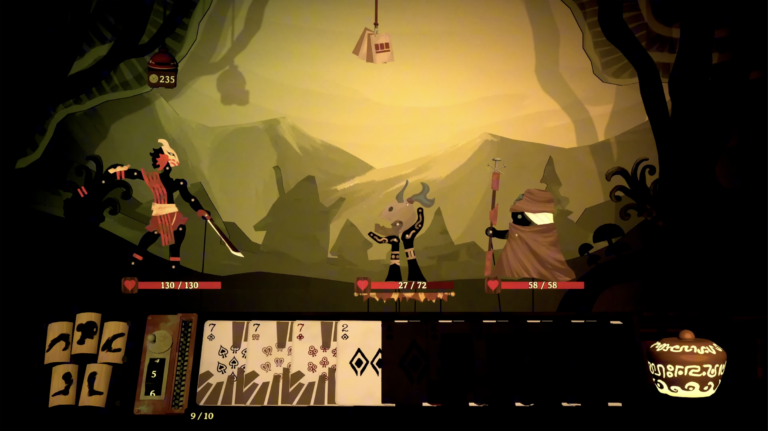
In most deckbuilders, you acquire cards, spend them, and occasionally destroy them to thin your deck. In Deadhand Theater, you are playing a shadow puppet controlled on a theatrical stage — and the puppet’s limbs are passive modifiers that function like equipped relics. Tearing off a limb mid-battle triggers that limb’s active effect and can swing a fight, but the passive bonus that limb was quietly providing vanishes the moment it’s gone, and stays gone until you find or buy a replacement. The body is the deck.

Poker Hands Drive Every Command — Here Is How

The combat system works like this: you hold a hand of standard playing cards (four suits, normal ranks), and selecting cards that form recognized poker combinations — pairs, straights, flushes, full houses, and more — executes the puppet’s attacks. The strength of the combination determines the power of the output, so forming a high-ranking hand matters the same way it does at a real poker table. A full breakdown of how poker hands execute puppet attacks is available from All Things How.

What Bag Track Games added on top of standard poker math is a layer of card-level modifiers that shift how individual cards fit into hand combinations. An Encased Card doubles its rank but takes up two hand slots, rewarding focused builds that commit to one high-value card. A Stitched Card grows rank with each attack but cannot form poker hands at all, making it a solo damage-scaler rather than a combo piece.

The result is a dual optimization problem that doesn’t exist in Balatro’s design: you are simultaneously trying to form strong poker hands for combo effects and deciding whether to include cards that scale independently outside the hand structure. A single play can trigger multiple hand types at once — a pair, a three of a kind, and a high card all firing their own effects together — which creates explosive moments that feel earned by the build, not just lucky.

What Is Actually in the Free Demo

The demo covers Act 1 from its first fight through the act boss — a complete picture of the core loop. Players can access the full set of talismans and grafts for run-building, encounter Bazaars, Black Markets, and other stage types, and use the new Upgrade Stage, which spends a progression currency (labeled STC on the run-end screen) to strengthen the puppet between runs. Multiple difficulty settings are available, with harder settings unlocking progressively after clearing earlier ones.

Acts 2 and 3, the unlockables shop, and additional Upgrade Stage content are being held back for the full release.

The demo content library as announced on the Deadhand Theater Steam page: 60 talismans, 40 sigils, 45 hexes, 25 grafts, and 30 stage modifiers.

How This Demo Differs From Previous Playtests

Deadhand Theater has been in active playtest via itch.io through 2026. The September 2026 v0.3.0 update rebuilt the map selection view to show all nodes leading to the boss, significantly overhauled post-battle rewards, and introduced attack animations for every combination type.

The Steam demo launch represents a further step. Bag Track Games has updated the visual animations for poker hands, added new music for the main menu and boss battle, improved the UI throughout, and introduced the STC progression currency display. Several balancing adjustments and bug fixes from the playtest period are included. The developer also moved the poker hand ability guide to a more accessible position during combat — a usability change that addresses one of the larger friction points new players encountered in earlier builds.

A Puppet Stage Built on Indonesian Cultural Heritage

Deadhand Theater‘s visual and atmospheric identity is rooted in wayang kulit, the traditional Javanese shadow-puppet performance tradition. Wayang kulit is a UNESCO-recognized Intangible Cultural Heritage dating back at least 1,000 years in Indonesia, in which a puppet master (dalang) controls flat puppets behind a backlit screen to narrate mythological and moral stories.

Bag Track Games uses the dalang-puppet relationship not just as an aesthetic but as a structural metaphor for the player’s relationship to their character. The player controls the puppet; the puppet’s body is the resource pool; the theatrical stage is both the setting and the constraint. Audio design leans into this with heavy, slow-tempo gamelan-influenced instrumentation that sustains psychological tension throughout each combat encounter.

The game has previously appeared at the Game Devs of Color Expo and the Southeast Asia Game Showcase, where it represented a growing current in Indonesian indie game development: using indigenous cultural forms as structural game logic, not just surface decoration.

Does the Limb-Sacrifice System Actually Work?

The mechanic is the right idea in theory, and the demo is the first chance to judge it in practice. In genre terms, what Bag Track Games has designed is a form of destructive resource depletion that the genre has rarely attempted — most deckbuilders let you remove cards from your deck, but they don’t let the fight itself cost you a permanent passive modifier unless you choose it. The limb sacrifice makes every late-round decision feel genuine: the question isn’t “do I spend this card” but “how much of this body am I willing to use up to win this fight.”

That design logic is visible even in Act 1, which the demo covers completely. Whether it sustains the full three-act run — and whether the replacement economy through Bazaars and shops is tuned well enough to make limb loss recoverable rather than death-spiraling — is a question the demo is positioned to answer for players before they commit to the full release.

When Can Players Expect the Full Game?

Third-party aggregators have reported a Q1 2027 release target for the full game; Bag Track Games has not officially confirmed a release date on Steam. The developer has said its next development focus areas are polishing animations and visual details, and adding new stage types currently in progress. Player feedback from the demo’s in-game form, Discord, and Steam discussions will directly inform upcoming updates.

Players can wishlist Deadhand Theater on Steam. Bag Track Games is reachable via Discord (discord.gg/TsQ4dgWMgB), the studio’s account on X, and Bluesky.


Frequently Asked Questions

What is Deadhand Theater and how does it differ from Balatro?

Deadhand Theater is a dark, turn-based roguelike deckbuilder from Indonesian studio Bag Track Games in which players form poker hands from a standard card deck to command a shadow puppet’s attacks in combat. Unlike Balatro — which uses poker hands as a pure score-multiplier system — Deadhand Theater maps each hand combination directly to a combat action, creating a strategic tempo decision about when to use which hand rather than how to maximize a point total. The further distinction: the puppet’s body parts act as passive modifiers that can be sacrificed mid-fight for a powerful effect, at the permanent cost of that modifier — a resource-depletion mechanic Balatro does not have.

What does the free Deadhand Theater demo include?

The demo covers Act 1 in its entirety — every fight from the opening encounter through the act boss. It includes the full core combat loop (poker hands as commands, limb sacrifice), a selection of talismans and grafts for build variety, multiple stage types including Bazaars and Black Markets, and the Upgrade Stage where you spend progression currency to improve your run between encounters. Multiple difficulty settings are available, with harder difficulties unlocking progressively. Acts 2 and 3 and additional meta-progression content are reserved for the full release.

What is the wayang kulit connection in Deadhand Theater?

Wayang kulit is a traditional Javanese shadow-puppetry tradition recognized by UNESCO as an Intangible Cultural Heritage, in which a dalang (puppet master) controls flat leather puppets behind a backlit screen to perform mythological stories. Bag Track Games uses this form as both the game’s visual identity — silhouette characters on a lamplit stage with gamelan-influenced music — and as structural logic: the player acts as dalang controlling a puppet whose body is the resource pool. This makes Deadhand Theater part of a broader movement in Southeast Asian indie game development that treats indigenous cultural forms as game design foundations rather than surface aesthetic choices.

How does the limb sacrifice mechanic work mechanically?

Each of the puppet’s body parts provides a passive bonus during combat, similar to an equipped relic in games like Slay the Spire. At any point during a fight, you can sacrifice a limb to trigger its active effect — a potentially fight-swinging ability — but the passive bonus that limb was providing disappears immediately and stays gone until you find or purchase a replacement limb through a Bazaar or shop event. The risk calculation is deliberate: spending a limb now might save the current fight while making every future fight harder until you rebuild.

Source link