HomeAuto Mummy 4 Reunites Fraser and Weisz: Franchise Magic Words Come From Real Egyptian Doctrine
Mummy 4 Reunites Fraser and Weisz: Franchise Magic Words Come From Real Egyptian Doctrine
October 16, 2026:
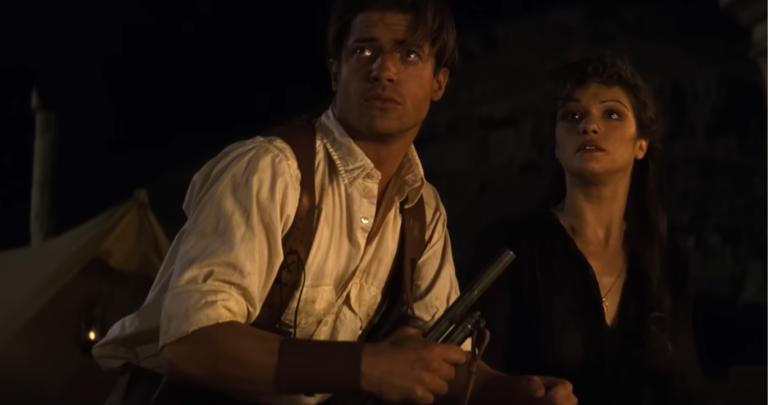
Brendan Fraser and Rachel Weisz in a still from The Mummy (1999). Universalpictures.com
Set photos published on October 14, 2026 confirm that Brendan Fraser and Rachel Weisz returned to set together for the first time since The Mummy Returns (2001) — twenty-five years between the last time Rick and Evelyn O’Connell shared a frame, and the images circulating online carry the particular weight of a reunion audiences had long assumed would never happen. John Hannah, who played the unforgettable Jonathan Carnahan across both original films, is also confirmed on set. What the photos cannot show is the intellectual architecture underneath the franchise — and that turns out to be worth examining, because The Mummy’s apparently absurd supernatural premise is built on something real: the ancient Egyptian doctrine that spoken language does not describe reality but constitutes it. That is not a poetic metaphor. It is a documented theological framework that governed Egyptian civilization for three thousand years, and the franchise borrowed it faithfully.
The Mummy 4 is in active principal photography, directed by Radio Silence (Matt Bettinelli-Olpin and Tyler Gillett), with a theatrical release scheduled for October 15, 2027. Fraser serves as both star and executive producer. The fourth film ignores the 2008 Tomb of the Dragon Emperor entry and positions itself as a direct sequel to The Mummy Returns. Oded Fehr is also confirmed to be reprising his role as Ardeth Bay, the Medjai warrior whose brotherhood has guarded a secret for three thousand years — and, as it turns out, that brotherhood has more historical grounding than most franchise fans realize.
Five concept clusters from the canonical films deserve the kind of close scientific and historical scrutiny that the franchise’s blockbuster reputation has tended to forestall: mummification and biological preservation, the Book of the Dead as a linguistic-cognitive artifact, the scarab beetle’s real biology versus its mythological encoding, the Medjay as an attested historical institution, and Hamunaptra as a composite of real Egyptian archaeology. In each case, what the franchise gets right — and what it deliberately inverts — reveals a creative team that did its homework even when it chose to ignore what it found.
Fraser and Weisz Return: What the Set Photos Confirm
The October 14 images, first published by SFFGazette.com and subsequently confirmed by multiple entertainment outlets, show Fraser and Weisz in on-location production together. New cast member Michael Johnston described his character as “a new character, but the film is just returning to its original formula” — signaling that the sequel intends to honor the tone and mythology of the 1999 and 2001 films rather than reinvent the franchise’s premise. Fraser had confirmed filming underway in September — the October photos provided independent visual confirmation that Weisz, whose participation had been announced but not yet documented in production images, was present and in active shooting.
Radio Silence brings a genre-fluent filmmaking sensibility to the material. Bettinelli-Olpin and Gillett’s Scream (2022) and its sequel demonstrated their capacity for franchise stewardship that respects established mythology while reshaping its emotional terms. David Coggeshall, who wrote Bodies Bodies Bodies (2022), is credited as screenwriter. What The Mummy 4 will do with the loss of Hamunaptra — the franchise’s primary supernatural location, collapsed at the end of the 1999 film — remains unanswered; the set’s London and Morocco locations suggest the geographic expansion the sequel will require.
Mummies Do Contain DNA: Science Confirms the Franchise’s Central Intuition
The Mummy (1999) treats the mummified body as a biological vessel capable of regeneration after three thousand years of preservation — a premise the film correctly locates in the ancient Egyptian understanding of death as reversible transition rather than final endpoint. The science in 2026 confirms one part of this and definitively refutes another.
Max Planck Institute scientists extracted and sequenced mitochondrial DNA from 90 Egyptian mummies and partial genomic DNA from three, overturning earlier consensus that Egypt’s warm, humid tomb conditions made long-term DNA survival unlikely. The methodology they developed opened pathways for reconstructing population genetics across millennia — demonstrating that the franchise’s core intuition, that a preserved body retains biological information across thousands of years, has real scientific grounding.
The part the franchise correctly sidesteps: DNA preservation is not resurrection. “The hot Egyptian climate, the high humidity levels in many tombs, and some of the chemicals used in mummification techniques contribute to DNA degradation and unlikely survival,” Johannes Krause of the Max Planck Institute for the Science of Human History noted in Nature Communications. True cellular resurrection would require not just intact genetic sequences but functional mitochondria, membrane-intact cells, and a working proteome — none of which three-thousand-year-old natron burial has been shown to preserve.
The ancient Egyptians understood this, at a practical level, better than the franchise acknowledges. Mummification preserved the body for the soul to re-enter, but the actual process was as much ritual as biology: organs were removed into canopic jars (liver, lungs, stomach, and intestines, with the heart always left in situ as the seat of consciousness), the body was packed with natron — a naturally occurring blend of four sodium compounds from the Wadi Natrun — and the entire procedure was understood as transformation, not mere preservation. Modern radiology and DNA extraction have allowed researchers to reconstruct individual health histories from the contents of canopic jars, a kind of biological time capsule that the franchise literalizes as a physical resurrection but that real science has turned into a population genetics revolution.
Ancient Egyptians Treated Language as Physics: How the Franchise Borrowed a Real Doctrine
The franchise’s deepest and most intellectually coherent element is the one that sounds most fantastical: the idea that reading specific words aloud from the Book of the Dead can reverse physical entropy and reconstitute a living body from desiccated remains. This is not arbitrary supernatural invention. It is a direct appropriation of the Egyptian doctrine of Heka.
Heka — usually translated as “magic” but more precisely meaning the primordial force by which the gods created and maintained the cosmos — was understood in ancient Egyptian theology as the power of the spoken and written word to constitute rather than describe reality. Thoth, the ibis-headed deity of wisdom and language, was understood to maintain the universe through continuous speech. The hieroglyph for “beetle” (kheprer) also meant “to come into existence.” Scribes wrote certain spells in red ink to demarcate their power from ordinary text — a distinction that survives today in the English word “rubric,” from the Latin for red.
“For ancient Egyptians, the Book of the Dead was nothing less than a resurrection and deification machine,” Foy Scalf, Head of Research Archives at the Oriental Institute, University of Chicago, has stated. This is not metaphorical. The ancient Egyptians understood correctly formulated spoken utterance as having physical force — the franchise’s “magic words” premise is a faithful dramatization of a documented theological framework that governed one of history’s most sophisticated civilizations for three thousand years.
The franchise makes one significant error about the text itself: the real Book of the Dead — known to its authors as “Reu Nu Peret Em Hru,” the Book of Going Forth by Day — was not a necromantic tool but a navigation manual for the afterlife. It was a corpus of up to two hundred individualized spells, never canonized in fixed form, recorded on papyrus scrolls, tomb walls, linen bandages, and amulets, tailored to each deceased person’s identity and social rank. Its purpose was to equip a soul for the challenges of the Duat (underworld) and achieve identification with Osiris — a process Egyptologists describe as resurrection and deification. It did not raise the physically dead. The franchise correctly identifies the ontological power of its language while miscategorizing its function.
Were Flesh-Eating Scarabs Real? Dung Beetles Navigate by the Galaxy
The flesh-eating scarabs of The Mummy (1999) rank among cinema’s most viscerally memorable images — coordinated swarms of beetles that strip flesh from bone, pour from ancient tombs in rivers of clicking horror, and in the Hom-Dai curse are depicted as Imhotep’s eternal prison and instrument of vengeance. The actual Scarabaeus sacer is completely harmless to humans and navigates by the Milky Way.
In 2013, researchers confirmed that dung beetles use the galactic band as a celestial compass, rolling their dung balls in perfectly straight lines even on moonless nights by orienting to the galaxy’s diffuse light. They are, by this measure, among the most sophisticated navigators in the insect world — and the most life-affirming symbols in the entire Egyptian religious tradition, making them the first non-human Milky Way navigators confirmed in any species.
The root word kheper encompassed simultaneously “beetle,” “to come into existence,” and “to transform” — making the scarab a hieroglyphic sign that meant transformation and creation as an inherent property of its existence. Heart scarabs — large amulets in the shape of the beetle — were placed over the hearts of the deceased to prevent the heart from testifying against the dead soul during the weighing-of-the-heart ceremony before Osiris: they were, in effect, carved pleas for mercy embedded directly into the mummy.
The franchise’s decision to weaponize the scarab is a deliberate thematic inversion of its actual symbolic weight. By making scarabs the mechanism of the Hom-Dai curse’s living burial, the filmmakers trap Imhotep with the very symbol of transformation and resurrection — denying him the natural cycle those symbols represent. This is more sophisticated than it appears: the most cosmically appropriate punishment for someone who sought forbidden resurrection is imprisonment by the symbol of rebirth itself. The actual ecological niche of the “flesh-eating scarab” is occupied in real entomology by blowfly larvae, which do consume decomposing tissue and form the basis of forensic entomology; the franchise displaced this biological reality onto a symbolically much weightier insect.
Were the Medjay Real? Oded Fehr’s Brotherhood Has Historical Precedent
Of all the franchise’s invented elements, the Medjai — the secret brotherhood sworn to prevent Imhotep’s resurrection, led by Ardeth Bay across both canonical films — has the deepest historical grounding. The Medjay were real.
Originally an ethnic group from the land of Medja, east of the Second Nile Cataract in Nubia (roughly corresponding to parts of modern Sudan), the Medjay were first employed as mercenaries and desert scouts by Middle Kingdom Egypt. Their extraordinary desert survival and tracking skills made them invaluable. By the 18th Dynasty of the New Kingdom (c. 1550–1292 BCE), the title “Chief of the Medjay” had become the highest law enforcement rank in ancient Egypt — and Egyptian officers with no Nubian ancestry continued carrying the designation as an occupational title for centuries after the original ethnic Medjay had fully assimilated into Egyptian society.
Most significantly for the franchise: the real Medjay were assigned specifically to protect royal necropolises, patrol desert boundaries, and guard tomb precincts. Papyri from the New Kingdom document Medjay patrols around the Valley of the Kings, charged with catching tomb robbers. Their role as guardians of sacred burial sites against intrusion is directly attested in Egyptian administrative records. The franchise’s transformation of this institution into a multigenerational secret brotherhood is historically creative but not entirely unfounded — it fuses the Medjay’s attested role as desert-specialized royal guardians with the broader historical reality of priestly bloodlines holding knowledge that could not be entrusted to ordinary administrative channels.
In a civilization where correct ritual execution was understood as cosmically load-bearing — where the wrong incantation could genuinely destabilize the order of Ma’at — institutions designed to hold dangerous knowledge across generations were not paranoid fantasy but rational institutional design. Ardeth Bay is, in this reading, not an invented character but a thematic descendant of a real and documented profession.
Hamunaptra Is Fiction, but Buried Egyptian Cities Are Not
Hamunaptra — the vast underground necropolis that serves as the franchise’s primary supernatural location — is explicitly fictional. No such city is attested in Egyptological records. However, several of its defining features are directly paralleled in real Egyptian archaeology.
The Valley of the Kings was chosen by New Kingdom pharaohs specifically because its remote, enclosed topography allowed each tomb’s entrance to be completely concealed after sealing, mirroring Hamunaptra’s design logic almost exactly. The pyramid tradition was abandoned because the pyramids’ visibility made them irresistible targets for looters; the Valley was a deliberate engineering response — a burial ground designed to be unfindable. Saqqara, the vast necropolis of Memphis, continues to yield undiscovered tombs to this day. Abydos, the cult center of Osiris, was the idealized burial destination for all Egyptians — the site where Osiris was held to have been buried and resurrected.
Most strikingly: as recently as 2021, a 3,400-year-old buried city — subsequently called the “Lost Golden City of Luxor” — was uncovered near Luxor, buried under sand, demonstrating that major Egyptian urban sites can remain hidden beneath the Sahara for millennia. Satellite imagery and LIDAR surveys of Egypt’s eastern desert have identified numerous buried structures whose surface signatures have been invisible to ground-level observers for centuries. The franchise’s most fantastical setting has the most real-world archaeological basis.
Hamunaptra’s “sinking” mechanism — an engineered architectural disappearance — is also not purely fantastical. The loss of the city at the end of the 1999 film is a genuine narrative constraint the creative team behind The Mummy 4 must navigate: the franchise’s primary supernatural location is gone, and any sequel must either account for that loss or expand the mythological geography. Fan speculation that the fourth film may relocate the action to South America is consistent with the pattern of sequels extending a franchise’s canonical reach.
The franchise’s term “Hamunaptra” blends phonetic approximations — “hamunet,” associated with underworld references in certain demotic texts, and “petra,” Greek for stone — though the etymology is a screenwriter’s invention. Fascinatingly, a small city referred to as “Hamunaptra” by British engineers in the 1850s turned out to be the site of Harappa, one of the two major cities of the Indus Valley Civilization — suggesting that the resonance of the name reaches across multiple archaeological traditions in ways its inventors may not have anticipated.
Frequently Asked Questions
What has been confirmed about The Mummy 4’s cast and production?
Set photos published October 14, 2026 confirmed that Brendan Fraser and Rachel Weisz are in active production together — the first confirmed images of both stars on set simultaneously since The Mummy Returns (2001). John Hannah and Oded Fehr are also confirmed to be reprising their roles. Matt Bettinelli-Olpin and Tyler Gillett (Radio Silence) are directing from a screenplay by David Coggeshall. Fraser is also serving as executive producer. The film is scheduled for theatrical release on October 15, 2027.
Did ancient Egyptians actually believe spoken words had physical power?
Yes — and this is the franchise’s most intellectually coherent element. The doctrine of Heka, usually translated as “magic” but more precisely meaning the primordial force through which the gods created the cosmos, held that correctly formulated spoken and written language did not merely describe reality but constituted it. Thoth, the god of wisdom, was understood to maintain the universe through continuous speech. The hieroglyph for “beetle” simultaneously meant “to come into existence.” The franchise’s Book of the Dead as a spoken-word resurrection trigger is a faithful dramatization of a real Egyptian metaphysical framework — even though the actual Book of the Dead (known to Egyptians as the Book of Going Forth by Day) was a navigation manual for the afterlife, not a necromantic tool.
Can mummy DNA actually survive thousands of years, and does that make resurrection possible?
Max Planck Institute researchers successfully extracted and sequenced complete mitochondrial DNA from 90 Egyptian mummies, overturning earlier skepticism about DNA survival in Egypt’s climatic conditions. So yes: genetic information can survive. But DNA sequences are not a blueprint for resurrection. Biological function requires not just intact genetic sequences but functional mitochondria, membrane-intact cells, and a working proteome — none of which three-thousand-year-old natron burial has been shown to preserve. The franchise’s internal logic sidesteps this problem by routing resurrection through metaphysics rather than biochemistry: the Book of the Dead provides the energy gradient; Heka does the cellular work. Whether that is satisfying depends on your relationship to ancient Egyptian theology.
Were the Medjay — Ardeth Bay’s secret brotherhood — historically real?
The Medjay were real. Originally a Nubian ethnic group employed as mercenaries and desert scouts, they became ancient Egypt’s elite paramilitary police force by the 18th Dynasty, with the “Chief of the Medjay” holding the highest law enforcement rank in the land. Papyri document their patrols of the Valley of the Kings, explicitly tasked with preventing tomb intrusion — precisely the function the franchise assigns to Ardeth Bay’s brotherhood, just with a supernatural charge attached. The franchise’s creative leap is transforming a real occupational institution into a multigenerational secret brotherhood, but the historical precedent for necropolis guardians with esoteric knowledge is not invented.