HomeAuto Spirited Away Stage Tour Casts Seven as Chihiro: Identity Is Name, Not Body
Spirited Away Stage Tour Casts Seven as Chihiro: Identity Is Name, Not Body
October 15, 2026:
Spiritedawayonstage.com
The world tour stage adaptation of Studio Ghibli’s Spirited Away announced three new cast members on October 15, 2026, bringing the total ensemble performing the role of Chihiro to seven — and in doing so, made visible the production’s most audacious intellectual claim: that identity is not housed in a single body, but held in a name that any worthy bearer can carry. The announcement, reported by animeanime.jp and cross-confirmed in the world tour cast unveiled by Anime News Network, named Inoue Kazu (of the idol group Nogizaka46), Toyoshima Hana, and Hirasawa Kokoro as three additions to a cast that already includes original 2022 performers Kanna Hashimoto and Mone Kamishiraishi, 2024 London addition Momoko Fukuchi, and understudy Marina Mori. While Anime News Network reported that the three new additions’ specific roles were not officially detailed at time of announcement, the production’s consistent casting architecture and the animeanime.jp report indicate all seven are engaged to perform Chihiro across the global run.
The world tour is scheduled to open at the National Theater and Concert Hall in Taipei, Taiwan on December 16, 2026, before proceeding to Tokyo’s Meijiza (March–May 2027), Toronto’s Princess of Wales Theatre (May 6–August 15, 2027), and the Ahmanson Theatre in Los Angeles (September 2–October 24, 2027), with additional legs in Nagoya, Osaka, Fukuoka, Sapporo, and London’s Coliseum through mid-2028. Full tour schedule and ticket information is available at the production’s official website.
Seven Performers, One Name: What the Casting Decision Is Actually Saying
The decision to distribute Chihiro across seven distinct actresses is unusual in contemporary international theater, and it is not primarily a logistical solution to a long global tour. It is the production’s clearest structural statement about what the film it adapts is actually about.
Cognitive neuroscientists Martin A. Conway and Christopher W. Pleydell-Pearce, writing in Psychological Review in 2000, described the Self-Memory System: a hierarchical architecture of autobiographical memory in which personal identity is anchored, most fundamentally, in the proper-noun self-concept — one’s own name. Their 2000 Psychological Review paper argues that strip the name and the self becomes unmoored. Hayao Miyazaki’s 2001 film dramatized this with extraordinary precision: Yubaba steals Chihiro’s name, leaving her with only “Sen,” and the entire narrative engine turns on the question of whether the self can survive without its anchor. Haku, also nameless, cannot leave the spirit world until Chihiro restores his name to him. The climax is not a battle or an escape — it is an act of cognitive restoration.
By casting seven actresses to hold the name and embody the role, John Caird’s production enacts the film’s argument at the level of production design. “Chihiro” is a name that any qualified bearer can carry. The character’s identity is not fixed in Hashimoto’s face or Kamishiraishi’s voice; it is held in the name that each performer takes on, reconstructed anew at every performance. The production does not merely adapt the film’s story — it instantiates the film’s thesis.
How Three Traditional Theater Forms Build One Impossible Bathhouse
Director John Caird and set designer Jon Bausor arrived at the bathhouse’s stage realization through a deliberate synthesis of traditions that theater scholar Homi Bhabha would recognize as a Third Space construction: a hybrid form that is neither Japanese theater nor Western theater, but a genuinely new form produced by their encounter. (Bhabha, The Location of Culture, Routledge, 1994.)
The architectural core is a Noh stage embedded inside a Western proscenium. Noh theater — a classical Japanese form developed in the 14th century, recognized as UNESCO Intangible Cultural Heritage — has a specific stage grammar: the hon-butai (main performance area), the hashigakari (the long bridge runway along which actors enter from the spirit world), and the spatial logic that the stage is already a threshold, a place where the human and spirit worlds overlap. Bausor placed that grammar inside the proscenium frame, creating a nested threshold: audiences sit in a modern Western theater, watch through a proscenium arch, and see within it a stage architecture already coded for supernatural transit. Chihiro does not merely cross from one world to another — she crosses through a stage form that architecturally means crossing between worlds.
The rotating three-level bathhouse structure then operates on top of that nested architecture. Rather than blacking out between scenes, the set turns to reveal new rooms — creating the impression that space itself reconfigures rather than that characters travel through it. This is not merely elegant stagecraft; it is a physical enactment of the bathhouse’s spatial rules, which are not the human world’s rules.
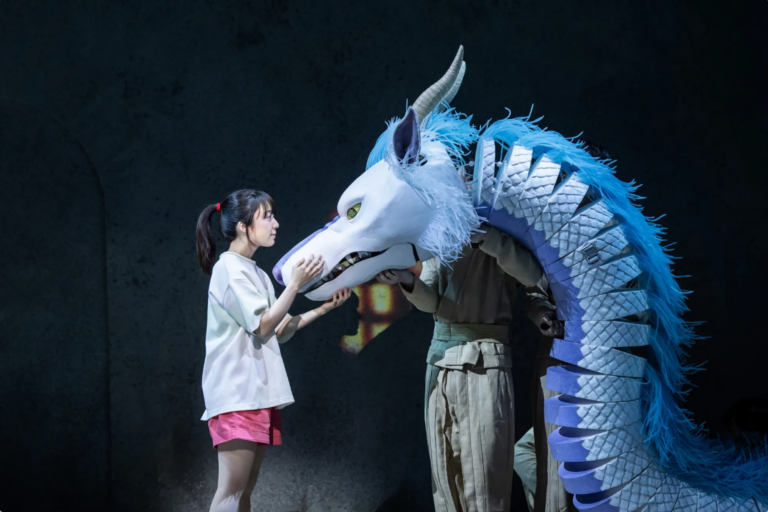
The production’s puppet vocabulary draws on Japan’s other great classical theatrical tradition, Bunraku, in which life-size puppet characters are operated by multiple visible handlers — traditionally three, each responsible for different parts of the figure’s body. Caird and puppet designer Toby Olié adapted this structure at a larger Western scale. No-Face, Yubaba, Kamajī, and the River Spirit are rendered as oversized puppets manipulated by dancer-puppeteers wearing khaki costumes that match the set. The puppeteers are not hidden; they are present, de-emphasized, operating at the threshold of visibility. Director Caird described this as making “complicity rather than illusion” the audience’s primary mode of experience: you see the mechanism and choose to believe in the spirit anyway.
As No-Face consumes and swells through the film’s central arc, additional dancer-puppeteers join the configuration. The growing number of visible operators physically externalizes the character’s consumption of others — the entity visibly incorporates more bodies as it grows. Caird described this as one of the production’s most technically and conceptually satisfying solutions.
How Does the Spirited Away Stage Musical Compare to the Film?
Theater cognition scholars Berys Gaut and Lisa Zunshine provide the framework for understanding why this approach to visible mechanism produces a richer audience experience than pure theatrical illusion would. (Zunshine, Why We Read Fiction: Theory of Mind and the Novel, Ohio State University Press, 2006.)
Cognitive aesthetics research — the study of how minds engage with and process artistic experience — shows that audiences watching a performance engage in rapid Theory of Mind modeling: they attribute intentions to characters, read emotional states, track multiple agendas simultaneously. Zunshine’s work on fiction and Theory of Mind demonstrated that this mental stack is not a burden but a source of engagement: the more layers of intentionality an audience can track, the more cognitively active and memorable the experience becomes.
The Spirited Away production adds a third layer. Watching a traditional performance, audiences track the character and the actor. Watching visible puppetry, audiences simultaneously track the puppet-character, the puppeteer’s intention, and the compositional logic that unifies them into a single fictional entity. This is not confusion — it is a cognitively richer state that produces more durable memory encoding and more active aesthetic engagement. By making its mechanism visible, the production asks audiences to hold three simultaneous intentional stances. The artifice is the experience.
The same logic applies to the seven-actress ensemble. Audiences who know that tonight’s Chihiro is Inoue Kazu, and who have perhaps seen a recording of Hashimoto’s performance, are tracking two layers of Chihiro simultaneously: the character and the particular performer’s interpretation of it. The role becomes legible as a role, which is precisely the film’s point about identity — not given, but performed, constructed, and held.
What Is the Spirited Away Stage Adaptation About?
For audiences encountering the production for the first time, the story follows ten-year-old Chihiro, who stumbles with her parents through an abandoned amusement park into the spirit world. Her parents are transformed into pigs by the witch Yubaba, who operates a vast bathhouse servicing Shinto nature deities — and Chihiro must take a job at the bathhouse, surrendering her name, to earn their freedom. The story’s emotional register is one of determined tenderness under disorienting pressure: a child learning that the rules of the world she grew up in do not apply here, and that survival requires her to understand a completely different set of rules while holding onto the knowledge of who she is.
Anthropologist Victor Turner’s theory of liminality — developed in The Ritual Process (Aldine, 1969) — describes threshold states in which normal social categories are suspended and transformation becomes possible. Turner derived the concept from folklorist Arnold van Gennep’s three-part ritual structure: separation from ordinary social life, a liminal period of radical uncertainty and trial, and reincorporation into society in a transformed state. Chihiro’s arc follows this structure precisely. The name-theft is separation. The bathhouse labor is the liminal period — she is “betwixt and between,” neither child nor adult, neither human nor spirit-world inhabitant. Her parents’ restoration and the recovery of her full name is reincorporation. Miyazaki did not merely write a fantasy adventure; he encoded a rite of passage with anthropological precision.
The production also carries a second allegorical register, most vivid in the Stink Spirit sequence: a monstrous nature deity arrives encrusted in physical corruption that manifests as toxic sludge and overpowering stench. Chihiro recognizes a foreign object embedded in its side, leads a team to extract it, and the sludge resolves to reveal the River Spirit — the pollution had a concrete, removable, industrial cause. In Japanese Shinto, kegare (ritual pollution) is a state of contamination that misogi (purification through water immersion) can remove. Miyazaki’s scene literalizes river pollution as spiritual ailment and depicts community-organized remediation as the cure: physical removal of embedded waste, followed by processing through a large purification system staffed by coordinated labor. The bathhouse’s water economy — processing contaminated deity-water and expelling treated waste — is structurally isomorphic to a municipal wastewater treatment plant, and the allegory is Miyazaki’s sharpest environmental argument.
World Tour Schedule: Where to See Spirited Away on Stage
The world tour represents a significant expansion from the production’s origins. The original 2022 run at Tokyo’s Imperial Theatre starred Kanna Hashimoto and Mone Kamishiraishi in alternating performances. A 2024 London run at the Gillian Lynne Theatre drew more than 300,000 audience members over 17 weeks, earned four Olivier Award nominations in 2025 (Best Set Design, Best Costume Design, Best Sound Design, and Best New Entertainment or Comedy Play), and won WhatsOnStage Best New Play at the 25th Annual WhatsOnStage Awards. Subsequent runs in Shanghai and Seoul sold out. Joe Hisaishi’s Academy Award-nominated score from the original film is performed live by a full orchestra throughout.
The world tour schedule is as follows. All productions are in Japanese with English captions (for international venues):
Taipei, Taiwan — National Theater & Concert Hall: December 16, 2026–January 31, 2027
Tokyo, Japan — Meijiza: March–May 2027
Toronto, Canada — Princess of Wales Theatre: May 6–August 15, 2027
Nagoya, Japan — Misonoza: June 2027
Osaka, Japan — Umeda Arts Theater: June–July 2027
Fukuoka, Japan — Hakata-za: July–August 2027
Sapporo, Japan — Cultural Arts Theater Hitaru: August 2027
Los Angeles, USA — Ahmanson Theatre: September 2–October 24, 2027
London, UK — London Coliseum: March–July 2028
For North American audiences, the Toronto and Los Angeles legs are the primary access points. Toronto’s Princess of Wales Theatre will host a three-month run beginning May 6, 2027; the Ahmanson Theatre in Los Angeles is scheduled to open September 2, 2027. Tickets and on-sale information for all legs are available through the production’s official website.
For audiences who want a preview before the live production arrives, GKIDS and Fathom Entertainment screened filmed captures of the 2022 Imperial Theatre run in U.S. cinemas on October 1 (Kanna Hashimoto as Chihiro) and October 8 (Mone Kamishiraishi as Chihiro) as part of Ghibli Fest 2026 stage screenings — both screenings have now passed. The original animated Spirited Away (2001) will return to cinemas in a 25th Anniversary theatrical engagement from October 17–21, 2026, via GKIDS and Fathom Entertainment.
Frequently Asked Questions
What does having seven Chihiro actresses mean for how audiences experience the show?
It means the production is asking audiences to experience “Chihiro” as a role that any worthy bearer can embody — which is precisely the film’s argument about identity. Cognitive neuroscientist research on autobiographical memory — established in Conway and Pleydell-Pearce’s 2000 study published in Psychological Review — shows that personal identity is anchored in proper nouns and constructed through memory rather than fixed in a body. The film’s name-theft narrative literalizes this: lose the name, lose the self. The stage production distributes the character across seven performers who each hold the name “Chihiro” for their run of performances, enacting the film’s thesis at the level of casting. Audiences watching Inoue Kazu or Toyoshima Hana carry the role are watching the production argue, in real time, that identity survives because it can be held by others who know your name.
How does the production use Japanese theatrical traditions, and why does it matter?
Director John Caird and set designer Jon Bausor embedded a Noh stage structure — with its hashigakari runway, traditionally used for the entrance of spirit-world figures — inside a Western proscenium theater. Bunraku-style puppetry (multi-operator visible manipulation) brings No-Face, Yubaba, and other spirit characters to life. Theater scholar Homi Bhabha’s concept of the Third Space (from The Location of Culture, Routledge, 1994) describes hybrid cultural forms that are genuinely new rather than compromised versions of their source traditions. This production is a Third Space artifact: it is not Japanese theater performing for Western audiences, nor Western theater wearing Japanese aesthetic costume. The visible puppeteers, the nested stage architecture, and the live Hisaishi score produce something that audiences across London, Shanghai, Seoul, and now global tour venues have navigated fluently — suggesting the hybrid form is expansive, not limited.
Where can North American audiences see the Spirited Away stage musical, and when?
Two North American legs are scheduled. Toronto’s Princess of Wales Theatre is set to host the production from May 6 through August 15, 2027. The Ahmanson Theatre in Los Angeles is scheduled to open September 2, 2027, with the run closing October 24, 2027. Tickets and on-sale dates will be announced through the production’s official website. The production is performed in Japanese with English captions at international venues.
Who are the original Chihiro actresses, and how does the new casting fit into the production’s history?
The role of Chihiro has been performed by seven confirmed actresses across the production’s history. Kanna Hashimoto and Mone Kamishiraishi originated the role in the 2022 Tokyo Imperial Theatre run, performing in alternating performances — the rotating-cast structure was built into the production from its first iteration. Momoko Fukuchi joined for the 2024 London run. The three new world tour additions announced October 15, 2026 are Inoue Kazu (a member of the idol group Nogizaka46), Toyoshima Hana, and Hirasawa Kokoro. Marina Mori has served as understudy across all runs. The casting reflects both the practical demands of a global multi-year tour and the production’s consistent philosophical position: the character is the name, not the performer.