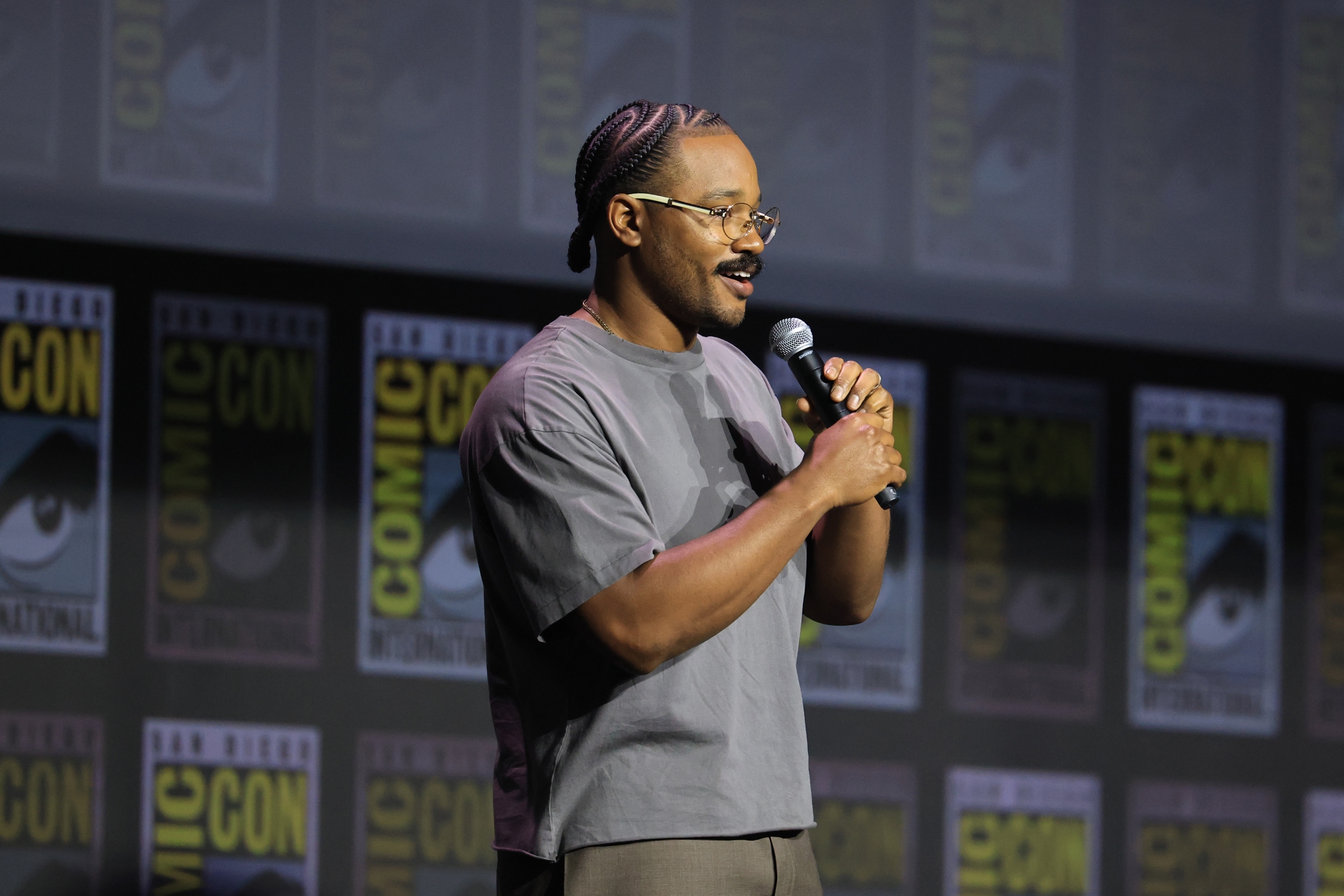
Hulu has committed to a complete first season of a reimagined X-Files with Ryan Coogler — the director and screenwriter behind Sinners — as writer, pilot director, and executive producer, the streamer confirmed the full series order on October 13, 2026. The pickup follows a two-hour pilot shot earlier this year in Vancouver on 65mm large-format film, the same format Coogler used for Sinners, and marks the most significant institutional commitment to the franchise since its original 1993 premiere.
The new series, produced by Coogler’s Proximity Media, Onyx Collective, and 20th Television under his five-year exclusive Disney television deal, centers on two new FBI agents — played by Danielle Deadwyler (Till, The Piano Lesson) and Himesh Patel (Yesterday, Christopher Nolan’s The Odyssey) — assigned to a long-shuttered division devoted to cases involving unexplained phenomena. Coogler has described the project as “a new chapter” that honors the original universe rather than erasing it, leaving open the possibility of appearances by the original cast while giving the new leads room to build their own identity.
“I’ve loved The X-Files for a long time,” Coogler said in an official statement accompanying the series order, “so getting the chance to write and direct the pilot has meant a great deal to me. What Chris Carter created is special, and we wanted to honor everything that made the original series connect with so many people while also finding our own way into that world.”
Why 65mm Film for a Streaming Pilot Is Not an Arbitrary Choice
The production detail that most clearly signals Coogler’s intentions is the decision to shoot the pilot entirely on 65mm large-format film. Autumn Durald Arkapaw, who serves as cinematographer, shot Sinners on IMAX 65mm and Ultra Panavision 70, bringing that same visual vocabulary to the X-Files pilot. This format, standard in Hollywood’s roadshow era of the 1950s and 1960s and then nearly extinct for decades, captures approximately four to five times the image information of standard 35mm film — finer grain, broader dynamic range, and a capacity to render shadow detail with a resolution that high-end digital cameras have only recently approached in practice. Euphoria’s third season shot significant 65mm footage, making it one of the very few television productions to have attempted this format.
Arkapaw took home the first Best Cinematography Oscar ever awarded to a woman or a Black person at the March 2026 ceremony, for her work on Sinners. She built a visual language for rendering Black bodies and Black spaces with the luminosity and interiority typically reserved for prestige theatrical releases. Applying that vocabulary to a paranormal television series is not decorative — it is an argument: that what the camera is about to capture deserves the fullest possible attention.
A show about what is hidden in institutional darkness — in classified files, in deniable evidence, in the faces of witnesses who cannot articulate what they experienced — has chosen a format that can show you more of the dark. The 65mm pilot’s reported two-hour runtime and the persistent early discussions about a theatrical release before the series pickup was confirmed suggest that Coogler conceived the pilot as a cinematic event first and a television delivery second.
What the Coogler Pilot Actually Is — and Who Is In It
The pilot was filmed from May 11 through approximately June 11, 2026, in Vancouver, British Columbia — the same city where the original X-Files shot its first five seasons, a detail that is almost certainly not coincidental for a filmmaker who describes himself as a long-time franchise fan.
The guest cast assembled for the pilot is a significant indicator of the project’s status in the industry. Amy Madigan — who earned Supporting Actress honors for her work in Weapons at the same March 2026 ceremony where Sinners took home four Oscars from its sixteen nominations — appears alongside Steve Buscemi, Ben Foster, Devery Jacobs (Blood Quantum, Reservation Dogs), Tantoo Cardinal, and Lochlyn Munro. This is not a cast that attaches to projects out of commercial obligation.
Showrunner Jennifer Yale, known for her work on Legion, See, and The Copenhagen Test, will steer the writers’ room going forward as Coogler transitions into his executive producer role. The pilot’s music was composed by Ludwig Göransson, Coogler’s frequent collaborator who also scored Sinners and all three Black Panther films, bringing a sonic vocabulary that has demonstrated an ability to hold multiple musical and cultural traditions simultaneously.
The X-Files’ Epistemological Engine, Explained
The X-Files is not primarily a show about aliens or monsters. It is a show about the sociology of belief in the face of institutional suppression of evidence. The franchise’s enduring structural power derives from what scholars of scientific reasoning would recognize as the Mulder-Scully dialectic: a sustained confrontation between abductive reasoning — the method described by philosopher Charles Sanders Peirce in the nineteenth century, in which an agent forms the boldest hypothesis that the available anomalous data could support — and the falsificationist methodology of scientific skepticism associated with Karl Popper, which demands reproducible, peer-reviewed evidence before accepting a claim.
The X-Files division in the fictional FBI operates as the bureaucratic expression of institutional ambivalence: these cases exist within the Bureau because someone in the apparatus believes they warrant investigation, yet the division is perpetually underfunded and marginalized, its findings deniable. The show drew direct inspiration from the real FBI Behavioral Science Unit at Quantico — itself an anomalous division whose methodology (psychological profiling) was openly mocked by the scientific establishment until it produced results.
UAP Hearings Made the Show’s Central Premise Non-Fiction
When the original X-Files premiered in 1993, its premise — that a shadow government actively suppressed evidence of anomalous aerial phenomena while a small, marginalized division of the FBI investigated cases conventional methods could not resolve — was understood as compelling genre fiction. In 2022 and 2023, former US military officers gave sworn Congressional testimony about structured craft exhibiting flight performance characteristics beyond known human technology. The institutional dynamic the original series dramatized decades in advance — phenomena filed, investigated inadequately, and deniably managed — became, in structural terms, an accurate description of a real government apparatus.
A Ryan Coogler X-Files arriving in this context is not arriving into the same cultural environment as the 2016 Fox revival. The question the franchise poses — not “what are they hiding?” but “how do we know anything, and who gets to decide what counts as knowing?” — is recognizably the central epistemological crisis of the current decade, in which the tools for distinguishing genuine anomaly from manufactured confusion are precisely what has been degraded.
How Sinners Rewires the Paranormal — and What That Means for X-Files
Coogler’s most recent film provides the clearest available window into his approach to paranormal storytelling. Sinners is a Southern Gothic horror-musical set in 1930s Mississippi that uses vampirism as a metaphor for the extraction of Black cultural production. Its central conceit — that the blues functions as a conjuring technology, opening temporal seams through which past and future versions of Black American musical identity become visible — is grounded in African-derived spiritual epistemology: the Vodou relationship with the lwa, the Yoruba concept of Àṣà (cultural tradition as a living entity), and the documented belief that blues music emerged from a crossroads bargain with a figure known as the Devil.
“I love horror cinema,” Coogler has said of the film’s genesis. “I wanted to bring that element to this story and it just made sense the more I learned about blues music and its relationship with spirituality and with the supernatural. I put both things together.”
What Sinners establishes is a specific mode of supernatural reasoning: in Coogler’s framework, the paranormal is not fundamentally opposed to Black cultural life — it is an expression of it. Folk wisdom, communal ritual, and ancestral knowledge are presented as epistemological systems that possess genuine explanatory power which the mainstream institutional framework cannot accommodate. This is precisely the structure of the original X-Files: Mulder’s paranormal findings are real within the fiction, while Scully’s scientific framework, however rigorous, consistently fails to contain them.
The field of ethnoscience — which studies indigenous and folk classification systems for natural phenomena and their relationship to formally validated scientific knowledge — has documented that many pre-Enlightenment epistemological frameworks predicted or described phenomena that Western science later validated through formal methods. Indigenous astronomical calendars in Mesoamerica achieved precision comparable to modern instruments. West African ethno-pharmacology documented plant compounds later synthesized as pharmaceuticals. The Dogon people of Mali possessed detailed documented knowledge of Sirius B (a white dwarf companion star) decades before Western telescopes confirmed its existence — a puzzle that remains contested but compelling.
A Coogler X-Files that takes seriously the explanatory power of non-Western knowledge systems — rather than treating them as local color against which the FBI’s empirical methods are validated — would represent a genuine intellectual intervention in the genre.
Real STEM Concepts the Franchise Has Always Encoded
The X-Files mythology posited several fictional scientific concepts that have since been partially validated by real research.
The show’s mythology depicted alien-human hybridization via engineered retroviruses. Today, approximately 8% of the human genome consists of sequences derived from ancient retroviral infections, and CRISPR-mediated gene editing routinely accomplishes targeted genomic insertions — placing the franchise’s core hybridization concept firmly within current scientific vocabulary.
The series depicted craft capable of right-angle turns at speed, silent operation, and apparent gravity manipulation — characteristics consistent with sworn military UAP testimony in 2022 and 2023. Proposed real-world mechanisms include inertial mass reduction via oscillating electromagnetic fields, a hypothesis that appeared in US Navy patent filings between 2016 and 2019.
Most striking is the franchise’s central mythology around suppressed memory of abduction experiences. In 2000, neuroscientist Karim Nader at McGill University demonstrated that retrieved long-term memories become briefly chemically labile — unstable and alterable — before being re-stored in a process called reconsolidation. Blocking protein synthesis during memory retrieval can disrupt or alter the stored memory. The X-Files’ fictional technology of targeted memory suppression, which previously appeared to be pure genre invention, now has a peer-reviewed neurobiological mechanism. When the new series revisits that mythology, it will be dramatizing something real science has partially confirmed.
Who Are Danielle Deadwyler and Himesh Patel?
Danielle Deadwyler established herself as one of the most significant dramatic performers of her generation with her portrayal of Mamie Till in Till (2022), a role requiring the sustained expression of grief, defiance, and political consciousness under conditions of extreme narrative compression. Her subsequent work in The Piano Lesson demonstrated range across historical American dramatic material. As one of the new X-Files leads, she brings the specific quality of making interiority legible — a critical skill for a show whose central dramatic method is placing a credible, watchable human being in the path of the inexplicable.
Himesh Patel arrived at international prominence through Yesterday (2019) and deepened his dramatic credentials with Station Eleven (HBO Max, 2021), a quiet and exact performance in a genre-adjacent prestige production. He appears next in Christopher Nolan’s The Odyssey, which suggests a career deliberately positioned at the intersection of commercial reach and serious filmmaking ambition. The pairing of Deadwyler and Patel as the new X-Files agents — neither of them primarily associated with television genre work — mirrors the original casting of Gillian Anderson and David Duchovny: actors whose qualities ran against type for the format they were entering.
What the Show Doesn’t Have Yet — and What That Means
Hulu has not announced a premiere date, episode count, or production start date for episodes beyond the pilot. The confirmation of a full series order means the writers’ room under Jennifer Yale is the active front of the project, with principal photography on additional episodes expected to begin in 2027 at the earliest. No release window has been confirmed as of October 14, 2026.
The absence of a premiere date is not unusual at this stage of a premium series order; it is also a signal that Hulu and Disney are treating this as a tentpole property rather than a filler pickup. Productions that commit to 65mm film and assemble casts of this caliber do not typically rush to a release date before the creative work is locked.
Original series creator Chris Carter is attached as a non-writing executive producer, a credit structure that suggests creative blessing without direct artistic control — the arrangement that typically produces the best continuations of long-running franchises when the incoming creative has their own vision.
Frequently Asked Questions
Is the new X-Files a full reboot, or is it connected to the original series?
Ryan Coogler has described it as a “new chapter” rather than a hard reboot. The new series introduces two entirely new FBI agents — Danielle Deadwyler and Himesh Patel — assigned to a division investigating unexplained phenomena, with Chris Carter attached as a non-writing executive producer. Coogler has said the new series honors the original universe, which leaves the door open for original cast appearances, but the creative focus is on the new characters rather than on Mulder and Scully.
Who is in the cast of the new X-Files pilot?
The two leads are Danielle Deadwyler (Till, The Piano Lesson) and Himesh Patel (Yesterday, Station Eleven). The pilot’s guest cast includes Amy Madigan (2026 Academy Award winner for Weapons), Steve Buscemi, Ben Foster, Devery Jacobs (Reservation Dogs), Tantoo Cardinal, and Lochlyn Munro. Jennifer Yale (Legion, See) serves as showrunner for the ongoing series.
When will the new X-Files be available on Hulu?
No premiere date has been announced as of October 14, 2026. Hulu confirmed the full first-season order on October 13, 2026, but production on episodes beyond the pilot has not yet formally begun. A 2027 or later premiere window is the most realistic expectation given the current production status.
What does it mean that the pilot was shot on 65mm film, and does that matter for streaming?
65mm large-format film captures approximately four to five times the image information of standard 35mm film, producing exceptional shadow detail, finer grain, and greater dynamic range. For a show about what is hidden in institutional darkness — classified documents, deniable evidence, witnesses who cannot articulate what they saw — cinematographer Autumn Durald Arkapaw’s choice of format functions as an argument about the seriousness of what the camera is capturing. Most of the format’s raw information advantage is not fully reproducible on home streaming screens, but the aesthetic texture it produces — the particular quality of light and shadow on film emulsion — is perceptible even at lower resolution, and it has been the defining visual vocabulary of prestige theatrical cinema for decades. Coogler’s decision to bring it to television is a statement, not a technical specification.