HomeAuto World First: Commercial Green Ammonia Refueled Ship in Open Water, Closing Carbon-Free Fuel Chain
World First: Commercial Green Ammonia Refueled Ship in Open Water, Closing Carbon-Free Fuel Chain
October 15, 2026:
Cmb.tech
On October 13, 2026, a 5,547-cubic-meter (approximately 196,000 cubic feet) converted bunkering vessel pulled alongside a 210,000-deadweight-ton bulk carrier at an anchorage off Zhoushan, China, and pumped 1,000 tons of certified ammonia across a hose — completing the world’s first commercial ship-to-ship transfer of green ammonia as marine propulsion fuel. For the global shipping industry, which accounts for roughly 3% of global greenhouse-gas emissions and has long debated whether ammonia can actually function as a zero-carbon fuel at sea, the operation answered the most stubborn practical question: yes, the complete supply chain now works, end to end, under real commercial conditions.
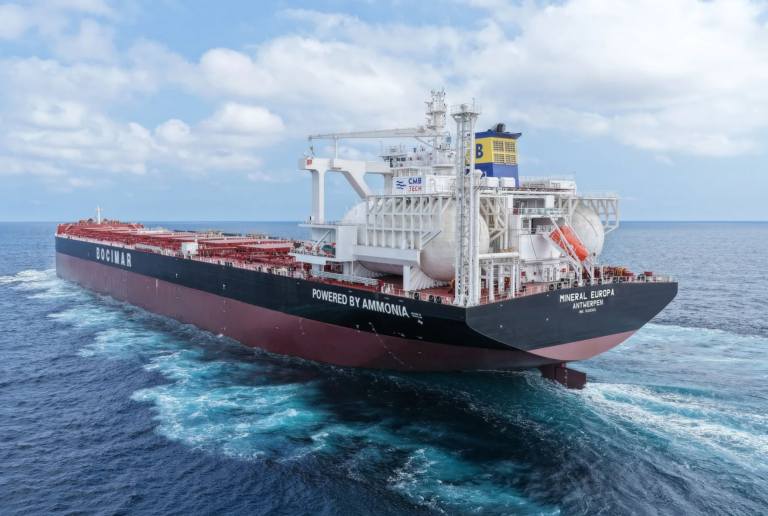
The receiving vessel, Mineral Europa, is the world’s first ammonia-powered dry bulk carrier in the 210,000-DWT class — a Newcastlemax-size ship built by CSSC Qingdao Beihai Shipbuilding in China for Belgium’s CMB.TECH. The company expects to take delivery of 21 ammonia-powered vessels by 2029, comprising 18 dry bulk carriers, one container ship, and two chemical tankers — most within the next nine months. The bunkering vessel, Shenghang Yongle, is a converted semi-refrigerated liquefied gas carrier that holds the first ammonia bunkering class certificate issued by China Classification Society (CCS) — and which entered service less than five weeks before this operation. The operation was jointly conducted by CEEC Hydrogen Energy Co., CMB.TECH, and Jiangsu Andefu Energy Technology Co.
Six World Firsts in One Operation
Chinese state energy engineering firm CEEC described the Zhoushan bunkering as achieving six simultaneous world firsts:
The first commercial ship-to-ship green ammonia bunkering at an open anchorage. The entry into service of the first dedicated liquid ammonia bunkering vessel. The implementation of the first take-or-pay sales contract for green ammonia in ocean shipping. The issuance of the first ship-to-ship liquid ammonia bunkering license. The first commercial ocean voyage by a 210,000-ton ammonia-powered bulk carrier. And the first full-chain carbon footprint traceability from a green ammonia production facility to a port storage tank.
Together, these milestones close what industry observers have called the “missing link” in green ammonia as a marine fuel: until October 13, you could point to individual pieces of the chain — engines that burn ammonia, vessels fitted to carry it, offshore production facilities making it from renewable electricity — but no single operation had connected all of them simultaneously under commercial, certified conditions. Now one has.
How the Engine Actually Burns Ammonia — and What It Cannot Quite Do Yet
Mineral Europa is powered by a WinGD X72DF-A — a large-bore, two-stroke dual-fuel engine that runs ammonia as its primary fuel using high-pressure direct injection. In full-load testing at WinGD’s Engine Research and Innovation Centre in Winterthur, Switzerland, the design achieved diesel-equivalent thermal efficiency, while keeping ammonia slip below 10 parts per million and nitrous oxide (N₂O) below 3 ppm — without any exhaust after-treatment system. In January 2026, WinGD completed the world’s first type approval testing for an ammonia-fueled two-stroke marine engine — an achievement witnessed by Lloyd’s Register and classification societies. The X72DF-A variant installed in Mineral Europa subsequently completed its own factory acceptance testing in June 2026 at CSSC Engine Co. in China.
The one caveat a technically literate reader should understand: today’s ammonia marine engines are not literally fossil-fuel-free. The X72DF-A requires approximately 5% conventional pilot oil by energy content at full load to ignite the ammonia in the cylinder. This means roughly 95% of the vessel’s propulsion energy comes from zero-carbon ammonia, with 5% from marine diesel oil. That is a vast improvement over a conventional vessel but is not net-zero combustion on its own — the well-to-wake carbon accounting depends on both the upstream production of the green ammonia and what the 5% pilot fuel emits.
The second physical constraint: ammonia contains only 18.6 megajoules of energy per kilogram (MJ/kg), compared to approximately 44 MJ/kg for conventional marine diesel. That means 1,000 metric tons of ammonia delivers the combustion energy of only about 422 tons of diesel fuel — so an ammonia-fueled vessel needs roughly 2.4 times more volume or mass of fuel for the same voyage range. Mineral Europa carries its liquid ammonia in two 3,000-cubic-meter (106,000-cubic-foot) Type C deck-mounted tanks, held at approximately −33°C (−27°F) at atmospheric pressure — the same temperature at which ammonia liquefies under standard refrigeration, a technology used industrially for decades.
Where Does This Fuel Come From? From Wind Turbines in Jilin
The 1,000 metric tons of ammonia transferred at Zhoushan originated at CEEC’s Songyuan Hydrogen Energy Industrial Park in Jilin Province, northeastern China — approximately 2,000 kilometers (1,240 miles) north of Zhoushan. The facility, known in Chinese as “Qing Hydrogen No. 1” and launched commercially on December 16, 2025, is described as the world’s largest integrated green hydrogen, ammonia, and methanol project.
Phase 1 of the project harnesses 800 megawatts of renewable capacity to produce approximately 45,000 metric tons of green hydrogen per year, which is then converted via the Haber-Bosch process into roughly 200,000 metric tons of green ammonia and methanol annually. The critical innovation at Songyuan is not the Haber-Bosch synthesis itself — that is century-old technology — but a proprietary “multi-stable flexible control strategy” that matches the normally inflexible ammonia synthesis process (which requires constant pressure and temperature) with the variable output of renewable wind and solar power. That pairing had been one of the hardest engineering problems in scaling renewable ammonia production.
The ammonia used at Zhoushan holds ISCC EU RFNBO certification, confirmed by Bureau Veritas on December 2, 2025. RFNBO stands for Renewable Fuels of Non-Biological Origin — the standard required under the EU’s FuelEU Maritime regulation for fuel to count toward European green fuel compliance obligations. This certification means the Songyuan ammonia is not merely “green” in a marketing sense; it has been independently verified to meet the EU’s well-to-wake lifecycle greenhouse-gas accounting standard. For the dozens of ammonia-capable vessels that CMB.TECH and its partners plan to deploy on European-adjacent routes, that certification is what converts this from a demonstration into a commercially usable product.
Before reaching Zhoushan, a total of 5,000 metric tons of ammonia were shipped from Songyuan to Nanjing Port — transported by road using specialized tank trucks, a journey of approximately 700 kilometers (435 miles). From Nanjing, Shenghang Yongle carried 1,000 metric tons onward to Zhoushan, where the ship-to-ship transfer was completed. That multi-modal supply path — inland wind farms to road transport to coastal port to dedicated bunkering vessel to open-water anchorage to deep-sea propulsion engine — is the entire green ammonia fuel chain, demonstrated in sequence for the first time.
CEEC’s second phase, already under construction, is expected to more than double the facility’s annual output when it comes online. The project’s ultimate vision is to connect Songyuan’s production directly to ocean shipping routes through a dedicated sea-transport and bunkering network, with a Panjin Port ammonia terminal planned, which CEEC and Andefu expect to complete in the second half of 2027.
Why Ship-to-Ship at Anchorage Changes the Economics
Previous green ammonia bunkering events — a handful globally, all in the early demonstration phase — have involved quayside transfers at fixed terminal facilities or shipyard deliveries. Most significantly, NYK Line conducted an STS ammonia transfer on September 17, 2026, at Japan Marine United’s Ariake Shipyard: fuel from the carrier Shoei Maru was delivered to a gas carrier undergoing pre-delivery preparations — a critical technical milestone, but a shipyard operation, not a commercial bunkering, and using conventional rather than certified green ammonia.
The Zhoushan event is different in kind. Bunkering at an anchorage — in open water, away from port infrastructure — is how the global LNG marine fuel market scaled from niche to mainstream. An LNG bunkering vessel can travel to where a ship waits, regardless of whether the waiting port has LNG terminal infrastructure. Green ammonia gains the same flexibility with Shenghang Yongle operational: ships do not need to call at ports with dedicated ammonia terminal facilities to refuel. That geography-agnostic capability is the commercial unlock that STS bunkering provides.
Alexander Saverys, CEO of CMB.TECH, called Mineral Europa the beginning of a “propulsion revolution” and said it proves large ocean-going ships “can be powered by ammonia.” Following the bunkering operation, Mineral Europa departed Zhoushan on a charter to Australian mining giant Fortescue, bound for Australia to carry iron ore — its first commercial voyage across the Pacific.
What Comes Next — and What the Industry Still Lacks
CMB.TECH is the most aggressive early adopter of ammonia propulsion. Fortescue has chartered up to 12 vessels — Newcastlemax bulk carriers — from CMB.TECH’s dry bulk division Bocimar, and Mitsui O.S.K. Lines has signed for nine ammonia-powered vessels. CMB.TECH has also secured a green ammonia offtake agreement with CEEC Hydrogen Energy to supply fuel from Songyuan for 11 of those vessels.
A separate ammonia bunkering trial is planned at Port Hedland in Western Australia — Fortescue’s key iron ore export hub — later this year, confirmed by Pilbara Ports Authority.
The honest picture, though, is that one commercial bunkering and one operational fleet is not a global fuel network. According to analytical assessments drawing on DNV data, ammonia bunkering rates 2.5 out of 5 for readiness toward “repeatable global commercial deployment” — the engine technology is commercial; the port availability and green fuel supply remain significant bottlenecks. DNV’s Maritime Forecast projects ammonia will become the dominant fuel choice for new ships by 2042 and represent approximately 25% of maritime fuel by 2050 — implying demand of roughly 120 million metric tons per year of green ammonia by mid-century. Demand-side projections from a separate EU-funded DNV study put the figure even higher: 2.3 million tons by 2030, rising to 62 million metric tons by 2040, and 245 million metric tons by 2050.
The IMO in May 2026 adopted what became the first binding net-zero targets for any industrial sector globally, committing international shipping to net-zero GHG emissions by or around 2050, with interim checkpoints requiring at least 30% reduction by 2030 and 80% by 2040 versus 2008 levels. The IMO is developing a tradeable credits and fuel-intensity standard mechanism — policy signals that analysts expect to sharpen commercial incentives for green ammonia infrastructure investment.
One supply-security consideration deserves attention for operators outside China: CMB.TECH and its partners have, in effect, built the world’s first commercial green ammonia marine fuel chain primarily around a single Chinese state-owned supplier (CEEC) and Chinese-based logistics. That makes the emerging ammonia bunker market significantly dependent on Chinese production infrastructure at this early stage — a concentration risk that non-Chinese fleet operators may want to consider as they plan fuel strategies. Multiple ammonia production and bunkering projects are advancing in Norway, the US Gulf Coast, Southern Africa, and Australia, which will diversify supply over time.
CEEC has described the Zhoushan operation as a “China solution” designed to be replicable — an engineering and logistical template for scaling green ammonia supply from isolated demonstrations to large-scale commercial logistics. The ambition is a globally distributed network of bunkering vessels, each capable of supplying certified zero-carbon ammonia to a growing fleet. The Pacific crossing of Mineral Europa, which began October 13 at Zhoushan and is now underway, is where that network’s commercial existence began.
Is This How LNG’s Rise Looked in Year One?
Shipping’s path to decarbonization has spent years on the “chicken-and-egg” problem: shipowners say they will not order ammonia-powered vessels without guaranteed fuel supply; fuel producers say they will not build green ammonia infrastructure without committed buyers. The commercial structure assembled around the Zhoushan operation — a take-or-pay offtake contract, a certified fuel, a dedicated bunkering vessel, a fleet of 21 vessels on order — is the answer to that deadlock. It does not resolve the question of whether green ammonia can scale to hundreds of millions of metric tons per year by 2050. But it demonstrates, at commercial scale and with certified emissions accounting, that the entire chain from wind turbine to propeller now works.
The LNG marine fuel market’s first ship-to-ship bunkering, in 2016, was followed by thousands of LNG-fueled vessels over the next decade. Whether ammonia follows the same trajectory will depend on fuel costs, infrastructure investment, crew training capacity, and IMO policy. But as of October 13, the first dominoes are down.
Frequently Asked Questions
How does green ammonia work as a ship fuel — and what makes it “green”?
Conventional ammonia is one of the world’s most widely traded industrial chemicals, produced for fertilizers primarily using hydrogen derived from natural gas (a high-emissions process). “Green” ammonia is produced by splitting water into hydrogen and oxygen using electrolysis powered by renewable electricity, then combining that hydrogen with atmospheric nitrogen via the century-old Haber-Bosch process. The fuel contains no carbon, so combusting it in a marine engine produces no direct CO₂. In Mineral Europa‘s WinGD dual-fuel engine, ammonia serves as approximately 95% of the energy input, with conventional marine diesel oil comprising the remaining ~5% needed to ignite it. The “green” designation is verified by third-party certification: the ammonia used at Zhoushan holds ISCC EU RFNBO certification, confirmed by Bureau Veritas, meaning it meets the EU’s well-to-wake lifecycle greenhouse-gas accounting standard. For further details on the certification process, see the CMB.TECH SEC filing details.
Why does ship-to-ship bunkering at an anchorage matter more than quayside delivery?
Quayside bunkering requires a port with dedicated ammonia terminal infrastructure — expensive, time-consuming to build, and currently available at only a handful of locations globally. Ship-to-ship bunkering at anchorage means a specialized bunkering vessel like Shenghang Yongle can travel to wherever an ammonia-powered ship is waiting, without any permanent shore-based ammonia facility needed at that location. This is exactly how LNG bunkering expanded from a port-specific specialty to a global service: once dedicated STS bunkering vessels entered service, LNG-fueled ships could refuel at hundreds of anchorages worldwide rather than the few ports with LNG terminals. Green ammonia now has the same bunkering flexibility, with Shenghang Yongle providing the proof of concept.
What are the real obstacles to ammonia becoming mainstream marine fuel?
Three significant gaps remain. First, energy density: ammonia delivers less than half the energy per kilogram of conventional diesel, meaning more tank volume for the same voyage range — a real cost and design constraint for new vessels. Second, toxicity: ammonia is acutely toxic, requiring special safety protocols, detection systems, crew training, and emergency-response procedures that go well beyond conventional fuel handling. The IMO issued interim seafarer training guidelines for ammonia in July 2026, but a large trained workforce does not yet exist. Third, and most critically, scale of green supply: the Songyuan facility’s 200,000 metric tons per year is substantial by current green ammonia standards, but DNV projects 120 million tons needed by 2050 — a 600-fold increase. Today’s green ammonia supply represents a fraction of 1% of that.
When will ammonia-fueled ships be common, and where can they currently refuel?
CMB.TECH alone plans 21 ammonia-powered vessels by 2029. Industry-wide, approximately 41 ammonia-fueled vessels were on order globally as of mid-2026, with delivery expected by 2030. As of October 2026, commercial green ammonia marine bunkering has been demonstrated at Zhoushan, China; a trial is planned at Port Hedland, Australia later this year; Rotterdam expects ammonia bunker deliveries from 2026–2027; and Norway’s Azane Fuel Solutions is developing an ammonia bunker facility at Florø. DNV projects that ammonia dominates new ships by 2042 and will represent approximately 25% of the total maritime fuel mix by 2050.