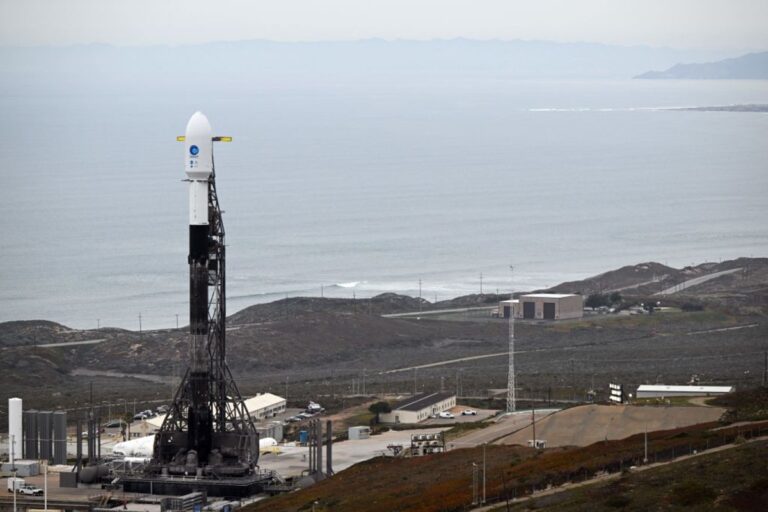
SpaceX USSF-481 Mission Launches Tomorrow; Falcon 9 Booster B1081 Hits 28th Flight

October 15, 2026:

SpaceX USSF-481 Mission Launches Tomorrow; Falcon 9 Booster B1081 Hits 28th Flight
PATRICK T. FALLON/AFP via Getty Images

SpaceX’s classified USSF-481 mission is scheduled to launch from Vandenberg Space Force Base’s SLC-4E pad on October 15, 2026, at 7:44 PM ET (23:44 UTC) — a launch that will mark approximately the 28th flight of battle-tested booster B1081 and the latest chapter in a $1.6 billion Pentagon program to build a proliferated missile-sensing satellite network in polar orbit. The mission advances the Proliferated Warfighter Space Architecture, a Defense Department initiative to deploy hundreds of linked military satellites that sits at the center of the Trump administration’s Golden Dome missile defense plan.

What Is USSF-481 — and Why Does It Keep Getting Classified?

USSF-481 is a national security mission contracted under the Pentagon’s National Security Space Launch program, which the U.S. Space Force manages alongside the National Reconnaissance Office. The payload is classified. The destination orbit — polar low Earth orbit — is not.

That orbit tells most of the story. Polar LEO, typically at inclinations above 85 degrees, provides global coverage on every orbital pass: a satellite at 750–1,200 km altitude in a near-polar orbit sweeps over every point on Earth’s surface twice daily. That geometry is specifically designed for wide-area surveillance, missile warning, and infrared sensing of ground-based launch signatures — exactly the capabilities the Space Development Agency is assembling in the PWSA.

SLC-4E at Vandenberg is the only U.S. launch pad that permits southward or polar departure azimuths without overflying populated land. Every Falcon 9 classified national security mission that requires polar orbit launches from SLC-4E. USSF-481 is no exception.

The $1.6 Billion Contract Behind the Mission

USSF-481 falls under a Space-Based Sensing and Targeting (SBST) contract awarded to SpaceX, worth approximately $1.6 billion for 18 Falcon 9 launches from Vandenberg through the end of 2027. The contract covers two task orders under NSSL Phase 3 Lane 1, the program tier designed for less operationally complex national security missions. All 18 launches target the same general destination: polar or near-polar orbit over the Pacific.

Lane 1 sits alongside NSSL Phase 3 Lane 2, the more demanding tier reserved for complex, high-value payloads. Under FY2026 Lane 2 task orders, SpaceX holds five missions at a ceiling of $714 million; United Launch Alliance holds two at $428 million. Together, the two lanes account for the core of the Pentagon’s civil and military launch portfolio through FY2029.

How a Reused Booster Becomes a Strategic Asset

Booster B1081 flew its 26th mission in July 2026 and its 27th — a previous USSF mission, USSF-153 launched September 10 from Vandenberg — when it launched and landed on a drone ship in the Pacific. USSF-481 will be its reportedly 28th flight.

This record matters economically. SpaceX’s Falcon 9 Block 5 design introduced titanium grid fins, a strengthened octaweb interstage, and uprated Merlin engine components specifically to enable 10 or more reuses per booster with minimal refurbishment between flights. Each reuse eliminates the cost of manufacturing a new first stage — historically estimated at roughly 60 to 70 percent of a Falcon 9’s per-launch price — and passes some of that savings into mission pricing for government customers.

The current record holder for flight reuse is booster B1067, which flew its 37th mission on August 25, 2026, in a flight that was simultaneously the 100th Falcon 9 launch of 2026. USSF-481 will not challenge that record, but at 28 flights, B1081 demonstrates that national security payloads — historically flown on expendable rockets at far greater per-unit cost — now routinely fly on hardware proven across dozens of prior missions.

What Is Being Built in Orbit: PWSA and Its Laser Mesh

The PWSA is the Space Development Agency’s answer to a strategic vulnerability: U.S. national security space assets historically have been concentrated in a small number of expensive, exquisite satellites in geosynchronous orbit — precisely the targets a potential adversary would strike first. PWSA replaces that with a proliferated LEO constellation designed to be too numerous and too redundant to meaningfully degrade.

The architecture has two functional layers. The Transport Layer carries data between satellites using Optical Inter-Satellite Links (OISL) — free-space laser communication terminals, four per satellite — that form a mesh network in orbit capable of routing data from sensor to command node without touching a ground relay station. A 2025 Government Accountability Office report flagged that OISL capability had not been fully demonstrated before SDA committed to further Tranche 2 investment, a notable acquisition risk for a technology that is central to the architecture’s value.

The Tracking Layer carries wide-area infrared sensors designed to detect the heat signature of a missile launch at any point on Earth’s surface within seconds of ignition. Tranche 0, a demonstration constellation of 23 satellites launched between 2023 and 2024, validated the basic architecture. Tranche 1 added more than 150 operational satellites. Tranche 2 — the phase USSF-481 serves — calls for more than 550 satellites across both layers.

Starshield and the Classified Payload Question

SpaceX’s Starshield satellite program — a military adaptation of Starlink hardware with government-controlled encryption and government-owned frequencies — is one of the likely payload families for classified USSF missions from Vandenberg. Starshield had launched more than 183 satellites through 2025, serving three customer verticals: the Space Development Agency’s PWSA transport nodes, the National Reconnaissance Office’s surveillance imaging network, and USSF space situational awareness satellites.

The classified nature of USSF-481 means no public confirmation of payload type is available. What is available is a pattern: every confirmed Starshield and SDA payload has targeted polar or near-polar LEO, every launch has used Vandenberg SLC-4E, and every booster recovery has landed on a drone ship in the Pacific. USSF-481 fits that pattern in every disclosed detail.

Golden Dome: The Strategic Context

The White House named PWSA as a key element of the Golden Dome missile defense initiative, a layered system designed to intercept ballistic missiles, hypersonic glide vehicles, and cruise missiles at multiple engagement points from boost phase through terminal descent. SpaceX is among the front-runners for a prime Golden Dome contract, a designation that has added strategic weight to what might otherwise read as a routine commercial launch cadence.

The linkage creates a feedback loop with concrete implications for national security space launch economics: as PWSA grows mission by mission, the $1.6B SBST contract and the FY2026 NSSL Lane 2 task orders provide stable government revenue that, in turn, funds the continued development of Falcon 9’s reusability program. Each classified launch both funds and demonstrates the technology that makes the next classified launch cheaper.

Blue Origin and the Competitive Landscape

SpaceX does not hold the NSSL franchise alone. Blue Origin, whose New Glenn exploded at Cape Canaveral on May 28, 2026, during a pre-launch static fire test, remained on the NSSL Lane 1 contractor list as of mid-2026, though its path to Lane 2 certification was severely disrupted by the explosion. United Launch Alliance holds Lane 2 task orders alongside SpaceX. Rocket Lab and Stoke Space compete in Lane 1.

For missions requiring polar departure from the U.S. West Coast, however, the competition narrows sharply. ULA’s Vulcan and Blue Origin’s New Glenn launch from Cape Canaveral, which cannot reach polar LEO without overflying land. Only Vandenberg permits the southward azimuth that PWSA’s polar architecture requires, and SpaceX is currently the only certified operator at SLC-4E for the scale and flight cadence PWSA demands.

What to Watch on Launch Night

SpaceX is expected to webcast the launch approximately 15 to 20 minutes before liftoff. Booster B1081 will separate approximately 2.5 minutes after launch, perform a boostback burn, and target a drone ship landing in the Pacific Ocean — the standard profile for Vandenberg polar missions, which fly south-southwest over the ocean to avoid populated areas.

Upper stage engine ignition, fairing separation, and payload deployment will not be broadcast publicly. SpaceX typically cuts the webcast feed shortly after the drone ship landing for classified missions. The launch window opens at 7:44 PM ET on October 15, 2026.

What the USSF-481 Launch Means for SpaceX’s 2026 Record

With USSF-481 scheduled, SpaceX is tracking toward approximately 114 Falcon 9 launches in 2026 — a pace that would surpass its own prior annual records. The $1.6B SBST contract guarantees at least 18 of those launches carry Pentagon classified sensing payloads from Vandenberg through 2027, providing revenue predictability that anchors SpaceX’s West Coast launch operations regardless of commercial Starlink traffic fluctuations.

The booster reuse data that emerges from each mission — turnaround time, refurbishment cost, hardware condition after propellant-grade thermal and structural loading — feeds directly into SpaceX’s long-term engineering roadmap for Starship, which targets similar reuse economics at a far larger scale. In that sense, every flight of B1081 is simultaneously a Pentagon mission and a data point in a much longer engineering experiment.


Frequently Asked Questions

What is USSF-481 and what does it carry?

USSF-481 is a classified U.S. Space Force mission contracted under the National Security Space Launch program. The payload has not been publicly disclosed. Based on the mission’s polar orbit profile from Vandenberg SLC-4E and the pattern of prior classified Falcon 9 launches from that pad, the payload is likely part of the Space Development Agency’s PWSA missile-sensing network or the Starshield satellite family — though SpaceX and the Space Force have not confirmed the payload type. The USSF-481 mission is listed as SBST TH-2 on publicly available launch schedules, identifying it as the second task order under the $1.6 billion Space-Based Sensing and Targeting contract.

How many times has a Falcon 9 booster been reused, and what is the record?

The current flight-reuse record for a Falcon 9 booster is held by booster B1067, which completed its record 37th flight on August 25, 2026 — simultaneously the 100th Falcon 9 launch of that year. Booster B1081, which will fly on USSF-481, is reportedly on its 28th mission — a number consistent with its documented 27th flight on USSF-153 in September 2026. SpaceX’s Block 5 design was specifically engineered to sustain 10 or more reuses per booster with minimal refurbishment between flights.

What is the PWSA and why does it matter for missile defense?

The Proliferated Warfighter Space Architecture is the Space Development Agency’s program to build a large constellation of small military satellites in polar low Earth orbit. Unlike traditional geosynchronous military satellites — expensive, few, and vulnerable — PWSA’s design floods LEO with hundreds of interconnected satellites linked by laser communication terminals, creating a mesh network capable of detecting missile launches globally within seconds and routing data to warfighters without ground relays. The White House has identified PWSA as central to Golden Dome missile defense, the administration’s layered system designed to intercept ballistic missiles, hypersonic glide vehicles, and cruise missiles at multiple points in their flight paths.

How much does a national security Falcon 9 launch cost the Pentagon?

SpaceX holds a Space-Based Sensing and Targeting contract worth approximately $1.6 billion for 18 classified Falcon 9 launches from Vandenberg through the end of 2027 — an average of roughly $89 million per mission. Under Lane 2 task orders, SpaceX holds five FY2026 missions at a ceiling of $714 million, while United Launch Alliance holds two at $428 million. Booster reuse reduces manufacturing costs per mission, though the specific per-launch price for individual classified missions is not publicly disclosed.

Source link