HomeHealth Idaho Moms and Grandmothers Are Taking the Fight for Abortion Rights to Their Neighbors’ Doors
Idaho Moms and Grandmothers Are Taking the Fight for Abortion Rights to Their Neighbors’ Doors
October 14, 2026:
It’s the only state this year where voters could reverse an abortion ban. With little national support, older women who never expected to be activists are powering the campaign.
This story was originally reported by Shefali Luthra of The 19th, and republished through Rewire News Group‘s partnership with the 19th News Network.
Lisa Wirsching knocked on strangers’ doors. She collected petition signatures at the farmers’ market. She approached her neighbors, asking them if she could talk to them about Idaho’s abortion laws, if they’d heard about Proposition 1 or if they knew how they planned to vote.
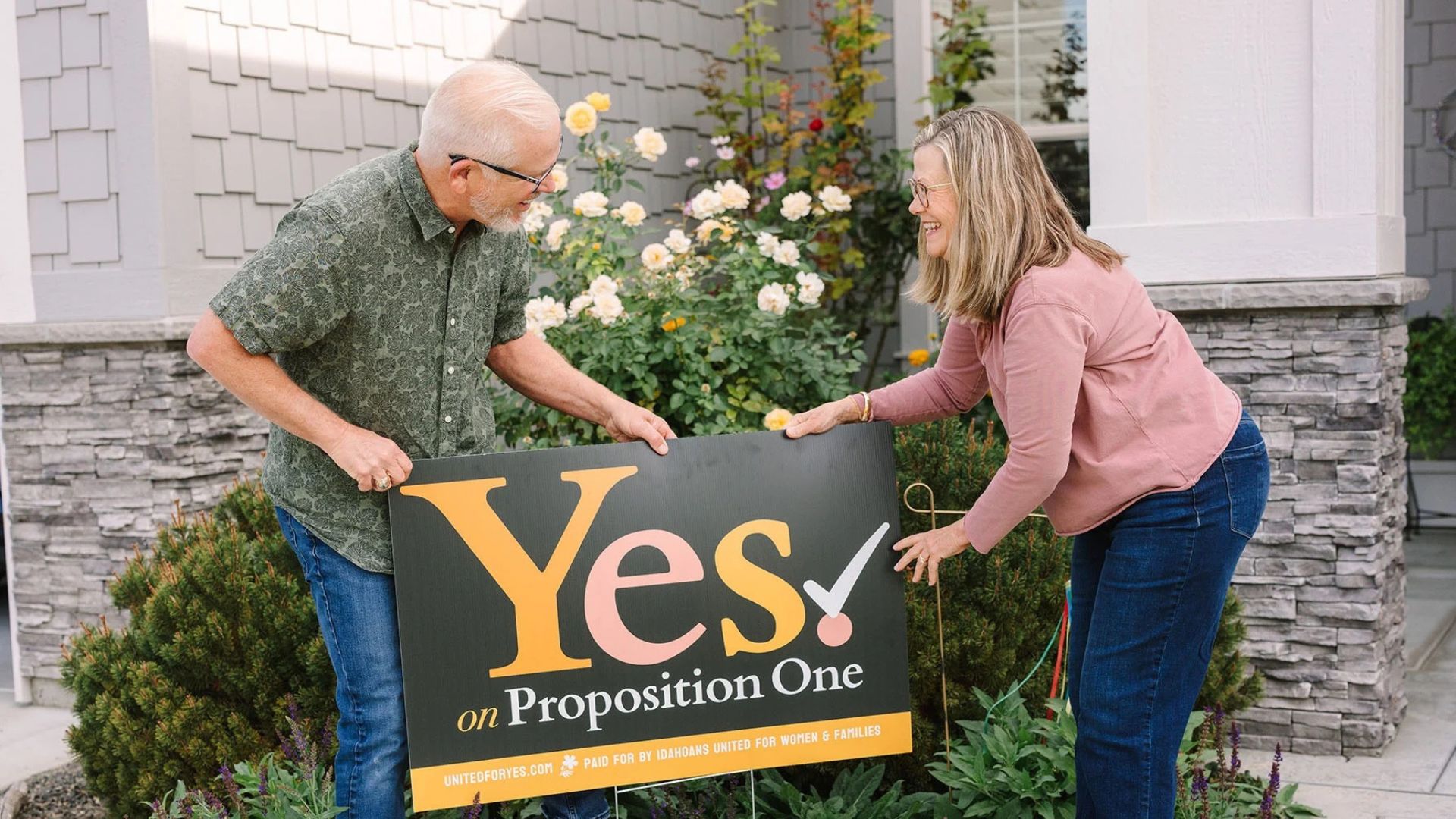
When a man biking past her house saw the giant “YES on Prop 1” sign on her lawn, he yelled “baby killer” at her. Wirsching, who was unloading groceries from her car, ran into the street to stop him. She thought if they could have a conversation, she could help him understand.
She even started baking batches of chocolate chip cookies and loaves of banana bread for the campaign staffers behind the effort to overturn her state’s abortion ban. It was the perfect excuse to drive the half hour from her home in Meridian to Boise, Idaho, pet the office cat, and hug the people who now may as well be family.
On some days, it seems as if the campaign to overturn Idaho’s abortion ban has taken over Wirsching’s life. But just a year ago, this grandmother living outside of Boise would hardly have called herself a political woman. She supported abortion rights, she said, and mourned the overturn of Roe v. Wade. Still, she never thought the issue could shape her own life so intimately.
That changed when her youngest daughter, Abby Nichols, was pregnant with her first child.
Near the end of her first trimester, Nichols learned her fetus had trisomy 18, a genetic anomaly that stunts development. Only 10 percent of babies born with the condition survive to their first birthday. When Nichols decided to end her pregnancy—which she felt would spare needless suffering—she couldn’t get help in Idaho. After contacting medical providers in Colorado and Washington, she finally found an appointment in Seattle.
Her family was shocked about the abortion law in their state, one of the most severe in the country. The ban allows abortions to save a pregnant person’s life but doesn’t have an exception for the health of the patient or when there is little chance of having a baby who will live.
“I knew that there were strict abortion laws, not knowing the details of that,” said Nichols’ father and Wirsching’s husband, Steve Wirsching. “And it was like, ‘What do you mean, they can’t help her? What are you talking about?’”
Days before her procedure, Nichols saw her doctor in Idaho one more time, hoping that she might have already miscarried—that she wouldn’t need to travel for an abortion.
“It made a really sad situation just absolutely cruel—that I couldn’t just be at home with doctors who knew me, providing me a procedure that they know how to do and are trained to do,” Nichols said.
Now, the Wirschings are fighting in the hopes that no one else will have to endure what they did.
“I don’t want another family to have to go through this,” Lisa Wirsching, now 65, said recently. “You know, a young couple is happy to start their family—and to get this news? And these people judge us.”
Idaho is the only state in this election cycle where voters could reverse an abortion ban. If Proposition 1 passes and the ban falls in November, legalizing abortion until the fetal viability line that typically falls around 23 to 25 weeks, it will be thanks to an army of people like the Wirschings—the residents who have found themselves compelled to politics because they don’t see how things can go on like this.
Since federal abortion protections were overturned in 2022, citizen-led ballot initiatives to change or overturn abortion laws have popped up across the country. Highly organized, well-funded campaigns led to abortion bans being overturned in Arizona and Missouri, and secured abortion rights in states such as Montana, Michigan, and New York.
But Idaho’s campaign has drawn little national attention or funding. Almost all of its backing has come from inside Idaho, with the campaign only this past month attracting financial support from a national political action committee called Government That Works, along with a $250,000 donation from former New York City Mayor Michael Bloomberg. The American Civil Liberties Union, which has heavily supported abortion measures in other states, has stayed out of the Idaho campaign. National organizers have suggested the campaign is not sufficiently ambitious in part because it would leave a viability cutoff in place, said Melanie Folwell, the executive director of Idahoans United for Women and Families, the organization leading the campaign.
In Idaho, then, the effort is largely powered by volunteers—neighbors speaking to neighbors about what the state’s abortion ban has meant to them, trying to bridge some kind of connection or understanding. They are predominantly older women, Idaho residents who say they fear how the state’s ban could affect future generations. In short, it’s powered by women like Lisa Wirsching.
“It could affect my grandsons and their future. It’s just so important to get it fixed and changed,” Wirsching said. “We need abortion in our country. I never thought I’d be saying that, either, but we need it. It’s health care.”
Idaho’s abortion ban took effect in the summer of 2022. A study published last year found that between August of that year and December 2024, the state lost more than a third of its 268 OB-GYNs. Many said they no longer felt able to provide the medical care patients needed. At least one hospital shut down its labor and delivery ward, citing the state’s “legal and political climate,” the mass exodus of doctors and the legislature’s enactment of policies that “criminalize physicians for medical care.” Pregnant patients have been airlifted to Utah for medical care in high-risk situations.
The state, governed almost entirely by Republicans, has defended its ban against repeated legal challenges. This summer, the Idaho Republican Party platform once again endorsed language in its platform that calls abortion murder, saying that the party would “support the criminalization of all murders by abortion within the state’s jurisdiction.”
Research suggests that most Idaho voters believe abortion should be banned in most or all cases—in fact, Idaho voters are some of the most likely in the country to support abortion restrictions.
But across party lines, residents are worried the state has gone too far.
Getting Prop 1 on the ballot required organizers who, led by Idahoans United for Women and Families, started working in 2025 tocollect signatures from more than 70,000 registered voters from around the state. About a quarter of the over 100,000 people who signed the initial petition said they were registered Republicans, according to campaign data. Even more said they weren’t affiliated with a political party at all. Statewide polling done last year indicates that 60 percent of residents, including a plurality of Republicans, would vote for Proposition 1.
Now, over 1,800 volunteers across the state have signed up to campaign for the abortion rights measure.
“We’re fighting for the soul of our state,” said Mistie Dellicarpini-Tolman, the state director for Planned Parenthood’s Idaho-based political arm. “There’s a tipping point you can feel in the air of people thinking this is getting too much.”
The campaign has drawn people from all political backgrounds, but its biggest supporters are older women, said Folwell, one of the few paid employees on the campaign. Data from the campaign shows that women ages 56 and older made up about a quarter of all people to sign the petition putting Proposition 1 on the ballot. Often, Steve Wirsching said, he’s one of just two men in a crowd of women going to knock on doors to talk about abortion rights.
“These women—man, they are fearless,” he said.
Suzanne Gallus, a 56-year-old Catholic mom of seven, hadn’t thought too much about abortion before Idaho enacted its ban. She’d felt uncomfortable with her church’s staunch anti-abortion position—but when the procedure was legal, she never felt like she needed to grapple with that discomfort. What she did know: All of her children were born through homebirths, and she’d never had to worry about getting the medical care she needed.
In October of 2024, Gallus attended a conference about combating Christian nationalism, an issue that felt particularly pertinent in her home of northern Idaho, which has been adopted as a homebase by Christian nationalist groups. By chance, she saw a panel about Idaho’s abortion law. She heard about the women who were airlifted to Utah. She learned about the closed labor and delivery ward in Sandpoint, Idaho, just a bit north of her.
“They said the word ‘airlifted,’ and I was like, are you kidding me?” she said.
That night she stayed up until maybe 3 a.m., reading everything she could. Abortion rights became all-consuming. So did overturning Idaho’s law.
Just after Christmas last year, she started collecting signatures. She built a routine of dropping her 12-year-old son at baseball practice and driving 20 minutes from her home in Rathdrum south to Coeur d’Alene, a conservative Idaho resort town. Once she got there, she timed herself to see how quickly she could get ten signatures for the petition to put abortion on the ballot. It typically took her no more than an hour; her record was 43 minutes.
People were willing to listen, she said—even when she didn’t expect them to be. She remembered knocking on one door, apprehension creeping in as she noticed the family’s “Don’t Tread on Me” license plate. A man opened the door. He was a registered Republican, a paramedic living in Idaho but working across the border in Spokane, Washington.
He told her he was worried about the risks Idaho’s ban posed to pregnancy, and about the health consequences it could have for people he treated. Both he and his wife signed her petition.
Gallus’ work has put her at odds with longtime friends. Her husband supports her activism, but “apprehensively so,” she said. Even her own children, who for months knew nothing about her involvement in the state’s abortion rights campaign, have struggled with her advocacy—something they learned about in a letter she wrote to them in August 2025, months after joining the campaign.
“Our humanity, our bodies, our brains, our relationships—are complicated,” Gallus wrote. “My reproductive life is over. But I want better for you, your friends, your kids, and our grandchildren.”
In Coeur d’Alene, Idaho, 77-year-old Terri Luce was still recovering from a weeks-long hospitalization when she attended a Thursday night gathering this fall of more than two dozen people, mostly women, who had come to learn about how they could help overturn the Idaho ban, and what they could do in the final stretch before Election Day.
She’d already gathered signatures for Prop 1 to make it on the ballot. Luce, who worked as a nurse for decades, hadn’t volunteered for a political campaign since she was a teenager.
“When Roe v. Wade got overturned, my stomach turned. A lot of memories came back,” she said. There were girlfriends she remembered from her early 20s who had gotten abortions in Mexico because the procedure wasn’t yet legal in the United States.
“I just want to see us get the rights we had,” she said.
With the election so close, she said, she had to do everything she could to make sure people came out to vote. If she stayed home, and the abortion measure failed, she’d never forgive herself. “I just need to finish this,” she said.
Amy Grey, who has lived in Moscow, Idaho for the past 25 years, had always supported abortion rights, but she had never gotten involved in politics. After President Donald Trump’s reelection, she said, she needed to feel like she was doing something. She learned about Proposition 1.
“It’s just such a private, fundamental choice as a human being,” she said. “There was a generation of women who fought this fight—and here we go again.”
Grey, 58 and a mother of two, knocked on almost 6,000 doors to collect signatures, building in extra time to do so on her way to the gym or the grocery store. Last year, she spent Halloween outside one of Main Street’s cafes, guessing based on people’s costumes who might be likely to support abortion rights as she tried to gather signatures. This Halloween is bookmarked for reminding people to vote.
Last winter, she drove north to Coeur d’Alene, Idaho—around 90 minutes each way from Moscow—on the weekends to gather more signatures. One man, whose daughter had just come home from a sleepover, told her he wasn’t sure what to think; his wife supported the measure, but he wasn’t sure that he was comfortable with abortion. Grey thanked him for his time, left his house and continued through the cul-de-sac.
Then she saw his truck pull up next to her. He had told himself that if he saw her again, he’d ask her to keep talking about it. He wanted her to change his mind.
“We can’t be afraid of these conversations,” she said. “And we can’t feel like we can’t learn something from them either. And so you face it, I think. And you brush it off when you’re told you’re evil.”
Unlike her mother, father, or sister, Abby Nichols hasn’t been able to spend time organizing voters. The memory of her lost pregnancy has been too fresh. Over the past year, she said, she collected maybe three signatures for Proposition 1. She heard about the woman who tried to tell her sister, Angela, that people in Idaho weren’t being denied medically necessary abortions.
“My parents and my sister have gone way beyond their comfort zone to have my mom and sister out door knocking on the weekend,” she said. “I wasn’t in a place to do that, but I was just always so grateful to see them doing that—because I know that that’s not my sister’s comfort zone. And they stood outside of the farmers market and were called baby killers.”
Nichols is waiting to see what happens with Idaho’s abortion law before she decides whether to try for another baby. Every “YES” sign she sees is another glimmer of hope. But she tries not to read too much of the news; they’re scared of what results November 3 will bring.
In September 2026, with weeks to go before the election, she sat down before a camera to record a video supporting Prop 1. It was time to talk about what happened to her—and to ask her neighbors if they’d consider voting for a law that might prevent her from going through that again.
“People are going to know, like, ‘Oh, she’s one of those women,’” she said. “But I’m at this point where it’s like, OK, we’ve got a month till the election. Here’s my chance.”
To check your voter registration status or to get more information about how to vote and what’s on your ballot, visit vote.org.