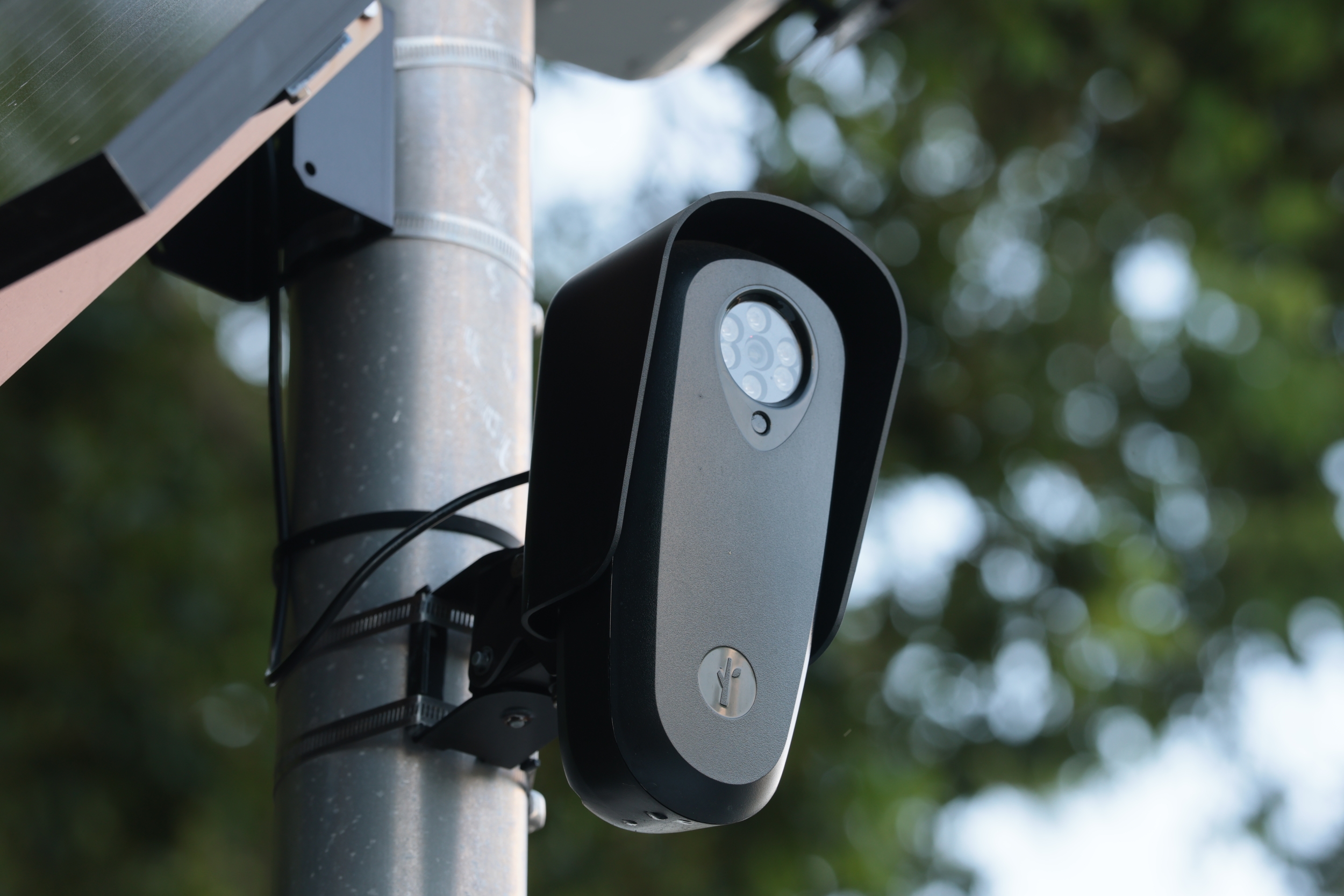
Two courts issued directly opposing constitutional rulings on warrantless police searches of automated license plate reader databases within days of each other — a judicial split that privacy advocates say could determine whether location records captured by 120,000 cameras tracking 20 billion vehicle passes every month constitute a form of permanent government surveillance that the Constitution requires police to justify before a judge.
On October 1, a federal district court in Oklahoma became one of the first federal courts to find a Flock Safety ALPR database search unconstitutional under the Fourth Amendment, suppressing evidence in a drug case and calling the technology’s nationwide deployment a form of indiscriminate mass surveillance. One day later, a Santa Clara County Superior Court judge dismissed a high-profile California state constitutional challenge to San Jose’s citywide license plate reader network, finding that drivers retain no privacy on public roads. The Electronic Frontier Foundation, which helped bring the California case, called the dismissal “extremely disappointing” and announced it will appeal.
What ALPRs Are — and How Flock’s Network Works
Automated license plate readers are fixed or vehicle-mounted cameras that continuously photograph passing vehicles, capture their license plate numbers, and log the timestamp and location of each capture. That data is uploaded to a searchable cloud database — most often operated by Flock Safety, the dominant commercial provider — where any authorized officer at any member agency can query a plate and retrieve a historical record of its sightings across the entire networked system, spanning multiple agencies, multiple cities, and multiple states.
Flock Safety operates approximately 120,000 cameras across more than 6,000 communities in 49 states, serving more than 4,000 law enforcement agencies. The network captures approximately 20 billion vehicle passes per month. According to findings cited in the Oklahoma ruling, those cameras generate more than 100,000 warrantless database searches by law enforcement every month. San Jose’s system, built on Flock hardware, now comprises nearly 500 fixed cameras blanketing the city’s streets. Following an officer misconduct incident disclosed by Police Chief Paul Joseph in September, the department reduced its data retention period to 30 days.
A single database query can reconstruct a vehicle’s movements across multiple states over weeks — from nothing more than typing a plate number. Law enforcement agencies argue the databases are invaluable for solving crimes, locating stolen vehicles, and tracking suspects without the delay and resource cost of manual surveillance. Critics — including the EFF, the ACLU, and a growing number of legislators — contend that the aggregate effect transforms every car journey into a permanent, searchable government record, without the constitutional guardrails that would apply to any traditional investigative technique of comparable depth.
California: Public Roads, No Privacy
The California case, SIREN and CAIR-CA v. City of San Jose, was filed on November 18, 2025, by the EFF and the ACLU of Northern California on behalf of two nonprofit organizations: SIREN (Services, Immigrant Rights and Education Network) and CAIR California, both of which serve San Jose’s immigrant communities. The complaint alleged that San Jose’s practice of permitting warrantless officer searches of its Flock database violated Article I, Section 1 of the California Constitution, which guarantees privacy rights, and the California Constitution’s prohibition on unreasonable searches.
The Santa Clara County Superior Court sustained the city’s demurrer — the procedural motion to dismiss — without leave to amend, meaning the plaintiffs cannot refile with a revised complaint at the trial level. In his reasoning, Judge Jeffrey El-Hajj relied on a 2024 decision from California’s Fourth District Court of Appeal, which had upheld the use of footage from San Diego’s streetlight camera network in a murder prosecution, holding that drivers on public streets carry no reasonable expectation of privacy. The trial court rejected arguments that San Jose’s networked system — its density, its reach, its retention period — crosses a qualitatively different constitutional threshold than a single traffic camera. The sheer quantity of cameras, the court found, does not change the constitutional calculus.
San Jose City Attorney Susana Alcala Wood welcomed the ruling. She said it confirmed that the city’s ALPR deployment meets required constitutional privacy standards and captures only information visible from public rights-of-way.
The EFF disagrees sharply. In a statement published alongside the ruling, EFF staff attorneys Devanshi Nishar and Andrew Crocker called the decision “wrong on the law” and argued it ignores a body of Supreme Court precedent on the privacy implications of aggregating individual-level data over time. The court’s analogy to standalone streetlight cameras, they wrote, fails to account for what a networked system actually produces — not a snapshot, but a granular map of a person’s patterns of movement, intimate associations, and daily life, reconstructed from months of photographic records.
The city is not fully clear of ALPR litigation. A separate federal civil lawsuit brought by three San Jose residents remains pending, challenging the same practices under the Fourth Amendment.
Oklahoma: A Federal Court Draws the Line
The day before the California dismissal, U.S. District Judge Sara Hill of the Northern District of Oklahoma ruled in the opposite direction in a criminal suppression proceeding — United States v. Melisa Susan Kyle. The case arose from a traffic stop on an Oklahoma highway. A Tulsa County Sheriff’s deputy, Freddie Alaniz, noticed a woman driving a car with California plates and began following her, apparently for no reason beyond her out-of-state registration. While tailing her, Alaniz queried her plate through Flock’s ALPR system. The search returned more than 30 days of location data — more than 50 individual sightings — enabling authorities to trace the vehicle across at least three states over the preceding month from a single lookup.
Judge Hill ordered all evidence derived from that search suppressed, finding it violated Kyle’s Fourth Amendment right against unreasonable searches. The opinion directly addresses the gap between what courts have historically expected of surveillance and what modern ALPR infrastructure actually delivers. Hill offered a pointed illustration of the difference: people might reasonably expect a friend to mention seeing their car somewhere; they would not expect a stranger — let alone law enforcement — to approach them with a photographically documented log of every place their vehicle had been for the preceding 30 days, shared with agencies nationwide.
The ruling characterizes Flock’s network as “approaching dragnet-type law enforcement practice” and finds that the warrantless search intruded on Kyle’s “reasonable expectation of privacy in the whole of her physical movements.” Hill acknowledged that nearly every court to have previously examined the issue had reached the opposite conclusion — but concluded that existing precedent, properly applied against the full scope of modern ALPR capabilities, compels a different result.
Flock Safety pushed back. A company spokesperson said the ruling defied prevailing ALPR case authority in comparable cases, including multiple recent decisions within Oklahoma itself, and said the company expects the ruling to be appealed and overturned. Hill’s ruling is not binding precedent — it applies only in the Northern District of Oklahoma — but it is among the first federal rulings to find a Flock search unconstitutional, and privacy advocates say it provides a new and significant citation for defendants challenging ALPR evidence in federal courts nationwide.
How Chatrie Changed the Legal Landscape
The legal backdrop to both rulings is a landmark Supreme Court decision issued four months earlier. On June 29, 2026, the Court ruled 6–3 in Chatrie v. United States that law enforcement conducted a Fourth Amendment search when it obtained a suspect’s Google Location History data from the company, establishing that a warrant was required before police could access it. Justice Elena Kagan wrote the majority opinion, joined by Chief Justice Roberts, and Justices Sotomayor, Kavanaugh, and Jackson; Justice Gorsuch concurred in the judgment, bringing the outcome to 6–3 against the government, with Justices Thomas, Alito, and Barrett in dissent.
The case built directly on Carpenter v. United States (2018), which had extended Fourth Amendment protection to cell-site location records, and the majority found that the rationale of Carpenter applied with equal or greater force to the finer-grained location data that services like Google retain. The Court vacated the lower court decision and remanded for further proceedings.
The EFF has argued that Chatrie should govern ALPR database searches, given that both technologies produce granular, time-stamped records of a person’s physical movements at scale. Judge Hill in Oklahoma drew on the same line of reasoning, while the California court declined to extend Chatrie beyond the voluntary-upload context, treating ALPR data as categorically different because it is captured from public roads rather than transmitted privately to a third-party service. That distinction is now the central question the EFF plans to raise on appeal.
Pattern of Misuse, Pattern of Expansion
The dueling rulings arrive amid mounting evidence that ALPR databases — designed for criminal investigation — are routinely used for purposes well beyond that scope. An EFF analysis of millions of Flock searches, published earlier this year, found that absent a warrant requirement, agencies had used ALPR databases for school residency verification and background checks, among other administrative purposes with no connection to criminal activity. Buford City Schools in Georgia ran more than 375 residency-verification searches through Flock — a use that has nothing to do with crime and everything to do with tracking where families live.
A separate incident has intensified scrutiny of San Jose’s deployment specifically. Police Chief Paul Joseph disclosed in September that an officer had been fired in April for allegedly sharing ALPR-derived location data with a family member for personal, non-law-enforcement reasons. The department subsequently reduced its Flock data retention period from one year to 30 days.
In Congress, Sen. Bernie Sanders introduced the Ban Flock Act on October 2, co-sponsored by Sen. Jeff Merkley and Rep. Alexandria Ocasio-Cortez. The legislation would prohibit federal agencies from using automated license plate readers or accessing ALPR data held by local police departments and private companies, and would freeze federal grant funding to agencies holding ALPR contracts.
Sen. Josh Hawley has introduced the Stop Flock Abuse Act, which takes a regulatory rather than prohibition approach, and Rep. Thomas Massie has introduced the Flock-Off Act, which would block federal funding for municipalities using ALPRs and biometric cameras. Several states and municipalities have also moved to impose limits on ALPR retention and use.
What Comes Next — and Who Can Use the Oklahoma Ruling Now
EFF’s announced appeal of the California dismissal will move the case to the California Court of Appeal, where the organization will argue that the trial court’s reliance on the 2024 streetlight camera decision was misplaced — that networked ALPR systems are categorically different from individual cameras, and that Chatrie and Carpenter require a more searching constitutional analysis than the lower court performed.
Whether an appellate court agrees could ultimately determine whether cities across California continue to expand ALPR infrastructure without warrant requirements, or whether mass-scale vehicle tracking joins cell-site location data and Google Location History in the category of surveillance technologies the Constitution requires police to justify before a judge.
The Oklahoma ruling’s immediate practical significance lies not in Oklahoma but across the entire federal system. United States v. Kyle is now a citable federal court decision finding a Flock database search unconstitutional — among the first of its kind from a U.S. district court. Defense attorneys in any federal court in the country handling a case in which Flock-derived ALPR evidence was obtained without a warrant can now cite Judge Hill’s opinion in a motion to suppress, forcing the government to defend the search before a federal judge who may be persuaded by the same reasoning. Judge Hill acknowledged she was departing from nearly all prior authority — but concluded that the full scope of Flock’s capabilities, applied against the Carpenter/Chatrie precedent line, required it. That analytical framework is now available to any defense counsel who wants to make the same argument.
The central constitutional question the rulings leave open — whether querying a month of cross-state location history from a nationwide camera network is meaningfully different from following someone in person — remains unresolved at the appellate level. No federal circuit court has definitively addressed it. That gap is where the next phase of this litigation will be decided.
Frequently Asked Questions
Are police required to get a warrant before searching license plate reader databases?
Under current law, the answer depends entirely on where you are and which court has jurisdiction. As of October 2026, the overwhelming majority of courts — including the California court that dismissed the EFF’s challenge — have held that drivers have no reasonable expectation of privacy on public roads, and that querying an ALPR database does not require a warrant. However, a federal district court in Oklahoma ruled on October 1 that a warrantless Flock database query violated the Fourth Amendment. That ruling is limited to the Northern District of Oklahoma and is not binding on any other court. No federal appellate court has definitively addressed the question. The EFF is appealing the California dismissal and expects the question to reach higher courts.
What does the Supreme Court’s Chatrie decision mean for license plate reader surveillance?
Chatrie v. United States (decided June 29, 2026) held that law enforcement must obtain a warrant before accessing a person’s Google Location History. The Court built on Carpenter v. United States (2018), which required a warrant for cell-site location records, and found that the detailed, time-stamped location data held by Google triggers the same Fourth Amendment protections. The EFF argues Chatrie should apply equally to ALPR databases, which produce similarly granular location histories. The California court disagreed, treating ALPR data differently because it is captured from public roads. The Oklahoma court agreed with the EFF’s reading. The Supreme Court has not yet directly addressed ALPR searches.
Can defense attorneys use the Oklahoma ruling to challenge Flock evidence in other states?
Yes, immediately, even though it is not binding precedent. United States v. Kyle is a published federal district court decision finding a Flock database search unconstitutional under the Fourth Amendment. Defense attorneys in any federal criminal case in which Flock-derived ALPR evidence was obtained without a warrant can now cite Judge Hill’s opinion in a motion to suppress, arguing her reasoning should be adopted. The ruling is persuasive, not controlling — a federal judge in another district is not required to follow it — but it provides a structured constitutional argument and a citation where previously none existed.
What is Flock Safety, and how does its license plate reader network work?
Flock Safety is an Atlanta-based company that operates the largest commercial ALPR network in the United States. Its fixed cameras photograph every passing vehicle, extract the license plate number along with additional identifying characteristics (vehicle make, model, color, and a proprietary “Vehicle Fingerprint”), and upload the data in real time to a cloud database. Law enforcement officers access the database through a web portal or mobile app; any officer at any of Flock’s 4,000-plus member agencies can query any plate and retrieve every recorded sighting across the entire network — including sightings captured by cameras in other cities, other states, and other agencies. A single query can return 30 or more days of location records spanning multiple states. The network captures approximately 20 billion vehicle passes per month and generates more than 100,000 law enforcement searches per month, all without a warrant requirement.