Alpha Nomos Launches on PS5, Xbox, and PC: Each Upgrade Reshapes Your Combat and Your Soundtrack

October 14, 2026:

Alpha Nomos Launches on PS5, Xbox, and PC: Each Upgrade Reshapes Your Combat and Your Soundtrack
Alpha. Nomos
Ribcage.games

Alpha Nomos, the debut commercial release from indie studio RibCage Games, launched on October 12 on PlayStation 5, Xbox Series X|S, and PC via Steam with a design claim that separates it from most games in the rhythm-action genre: the soundtrack is not something that plays beneath the combat — it is something the player builds through their combat choices.

The game is available now at $17.99 on US PlayStation and Xbox storefronts. A 10% launch discount on Steam reduces the price to $16.19 through October 24 — after which the Steam version reverts to the standard price.

RibCage Games is a four-person indie studio founded by developers who left mobile gaming to build the kind of immersive PC experiences they grew up with. Alpha Nomos is their debut commercial release. “We’re a small studio, and this is our first commercial release,” the team wrote on the Xbox Wire. “Alpha Nomos started from a simple frustration: we love rhythm games, and we always felt the rhythm could go deeper. We felt it could be the foundation of the whole thing instead of a layer on top.”

Cello, Corrupted Puppets, and a World That Broke

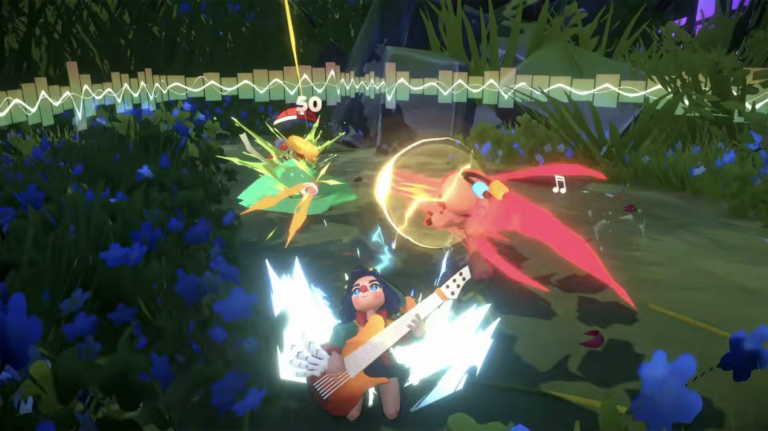
Players take on the role of Cello, a musician-warrior who wakes into a ruined world. Cities are abandoned. Arenas are corrupted. Puppet enemies — distorted and sinister beneath their performance-art aesthetic — fill the spaces between. Cello is searching for her friends and for answers to two questions the world will not easily give up: what destroyed everything, and what is the Alpha Nomos itself?

RibCage describes the game’s visual language as “puppetcore” — clown faces, empty streets, a beauty that curdles the longer you look. Environments range from decayed urban arenas to a corrupted circus. The tone is vibrant and unsettling simultaneously — the aesthetic of a performance that has gone deeply wrong.

How the Weapons Work: Real Players, Real Takes

Every weapon Cello carries was built from live studio recordings, not a sample library. Each hit produces the sound of a real musician playing a real instrument in a real room.

“We recorded every weapon with real players in a real room,” said Emil Lager, CTO at RibCage Games. “You can hear someone’s hands in it.”

The Xyloblades — a pair of xylophone-swords — play an actual xylophone note on every successful hit. Each strike is simultaneously a combat action and a musical event. Chain hits on the beat, and the room fills with a real xylophone riff the player is generating in real time. A second weapon in Cello’s arsenal is built around a saxophone body: curved brass, long cutting edge, the shape of something designed to sing and cut at the same time.

Why Rhythm Is the System, Not the Score

Most rhythm games treat timing as a scoring layer: hit on the beat and score points; miss and lose a multiplier. Alpha Nomos uses a different architecture. In its combat system, landing attacks on beat makes them hit harder, and missing the beat has mechanical consequences — the room “pushes back.” The rhythm is not a grade on top of the fight; it is the fight.

That architecture extends to the upgrade system. As a roguelite, Alpha Nomos is built around runs — players fight through advancing arenas, making upgrade choices between encounters that carry forward within each run. Alpha Nomos’s specific innovation is that every upgrade choice is simultaneously a sound design choice.

How Timing Works Technically

The game is built on FMOD, the adaptive audio middleware used widely across the game industry to manage soundscapes that change based on player state and events. Seven audio-effect powerups — Reverb, Flanger, Delay, and four others — each reshape not just Cello’s combat mechanics but the active soundtrack simultaneously. Selecting Reverb as an upgrade adds a reverb layer to the mix at that moment; selecting Delay adds delay processing to what is already playing. By the end of a strong run, the soundtrack is one the player assembled through combat decisions.

“In Alpha Nomos, the music isn’t just playing in the background — it’s the rule that governs the entire world. Every weapon has its own sound, every upgrade changes the music, and every run becomes its own composition,” RibCage Games stated.

The rhythm itself has more depth than a single pulse. Players can land eighth-note strikes between main beats, and deliberate rests can be used as part of a combo structure. A spatial rhythm indicator moves visibly through the arena — giving players a positional cue as well as an audio one — and on-beat attacks earn a “PERFECT” rating on screen.

A note on latency: because rhythm is the combat system rather than a scoring layer, audio latency has direct gameplay consequences in Alpha Nomos. A timing mismatch between what a player hears and what the game registers — caused by a TV’s audio processing, Bluetooth headphones, or HDMI delay — will directly impair combat effectiveness. RibCage includes a timing-offset calibration setting to account for this, and recommends using a controller on PC. For players on displays or audio setups with measurable latency, testing the offset setting before serious play is strongly advisable.

Who Made This and What It Took

The game’s original score was composed by Totem Warriors and recorded live — not programmed — to integrate directly into the rhythm systems.

Alpha Nomos drew inspiration from Hi-Fi Rush, Crypt of the NecroDancer, and BPM: Bullets Per Minute — three games that each pushed the boundary between rhythm mechanics and action gameplay in different directions.

How Is Alpha Nomos Different From Hi-Fi Rush

Hi-Fi Rush (2023, Tango Gameworks) locked everything to BPM — every combat action, environmental event, and animation tied to a fixed game-wide pulse. Its world moved to one tempo. Alpha Nomos takes a different approach: the upgrade system alters the tempo and texture of the active mix dynamically, so the sonic environment is not fixed but evolving based on what the player built. Where Hi-Fi Rush is a conductor’s performance in a pre-arranged score, Alpha Nomos is closer to live improvisation within a structure.

Pricing and Platform Breakdown

Alpha Nomos is available on the US PlayStation Store at $17.99. On Xbox, it is also $17.99. On Steam, the 10% launch discount brings the price to $16.19 through October 24 — after that date, the Steam price returns to the standard $17.99. The discount applies to the Steam version only and does not carry over to console purchases.

Full controller support is confirmed on PC. The game is single-player. Interface and subtitle support is available in 23 languages including English, French, Italian, German, Spanish, Japanese, Korean, Portuguese, Russian, and Simplified Chinese. A free demo remains available on Steam for players who want to test the rhythm combat before purchasing.


Frequently Asked Questions

What platforms is Alpha Nomos available on, and what does it cost?

Alpha Nomos launched October 12, 2026, simultaneously on PlayStation 5, Xbox Series X|S, and PC via Steam. The price is $17.99 on US console storefronts. The Steam version carries a 10% launch discount through October 24, 2026, bringing it to $16.19 on PC during that window.

How is Alpha Nomos different from Hi-Fi Rush or Crypt of the NecroDancer?

Alpha Nomos’s central distinction is that the upgrade system simultaneously modifies both combat mechanics and the active soundtrack. Each of its seven audio-effect powerups — including Reverb, Flanger, and Delay — adds a new layer to the FMOD-driven live mix as the player selects it. Hi-Fi Rush locks the world to a single pre-arranged BPM; Crypt of the NecroDancer ties movement to the beat in a grid dungeon. Alpha Nomos makes the beat itself something the player shapes through build decisions.

Does audio latency from TVs or Bluetooth headphones affect gameplay?

Yes — and significantly so, because rhythm is the combat system, not just a scoring layer. A timing mismatch between audio and visual feedback caused by TV audio processing, Bluetooth delay, or HDMI latency will directly reduce combat effectiveness. RibCage Games built a timing-offset calibration setting into the game specifically to address this. Players using high-latency setups should test and adjust the offset setting before beginning serious runs. Using a wired controller on PC is recommended.

What is the story in Alpha Nomos, and what is Cello looking for?

Cello is a musician-warrior navigating a post-apocalyptic world whose cities are abandoned and arenas are overrun by corrupted puppet enemies. She is searching for her friends and chasing two questions the game’s narrative is built around: what caused the destruction of the world, and what is the force called the Alpha Nomos? The game’s “puppetcore” aesthetic — clown imagery, corrupted circus environments, a beauty that turns sinister — frames the lore as something strange and deliberately unsettling beneath its vibrant surface.

Source link