October 12, 2026:


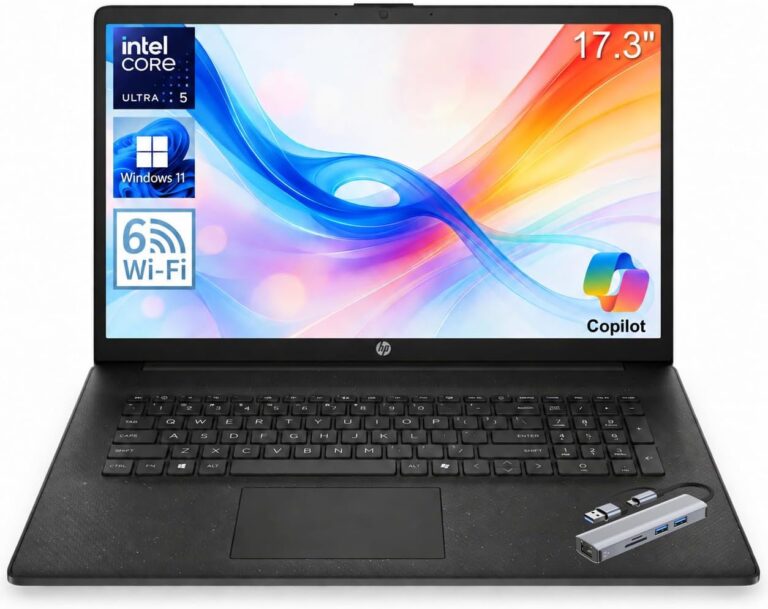
If you need a large-screen Windows laptop with a genuine AI accelerator chip and you want it for under $900, today’s Amazon listing on the HP 2026 Pavilion 17.3″ AI PC (Intel Core Ultra 5 225U, 16GB DDR5, 512GB NVMe SSD) is priced at $899.99 — roughly $210 below the verified average market price of $1,109. That gap is meaningful. What matters just as much, though, is a distinction that almost no deal writeup explains: this laptop is an AI PC, but it is not a Copilot+ PC — and in 2026, that distinction has real consequences for which Windows AI features you can use. Prices can change without notice; verify the current price before purchasing.
The $1,399 figure referenced as the “list price” represents HP’s suggested retail price, which Amazon defines as the “suggested retail price of a new product as provided by a manufacturer, supplier, or seller” — a figure that, according to Amazon’s own disclosures, “may not necessarily reflect the product’s prevailing market price.”
A price-tracking tool confirms the gap: this specific SKU (16GB DDR5, 512GB NVMe SSD) has sold as low as $799.99 and as high as $1,399, with an average market price of approximately $1,109. The $899.99 price, if confirmed active, puts the laptop $210 below that average — a substantive discount, not a marketing one. Amazon introduced stricter rules in April 2026 requiring sellers to substantiate list prices with 90-day sales data, meaning the gap between a stated “list price” and what the market has actually charged for a product has come under increasing scrutiny. Use a price tracker before any major technology purchase to confirm you are getting a genuine discount.
The term “AI PC” in 2026 covers a wide range of hardware, and understanding where this HP lands requires knowing one number: 12 TOPS.
TOPS stands for Tera Operations Per Second, the standard metric for measuring how much work a Neural Processing Unit (NPU) can perform per second. You can read a full breakdown of TOPS and what the metric means for AI PCs at Windows Central. An NPU is a dedicated block of fixed-function silicon on the processor chip — distinct from both the CPU and GPU — engineered specifically to run the matrix multiplications that power AI workloads at very low power. The Intel Core Ultra 5 225U inside this HP laptop includes an NPU marketed as “Intel AI Boost,” rated at 12 TOPS per Intel’s own specifications.
Twelve TOPS is real, functional AI acceleration. Here is what it handles well: background blur during video calls, microphone noise suppression, the HP True Vision camera’s temporal noise reduction, and real-time transcription for basic use cases. Microsoft Copilot works on this machine — but it does so primarily through cloud processing, not local inference, per Microsoft’s Copilot+ PC requirements documentation.
Here is what 12 TOPS does not handle: Windows Recall, live real-time translation (full), AI image generation in Paint (Cocreator), and any workload involving a locally-run large language model. Those features require a Copilot+ PC.
Microsoft set the Copilot+ PC threshold at 40 TOPS minimum from the NPU alone, as documented on Microsoft Learn’s Copilot+ PC requirements page. The Intel Core Ultra 5 225U delivers 12 TOPS from its NPU, with a combined total of 24 TOPS across CPU, GPU, and NPU — still well below the 40-TOPS floor, as notebookcheck.net’s full 225U specifications confirm. Independent chip analysis reaches the same conclusion: a laptop with the Core Ultra 5 225U does not meet the Copilot+ PC requirements, and its NPU functions as a supplementary acceleration block rather than a full Copilot+ engine.
That is not a reason to avoid this laptop. It is a reason to understand it. If your AI use case is noise cancellation and smart camera features in video calls, 12 TOPS is sufficient. If you want to run Windows Recall or generate images locally without an internet connection, you need a Copilot+ PC with AMD Ryzen AI 300 or Intel’s Core Ultra 200V (Lunar Lake) series — most of which start above $1,000.
The 225U is an Arrow Lake U-series processor released in Q1 2025. It carries 12 cores (2 high-performance P-cores plus 8 efficiency cores plus 2 ultra-low-power cores), 14 threads, and a peak boost of 4.8 GHz via Intel Turbo Boost. The P-cores use Intel’s Redwood Cove architecture; the efficiency cores use Crestmont — the same hybrid design Intel has refined across the last three processor generations.
The chip’s base TDP runs 12-15 watts, with OEM-configurable burst headroom. In a 17.3-inch chassis like this HP, HP likely allows sustained performance at a higher power limit than a 13-inch ultrabook would — which benefits multitasking performance in prolonged workloads, though it is below what an H-series chip (designed for 28-45W sustained) delivers.
For everyday productivity — web browsing, Office applications, video calls, PDF editing, light photo work — the 225U is adequate for most home and student workloads. Benchmark scores place Geekbench 6 multi-core results in a competitive range with the previous-generation Core Ultra 5 135U and meaningfully ahead of older Core i5 designs, though trailing current-generation H-series and AMD Ryzen AI processors at equivalent or slightly higher price points.
The 16GB of DDR5-5600 RAM runs at roughly 1.75 times the bandwidth of DDR4-3200. In a laptop used for web browsing and Office productivity, that bandwidth advantage is modest in day-to-day use — the amount of RAM (16GB) matters more than the generation for those tasks. Where DDR5 earns its keep: video editing, working with large datasets, and AI workloads where the NPU or integrated GPU needs to move large amounts of data quickly. For AI inference specifically, memory bandwidth is one of the key constraints on NPU throughput, so DDR5’s wider data pipe is genuinely relevant here.
The 512GB PCIe NVMe M.2 SSD offers sequential read speeds in the range of 2,000-3,500 MB/s, compared to roughly 550 MB/s for older SATA-based SSDs still found in budget competitors. That translates directly to faster boot times, faster application launches, and faster file transfers — a practically noticeable difference from older-generation storage.
One specification in the deal requires close reading. HP offers the 17-inch Laptop AI PC in multiple display configurations: a 17.3-inch HD+ (1600×900) anti-glare panel at 250 nits, and a 17.3-inch FHD (1920×1080) IPS anti-glare panel at 300 nits, as the HP product page for this model confirms. The specific SKU in this deal — 16GB DDR5, 512GB NVMe SSD — ships with the HD+ (1600×900) 250-nit display, not the higher-resolution FHD IPS panel.
For general home use, streaming, and document work, HD+ on a 17.3-inch screen at normal viewing distances (24-30 inches / 61-76 cm) is acceptable. For side-by-side document comparison, design work, or users with high-resolution content needs, the FHD IPS panel at 300 nits offers meaningfully better sharpness and brightness, and is available in a different configuration. Verify the display spec matches your expectations before purchasing.
The laptop’s port complement covers the productive essentials: one USB Type-C 10 Gbps port with DisplayPort 1.4 and USB Power Delivery (for charging and external display output), two USB Type-A 5 Gbps ports, HDMI 1.4b, and a combo audio jack. Wi-Fi 6 (802.11ax) delivers better performance in congested home or office networks with multiple devices than older Wi-Fi 5. Bluetooth 5.4 is current-generation for peripherals.
HP’s Fast Charge capability brings the 3-cell battery to 50% in approximately 45 minutes, per HP’s product specifications. Battery life claims for this class of laptop with a 17.3-inch display and a 12-15W TDP processor typically land in the 7-10 hour range under moderate use — consistent with the 3-cell capacity HP specifies here.
Whether the current price is the right moment to buy depends on how you weigh three factors.
First, the verified floor: this laptop has sold as low as $799.99, so a buyer with flexibility and no urgency could monitor for a return to that lower price. The verified average has been $1,109, making $899.99 a discount of roughly 19% from typical market pricing rather than the 36% implied by comparison to the $1,399 MSRP.
Second, competitive context: the HP OmniBook 5 and similar 16-inch AI PCs with AMD Ryzen AI 5 (which carries significantly higher TOPS via AMD’s Ryzen AI NPU) have appeared near or below $900 on sale. Those configurations reach or approach the Copilot+ PC 40-TOPS threshold — giving a buyer access to the full Windows AI feature set this HP Pavilion cannot run locally. If AI features beyond video-call enhancements matter to you, that comparison is worth making before purchasing.
Third, the use-case fit: for a student, a remote worker doing video calls and Office work, or a home user wanting a large screen for streaming and light productivity, the 225U’s performance and the HP’s build quality are appropriately matched to those needs at this price point. This laptop does not need to be a Copilot+ PC to serve that workload well.
| Spec | Detail |
|---|---|
|
Processor |
Intel Core Ultra 5 225U (12 cores, up to 4.8 GHz) |
|
NPU |
Intel AI Boost — 12 TOPS (not Copilot+ PC qualified) |
|
RAM |
16GB DDR5-5600 MHz |
|
Storage |
512GB PCIe NVMe M.2 SSD |
|
Display |
17.3-inch HD+ (1600×900), anti-glare, 250 nits |
|
Connectivity |
Wi-Fi 6 (802.11ax), Bluetooth 5.4 |
|
Ports |
USB-C 10Gbps (DP 1.4, USB PD), USB-A x2, HDMI 1.4b, audio combo |
|
Camera |
HP True Vision 720p HD with noise reduction |
|
Battery |
3-cell Li-ion; HP Fast Charge (50% in ~45 min) |
|
Weight |
4.86 lbs (2.20 kg) / 0.81 inches (2.06 cm) thick |
|
OS |
Windows 11 Home |
|
Current Amazon Price |
$899.99 (list price $1,399; verified average market price ~$1,109) |
An AI PC is any laptop with a processor that includes a Neural Processing Unit (NPU) for AI acceleration. A Copilot+ PC is Microsoft’s certified tier for devices whose NPU delivers at least 40 TOPS, which unlocks the full suite of on-device Windows AI features including Windows Recall, AI image creation (Cocreator), and real-time translation. The HP Pavilion 17 AI PC with the Core Ultra 5 225U delivers 12 TOPS from its NPU — making it an AI PC but not a Copilot+ PC. It handles background blur, noise suppression, and cloud-assisted Copilot, but cannot run Copilot+ PC-exclusive features locally.
The $1,399 figure is the manufacturer’s suggested retail price (MSRP), which Amazon defines as the price “provided by the manufacturer, supplier, or seller” and discloses “may not necessarily reflect the product’s prevailing market price.” Price history data shows this laptop has averaged approximately $1,109 on Amazon and sold as low as $799.99. Measured against the average market price rather than the MSRP, the current $899.99 price represents roughly a 19% discount — still a meaningful reduction, but not the 36% implied by the MSRP comparison. Amazon introduced stricter list-price rules in April 2026 requiring sellers to substantiate reference prices with 90-day sales data; using a price-tracking tool before any purchase is recommended.
The Intel AI Boost NPU at 12 TOPS handles AI inference tasks that are lightweight and run continuously in the background: eliminating microphone noise on video calls, reducing camera image noise in real time, applying intelligent background blur, and supporting basic real-time transcription. It also assists Microsoft Copilot — but Copilot on this machine relies primarily on cloud processing rather than local inference. Tasks requiring an on-device large language model, Windows Recall, or Copilot+’s AI image generation require a Copilot+ PC (40+ TOPS NPU).
The 16GB DDR5 / 512GB NVMe SSD configuration in this deal ships with the 17.3-inch HD+ (1600×900) anti-glare display at 250 nits — not the FHD (1920×1080) IPS 300-nit panel, which is available in a different configuration. For document work and streaming at normal viewing distances, the HD+ panel is functional. For sharper text or content-creation work, consider whether the display resolution meets your needs before purchasing.