October 10, 2026:


Amazon’s Prime Big Deal Days sale drove the Garmin Venu 3S to its lowest documented price ever — approximately $288 through third-party sellers on Amazon, down from its original $449.99 retail price. That $162 savings represents a 36% discount on a fitness smartwatch that still runs the full Garmin health-tracking suite, including ECG, Body Battery monitoring, multi-constellation GPS, and a 10-day battery that outlasts every Apple Watch and Samsung Galaxy Watch on the market. The $288 price point appears through third-party sellers on Amazon’s marketplace, not directly from Amazon itself — a distinction that matters for return policy and warranty coverage. Confirm seller status before purchasing and check the current listing price, which may fluctuate post-Prime Day.
The Venu 3S launched in late 2023 at $449.99 and held close to that price through most of its commercial life, with its lowest Amazon-direct price reaching $349.99 in January 2025 during a promotional window. Third-party sellers on Amazon began discounting more aggressively in 2026 as the Venu 4 and Venu X1 arrived, and Amazon’s Prime Big Deal Days — which ran October 6 and 7, 2026 — pushed the entire Venu 3 lineup to record territory. The Amazon direct price history confirms a floor of $349.99 for Amazon-direct sales.
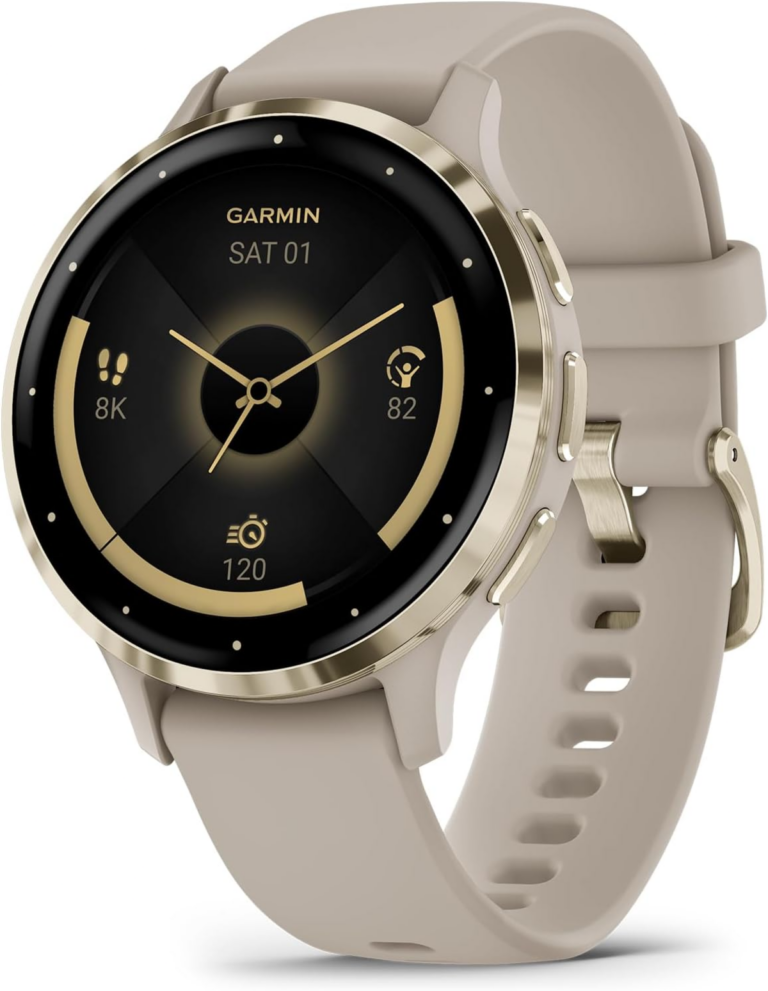
The $288 mark for the Venu 3S French Gray (41mm case with silicone band, model 010-02785-02) is the lowest documented price for this specific colorway — below the prior record low of $294 set in August 2026 and well below the $349.99 floor that Amazon-direct sales had previously established. At $288, the Venu 3S is priced squarely alongside mid-tier Garmin Forerunner running watches, while packing substantially more lifestyle and smart-notification functionality.
The Venu 3S’s 1.2-inch AMOLED touchscreen is one of the key engineering decisions that defines both the watch’s appeal and its constraints. Unlike the transflective LCD displays Garmin uses on its sport-focused Forerunner and Fenix lines — which reflect ambient light to stay readable in direct sunlight — AMOLED panels emit their own light per pixel. Each pixel switches off independently, enabling true blacks and vivid color contrast indoors and at night. The trade-off is power: an AMOLED display that runs continuously drains a battery far faster than a reflective display that uses ambient light for free.
The Venu 3S’s published 10-day battery life assumes standard smartwatch mode, where the screen activates on wrist raise or button press and stays dark most of the day. With always-on display enabled — so the watch face is continuously visible like a traditional watch — the always-on battery drops to four days based on owner and reviewer testing. That is still dramatically longer than what you get if Apple Watch requires daily charging — which both the Apple Watch Series 11 and Samsung Galaxy Watch 9 do. But a buyer who wants always-on display should calibrate expectations: the “10 days” figure in marketing materials describes a specific usage mode, not the always-on experience.
The display is protected by Corning Gorilla Glass 3, the watch frame is fiber-reinforced polymer with a stainless steel bezel, and the whole assembly weighs 27 grams (0.95 oz) without the silicone band — a genuinely light wrist presence for users who find larger GPS watches uncomfortable.
The Venu 3S supports multi-constellation GNSS: it receives signals from the US GPS network, Russia’s GLONASS system, and the European Union’s Galileo constellation simultaneously. A GPS receiver calculates position by measuring how long signals take to arrive from at least four satellites. Using three constellations instead of one dramatically increases the number of satellites in view at any moment — particularly useful in urban environments where buildings block portions of the sky, or on trail runs under dense tree canopy where signal dropout is common.
The trade-off: GPS mode drains the battery more aggressively than standard smartwatch mode. According to official Garmin specifications, the GPS battery life of 21 hours is sufficient for a full marathon plus warm-up or a long trail run, but not for multi-day unsupported adventure racing. Users who know they will not need GPS for more than a few hours at a stretch — commuters tracking daily steps, gym-focused athletes, or casual walkers — will rarely encounter this constraint and will enjoy the 10-day battery life of standard smartwatch mode.
The Garmin Connect fitness tracking platform syncs all data via Bluetooth to both iOS and Android, where detailed workout summaries, sleep history, and body metrics are stored on Garmin’s US-based servers.
Body Battery: Garmin’s proprietary energy score (0–100) aggregates data from overnight Heart Rate Variability (HRV), stress readings, sleep duration, and workout load to estimate how rested and ready you are at any given hour. The algorithm is unpublished — it is Garmin’s proprietary model, not an academic metric — but thousands of athletes use it as a practical daily guide for training load management. When Body Battery reads 90+, you are recovered; under 30, additional intensity training is not advisable.
HRV Status: Heart Rate Variability is the millisecond-level variation between consecutive heartbeats. High HRV generally indicates the autonomic nervous system is in a parasympathetic (rest-and-recovery) state; low HRV correlates with stress, illness, or overtraining. The Venu 3S measures HRV overnight using its optical photoplethysmography (PPG) sensor — less precise than a clinical ECG chest strap, but consistent enough over time to show meaningful trends. Garmin uses a 5-minute overnight window for its HRV Status reading.
ECG: The watch includes a single-lead electrocardiogram sensor, cleared by the FDA for detection of atrial fibrillation (AFib) in the United States. The ECG capability is activated by regional regulatory status — it is enabled in the US market. Unlike a 12-lead clinical ECG, a wrist-based single-lead ECG can identify AFib rhythm signatures but cannot diagnose other cardiac conditions.
Sleep Coach: The Venu 3S provides personalized nightly sleep coaching, factoring in recent activity levels and nap detection. Nap tracking — the ability to log and credit daytime rest toward daily energy accounting — was one of the headlining additions when the Venu 3 series launched.
Wheelchair Mode: The Venu 3S was the first watch in the Venu line to offer a dedicated Wheelchair Mode, replacing step-counting with push-counting and adding handcycle and push wheelchair activity profiles. It is a meaningful accessibility inclusion for a lifestyle smartwatch category that rarely acknowledges users outside standard bipedal fitness contexts.
Where Apple Watch Series 11 and Samsung Galaxy Watch 9 both last approximately one day on a charge — requiring nightly docking that many users find disruptive to sleep tracking continuity — the Venu 3S’s multi-day battery is a structural advantage, not just a marketing claim. The Apple Watch lasts one day compared to the Venu 3S’s 5 to 10 days depending on usage. At $288 vs. the Apple Watch Series 11’s starting price of approximately $399 and the Galaxy Watch 9’s approximately $249 to $299 range, the Venu 3S offers a meaningfully longer charge cycle at a comparable or lower price point post-discount.
The trade-off is app ecosystem breadth. The Venu 3S runs Garmin’s proprietary OS rather than watchOS or Wear OS, meaning it does not support third-party app development at the same depth as Apple or Samsung platforms. Garmin’s Connect IQ marketplace offers a curated selection of watch faces and apps, but the ecosystem is smaller. For users whose primary use case is fitness tracking, health monitoring, and smart notifications — rather than running complex third-party apps on their wrist — this is rarely a limitation.
This deal is most compelling for:
Small-wrist fitness users who have avoided 44–45mm watches due to size. The Venu 3S’s 41mm case at 27 grams (0.95 oz, without band) is one of the lightest full-featured GPS fitness watches available at any price.
Battery-conscious buyers who are tired of nightly charging. Five to ten days of charge life, depending on display mode and GPS usage, eliminates the “dead watch during a workout” experience that plagues Apple Watch users.
Multi-activity trackers who want health monitoring and workout tracking in a single watch. With 30+ built-in sports apps — including running, cycling, pool swimming, HIIT, yoga, golf, and wheelchair push/handcycle — the Venu 3S handles most training contexts without a second device.
Cost-conscious buyers stepping up from a basic fitness band. At $288, the Venu 3S costs roughly the same as premium fitness trackers like the Fitbit Charge 6 or Garmin Vivosmart series, while adding a color AMOLED screen, full GPS, ECG, music storage, phone call support, and contactless payments.
As of October 9, 2026, the Venu 3S (French Gray, 41mm) is available on Amazon at approximately $288 through third-party sellers. Amazon’s own storefront has not offered the Venu 3S below $349.99, which was the Amazon-direct record low recorded in January 2025. Third-party seller listings on Amazon typically still carry Amazon’s standard 30-day return window for fulfilled orders, but buyers should confirm the seller’s fulfillment method (Amazon FBA vs. merchant-fulfilled) before purchasing, as return logistics differ. The fact that this Garmin Venu 3S hits record low was confirmed by multiple established technology publications on the same day.
Prices in this category moved rapidly during and after Prime Big Deal Days (October 6–7, 2026). The $288 price may rise, fall, or sell out without notice. Check the listing before completing any purchase.
The 10-day battery life Garmin publishes applies to standard smartwatch mode, where the screen activates on wrist raise and stays dark otherwise. With the always-on AMOLED display enabled — showing the watch face continuously — real-world battery life drops to approximately 3.5 to 4 days, based on reviewer and owner testing. In GPS tracking mode, the battery lasts approximately 21 hours. For most users who do not need always-on display and run GPS for a few hours per week, 7 to 10 days between charges is a realistic expectation.
Yes. The Venu 3S pairs with both iOS and Android via the Garmin Connect app. Smart notifications, call routing, and voice assistant access all require a paired smartphone in proximity. Music playback can run from the watch’s 8 GB onboard storage without a phone present, with Spotify, Amazon Music, and Deezer playlists available for offline download (premium subscription required for each service).
At the sub-$300 price points seen during and after Prime Big Deal Days, the Venu 3S deals have been through third-party sellers on Amazon’s marketplace — not Amazon’s own storefront. Amazon-direct pricing on the Venu 3S has not dropped below $349.99. Third-party fulfilled orders still typically offer a 30-day return window, but verify the seller’s fulfillment and return policy before purchasing, as these can differ from Amazon-direct orders.
Body Battery is Garmin’s proprietary energy management score, ranging from 0 to 100. It combines overnight Heart Rate Variability data, stress level measurements, sleep duration, and workout load from recent days to estimate your current energy reserve. A score above 75 generally indicates you are well-rested and ready for high-intensity activity; below 25 suggests rest rather than intense training. The algorithm is not published by Garmin and is not a clinical metric — it functions as a practical daily heuristic for training load management.
Prices and availability are subject to change. TechTimes may earn a commission on purchases made through links in this article. The $288 price reflects third-party seller listings as of October 9, 2026; verify current price before purchasing.