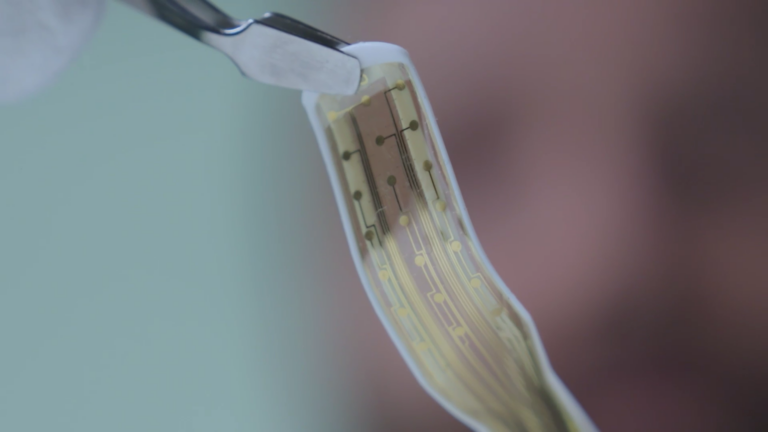
The surgical robot that could help millions of Parkinson’s patients receive a better brain implant had to solve a problem that had nothing to do with the implant itself: it needed to navigate curves. A European research consortium announced October 7, 2026, the successful completion of the MINIGRAPH project — a four-year, nearly €4 million (approximately $4.5 million) effort that has produced the first preclinically validated system combining ultra-thin graphene neural probes with magnetic robotic guidance capable of reaching deep brain targets along curved trajectories that conventional rigid surgical frames cannot navigate. The result is not just a better electrode — it is the first integrated platform to close two independent engineering gaps simultaneously, raising the prospect of expanding who can receive deep brain stimulation, not only how well it works.
INBRAIN Neuroelectronics, which anchored the seven-institution consortium, led the MINIGRAPH completion announcement one day after submitting results. The project — its full name is Minimally Invasive Neuromodulation Implant and implantation procedure based on ground-breaking GRAPHene technology — was funded under the European Innovation Council’s EIC Pathfinder Challenges program, a Horizon Europe initiative targeting the highest-risk, highest-potential early-stage research. MINIGRAPH was selected from among more than 400 competing proposals, running from October 2022 through June 2026 under grant agreement Nº 101070865.
Graphene vs. Metal: Why the Electrode Material Matters
To understand what MINIGRAPH accomplished, it helps to understand why conventional neural implants degrade — and why graphene is physically different in a way that matters.
Standard deep brain stimulation (DBS) systems use metal microelectrodes — typically platinum, iridium, or tungsten alloys — to deliver electrical pulses to brain tissue. When these electrodes inject charge, they undergo what electrochemists call Faradaic reactions: electrochemical exchanges at the metal-electrolyte interface that involve actual chemical transformations, not just temporary charge storage. Over months and years, those reactions produce reactive oxygen species, dissolve trace amounts of electrode material, and create local pH shifts that trigger inflammatory scarring around the implant. The scar tissue degrades signal quality, raises the stimulation threshold, and ultimately shortens the functional life of the device.
Graphene operates differently. As a two-dimensional lattice of carbon atoms just one atom thick, graphene’s charge injection mechanism is predominantly capacitive — the electrode accumulates charge at its surface without the chemical reaction that corrodes metal. MINIGRAPH’s graphene thin-film probes demonstrated charge injection capacity approximately 200 times greater than platinum-iridium without triggering Faradaic degradation. That physical difference is not incremental. It changes the long-term viability calculation for a chronically implanted device. MINIGRAPH researchers reported more than 10 years of projected stability through accelerated ageing tests, alongside functional performance validated in both rodent and sheep studies.
The probes themselves are approximately 10 micrometers thick — far thinner than a human hair, which typically measures 70 to 100 micrometers in diameter. Individual electrode contact sites range from 25 to 300 micrometers across, enabling high-density neural recording across cortical and subcortical targets in configurations not achievable with conventional wire-bundle leads. INBRAIN reported that these leads delivered the highest resolution brain recording and stimulation yet achieved with an implantable graphene device in the animal studies.
What the Magnetic Robot Can Do That Rigid Frames Cannot
The second engineering gap MINIGRAPH addressed is mechanical: flexible graphene probes, precisely because of their thinness and pliability, cannot be deployed with conventional rigid surgical robot arms. The forces involved in penetrating neural tissue cause thin-film probes to buckle and deflect unpredictably when pushed through a straight-line rigid guide.
The MINIGRAPH answer was to guide the probe rather than push it — using electromagnetic fields generated outside the patient’s body to steer a magnetically responsive carrier attached to the probe tip. This approach, called remote magnetic navigation, gives a surgeon directional control over a flexible device moving through tissue without requiring a rigid delivery structure.
Nanoflex Robotics and ETH Zurich developed the robotic system for MINIGRAPH, adapting the electromagnetic Remote Intervention System that Nanoflex had previously demonstrated for teleoperated stroke thrombectomy at major Swiss university hospitals. Nanoflex was spun out of ETH Zurich’s Multi-Scale Robotics Lab in 2021, bringing more than 20 years of ETH research on magnetically actuated surgical devices to the project. The system operates under X-ray imaging guidance, giving surgeons continuous real-time visualization of probe position during implantation.
The capability that matters most for Parkinson’s disease is not straight-line precision — it is curved-path navigation. The subthalamic nucleus, the primary DBS target for Parkinson’s, frequently cannot be reached in a straight line from an optimal skull entry point without passing through structures that carry unacceptable risk. Conventional stereotactic frames lock surgeons into straight-line trajectories; if the anatomy does not cooperate, the surgeon either accepts a suboptimal entry point or declines to operate. The MINIGRAPH system navigated curved and straight paths to target with sub-millimeter accuracy in validated preclinical testing. The robotic implantation procedure was validated both in laboratory conditions and in a live sheep model.
“The MINIGRAPH project demonstrated the feasibility and potential to use electromagnetic robotics to control the delivery of next-generation BCI not only through straight but also curved trajectories deep into the brain with sub-millimeter accuracy,” said Matt Curran, Co-Founder and CEO of Nanoflex Robotics. “This will give surgeons in the future more options of how they can implant these ground-breaking devices.”
The Electronics That Close the Loop
A high-performance electrode and a precise delivery robot are two components. MINIGRAPH’s third element — custom implantable electronics — is what makes the system capable of autonomous therapeutic operation rather than just better static stimulation.
The consortium, with contributions from imec (Belgium), developed a custom application-specific integrated circuit (ASIC) incorporating a high channel count combining independent stimulation and recording channels. That combination — simultaneous high-density recording alongside independently programmable stimulation — is the hardware foundation for closed-loop neuromodulation: a therapy mode in which the implant continuously monitors the patient’s own neural activity, identifies disease-relevant patterns (such as the pathologically elevated beta-band oscillations in the subthalamic nucleus associated with Parkinson’s motor symptoms), and automatically adjusts stimulation parameters in real time without requiring a clinician to manually reprogram the device.
The MINIGRAPH architecture integrates autonomous software designed to decode therapy-specific biomarkers from the multi-channel graphene recordings and translate them into stimulation adjustments. The long-term vision is a system that closes the therapeutic loop entirely — continuously monitoring neural activity, recognizing disease signatures, and modulating stimulation in response, personalizing therapy to each patient’s real-time neural state in a way that fixed-parameter open-loop DBS cannot.
Jose A. Garrido, Ph.D., Co-Founder and Chief Scientific Officer of INBRAIN, described the integrated system’s significance: “MINIGRAPH brought together the neural interface, intelligent electronics, autonomous software and robotics as a single integrated system. This work helps build the foundation for autonomous neurotherapeutics that can decode neural activity and deliver precise neuromodulation that can be accessible to more patients at scale.”
Seven Institutions, One Manufacturing Pathway
Perhaps the most strategically significant outcome of MINIGRAPH is the integration it achieved rather than any single component breakthrough. The BCI field has historically produced electrode advances, electronics advances, and surgical robotics advances in parallel research streams that fail to connect into a deployable system. MINIGRAPH was specifically designed to close that integration gap.
The seven-institution consortium coordinated by ICN2 — the Catalan Institute of Nanoscience and Nanotechnology in Barcelona — encompassed every layer of the technology stack: ICN2 contributed graphene materials science expertise rooted in its role as a core EU Graphene Flagship participant; imec brought semiconductor-grade implantable electronics design and fabrication capacity; Fraunhofer IZM contributed wafer-level implant manufacturing processes that allow entire implant systems to be fabricated on a single 200mm (8-inch) semiconductor wafer substrate — the same mass-production approach used for consumer electronics chips, applied to medical implants; Leiden University Medical Center (Netherlands) provided clinical neurology expertise and translational validation capacity; ETH Zurich and Nanoflex Robotics built and validated the magnetic robotic system; and Palacký University Olomouc (Czech Republic) conducted the cellular and molecular biocompatibility studies required for any future regulatory submission.
The wafer-level fabrication approach at Fraunhofer IZM is particularly significant for eventual clinical scalability. Batch semiconductor manufacturing is how the electronics industry drives down per-unit cost and achieves quality consistency at millions of units per year. Applying those techniques to neural implant production would represent a fundamental manufacturing shift for a device category that currently involves substantial manual assembly.
The consortium also conducted extensive toxicity and biocompatibility studies at the cellular and molecular levels — a prerequisite for any future regulatory pathway toward human trials.
What Stands Between Here and the Clinic
MINIGRAPH is a research milestone, not a regulatory one, and the distance to clinical use remains substantial. Successful preclinical validation in animal models is the beginning of a regulatory and clinical development pathway, not the end.
INBRAIN’s next required step is first-in-human studies — Phase I safety trials that will need to demonstrate, in a small number of human patients, that the graphene-based system is safe to implant and does not cause unexpected adverse effects. Those studies will need independent institutional review board approval and regulatory authorization in at least one jurisdiction before they can begin. Following safety trials, larger efficacy studies would be required to demonstrate that the system provides meaningful clinical benefit for Parkinson’s patients. Regulatory filings would then need to proceed through both the U.S. FDA and European CE marking pathways, each with its own review timeline.
INBRAIN is not starting that process from scratch. The company previously received FDA Breakthrough Device Designation for its Intelligent Network Modulation System as an adjunctive therapy for Parkinson’s disease — a designation that predates MINIGRAPH’s completion and entitles INBRAIN to ongoing FDA interaction throughout development and prioritized review of its eventual premarket submission. That designation meaningfully accelerates the FDA engagement process, though it does not guarantee approval or shorten the required clinical evidence timeline.
INBRAIN is also pursuing robotic implantation approaches beyond the MINIGRAPH framework. The company has a separate collaboration with Robeauté to explore how microrobotic neurosurgical technologies could further improve neural implantation precision and accessibility, signaling that INBRAIN views autonomous implantation as a strategic capability to develop across multiple platform approaches rather than a single-vendor technology bet.
Why Access Matters as Much as Performance
The technical case for graphene neural interfaces is compelling on its own — better signals, less scarring, longer device life. But the more consequential argument for a system like MINIGRAPH may be structural rather than biological.
More than 10 million people worldwide live with Parkinson’s disease. Deep brain stimulation is already an approved and effective therapy for many of them, particularly those with motor symptoms that stop responding adequately to medication. Yet only a fraction of eligible patients ever receive DBS implants. The barriers are not primarily scientific — they are logistical and human: DBS implantation currently requires a subspecialty-trained neurosurgeon, extensive operating room time, and a hospital infrastructure equipped for stereotactic neurosurgery. That combination means the therapy is effectively unavailable in much of the world, and even in well-resourced medical systems, long surgical wait times and limited surgical volume constrain patient access.
An autonomous magnetic robotic system that reduces the procedural skill barrier, shortens operating room time, and enables implantation in anatomically challenging cases that conventional frames cannot address would expand DBS access not by making the technology marginally better but by making the procedure reliably reachable by a larger clinical workforce. If the accuracy and safety of the MINIGRAPH robotic system translates from sheep to humans — a step that remains to be demonstrated — the limiting factor in DBS access could shift from surgical expertise to implant supply. That is a different kind of clinical impact than improved electrode performance alone.
Beyond Parkinson’s disease, the same platform architecture is directly applicable to drug-resistant epilepsy, chronic pain, and other neurological conditions where closed-loop neuromodulation has shown early clinical promise but has not yet achieved widespread use.
Frequently Asked Questions
Why does graphene outperform metal electrodes in brain implants?
Conventional metal microelectrodes (platinum, iridium, tungsten) degrade over time because charge injection triggers Faradaic reactions — electrochemical processes at the metal-electrolyte interface that produce corrosive byproducts and stimulate inflammatory scarring in surrounding brain tissue. Graphene injects charge primarily through a capacitive, non-Faradaic mechanism that avoids those chemical reactions. MINIGRAPH’s graphene probes demonstrated approximately 200 times greater charge injection capacity compared to platinum-iridium without triggering Faradaic damage, and researchers reported projected stability exceeding 10 years based on accelerated ageing tests. The practical result is a neural interface designed to maintain signal quality and functionality over the entire lifespan of a chronically implanted device.
How does magnetic navigation work for deep brain surgery?
Rather than pushing a rigid guide tube toward a brain target in a straight line — as conventional stereotactic frames do — magnetic navigation uses electromagnetic coils outside the patient’s body to generate controlled magnetic fields that exert steering force on a magnetically responsive tip attached to the flexible probe. The surgeon directs the probe by adjusting the field’s direction and magnitude, guiding it along whatever path — straight or curved — leads safely to the target. Nanoflex Robotics, which developed the MINIGRAPH robotic system in collaboration with ETH Zurich, previously demonstrated electromagnetic guidance for stroke thrombectomy in arteries before adapting it for brain implantation. The system operates under continuous X-ray imaging so the surgical team can see probe position in real time.
When might graphene brain implants become available to patients?
MINIGRAPH is preclinical — the system has been validated in laboratory and animal studies but has not been tested in humans. INBRAIN Neuroelectronics, the project’s lead company, holds FDA Breakthrough Device Designation for its graphene-based neural modulation platform, which provides prioritized FDA engagement throughout development. However, first-in-human safety trials, larger efficacy studies, and full regulatory filings across multiple jurisdictions must all be completed before clinical availability. The regulatory pathway from preclinical validation to approved device typically takes a decade or more, though Breakthrough Device Designation and parallel regulatory strategies can accelerate the timeline. A realistic window for initial human studies, if all goes well, is the latter half of this decade.
Can this platform treat conditions beyond Parkinson’s disease?
The MINIGRAPH architecture is not limited to Parkinson’s disease, even though that condition was the project’s primary clinical target. The core technology — a high-channel-count graphene neural interface capable of decoding multiple disease-relevant biomarkers paired with closed-loop stimulation — is applicable to any neurological condition amenable to chronic electrical neuromodulation. Drug-resistant epilepsy, essential tremor, dystonia, chronic pain, and obsessive-compulsive disorder all have active DBS research programs. The magnetic navigation system’s ability to reach anatomically challenging deep targets along curved trajectories is similarly disease-agnostic. INBRAIN has noted that its graphene platform targets conditions not responding to conventional medication — a category that extends well beyond Parkinson’s.