HomeAuto Marine Biodiversity Drives Ocean Carbon More Than Any Service: Just Seven Datasets
Marine Biodiversity Drives Ocean Carbon More Than Any Service: Just Seven Datasets
October 9, 2026:
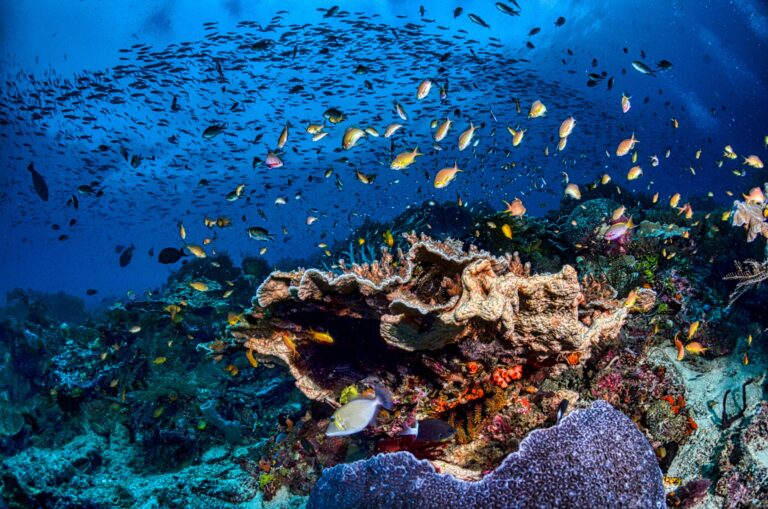
Tom Fisk/pexels.com
The ocean’s carbon-capturing machinery is more dependent on biodiversity than any other ecosystem service science has ever measured — and the scientific evidence for that dependence rests on only seven datasets. That is the most consequential finding of the largest global biodiversity synthesis ever assembled, published Tuesday in Nature Ecology & Evolution by researchers at King’s College London and Imperial College London, with collaborators from the Natural History Museum and the Alan Turing Institute. The study’s arrival — just 12 days before the United Nations Convention on Biological Diversity convenes its first-ever formal review of global biodiversity targets in Yerevan, Armenia — gives policymakers fresh, quantitative grounds for treating marine biodiversity protection not as a conservation goal adjacent to climate action, but as a precondition for it.
Redundancy Myth Falls Apart Under Global Data
For decades, a reassuring idea circulated through ecological science and conservation policy alike: ecosystems carry spare capacity. Lose a few species, and others will step in to perform the same functions. This concept of functional redundancy gave policymakers a margin of comfort — a suggestion that extinction need not translate directly into the loss of services humanity depends on.
The new synthesis, led by Dr. Emma Moffett, a lecturer in geography at King’s College London, dismantles that comfort with the most comprehensive dataset ever assembled for the question. Combining 423 published studies and 222,829 data points across ecosystems — terrestrial, freshwater, marine, and estuarine — more than twice the size of the next largest database of its kind — the team assessed 23 categories of ecosystem services and functions ranging from pollination and water quality to carbon sequestration and biological pest control.
What they found challenges the redundancy hypothesis at global scale. Of the 23 service categories, quadratic (saturating) relationships were most common, but linear relationships were nearly as frequent — 11 categories fit a saturating model, 9 fit a linear model, and only 2 fit a logarithmic model. Crucially, saturation limits had rarely been reached within the biodiversity gradients present in the empirical literature itself. In other words, the point at which adding more species stops improving ecosystem performance had almost never been observed in real data — implying that functional redundancy has been broadly overestimated, and that individual species contribute more uniquely than substitution models assumed.
Moffett said in a statement from King’s College London that the data challenged the assumption that ecosystems carry backup capacity, noting that ecological benefits keep climbing as diversity rises — which means they fall as species are lost.
What Only Seven Datasets Can Tell Us About Ocean Carbon
The finding that will most directly reshape climate policy sits in a number that seems almost too small to carry such weight: 7.
That is the number of datasets in the entire synthesis that directly measure how ocean carbon sequestration responds to changes in biodiversity — compared to 154 datasets for terrestrial carbon sequestration, and thousands of datasets for other service categories. Yet across those seven datasets, the signal is the strongest in the entire analysis. Oceanic carbon sequestration produced a Fisher’s Z-transformed effect size of 1.48 — by far the largest positive response to biodiversity of any service or function measured. By comparison, hazard regulation produced an effect size near zero, and air quality regulation produced a near-zero negative value.
To understand why this matters, it helps to understand what those seven datasets are actually measuring. The ocean absorbs carbon through the biological pump: a cascade of biological processes in which phytoplankton fix atmospheric carbon dioxide through photosynthesis in the sunlit surface layer, organic matter passes up the food chain to zooplankton and higher trophic levels, and dead organisms, fecal pellets, and “marine snow” sink through the water column, carrying that carbon to the deep ocean and seafloor sediments where it may be stored for centuries or longer. Without this biological pump, scientists estimate atmospheric CO₂ concentrations would be approximately 400 parts per million higher than they are today.
The pump’s efficiency is not a simple function of the amount of life in the ocean. It depends on who is in the ocean — on the species composition of phytoplankton communities, the structure of microbial food webs, and the trophic relationships that determine how much carbon reaches depth rather than being recycled at the surface. Biodiversity, in this system, is not a decorative surplus; it is a functional determinant of how much carbon the ocean sequesters.
That is what the seven datasets are measuring. And the signal they produce — effect size 1.48, the strongest in the study — suggests that biodiversity loss in marine systems would degrade the biological pump in ways that terrestrial carbon loss would not.
“The ocean result stopped us in our tracks,” Moffett said. “Carbon capture at sea responded to biodiversity more strongly than anything else we measured, and yet it’s one of the least studied areas we found. If the world is counting on blue carbon to help with climate change, marine life can’t be an afterthought.”
The implications extend beyond the study itself. Global climate models and carbon budgets that rely on ocean carbon sinks as a buffer against warming are effectively resting on an assumption — that the ocean’s carbon uptake will remain stable under ongoing biodiversity loss — that has almost no empirical basis. The Moffett synthesis is the first to quantify the magnitude of that gap. That is not a reason to dismiss ocean sinks as a climate tool; it is a reason to protect the marine biodiversity that sustains them.
How Species Saturation Varies Across Ecosystems
The study’s methodology offers a technical advance that goes beyond its headline findings. Previous analyses of the biodiversity–ecosystem service relationship could not compare across service categories that show different functional forms — saturating relationships and linear relationships don’t have a common unit. The Moffett team addressed this by calculating Fisher’s Z-transformed correlation coefficients as a standardized effect size for each of the study’s 1,959 datasets, enabling comparison across all 23 service categories on a single scale for the first time.
The effect-size analysis also revealed a specific finding about where saturation occurs, when it occurs at all. In marine ecosystems, biodiversity often needs to reach approximately 23 species (plus or minus 17) before a given service saturates — compared to roughly 14 (plus or minus 9) in terrestrial systems and roughly 4 (plus or minus 2) in freshwater systems. The authors attribute the higher threshold in marine systems to their greater trophic complexity, the prevalence of mutualistic and co-evolutionary interactions, and the vast spatial scale over which species interact.
The study also reveals that spatial scale modulates biodiversity’s contribution. Across all ecosystem service and function categories, biodiversity effects strengthened with increasing grain — that is, the larger the area being measured, the stronger the apparent role of biodiversity. The authors attribute this partly to beta-diversity effects, where turnover in species composition across sites amplifies functional complementarity at broader scales. But for some services — hazard regulation, net primary productivity, and biomass turnover rate — the reverse was true: biodiversity effects weakened at larger scales, possibly because averaging over wider areas masks the fine-grained species interactions that actually drive service delivery.
Dr. Will Pearse, an Associate Professor in Evolutionary Ecology at Imperial College London, noted that the study’s global framework enables a new level of operational specificity — explaining that scientists can now predict the benefits biodiversity provides anywhere on Earth, making it easier to recognize and take advantage of those benefits.
Some Services Depend on One or Two Species Alone
Not all ecosystem services fit the linear or saturating pattern, and the hazard regulation result is an important outlier that carries its own policy lesson.
Hazard regulation — the capacity of coastal ecosystems such as sand dunes and wetlands to buffer communities against flooding, storm surges, and erosion — showed a near-zero effect size in the analysis, despite often showing a linear functional form. The authors explain this apparent contradiction: services like coastal flood protection are frequently dominated by one or two foundational species — the particular shrub species that stabilizes a sand dune, or the mangrove tree that defines a coastal wetland’s structure. The service is delivered by those anchor species, not by the broader community. Adding more species to the system does not straightforwardly improve flood protection if the foundational species are already present and functional.
But the paper cautions strongly against reading this as license to ignore broader biodiversity in these systems. Maintaining the wider community of species is likely essential for sustaining the conditions that allow foundational species to persist and function effectively. Remove enough of the ecological web that surrounds a foundational species, and the foundational species itself may eventually fail — not because of direct harm to it, but because the network of interactions it depends on has frayed.
This insight — that conservation priorities must simultaneously maintain overall diversity and safeguard functionally irreplaceable “keystone” taxa — is one of the study’s most directly actionable findings for the 30×30 planning process. Which 30 percent of Earth’s land and oceans should be protected, and how, depends critically on identifying not just where species are abundant, but where functionally unique, irreplaceable species are concentrated.
Biodiversity Loss and the Farms That Cannot Afford to Lose It
The study’s forecasting exercise — the first to link a global biodiversity-ecosystem service synthesis directly to IPCC Shared Socioeconomic Pathways — produces a regional picture of future food security that adds urgency to the study’s other findings.
Focusing on biological pest regulation — the free ecological service provided by natural predators and parasitoids that suppress crop pest populations — the team linked their biodiversity-ecosystem service relationships to projected Biodiversity Intactness Index values under five SSP scenarios from the PREDICTS project. Under a fossil-fuel-driven development pathway (SSP5) compared to a middle-of-the-road trajectory (SSP2), natural pest regulation declines — and the decline is not distributed evenly across the globe.
North America, South America, and Asia are projected to see the largest reductions in biological pest control. More troublingly, the countries forecast to lose the most are precisely the countries least equipped to compensate: nations experiencing the fastest population growth and with the lowest Human Development Index scores. The statistical relationship is significant and specific — pest protection declines significantly under SSP5 (β = −0.0488, z = −4.65, P < 0.001), and the decline hits faster-growing countries harder (β = −0.0088, z = −4.28, P < 0.001). Countries with lower HDI values are also more exposed (β = 0.176, z = 4.59, P < 0.001), and their exposure is further amplified under the fossil-fuel pathway.
For farming communities in these regions — communities that already rely heavily on natural pest control because synthetic pesticides are expensive, inconsistent in supply, or hazardous without protective equipment — the projected losses represent a direct threat to food production. These are not abstract ecological losses; they are losses in a service that currently substitutes for inputs those farms cannot reliably access.
What This Means for 30×30 and COP17
The synthesis lands 12 days before CBD COP17 opens in Yerevan, Armenia on October 19 — the first Conference of the Parties since the Kunming-Montréal Global Biodiversity Framework was adopted in December 2022 at which signatory governments will formally and collectively review progress toward the framework’s 23 targets. The review will assess whether the world is on track to protect 30 percent of land and ocean by 2030 under Target 3, to mobilize at least $200 billion annually in biodiversity finance, and to meet the other 22 commitments embedded in the framework.
The Moffett synthesis does not offer simple good news or bad news for that process. It does offer something more durable: a quantitative foundation for making wiser choices about which 30 percent of Earth’s surface to protect, and what to prioritize within that protected area network.
For marine conservation, the message is specific. Protecting a patch of ocean is not equivalent to fostering a diverse community within that patch. Marine protected areas are necessary, but they are not sufficient if the goal includes maintaining the biological pump that gives those areas their climate value. “Maximizing the efficacy and long-term viability of blue carbon strategies will require moving beyond habitat preservation towards explicitly incorporating biodiversity as a key component,” the paper states — an argument that reframes marine conservation as a climate imperative, not merely a species-protection goal.
For terrestrial and freshwater conservation, the message reinforces what conservation biology has long argued but struggled to quantify at global scale: individual species matter, redundancy is rarer than assumed, and the communities that support foundational species — even when those species are the proximate providers of a given service — must be preserved as a system, not managed down to the minimum number of species required to maintain a single target function.
The full dataset and model forecasts for all 23 ecosystem service and function categories across all five SSP scenarios have been released publicly via Zenodo open access repository to support national biodiversity strategy planning ahead of COP17.
Frequently Asked Questions
What is functional redundancy, and why does it matter for conservation?
Functional redundancy is the idea that multiple species within an ecosystem can perform the same ecological role, such that losing one species does not reduce the ecosystem’s overall function because another species substitutes for it. The concept has been used to argue that some level of biodiversity loss is acceptable, since “backup” species can cover the gap. The Moffett et al. synthesis challenges this at global scale: across most of the 23 ecosystem service categories analyzed, biodiversity effects continued to grow as species diversity increased, with saturation limits rarely observed in real-world data. This implies that more species contribute uniquely to ecosystem performance than the redundancy assumption predicts — meaning individual extinctions carry more functional consequence than the “backup species” model suggests.
Why does ocean biodiversity matter for climate change, and how vulnerable is it?
The ocean absorbs carbon through the biological pump: phytoplankton fix CO₂ at the ocean surface, organic matter travels up the food chain, and dead organisms and fecal pellets sink, carrying carbon to the deep ocean where it can be stored for centuries. The efficiency of this pump depends on the composition of marine communities — the diversity of phytoplankton species, the structure of microbial food webs, and the trophic relationships that determine how much carbon sinks rather than being recycled at the surface. The new study found that oceanic carbon sequestration is more sensitive to biodiversity than any other ecosystem service measured (Fisher’s Z effect size = 1.48). This finding rests on only 7 datasets globally, representing a critical knowledge gap: the most biodiversity-sensitive ecosystem service is the least empirically characterized. If marine biodiversity continues to decline, the ocean’s carbon-capture capacity could weaken in ways that current climate models do not account for.
What is the Kunming-Montréal Global Biodiversity Framework and what does this study change about it?
The Kunming-Montréal Global Biodiversity Framework is an international agreement adopted by 196 countries at COP15 in December 2022. Its headline commitment is Target 3, known as 30×30 — protecting at least 30 percent of terrestrial, freshwater, and marine areas by 2030. The framework’s broader goal is to halt and reverse biodiversity loss and to reconnect conservation action to human well-being. CBD COP17, opening October 19 in Yerevan, Armenia, will conduct the first formal global review of countries’ progress toward these targets. The Moffett study strengthens the framework’s scientific foundation by providing the first quantified, cross-system, effect-size evidence that biodiversity is not merely a conservation value but a functional prerequisite for climate stability, food security, and flood protection. It also complicates the 30×30 implementation question: the which 30 percent matters as much as the how much, and identifying irreplaceable foundational species and under-documented biodiversity hotspots — especially in marine and freshwater systems — must be a higher priority than counting protected hectares.
How will biodiversity loss affect food production in low-income, fast-growing countries?
Using projected biodiversity changes under IPCC Shared Socioeconomic Pathways, the Moffett team modeled future changes in biological pest regulation — the natural suppression of crop pests by predators and parasitoids. Under a fossil-fuel-driven development scenario (SSP5), biological pest control declines relative to a middle-of-the-road pathway, with the sharpest losses in countries experiencing rapid population growth and with low Human Development Index values. These are precisely the countries that rely most heavily on natural pest control and have the least capacity to substitute it with expensive synthetic inputs. The finding translates a global biodiversity statistic into a concrete food-security risk for the most vulnerable populations.