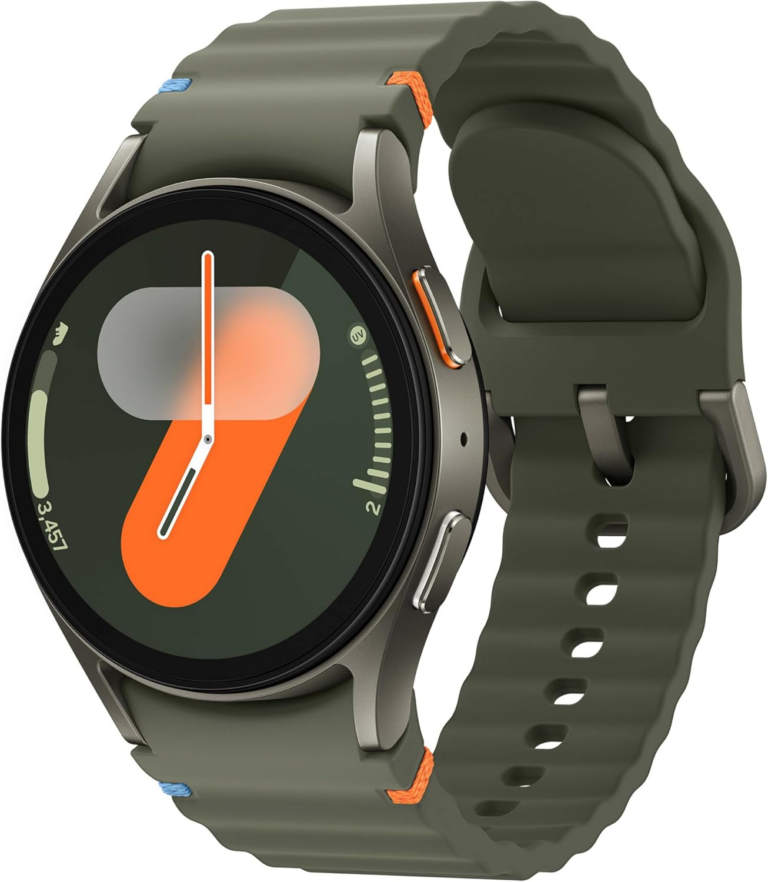
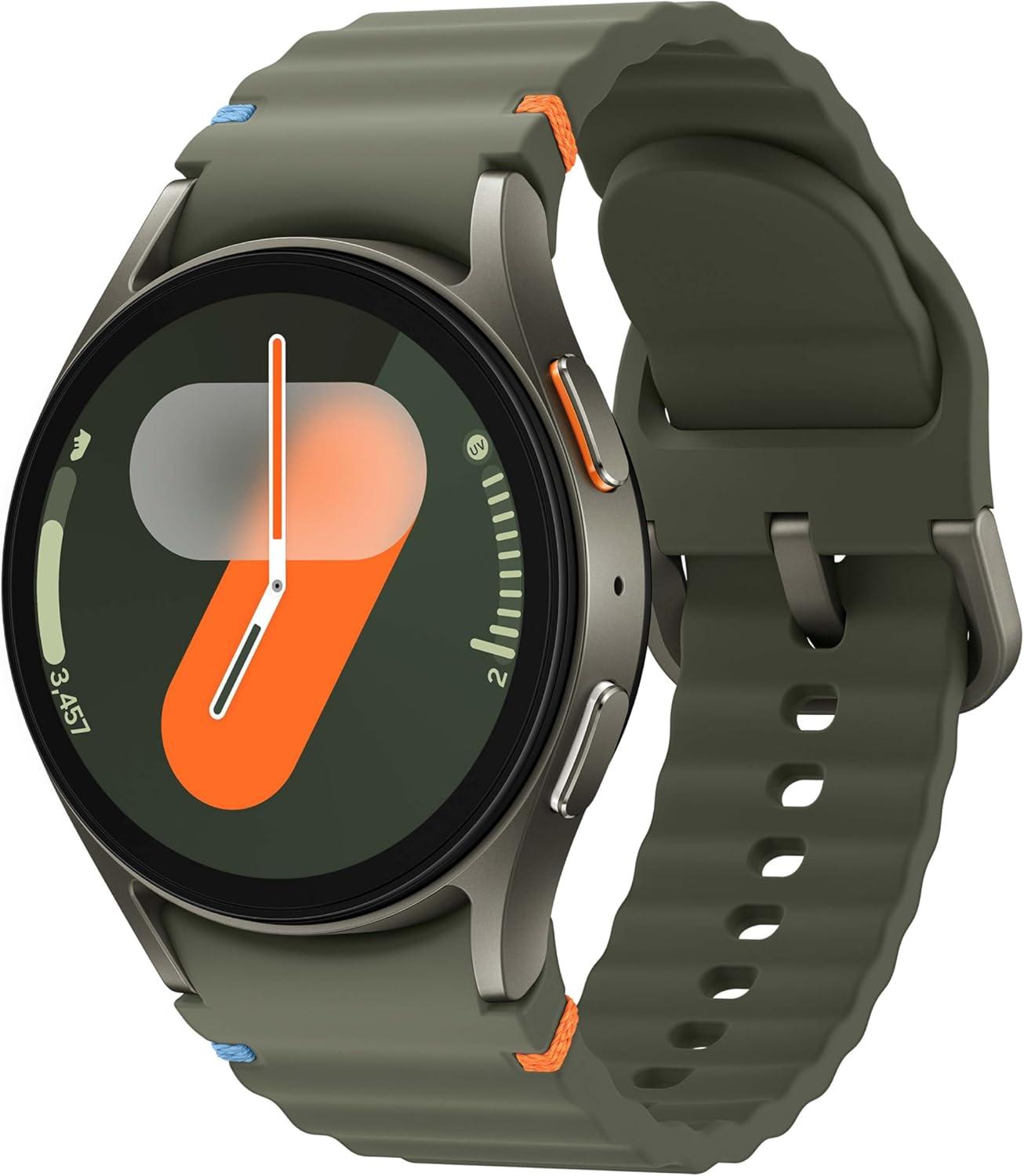
Amazon dropped the Samsung Galaxy Watch 7 40mm Bluetooth in Green to $159 — among its lowest-ever recorded prices — during the retailer’s Prime Big Deal Days sale, which ran October 6–7. That price puts FDA-cleared obstructive sleep apnea screening and Samsung’s Gate-All-Around 3nm wearable chip within reach for Android buyers who would rather put $220 toward other priorities than into a generational upgrade. The deal was available to all Amazon shoppers — no Prime membership required — and the price may still be reflected in the current Amazon listing, though Prime Big Deal Days officially closed October 7.
The Galaxy Watch 7 launched in July 2024 and was succeeded by the Galaxy Watch 8 in July 2025 and the Galaxy Watch 9 in August 2026. Buying it today means buying two-generation-old hardware — a fact worth stating plainly. The Galaxy Watch 9 starts at $379.99 for the 40mm Bluetooth model and brings a Snapdragon Wear Elite chip and updated health features. If you have a specific reason to want current-generation hardware, $159 is not the right starting point. If you want the best price-per-capable-feature ratio in Samsung’s ecosystem and have no need for the Watch 9’s incremental improvements, the Watch 7 at $159 is a legitimate buy.
What You Need to Know Before Buying
At its $299.99 launch price in July 2024, the Galaxy Watch 7 was a mid-to-premium Android smartwatch competing directly with the Google Pixel Watch 3 and the Apple Watch SE. At $159 — confirmed by independent price-tracking sources — it costs $60 less than the Galaxy Watch FE, Samsung’s entry-level wearable, while offering substantially more capable hardware. The case for buying it is not that it competes with the Galaxy Watch 9; it is that it competes with the Apple Watch SE 2 and budget Wear OS options — and wins on health-feature breadth at this price point.
| Metric |
Details |
| Sale Price |
$159.00 |
| List Price |
$249.99 |
| Savings |
$90.99 (36% off) |
| Original MSRP (July 2024 launch) |
$299.99 |
| Condition |
New, US Version |
| Warranty |
One-year manufacturer |
| Prime membership required? |
No |
The Architecture Behind Sleep Apnea Detection
The Galaxy Watch 7 was the first smartwatch to receive FDA De Novo authorization for sleep apnea detection, in February 2024 — a regulatory classification the FDA created specifically for this feature. De Novo is distinct from a standard 510(k) clearance: Samsung’s authorization created a new device category — “over-the-counter device to assess risk of sleep apnea” — which other manufacturers, including Apple, subsequently used as the regulatory predicate for their own clearances. Apple received its own 510(k) sleep apnea clearance in September 2024, roughly seven weeks after the Galaxy Watch 7 launched.
Both companies use different physiological signals. Samsung’s Galaxy Watch 7 uses photoplethysmography — the watch’s optical BioActive sensor fires infrared and green light pulses into the skin and measures the reflected light to track blood oxygen saturation changes over two consecutive nights of sleep. According to Samsung’s official De Novo announcement, this approach detects signs of moderate to severe obstructive sleep apnea. Apple Watch uses its accelerometer to detect wrist-movement patterns that indicate disrupted breathing. Neither feature constitutes a clinical diagnosis — both flag potential signs of moderate to severe obstructive sleep apnea and prompt the user to consult a physician.
The feature is available to users aged 22 and older who have not previously been diagnosed with sleep apnea. It requires a minimum of two nights of monitoring data to generate a result and runs through the Samsung Health Monitor app on a paired Android phone. Samsung Health Monitor requires a Samsung account. The sleep apnea screening tool is not available on iOS.
Untreated obstructive sleep apnea carries documented cardiovascular risk, including elevated likelihood of hypertension, coronary artery disease, heart failure, cardiac arrhythmia, and stroke, according to Samsung’s FDA filing. The American Medical Association estimates 30 to 40 million Americans have sleep apnea, most of them undiagnosed. A $159 consumer screening tool that motivates someone to seek a formal polysomnography test is public-health relevant in a way a standard fitness tracker is not.
The Chip: What Gate-All-Around Means in Practice
The Exynos W1000 inside the Galaxy Watch 7 is built on Samsung Foundry’s second-generation 3nm process using a new GAA transistor architecture — a fundamental change in transistor architecture rather than a simple die shrink. In FinFET transistors (used in the predecessor Exynos W930, built on a 5nm node), the gate electrode contacts the channel on three sides. In GAA design, the gate surrounds the channel entirely on all four sides — reducing current leakage, increasing drive current, and allowing more transistors per unit area at lower operating voltage.
For a device worn on the wrist with a battery measured in hundreds of milliamp-hours, the efficiency gain matters more than raw peak performance. Samsung claims 30% greater power efficiency compared to the Exynos W930, alongside performance improvements of 2.7x in app launch speed, 3.4x in single-core tasks, and 3.7x in multi-core tasks, according to Samsung’s Exynos W1000 official specifications. The practical effect: the watch runs its always-on display engine (a dedicated 2.5D AoD processing block) without the significant battery penalty that plagued earlier Galaxy Watch generations.
The five-core CPU configuration — one high-performance Cortex-A78 core running at up to 1.6 GHz alongside four efficiency-focused Cortex-A55 cores at up to 1.5 GHz — lets the operating system route background health-monitoring tasks (continuous heart rate, sleep tracking, step counting) to the efficiency cores while reserving the A78 for UI interactions and active workout sessions.
The GPU — an Arm Mali-G68 MP2 — is unchanged from the Exynos W930, which means graphical workloads (watch face rendering, animations) see no performance uplift from the architecture change. Samsung’s own watchface resolution cap remains 960 × 540 pixels. This is not a practical limitation for smartwatch use, but it means the “3nm” headline does not translate to visual improvements.
What the Sensors Actually Measure
The Samsung BioActive Sensor in the Galaxy Watch 7 combines three measurement modalities in a single module:
Optical PPG (photoplethysmography): Uses green, red, and infrared LEDs to measure heart rate, blood oxygen (SpO2), and the data feed into sleep apnea detection.
Electrical biosignal (ECG): An electrocardiogram capability that requires direct skin contact on the watch’s underside sensor. Produces a single-lead ECG trace readable via Samsung Health Monitor. In the US, ECG and blood pressure monitoring features require a Samsung Galaxy smartphone (not compatible with other Android devices) and a Samsung account.
Bioelectrical Impedance Analysis (BIA): Sends a low-level electrical current through the body to estimate body composition — muscle mass, body fat percentage, body water, and skeletal muscle. Used to track fitness composition changes over time.
The watch also includes a skin temperature sensor, accelerometer, barometer, gyroscope, geomagnetic sensor, and ambient light sensor. For GPS, it uses a dual-frequency system covering the L1 band (standard GPS) and L5 band. The L5 band provides greater accuracy in urban environments where GPS signals reflect off building surfaces before reaching the receiver — a documented weakness of single-band GPS systems in dense cities.
Water resistance is rated at 5ATM (rated for up to 50 meters / 164 feet depth) plus IP68 dust and water protection. The chassis also carries MIL-STD-810H certification — a US military standard covering shock, vibration, humidity, altitude, and extreme temperature resistance.
How It Holds Up in October 2026
The Galaxy Watch 7 runs Wear OS 5 with One UI Watch 6 and has received software support through Wear OS 6 and One UI Watch 8. It works with any Android phone running Android 11 or later and does not require a Samsung device for core smartwatch functions — though ECG, blood pressure monitoring, AI text reply suggestions, and some Galaxy AI features do require a Samsung Galaxy phone paired through the Samsung Health app (version 6.27 or later).
The Galaxy Watch 9 brings an upgraded Snapdragon Wear Elite chip with Gemini AI integration — features the Galaxy Watch 7 does not have. For most buyers’ actual usage — step counting, sleep tracking, heart rate monitoring, occasional workout tracking, NFC payments, and message glances — the Galaxy Watch 7 handles these tasks identically to the Watch 9. The performance gap between the Exynos W1000 and the Snapdragon Wear Elite is real, but it expresses itself primarily in AI workload handling and app launch speed in intensive scenarios, not in routine health monitoring.
Battery life is the Galaxy Watch 7’s most consistent criticism across independent reviews. Real-world use on the 40mm model yields approximately one to one-and-a-half days per charge — requiring a nightly charging routine. Buyers who currently charge a phone nightly will adapt easily; buyers who expect multi-day wearable battery life (Garmin’s fitness trackers typically run five to fourteen days) will find the Watch 7 frustrating regardless of price.
Is the Samsung Galaxy Watch 7 Still Worth Buying in 2026?
At $159, the practical question is whether the features you plan to use justify it over alternatives at similar prices. The Watch 7 outcompetes the Apple Watch SE 2 on health feature depth (ECG, BIA, blood oxygen, sleep apnea screening) and outcompetes generic Wear OS smartwatches on software polish and health ecosystem depth. It does not compete with the Galaxy Watch 9 on current-generation features or longevity of software support. Samsung has not published an end-of-support date for the Watch 7, but as a 2024 device with confirmed updates through Wear OS 6, it has at least one additional platform generation of active support behind it.
For a buyer who owns a Samsung Galaxy phone, wants FDA-cleared sleep apnea screening at the most accessible price currently available, and has no use case that specifically requires the Snapdragon chip or Gemini integration, the Galaxy Watch 7 at $159 is a defensible purchase. For a buyer whose use case would benefit from the Watch 9’s AI features or who values long software runway, the $220 price difference is worth it.
The 40mm Green Bluetooth model linked in this article is the only Prime Big Deal Days variant that did not require an Amazon Prime membership. Check the current Amazon listing to confirm whether the sale price remains active.
Frequently Asked Questions
Is the Galaxy Watch 7 still worth buying now that the Galaxy Watch 9 is out?
It depends on your use case. The Galaxy Watch 9 launched in August 2026 with a Snapdragon Wear Elite chip and Gemini AI integration, both of which the Watch 7 lacks. For everyday health monitoring — sleep tracking, heart rate, step counting, NFC payments, and FDA-cleared sleep apnea screening — the Watch 7 performs these functions identically. At $159 versus $379.99 for the Galaxy Watch 9 40mm Bluetooth, the two-generation-old model delivers most of what most buyers actually use, without paying for the hardware delta that expresses itself mainly in AI workloads.
What does FDA-authorized sleep apnea detection on a smartwatch actually do?
The Galaxy Watch 7’s sleep apnea detection uses photoplethysmography — optical sensors that track blood oxygen saturation changes during sleep over two consecutive nights. If the feature detects signs consistent with moderate to severe obstructive sleep apnea, it notifies you and prompts you to seek a physician evaluation. It does not diagnose sleep apnea; it screens for it. The feature is available to users aged 22 and older without a prior sleep apnea diagnosis, through the Samsung Health Monitor app on a paired Android phone. Samsung received FDA De Novo authorization for this feature in February 2024 — the first such authorization for a consumer smartwatch — which created the regulatory category that Apple subsequently used as a predicate for its own clearance in September 2024.
Does the Prime Big Deal Days deal require an Amazon Prime membership?
The $159 price on the Galaxy Watch 7 40mm Green Bluetooth model was the only Amazon Prime Big Deal Days Galaxy Watch price that did not require an Amazon Prime membership — all other Galaxy Watch models in the same sale were Prime-member exclusives. The sale officially ran October 6–7; check the current Amazon listing to verify whether the price remains active or has reverted to the $249.99 list price.
How does the Galaxy Watch 7’s 3nm chip differ from chips in older Galaxy Watch models?
The Exynos W1000 uses Gate-All-Around transistors — a different physical architecture from the FinFET transistors in the Exynos W930 (5nm) used by the Galaxy Watch 6. In GAA design, the transistor gate surrounds the channel on all four sides rather than three, reducing current leakage and improving power efficiency at smaller scales. Samsung claims 30% greater efficiency and roughly 3x the CPU performance of the W930. In practice, this means faster app response and the ability to run more background health sensors simultaneously without proportionally draining the battery. The Galaxy Watch 7 was the first consumer wearable to use this transistor architecture.