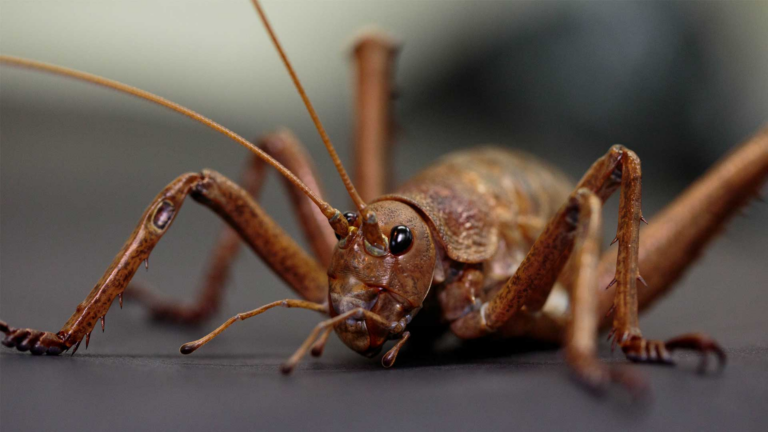
Wild-born giant wētā are now reproducing across ten sites in New Zealand — including a fifth generation of offspring at one island — after two Auckland facilities spent 15 years mastering a captive-breeding protocol that transformed how the world thinks about saving endangered invertebrates. A study published in the New Zealand Journal of Zoology has formalized the blueprint, making it the most comprehensively documented case of invertebrate species recovery through captive breeding and translocation ever recorded.
The species at the center of this achievement is the wētāpunga (Deinacrida heteracantha), the world’s heaviest orthopteran insect — the order that includes crickets, grasshoppers, and locusts. Adult females typically weigh around 35 grams (1.2 ounces), large enough to fill an adult’s palm, with exceptional individuals recorded at up to 70 grams (2.5 ounces). By the time conservationists took stock between 2005 and 2009, surveys on Te Hauturu-o-Toi — Little Barrier Island, a forested island of about 31 square kilometers (12 square miles) in the Hauraki Gulf — found fewer than 200 individuals left in the world.
What Drove Wētāpunga to a Single Island
Wētāpunga once ranged across Northland and Auckland. Like most large, flightless, nocturnal insects that evolved in the near-absence of land mammals, they had no natural defenses against the predators that arrived with human settlement: Pacific rats first, then cats in the 1870s, then stoats. European settlers also cleared the northern New Zealand forests for farming, eliminating habitat at scale.
By the second half of the 20th century, the species existed only on Te Hauturu-o-Toi. Cats were removed from the island in 1980; the rats — far harder to eradicate — not until 2004. After rat eradication, post-recovery surveys counted 78 wētāpunga in 2005 and 171 by 2009. The population was recovering but remained too fragile to support direct translocation: taking enough adults to establish new populations elsewhere would have risked the only surviving wild group. The solution was to take a handful.
How the Captive-Breeding Protocol Actually Works
In December 2008, six adult wētāpunga — three male, three female — were transported from Te Hauturu-o-Toi to Butterfly Creek, a wildlife facility in Manukau, South Auckland. The transfer was conducted with the formal blessing of Ngāti Manuhiri, the iwi that holds kaitiakitanga (guardianship) over Te Hauturu-o-Toi and its taonga species, and with permits issued by the Department of Conservation (DOC). Small additional founder groups of 12 insects — balanced between males and females — were collected every three to five years thereafter.
Butterfly Creek’s team spent three years figuring out the core biology. Climate-controlled rooms were maintained between 10 and 22 degrees Celsius (50 and 72 degrees Fahrenheit) to replicate the cool, humid forest environment. Females were given moistened soil containers for egg-laying. The diet had three components: fresh native leaves (karaka, karamu, māmāngi, māhoe, and kohekohe were preferred), moist leaf litter, and high-protein fish flakes. That last ingredient was critical for the youngest nymphs, which in the wild seek out fungus and bird droppings to meet their protein needs. Eggs averaged around nine and a half months to hatch, with some remaining viable for up to two years. Each nymph then moulted ten times across approximately 14 months before reaching adulthood. A productive female could generate up to 1,350 offspring across her lifetime.
In 2012, Auckland Zoo established a parallel breeding colony and scaled the operation dramatically. The key technical innovation was communal rearing: housing 20 nymphs together in large mesh cages rather than in individual containers. The breakthrough insight was that the cohort had to be age-matched — all nymphs within days of each other in developmental stage. In mixed-age cages, larger wētāpunga ate their smaller siblings. With properly matched cohorts at the right density, survival to release reached 80 percent. DOC later described Auckland Zoo’s approach as the “industrialization” of wētāpunga rearing: a word that captures the shift from a handcrafted operation producing insects by the dozen to a structured system producing them by the thousand.
Does Zoo Breeding Produce Insects That Can Survive in the Wild?
This is the central technical question that any captive-breeding program for large invertebrates must answer, and the wētāpunga paper provides the most detailed published answer yet.
Transport turned out to be straightforward. Many wētāpunga were carried to their new homes inside bamboo tubes tied to tree branches on recipient islands; large batches of younger nymphs were released directly onto native trees at night, when the nocturnal insects were active and most island birds were sleeping. No deaths were recorded during any of the 45 transfers.
The more consequential question was whether populations would persist across generations. International conservation translocation standards, maintained by the IUCN’s Species Survival Commission, treat four generations of wild-born reproduction as the accepted benchmark for translocation success. Monitoring teams on Motuora and Tiritiri Matangi — the two islands that received the first releases in 2010 and 2011 respectively — have now identified what the paper characterizes as fourth-generation wild-born adults at both sites, and fifth-generation individuals at one of them.
The density data is even more striking. Spotlighting surveys on recipient islands — searchers moving through the bush at night with torches — recorded up to 28.5 wētāpunga per person-hour of searching on some islands. The equivalent figure on Te Hauturu-o-Toi after rat removal was 1.4 per person-hour. The managed islands, freed of mammalian predators and stocked with zoo-bred founders, now support wētāpunga populations roughly 20 times denser than the remnant wild source population.
What Wētāpunga Do Once They Recover
The ecological significance of this recovery extends well beyond the species itself. Wētāpunga serve as what Auckland Zoo’s ectotherms team has described as “forest regenerators”: they eat native plant leaves, deposit seeds through their droppings, and return nutrients to the forest floor through their excrement — which is, according to everyone who works with them, among the largest produced by any insect on Earth. In the absence of small native mammals, New Zealand’s invertebrates have historically filled ecological roles that elsewhere belong to rodents and small marsupials. Recovering wētāpunga populations on these islands therefore restores not just a species but a functional layer of the ecosystem.
The 10 sites where populations are now established include eight predator-free islands in the Hauraki Gulf and Bay of Islands — Motuora, Tiritiri Matangi, Motuihe, The Noises archipelago, Urupukapuka, Moturua, Motuarohia, and Matakohe-Limestone Island near Whangārei — and two fenced mainland sanctuaries north of Auckland. The mainland sites introduce a different challenge: both still have mice. Whether wētāpunga can establish stably alongside rodents of that size is one of the open questions the paper explicitly names as requiring further investigation.
What the Science Is Not Yet Certain About
The authors are candid about the program’s remaining vulnerabilities. The most significant concerns genetics.
All ten wild populations trace back to a relatively small number of founders. An earlier study of the Cook Strait giant wētā (Deinacrida rugosa) — a related but distinct species — found evidence of genetic bottlenecks at translocation sites and recommended a minimum of 70 unrelated founder individuals to safeguard long-term genetic diversity. The wētāpunga program started with six individuals. While additional founder groups were collected at intervals, DNA samples taken from Motuora and Tiritiri Matangi in 2018 and 2019 are still being analyzed to assess genetic health across four generations. Results are awaited.
The generation-count timeline also carries a methodological caveat: it is partly based on models built from captive breeding data rather than from continuous in-situ tracking of individual lineages. Actual generational timing in wild conditions may differ from the modeled expectation.
These are real limitations. They do not diminish the program’s significance, but they are the honest boundaries of what the peer-reviewed paper currently claims.
Does This Matter for Other Endangered Insects?
This is the question that makes the wētāpunga study consequential beyond New Zealand.
Insects constitute the vast majority of animal biodiversity and are declining globally — one widely cited analysis found annual insect population decline rates exceeding one percent for certain orders in Europe and North America. But conservation funding and methodology have been systematically directed toward vertebrates. A 25-year analysis published in the Proceedings of the National Academy of Sciences found that 85 percent of global conservation resources go to birds and mammals, with the bias against invertebrates approximately 40 percent higher than previous estimates had suggested. Conservation translocation as a formal discipline has been developed overwhelmingly around vertebrate species.
The wētāpunga paper is the first peer-reviewed documentation at this scale of what happens when the vertebrate playbook — ex-situ captive breeding, structured translocation to predator-free sites, multi-generational monitoring — is applied rigorously to a large invertebrate. “By documenting this amazing conservation success story, we can share valuable knowledge on husbandry, release methods, and population persistence,” lead author Dr. Chris Green, Honorary Research Associate of DOC, said in the official DOC release.
Green explicitly named the Canterbury knobbled weevil (Hadramphus tuberculatus) and several native stag beetles as candidates for similar programs. The Canterbury knobbled weevil — considered by DOC to be among New Zealand’s rarest invertebrates, with a single known population of fewer than 100 individuals at a 12.4-hectare reserve in the South Island — has been a subject of early captive rearing experiments since its rediscovery in 2004. The wētāpunga protocol provides an approach it has never had.
The techniques developed for wētāpunga are already being applied beyond them. New Zealand’s Conservation Minister Tama Potaka announced in September 2026 that $75,000 in International Visitor Levy funding would support the captive breeding program for the critically endangered Māhoenui giant wētā (Deinacrida mahoenui) at Ōtorohanga Kiwi House, citing the lessons learned from the wētāpunga program. That program, which has bred over 300 Māhoenui giant wētā in captivity since 2021, is scaling up using methods that Butterfly Creek originally developed and Auckland Zoo refined, and recently translocated 97 captive-bred wētā to Ōtorohanga Kiwi House breeding partners.
Status Update: From Nationally Endangered to Nationally Increasing
When the program began, wētāpunga carried the classification Threatened – Nationally Endangered under New Zealand’s Threat Classification System. In 2022, that status changed to Threatened – Nationally Increasing — a category that recognizes a growing population while acknowledging continued dependence on active management.
“This species was endangered at the start of the program, it is now not endangered — it is recovering,” Green told Radio New Zealand. “The future of wētāpunga is looking bright.” The 1News NZ report citing Green’s RNZ interview confirmed his assessment of the program’s outlook.
The program could not have operated without ongoing support from Ngāti Manuhiri, who hold kaitiakitanga over the wētāpunga and over Te Hauturu-o-Toi. Every collection event from the source island required their blessing, and they have remained active partners throughout the program’s 15-year span. Community restoration groups across the upper North Island were equally central: raising funds, helping organize releases, and contributing to monitoring on the recipient islands.
What began with six insects in a Manukau wildlife park now spans ten wild populations scattered across island sanctuaries and mainland fenced reserves in New Zealand’s north — and, with the publication of the peer-reviewed study, a template that conservation programs in other countries can follow.
Frequently Asked Questions
How do scientists know wētāpunga populations are truly self-sustaining?
The internationally recognized benchmark for confirmed translocation success, established by the IUCN’s Species Survival Commission, is evidence of at least four generations of wild-born reproduction at a recipient site. On Motuora and Tiritiri Matangi — the first two islands to receive wētāpunga — monitoring has identified what researchers characterize as fourth-generation adults at both sites, and fifth-generation individuals at one. These generation counts are partly model-based, using captive breeding data to estimate wild developmental timelines, but the density data (28.5 wētāpunga per person-hour on recipient islands versus 1.4 on the source island after rat removal) independently suggests robust establishment.
Why does captive breeding work differently for insects than for vertebrates?
The core challenge is the same — maintaining genetic diversity, keeping enough individuals alive to release, and preventing maladaptive captive-bred behaviors — but the biology creates different constraints and opportunities. Insects can produce far more offspring per individual than vertebrates (a single female wētāpunga can yield up to 1,350 young in a lifetime), which means a small founder population can generate large release cohorts quickly. The main technical breakthrough for wētāpunga was solving the communal-rearing problem: keeping 20 same-age nymphs together in large mesh cages rather than rearing individuals separately dramatically increased throughput, while age-matching prevented older siblings from eating smaller ones. The resulting 80-percent survival rate to release is higher than many vertebrate programs achieve.
Which other endangered insects could benefit from this approach?
Lead author Dr. Chris Green specifically named the Canterbury knobbled weevil (Hadramphus tuberculatus) — probably New Zealand’s rarest invertebrate, with a single population of fewer than 100 individuals — and several native stag beetle species as prime candidates. The Māhoenui giant wētā (Deinacrida mahoenui), which is Nationally Critical, has already begun scaling up a captive breeding program at Ōtorohanga Kiwi House using techniques refined by the wētāpunga program, with $75,000 in government support announced in September 2026. More broadly, conservation experts at the 4th International Conservation Translocation Conference in Edinburgh in September 2026 highlighted that “thousands of species have benefited from translocations to date,” including the recovery of a Moorean tree snail from Extinct in the Wild to Critically Endangered — suggesting the approach works across invertebrate groups when applied with sufficient institutional commitment.
What does wētāpunga recovery mean for the ecosystems where they have been released?
Wētāpunga play a functional role in the forest — eating leaves, depositing seeds through their droppings, and recycling nutrients back into the soil through their waste, which is among the largest produced by any insect species. In New Zealand, where native land mammals are nearly absent due to the islands’ geological isolation before the arrival of people, large invertebrates historically filled ecological roles that belong to rodents elsewhere. Reestablishing wētāpunga on predator-free islands therefore restores an ecological layer, not just a species count.