Poker Roguelite The Devil’s Due Launches November 10: Enemy Shares Your Deck

October 8, 2026:

Poker Roguelite The Devil’s Due Launches November 10: Enemy Shares Your Deck
The. Devil. Due
Gamespeopleplay.co

Norwegian indie duo Games People Play announced The Devil’s Due launch date — its dark-comedy poker roguelite — as November 10, 2026. A free demo covering the first four layers of Hell is available right now, and the studio has been refining it publicly since late 2025.

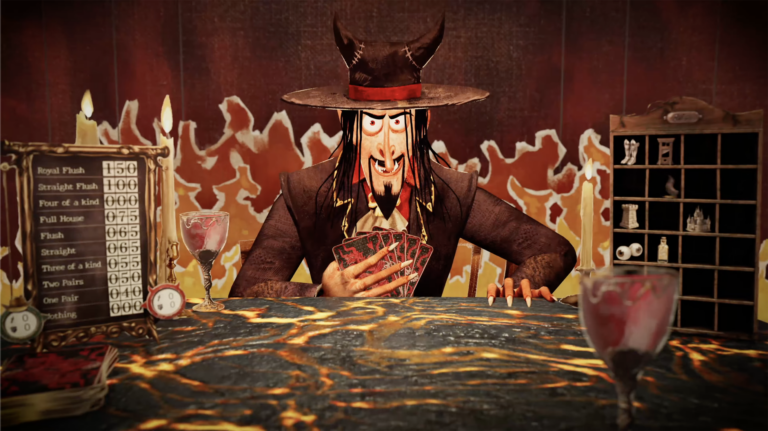
The premise is elemental: you lost your soul in a poker game against the Devil, and the only way out is to cheat your way back through all seven levels of Hell, one monstrous poker duel at a time. That setup is familiar to anyone who has spent time in the Balatro-wave of poker roguelites that has swept Steam since 2024. What is not familiar is the mechanic underneath it.

Every Card You Add Also Arms Your Opponent

In most deckbuilders — including Balatro — Balatro uses a private solo deck, so building toward a flush-heavy synergy or a high-card tower helps you and hurts no one else. The Devil’s Due changes this at the architecture level: you and your demonic opponent draw from the same unified deck on Steam. Every card you add, remove, duplicate, or boost in value is equally accessible to the monster sitting across the table.

That design choice has a direct consequence for how strategy works. In a solo-optimization deckbuilder, a run can converge on a “solved” build — a configuration so dominant it collapses the challenge into execution. In The Devil’s Due, that convergence is structurally blocked: the deck you are optimizing is also the deck being optimized against you. The question is never “what is the best deck?” but “what deck gives me the most advantage relative to what the enemy can pull from it?” Every run forces a different answer.

The combat itself converts poker hand strength determines damage into a damage-and-defense system. The strength of the poker hand you build — a pair, a straight, a flush — determines how much damage you deal. The cumulative numerical value of the cards in your hand acts as your defense total. Because poker hand rankings are universally understood, the combat layer is immediately readable without a tutorial: a player who assembles a full house knows they have hit something powerful, and they knew it before a single number flashed on screen.

Cheating Is the Asymmetry

The shared deck would be paralyzing if the only tool available were card selection. The Devil’s Due‘s second layer is the cheat system: a growing arsenal of tricks that tilt the deck in the player’s favor. Players can conceal cards mid-battle (pulling them from the shared pool before the enemy can access them), swap cards, boost card values to force more powerful hands, or actively sabotage the enemy’s draw.

The constraint is a suspicion meter. Every cheat increases it; push it too far, and suspicion meter triggers burst attack. Managing that meter is the third strategic layer stacked on top of deck composition and hand-building — a risk/reward calculation that runs in parallel with every other decision in a duel.

Designer Jack Kristoffersen described the game as “poker expanded with an entire suitcase of absurd cheating tools, encouraging hands no casino would ever permit.” He put the design intent plainly in a Steam Next Fest press release: “The goal was to make poker feel like poker. Not an abstract optimization puzzle. It’s about chaos, bluffing, desperation, and figuring out how to cheat just enough to survive without getting caught.”

Seven Layers, Each Themed on a Deadly Sin

The Devil’s Due structures its Hell across seven layers of Hell on Steam, each built around one of the seven deadly sins. The first four — Lust, Gluttony, Pride, and Wrath — are playable in the demo. Each layer introduces differently themed enemies and escalating difficulty. Navigation through each level is governed by a tarot-card path the Devil lays out at the start: players choose from routes that include monster fights, boss encounters, shops, healing shrines, and minigames. In a nod to the game’s commitment to the deception theme, even the shops can be scammed.

Death resets the run but not the unlocked library. Each failed attempt earns permanent upgrades and new relics that carry forward into subsequent runs. This is the roguelite structure the genre has standardized since Hades and Dead Cells made it the expectation: runs are designed to be failed, and the player’s understanding and toolkit both expand through failure rather than in spite of it.

A Monty Python Sensibility in Hell

The aesthetic frame matters here because it shapes how every other element lands. The Devil’s Due is not trying to be frightening. The art is hand-drawn and features Monty Python-inspired animation and aesthetic, treating Hell’s grotesque population of demonic monsters as objects of dark comedy rather than dread. The tone is irreverent throughout — absurdist in its premise, sassy in its execution, and deliberately lightweight for a game set in eternal damnation.

That tonal choice distinguishes it from the more abstract or mystical aesthetics common to the poker roguelite wave. Where Balatro wraps its mechanics in neon casino visuals and an impressionist Joker theme, The Devil’s Due populates its world with creatures that would fit comfortably in a Terry Gilliam animation reel.

The game’s protagonist is a gambling cheat who lost his soul to the Devil in the opening hand and now has nothing left to lose. His escape route runs through every monster the seven deadly sins can muster, using every dirty trick in a steadily expanding suitcase to stay alive one hand at a time. The tone is: absurdist, irreverent, and darker than its Monty Python aesthetics initially suggest — because the stakes, however comedic in framing, are damnation.

Demo History and Market Context

The development team — Jack Kristoffersen and Joachim Barrum, who have made games together for more than three decades — has run an unusually public development process. The first public demo appeared at The Devil’s Due at OTK Expo in November 2025, introducing the Lust and Gluttony layers and showing off the cheating combat system to the content-creator community. In June 2026, a substantially updated demo launched with the Steam Next Fest June 2026 update, adding two new layers — Pride and Wrath — plus new enemies, cheats, and relics.

SpreadCheat arrived on Steam in May 2026, meaning The Devil’s Due is not the studio’s Steam debut.

The game enters a market that has grown sharply but become more competitive. Roguelite revenue on Steam reached approximately $400 million in 2025, up about 80% from 2024, and nearly $500 million by mid-2026 alone. Annual roguelite releases climbed from 432 in 2021 to nearly 2,000 by year’s end in 2025, according to industry tracking. Within that crowded field, deckbuilders outperform action-roguelite clones on breakthrough rates — a pattern that works in The Devil’s Due‘s favor.

The Devil’s Due will launch in 13 languages at launch on Steam: English, French, Italian, German, Spanish, Simplified Chinese, Traditional Chinese, Japanese, Korean, Norwegian, Portuguese (Brazil), Russian, and Turkish.

Is This Worth Wishlisting Before November?

The free demo is the clearest answer. Four layers of Hell, a solid selection of cheat cards and relics, and the full shared-deck mechanic are available now in The Devil’s Due free demo on Steam. Players who liked Balatro’s poker core but found solo optimization eventually felt solved, or who want a more explicitly adversarial deckbuilder with a narrative frame to organize it, have a specific and testable proposition waiting for them.

For those less certain: the Monty Python-flavored dark comedy aesthetic is idiosyncratic enough that the demo is genuinely the right place to start. Whether the tone and the bilateral deck calculation click together is a personal-taste question, and the answer is available for free.


Frequently Asked Questions

How is The Devil’s Due different from Balatro?

The key mechanical difference is the shared deck. In Balatro, the player builds and optimizes a private deck — the opponent has nothing to do with it. In The Devil’s Due, both the player and the demonic opponent draw from the same unified deck. Every card you add, remove, or modify affects both sides of the table. This makes deckbuilding an adversarial calculation rather than a solo optimization problem, and it means builds that work in one run may not survive the same deck composition in another.

Is The Devil’s Due a gambling game with real money?

No. Like Balatro, The Devil’s Due uses poker’s hand-ranking system as a mechanical framework — a readable scale for combat damage — not as a vehicle for real-money wagering. There is no betting, no actual money at risk, and no connection to real gambling. The game is rated for the strategic use of poker-hand imagery, not for gambling mechanics.

Can I play The Devil’s Due before it releases?

Yes. A free demo is currently available on The Devil’s Due free demo on Steam. The demo covers the first four of the game’s seven layers of Hell — Lust, Gluttony, Pride, and Wrath — and includes a substantial selection of cheat cards and relics. It represents a meaningful portion of the game’s content and is the best way to evaluate whether the bilateral deck mechanic and dark-comedy tone work for you.

Does a shared deck actually make the game fairer or harder?

Neither, precisely — it makes the game structurally different. Because both you and your opponent access the same card pool, the adversarial pressure is baked into every deckbuilding decision rather than being imposed only through the difficulty of enemy actions. The cheat system (card swaps, value boosts, sabotage) is what gives you asymmetric access to the shared resource. The suspicion meter is what stops you from cheating your way to an infinite advantage. The net effect is a risk-management problem layered on top of a deckbuilding problem — which is most of what strategy card games are.

Source link