October 6, 2026:

It’s not your job to “fix yourself,” says the author of “When in Menopause,” a new book arguing that this hormonal transition is a public policy matter—not just a private health journey.

Menopause is having a moment.
After centuries of medical neglect and decades of cultural stigmatization, this period of hormonal decline and cessation is being taken more seriously as a topic of open conversation and health research. Some state laws now require insurance to cover hormone treatment for menopause.
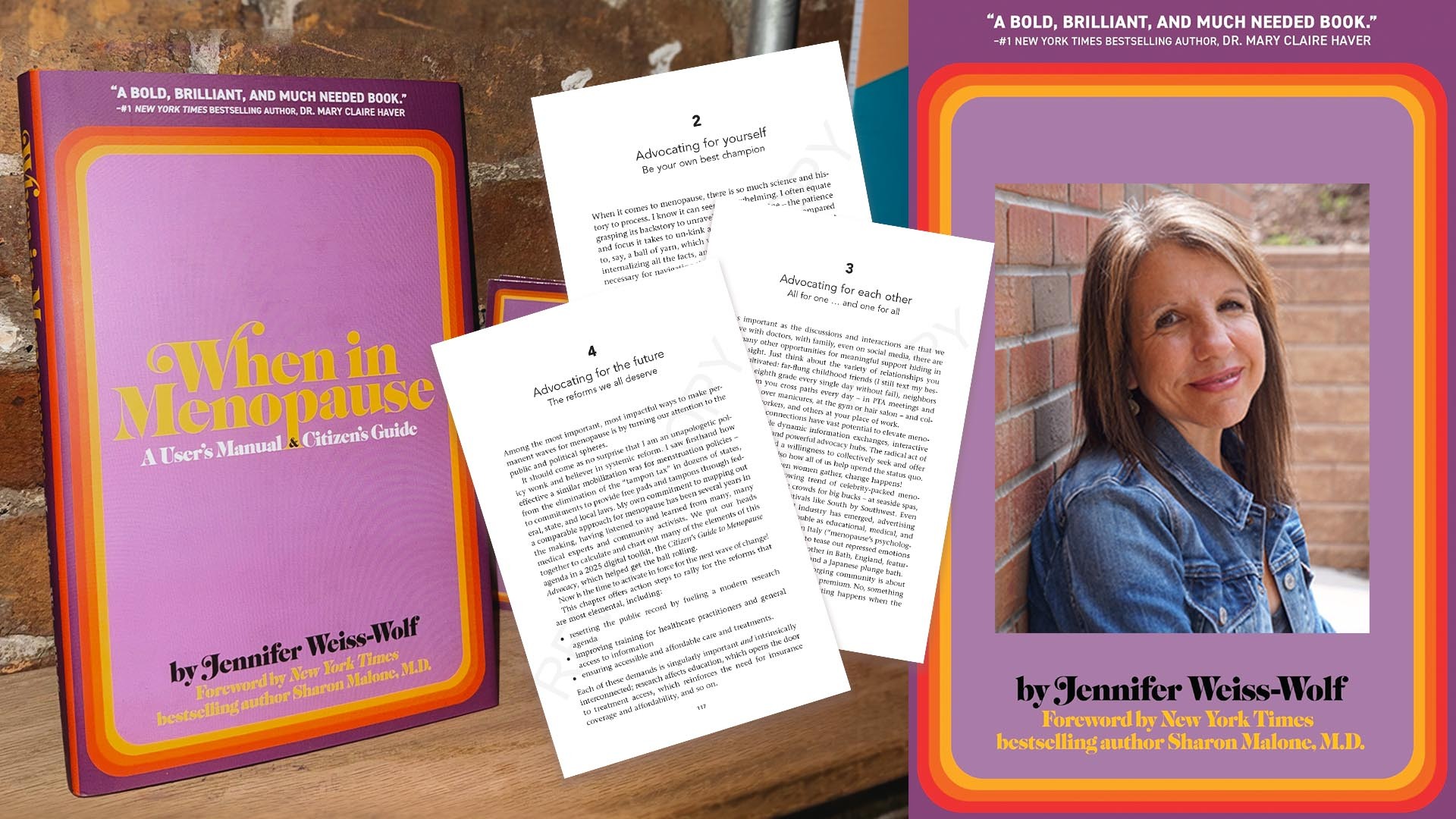
When in Menopause: A User’s Manual and Citizen’s Guide, a new book by the legal scholar and women’s health advocate Jennifer Weiss-Wolf, argues that menopause must also be taken up more widely as a public policy issue—and not treated solely as a private health matter.
Estrogen options and access have improved more or less continuously for the past century, since German scientists first injected menopausal women with cow ovarian tissue. But, as Dr. Sharon Malone writes in the book’s foreword, in 2002 “a nuclear bomb” dropped: The NIH abruptly halted a major, eight-year study on the health benefits of estrogen-plus-progestin treatment after five years over concerns of heightened breast cancer risks.
The findings turned out to be limited, and the relative danger for different kinds of patients was badly miscommunicated to the public and doctors alike. But the cancer news out of the Women’s Health Initiative (WHI) research turned estrogen into a “medicinal pariah.” A generation of women were left to suffer through menopause with little support.
Weiss-Wolf belongs to the generation that has clawed back their access to hormone replacement therapy (HRT) after later studies demonstrated not only its safety for most people but also its benefits to heart and brain health. Gen X women are now benefiting from new research and the rise of menopause specialists—and Weiss Wolf hopes her book will spur her cohort to demand even more.
“I’m really hoping that a lot of those people are fired up by what they went through, and are beyond letting it just be their problem that they had to solve, and really want to invest themselves in helping solve this for everybody, so that we’re all better off,” she said.
Weiss-Wolf spoke with Rewire News Group ahead of her Oct. 6, 2026, book release.
This conversation has been edited for length, structure, and clarity.
Explain what happens during menopause and during its lesser-known but increasingly prominent cousin, perimenopause (with whom I am currently getting acquainted)?
The first thing I’m going to say is I’m not a doctor. Everything that I share with you should not be taken as medical advice or expertise, and that is why I always work with doctors.
Perimenopause is actually what most of us are experiencing when we say, I’m in menopause. And that’s the symptoms that your body goes through due to fluctuating and eventually decreasing hormone levels. [Those include] vasomotor symptoms, which are hot flashes, [and] cognitive symptoms—so brain fog or anxiety.
Then [there is another] set of symptoms typically associated with menopause [that] are due to the lack of hormones in our reproductive system, so vaginal, vulvar, urinary tract [infections and] … in colloquial terms, vaginal dryness.
For some people, this happens earlier. But for most people, it is a 4-10 year prelude that tends to culminate with the final menstrual period by around age 51.
What would change if menopause were treated as a public policy concern?
It is the result of public policy decisions and neglect … that we do not have access to the care and treatment and support that we deserve. Those are deliberate decisions we’ve made along the way.
A lot of it does have to do with the health system: how we access health, how the medical profession functions, and how medical and scientific research is funded. But it’s actually much bigger than that. All of the deficits that have occurred [in] how the medical system treats menopause have led to commercial product industries being able to take advantage of all of the gaps in information—and profit mightily off of our confusion and our inability to get care.
When we go to see a clinician, and they’re not able to adequately connect the dots when we walk in the door that the things we describe to them are menopause, and instead they prescribe us [only] antidepressants or sleep meds. … [They] are not looking at us holistically because they’ve not been trained to do so.
We treat [menopause] as a private matter, [like] it is our problem. It is our burden. And I think that for too long, so many people have been trying really hard to “fix” themselves.
As you note in your book, menopause tends to be a worse experience for Black women. For example, their hot flashes period lasts longer than it does for women of other races. One researcher attributed these findings to both structural medical racism and to “weathering,” the concept that the stress of racism takes its toll on the body.
One foundational study [in hormone-replacement therapy] is called the SWAN Study. Among the findings in the SWAN study that demonstrate the racial disparity is that Black women’s menopause experience starts earlier, the symptoms are more severe, and it goes less treated.
I think that the additional study and reflection on the impact of systemic racism, of weathering of medical racism, is really important. Because the systemic story is much more important than the statistics. [Menopause] has to be understood [in relation to] people’s experience in society with the medical system—why there’s trust or distrust with the medical system; about who’s been included in research; and … who’s leading the research.
Omisade Burney-Scott, who founded Black Girl’s Guide to Surviving Menopause, is prolific in explaining the medical or physical or physiological experience why, especially for Black women, the cultural and social and spiritual and familial story of stories of menopause are empowering and so often ignored, neglected, and undermined. Especially as we have this rising menopause moment, which looks very white and upper class. …
There’s a lot of attention being paid, and it’s not always inclusive of a wide variety of experiences. And that absolutely includes race.
Wellness influencers and telehealth companies have skyrocketed in the perimenopause and menopause space. What’s the proper balance between finally taking a neglected issue seriously and giving women the access to care they deserve, and capitalizing on their distress?
I think of telehealth quite separately than I think of the consumer product industry.
One of the failures that we’ve experienced since the [Women’s Health Initiative] over the past 25 years has been the removal and invisibility of menopause care in medical training, so we have very few clinicians who are fluent in and able to effectively treat menopausal patients. There’s something like less than 4,000 menopause trained physicians in the Menopause Society, which is kind of the highest regarded menopause practitioner certification.
So we can think of the efficacy of telehealth … if you don’t have access to [specialist care] because you don’t live in a place that has [trained clinicians], there’s a real benefit there to people for whom just access to good care is not a thing.
The commercial market [is] … the Wild West. Here’s the structural problem: Because of the WHI and the distrust we’ve had of hormones … we live in a time where FDA-approved products—[meaning] pharmaceuticals, menopause hormone care, and some non-hormonal treatments—are subject to far more [constraints in how] they’re allowed to talk about and label [them and] communicate the safety and efficacy than commercial products, [which have no oversight].
So FDA-approved vaginal hormone cream, which is safe, … up until last year has been subject to a warning label that said that they [increase the risk of] cardiovascular disease, blood clots, and … probable dementia. That was never true, and yet those words were on the label required by the FDA.
On the flip side, something that has absolutely no safety record, no efficacy record, but is just something that some celebrity slapped their name on or some company created, knowing that people were desperate for care and treatment—[that] has no requirement and no oversight.
What are some products you’ve seen peddled as menopause solutions that have no proven value?
Fancy lubricants to deal with vaginal dryness. It’s not going to cure the symptom, which is declining estrogen. It may make you feel better for a minute, but it’s not going to help your long-term health.
There’s $1,000 red light wand things.
For your vagina? I think I’d be a little nervous to shine a red light wand on my vagina.
None of these things are going to resuscitate your ovaries [or] replenish the estrogen that’s no longer there. [But] they have no obligation to say that.
Just know that somebody who’s selling you something is preying upon the fact that you might be avoiding hormones because you have less-than-adequate information to guide that decision. … It’s likely a waste of your money.
Source