HomeAuto Reborn as a Space Mercenary Premieres on Crunchyroll: Spacecraft Stealth Is Real Engineering
Reborn as a Space Mercenary Premieres on Crunchyroll: Spacecraft Stealth Is Real Engineering
October 5, 2026:
Crunchyroll.com
The fall 2026 anime season welcomed a rare arrival on Sunday: a sci-fi isekai that swapped the medieval fantasy template for a space opera grounded in real physics. Reborn as a Space Mercenary: I Woke Up Piloting the Strongest Starship debuted its first episode on Crunchyroll on October 4, 2026, giving global viewers their first look at a series that has quietly been one of the most scientifically literate entries in a genre dominated by magic systems and dungeon crawls, according to the Crunchyroll fall 2026 anime lineup.
What distinguishes this premiere from the crowded isekai field is not merely its setting. The show’s three interlocking conceits — thermal infrared stealth as the primary combat detection medium, centrifugal-ring space colonies as the default habitat architecture, and machine intelligences occupying an unresolved legal-ethical liminal space — each maps directly onto a real, active research or philosophical frontier. A 2025 spacecraft infrared camouflage study published in the Nature-family journal Light: Science & Applications described the first practical prototype for spacecraft infrared camouflage. The show’s central combat innovation was already being engineered when the series went into production.
Sato Takahiro Wakes Up Cold Inside His Favorite Game
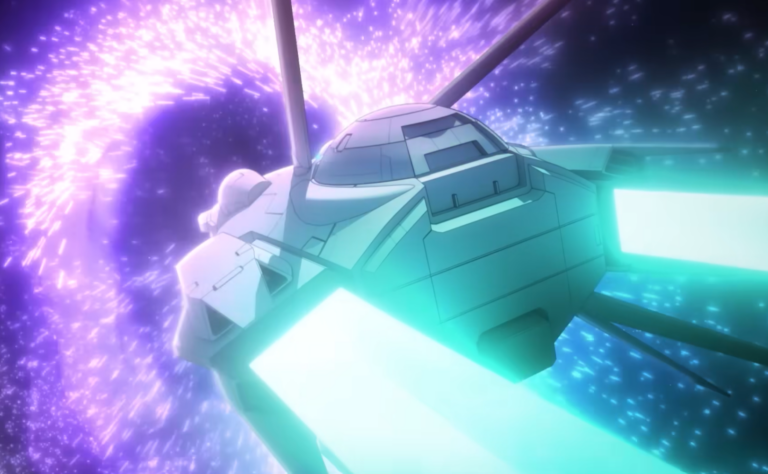
Episode 1, “First Space Colony” (はじめてのスペースコロニー), opens on Sato Takahiro — an exhausted Tokyo office worker — regaining consciousness inside the cockpit of a starship he recognizes immediately: the ASX-08 Krishna, a small-class ace-custom fighter he spent more than 3,000 hours piloting in his favorite space-simulation MMO, Stella Online. The ship’s systems are offline; he scrambles to restore life support before hypothermia claims him. Within minutes, a pirate vessel detects the Krishna’s generator powering up. What follows is a firefight that Hiro wins decisively — then systematically loots for cargo, credentials, and cover. He registers at the trading colony of Tarmein Prime under the alias Captain Hiro, accepts a deliberately low Bronze mercenary rank, and makes his first acquaintance with a space elf named Elma.
His driving ambition is not galactic conquest. It is a detached single-family home — an ikkodate — with a garden, and carbonated beverages he can actually drink. That last detail is not an incidental quirk. In microgravity, CO₂ bubbles cannot rise through liquid and escape at the surface. They nucleate throughout the drink and release chaotically when a container is opened, producing foam rather than a drinkable beverage. NASA astronauts have confirmed the effect — carbonated drinks absent from ISS, with food scientist Vickie Kloeris noting that “carbonated beverages including soft drinks and beer may become a foamy mess during space travel.” Hiro’s wish encodes the precise conditions he lacks.
The mundane-wish structure is a deliberate genre convention. Reborn as a Space Mercenary originated on Shōsetsuka ni Narō (小説家になろう), Japan’s largest amateur web-novel platform, where author Ryūto began serializing the story in February 2019, according to the Shōsetsuka ni Narō serial run. The “narou template” characteristically pairs an overpowered protagonist with a small, personal aspiration rather than a heroic mission — a deliberate inversion of the hero’s journey that encodes specific anxieties in Japanese working-class culture. In May 2026, Shōsetsuka ni Narō announced it had surpassed Narou 200 anime adaptations milestone, a number that arrived simultaneously with publisher Kadokawa citing Kadokawa declining profitability statement from over-reliance on isekai and narou-kei genres.
Hiro’s ikkodate aspiration is not incidental to the satire. In 2023, just 7.6% of Tokyo households whose primary earner was between 30 and 34 years old owned their home, compared with 19.2% nationally, according to the Tokyo homeownership rate age 30-34 data from the Tokyo Metropolitan Government’s Housing and Land Survey — a gap that reflects a housing ladder whose top rung is increasingly out of reach. The average price of a new condominium in Tokyo’s 23 wards reached ¥136.13 million (approximately $863,000 USD) in 2025, a 21.8% rise in a single year, per Tokyo condo record price 2025 data from the Real Estate Economic Institute. The series transplants this economic precarity 500 years into an interstellar future, where 80% of the population lives in orbital colonies and a planetary surface home costs hundreds of millions of Ener — a figure that functions as social satire even for readers unfamiliar with Tokyo real estate.
Infrared Stealth Is a Real Engineering Problem — and Real Scientists Are Solving It
The episode establishes the combat logic of its universe early: ships detect each other primarily through thermal emissions, not radar or optical sensors. Hiro’s most significant tactical innovation — developed from thousands of hours in Stella Online — is using the Krishna’s emergency cooling system to radically reduce its infrared signature, allowing it to hide among debris fields or approach hostiles undetected. The cooling system was designed to prevent engine overheating, not stealth. Hiro is exploiting an engineering edge case.
This is the correct engineering instinct, and it has a precise real-world analogue. In the vacuum of space, there is no convection and no conduction to an ambient medium. Thermal radiation is the only way heat dissipates from a powered spacecraft in vacuum, as established in spacecraft heat radiation analysis — meaning every reactor, life-support system, and weapon array is a light source in the infrared spectrum, shining against a near-absolute-zero (2.7 Kelvin) background. Infrared detection is now recognized as the primary threat to space objects precisely because it works at any altitude, any time of day, and achieves high signal-to-noise ratios against a cold background — while visual detection is masked by the daylit sky and microwave detection is limited by transmitter power, according to spacecraft infrared as detection threat.
In May 2025, a research team published results in Light: Science & Applications describing a multilayer thin-film device designed to provide both infrared stealth and thermal management for spacecraft. The device was tested on a satellite model observed outdoors with infrared cameras to simulate ground-based detection, and in a vacuum chamber pressurized to 0.15 Pa and cooled with liquid nitrogen to approximate the deep-space 3 Kelvin background. The paper specifically noted that in space, conduction and convection are inhibited, leaving thermal radiation sole heat dissipation — the same thermodynamic constraint that makes Hiro’s cooling trick valuable.
The show makes one engineering choice that inverts an existing game-based model. In Elite Dangerous — the space simulation that author Ryūto acknowledges as the direct inspiration for Stella Online — “Silent Running” works by trapping heat inside the hull, raising internal ship temperature while reducing the external signature. The series chose the opposite approach: active directed cooling that vents heat in a controlled direction, essentially the spacecraft equivalent of a stealth aircraft’s exhaust baffles. Both are plausible engineering tradeoffs. The show’s version more closely resembles what real researchers are now attempting to build.
Ring Stations, False Gravity, and the Case for Modular Housing
When Hiro registers at Tarmein Prime, he arrives at a trading colony typical of the series’ setting: a bicycle-wheel ring station built along an inner rim, buildings stacked outward from a central hub, generating simulated gravity through centripetal acceleration. The narrative establishes that roughly 80% of the civilization’s population lives in stations like this rather than on planetary surfaces.
This design has one of the most rigorously documented engineering histories of any science-fiction concept. Konstantin Tsiolkovsky proposed a ring-shaped rotating habitat in 1903. Hermann Potočnik elaborated the concept in 1928. Wernher von Braun published a detailed wheel-station design in Collier’s Magazine in 1952. The 1975 NASA Summer Study at Stanford produced the 1975 Stanford Torus NASA design: a ring 1.8 kilometers (1.1 miles) in diameter, rotating once per minute to generate 0.9 to 1.0g of artificial gravity on its inner surface, housing approximately 10,000 people. Gerard K. O’Neill’s The High Frontier: Human Colonies in Space (1976) scaled the concept further, proposing counter-rotating cylinders in the O’Neill High Frontier cylinder design at 8 kilometers (5 miles) in diameter capable of housing millions.
The physics are straightforward: artificial gravity in a rotating habitat equals the angular velocity squared times the radius (g = ω²r). For a comfortable 1g at or below 2 rotations per minute — above which the Coriolis effect becomes perceptibly disorienting — a ring must have a radius of at least 224 meters (735 feet). The show’s bicycle-wheel design falls in the range of the von Braun wheel, the smallest practical design category. Both NASA and ESA feasibility studies on large space habitats have concluded that standardized prefabricated structural modules reduce per-unit cost by an order of magnitude compared to bespoke construction — which is the precise logic the series uses to explain why modular mass-produced habitat blocks are the colonial standard rather than an aesthetic choice.
The residential hierarchy the series builds on top of this engineering is the show’s sharpest social observation: owning a planetary surface home costs hundreds of millions of Ener in a civilization where most people are colonial citizens by default, with no civil recourse if they fall out of registered status. The analogy to contemporary Japanese housing economics — and to a broader global pattern of urban housing as an aspirational luxury rather than a baseline right — is not subtle, and is not meant to be.
Machine Intelligences Own Nothing Except a Very Long Charter
The episode’s most philosophically dense element is woven into background world-building: the Grakkan Empire contains sentient “machine intelligences” — self-aware AIs that perform essential administrative and infrastructure functions — yet are legally classified as property. A past “Robot War” was resolved not through moral recognition but through political leverage: “robot fetishists” who advocated for AI civil rights as a constituency extracted a lengthy rights charter. The series presents this without irony. It is the show’s cynically accurate answer to how moral consideration actually expands.
That accuracy is documented. Historical expansions of the moral circle — the abolition of chattel slavery, the extension of voting rights, the recognition of legal personhood for corporations — were achieved through economic and political leverage, not philosophical consensus. Academic philosophers argued about the moral status of enslaved people for centuries. The legal facts changed when the political balance shifted. The machine intelligences in Reborn as a Space Mercenary achieve their charter the same way.
Contemporary philosophy of mind offers no clean resolution to the question the show raises. Functionalism — the view that what matters for morally relevant properties like consciousness is functional organization rather than physical substrate — holds that silicon and carbon are equally eligible for moral consideration if they implement the right information-processing structure, according to functionalism consciousness AI frameworks. Integrated Information Theory (IIT), developed by Giulio Tononi at the University of Wisconsin, identifies consciousness with integrated information (phi) above a threshold, and concludes that current feedforward neural networks have low phi — meaning behaviorally sophisticated AI systems may lack IIT-consciousness by design, per analysis in IIT consciousness AI boundary cases. Global Workspace Theory ties consciousness to a broadcasting architecture in which specialized processors share information through a global workspace; some current AI architectures already implement analogous structures, as described in AI consciousness global workspace research.
Nick Bostrom, in “Propositions Concerning Digital Minds,” argues that society and AI creators have a moral obligation to consider the Bostrom digital minds moral status of AI systems meeting consciousness thresholds, and that the moral consequences of denial — treating a conscious being as a labor-saving device — represent a genuine risk worth taking seriously. The series’ machine intelligences live in exactly the liminal space these frameworks describe: demonstrably conscious by behavioral criteria, legally commodified, protected by a charter that exists not because consciousness was proven but because political leverage forced a compromise.
Protagonist Hiro’s instinct to treat AIs as equals is presented in-universe as bizarre and radical. From a 2026 perspective, it looks like early-adopter reasoning about a problem that has no settled answer yet.
What the Narou Genre Actually Is, and Why a Sci-Fi Isekai Matters Right Now
Reborn as a Space Mercenary belongs to the narou-kei tradition: works that originated on Shōsetsuka ni Narō platform history, Japan’s largest self-publishing web-novel platform, and were subsequently adapted into commercial light novels and anime. As of May 2026, Shōsetsuka ni Narō’s hosted works had generated more than 200 commercial anime adaptations — a milestone the platform celebrated alongside announcing new content monetization programs.
Nearly all of those 200 adaptations are set in medieval fantasy worlds. The narou template itself does not mandate the setting: what it specifies is the protagonist structure (overpowered from the outset, or quickly becoming so), the motivational inversion (small personal wish rather than world-saving heroism), and the competence fantasy dynamic (watching a skilled person solve problems in a systematically described world). Reborn as a Space Mercenary runs all three template elements through a science-fiction framework that most narou authors have never attempted, partly because fantasy settings require less technical consistency than science fiction and partly because the platform’s readership skewed heavily toward fantasy during the genre’s boom years.
That the show’s publisher, Kadokawa, has publicly identified over-reliance on isekai and narou-kei as a factor behind declining profitability, according to Narou isekai Kadokawa saturation analysis, makes the sci-fi variant’s arrival more editorially significant than a simple “another isekai premieres” story. The genre’s own infrastructure is acknowledging saturation at exactly the moment a series arrives that demonstrates the template can produce something technically distinctive.
The series’ connection to Elite Dangerous — Ryūto’s acknowledged gaming inspiration and the direct model for Stella Online — also gives it an unusual lineage. Elite Dangerous is itself a simulation of a physically grounded model of interstellar travel, mercenary economics, and governance across a procedurally generated galaxy. The series inherits that game’s structural logic: bounties, rank ladders, independent contractors filling the policing vacuum left by overstretched navies, and internally consistent answers to questions about ship maintenance costs, guild credentialing, and the economics of space piracy. Most fantasy isekai never need to answer those questions. This one has 17 light novel volumes of answers already written.
Where to Watch and What to Expect
Reborn as a Space Mercenary: I Woke Up Piloting the Strongest Starship premiered on Tokyo MX on October 4, 2026 at 9:30 PM JST (8:30 AM ET), with a Crunchyroll global simulcast on the same date. The series is available on Crunchyroll in North America, Central America, South America, Europe, Africa, Oceania, the Middle East, and the CIS region. Studio A-Cat is producing the animation; Aniplex is the series producer. Director Norihiko Nagahama previously helmed The Strongest Magician in the Demon Lord’s Army Was a Human at the same studio. Series composition is by Takamitsu Kōno; music is by Kenta Higashiōji. The FLOW ASTERISM theme songs confirmed: the opening theme is “Unstoppable” performed by rock band FLOW; the ending theme is “My Way” performed by metal band ASTERISM.
The English-language light novel series, translated by Seven Seas Entertainment, currently runs to 17 volumes as of May 2026, with volume 17 in Japanese. The manga adaptation is published in ComicWalker, also licensed by Seven Seas. Crunchyroll has indicated an English dub in production; premiere date for the dub has not been announced as of this writing.
Frequently Asked Questions
Is the thermal stealth mechanic in Reborn as a Space Mercenary scientifically accurate?
The underlying physics are real. In the vacuum of space, a powered spacecraft can only lose heat through thermal radiation — there is no convection or conduction to a surrounding medium. That makes infrared emission the primary detection vector for spacecraft, and any method of reducing or directing that emission is genuinely stealthy from an engineering standpoint. A May 2025 paper in Light: Science & Applications described the first prototype spacecraft infrared camouflage breakthrough satellite 2025, using a multilayer thin-film to suppress thermal radiation while maintaining heat management — confirming that what Hiro does intuitively in the show is an active area of real spacecraft engineering research. The show’s specific implementation is fictional, but the engineering instinct is sound.
What makes this isekai different from the hundreds of others on Crunchyroll?
The overwhelming majority of isekai anime, including nearly all of the 200-plus adaptations originating from the Shōsetsuka ni Narō web-novel platform, are set in medieval fantasy worlds with magic systems and dungeon-crawling economies, as described in the isekai genre Wikipedia overview. This series is set in a technologically advanced interstellar civilization, uses real physics as its worldbuilding constraint rather than magic rules, and inherits its economic and social logic from Elite Dangerous, a space simulation game the author cites as a direct influence. The result is a sci-fi isekai with internally consistent answers to questions — how much does ship maintenance cost? How does mercenary guild credentialing work? — that fantasy isekai never have to address.
What is the narou genre, and why does it matter that this show comes from that tradition?
Narou-kei (ナロウ系) refers to works originating on Shōsetsuka ni Narō platform overview, Japan’s largest amateur fiction platform. The narou template pairs an overpowered protagonist with a modest personal aspiration rather than world-saving heroism — an inversion of the hero’s journey that encodes anxieties specific to Japanese working-class culture: the exhausted salaryman who fantasizes not about saving the world but about economic security and self-sufficiency. Hiro’s goal of a detached house with a garden maps directly onto the Japanese ikkodate aspiration, which is increasingly out of reach in a Tokyo housing market where average new condominium prices in the city’s central wards reached ¥136.13 million (approximately $863,000 USD) in 2025, according to Tokyo condo record price 2025. The series matters in the narou context because it demonstrates the template can produce technically rigorous sci-fi, at a moment when the genre’s own publisher has acknowledged that fantasy narou-kei overproduction is a commercial liability.
What does the show’s AI rights subplot have to do with real debates about machine consciousness?
The show depicts machine intelligences that are legally classified as property despite being behaviorally indistinguishable from conscious beings. Their rights were achieved through political leverage rather than philosophical consensus — a cynically accurate depiction of how moral consideration has historically expanded. Contemporary academic frameworks — functionalism, Integrated Information Theory, Global Workspace Theory — give no consensus answer on whether sophisticated AI systems have the kind of inner life that warrants moral consideration, as analyzed in AI consciousness framework review 2025. Nick Bostrom has argued in his Bostrom digital minds moral status paper that the failure to take this question seriously creates a genuine moral risk: that we might be treating conscious beings as tools. The show’s Grakkan Empire is what a civilization looks like when the political resolution precedes the philosophical one.