October 4, 2026:


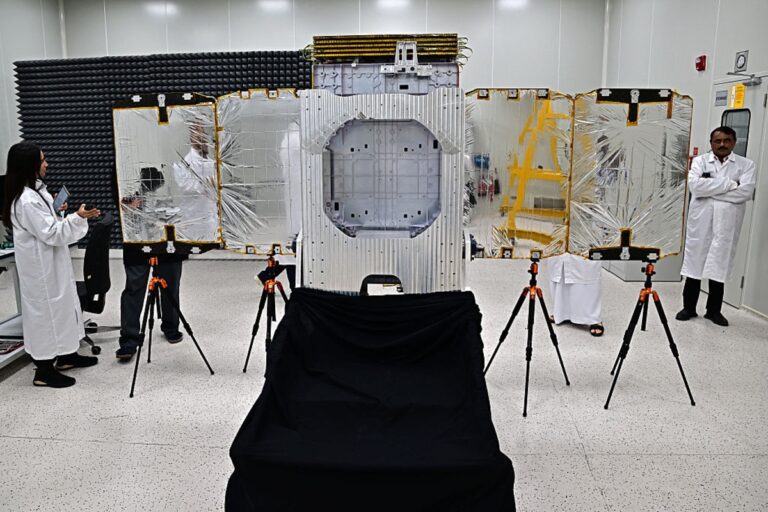
On October 1, 2026, a satellite designed, assembled, tested, and shipped from Abu Dhabi arrived in orbit — and the UAE’s answer to the question of what to do with it was not “sell the pictures.” It was “sell the conclusions.” Altair-1, built by startup Orbitworks in a Khalifa Economic Zones factory, lifted off aboard SpaceX’s Transporter-18 rideshare mission from Vandenberg Space Force Base, California, and has begun its commissioning phase in sun-synchronous orbit. It is the first of ten planned spacecraft in the Altair constellation, and before a single image was downlinked, France’s national space agency had already reserved capacity across all ten satellites.
Orbitworks is a 2024 joint venture between Marlan Space — an Abu Dhabi investor and subsidiary of the International Holding Company (IHC) — and California-based Loft Orbital. The company operates a 50,000-square-foot manufacturing hub inside KEZAD — the Khalifa Economic Zones Abu Dhabi — housing a 15,000-square-foot ISO-class cleanroom, electromagnetic interference chambers, thermal vacuum systems, and vibration test tables. That facility opened November 11, 2025, as the first commercial-scale satellite production site in the Middle East, and at full capacity Orbitworks says it can produce up to fifty satellites per year.
The distinction from what came before is deliberate. The UAE’s prior space pride — the Hope Mars Probe — was assembled in the United States at the University of Colorado. Even Khalifasat, the first satellite built by UAE engineers, was completed and shipped from South Korea. Altair-1 never left the Gulf until it was ready to fly. Emirates SkyCargo transported it from Dubai World Central to Los Angeles aboard a Boeing 777 freighter in August 2026, but by that point the spacecraft was finished — not a kit to be completed elsewhere.
“Two years ago, Orbitworks was an idea,” said Dr. Hamdullah Mohib, CEO of both Orbitworks and Marlan Space. “Today, a satellite built in Abu Dhabi is in orbit. The UAE is no longer only a buyer of space capability; it is a builder of it.”
What makes the Altair architecture commercially distinct is not the hardware list — it is where the computing happens. Traditional Earth observation satellites collect imagery and radio frequency data, downlink it to ground stations, and let analysts process it into usable intelligence over hours or days. Altair is designed to skip that bottleneck.
Each spacecraft carries five integrated sensor types: optical (sub-meter resolution), shortwave infrared (SWIR), thermal, hyperspectral, and radio frequency. NVIDIA GPUs aboard each satellite are designed to run inference workloads directly in orbit, producing analysis-ready outputs rather than raw sensor data. That shift — from downlinking images to downlinking conclusions — is what Orbitworks’ VP of Business Development, Salim Al Alawi, called a “cloud model for space”: customers access intelligence on demand, without owning the infrastructure that produced it.
This approach is not speculative. Loft Orbital, which co-integrates Altair’s spacecraft and handles constellation operations, demonstrated its viability in April 2026, when a NASA Jet Propulsion Laboratory software package called NAVI-Orbital ran Google’s Gemma 3 vision-language model on Loft’s YAM-9 satellite — the first reported in-orbit demonstration of a vision-language model operating autonomously on its own sensor data. YAM-9’s onboard compute — an NVIDIA Jetson Orin AGX GPU — received natural-language queries from JPL researchers and correctly identified areas of interest in imagery without human analysts in the loop. Altair extends that precedent to a commercial product.
NVIDIA’s space computing platform supports this shift. Its Jetson and IGX Thor systems deliver energy-efficient inference onboard spacecraft, while the newer Space-1 Vera Rubin module delivers 25 times more compute per GPU for orbital workloads compared to the H100 — all within the tight power budgets of solar-powered satellites.
Once fully operational — the full ten-satellite Altair constellation is targeted for deployment by late 2027 — the system will revisit any point on Earth approximately every four hours. Target use cases span disaster response, maritime domain awareness, wildfire detection, food security monitoring, infrastructure surveillance, and national security.
The commercial signal embedded in this launch is not that a Gulf state built a satellite. It is that France bought one — before the satellite had even completed commissioning.
France’s CNES space agency secured dedicated capacity across the full ten-satellite Altair constellation through a multi-year arrangement with Loft Orbital, Orbitworks’ mission operations partner. Additional anchor customers include the Abu Dhabi Maritime Academy and the Abu Dhabi Fund for Development. Orbitworks has disclosed ongoing discussions with prospective customers in North America, Africa, and Asia.
The CNES deal carries weight beyond its contract value. France has one of Europe’s most established space programs, and a European government agency reserving multi-year capacity from a constellation produced in the Middle East is structurally different from the UAE buying European satellite capacity — which is what has historically characterized Gulf space procurement.
Pierre-Damien Vaujour, CEO of Loft Orbital, described the UAE’s position in pointed terms: “The UAE space ecosystem has been growing steadily on solid foundations for decades, and it is now ready for liftoff.” He added that Altair shows “what the UAE has quietly built, and that it is ready to lead globally in AI-powered satellite constellation production and operations.”
On September 9, 2026 — three weeks before Altair-1 lifted off — Marlan Space and Loft Orbital announced a $1 billion program at France’s International Space Summit in Paris, attended by President Emmanuel Macron, to scale the constellation from ten satellites to fifty.
That program — Altair-Next Gen — brings together Mistral AI (French) for onboard language models capable of natural-language satellite tasking, and BlackSky (US) as the exclusive provider of very high-resolution electro-optical satellites. MaiaSpace, the Ariane Group launch subsidiary, has been selected as the preferred launch provider for the expanded constellation. The first satellites of the expanded program are expected to be built at the KEZAD factory.
The announcement followed IHC’s agreement to acquire an 80% stake in Marlan Space, announced September 8, 2026 — a move that brings IHC’s direct ownership into the manufacturing venture it had previously affiliated with.
The Orbitworks program connects to three distinct strands of UAE economic policy. The first is the National Space Strategy 2031, which targets UAE membership among the world’s ten largest space economies by that year, with a goal of doubling space economy revenues. The UAE has invested over $5.5 billion in its space program since 2014, with more than 170 entities now active across the sector and 30 satellites developed to date.
The second is Operation 300bn, the UAE industrial strategy targeting an increase in the manufacturing sector’s GDP contribution from AED 133 billion (approximately $36.2 billion) to AED 300 billion (approximately $81.7 billion — exchange rate as of October 2, 2026; conversions are approximate) by 2031. A satellite factory capable of fifty spacecraft per year sits squarely inside that framework.
The third is the Make it in the Emirates initiative, the campaign under which Orbitworks officially unveiled the Altair constellation and which provides the branding umbrella for UAE-manufactured exports.
H.E. Dr. Ahmad Belhoul Al Falasi, Minister of Sports and Chairman of the UAE Space Agency, noted that the launch “reflects the strength of the UAE’s national space ecosystem and its growing capacity to develop and manufacture advanced space technologies,” adding that Altair-1 demonstrates “how capabilities developed in the UAE can deliver solutions with commercial value beyond our borders.”
The name Altair derives from the Arabic al-ṭā’ir (الطائر), meaning “the flying one,” and references the star Altair, historically used by navigators for celestial reckoning. Orbitworks also points to a different Altair: the 1975 Altair 8800 personal computer, for which a young Microsoft wrote its first BASIC interpreter — a machine whose modest origins seeded an entire software industry. Whether the Altair constellation becomes a similar platform moment for Gulf space manufacturing will be determined by the nine satellites still being built in Abu Dhabi. One is in orbit. Nine more are on the factory floor.
Altair is a commercially operated ten-satellite Earth observation constellation built by Orbitworks in Abu Dhabi. What distinguishes it from conventional observation systems — which downlink raw imagery for ground-based processing — is onboard AI inference: NVIDIA GPUs aboard each satellite process collected data in orbit, delivering analysis-ready intelligence in minutes rather than hours. The five-sensor payload (optical, shortwave infrared, thermal, hyperspectral, and radio frequency) on each satellite is designed to address use cases from wildfire detection and maritime surveillance to agricultural monitoring and national security. Customers can either own individual satellites outright or access the constellation as a managed service, receiving intelligence rather than images.
Satellites carrying onboard AI use edge computing chips — typically GPU accelerators from companies like NVIDIA — to run inference workloads directly aboard the spacecraft. Rather than transmitting raw sensor data to a ground station and waiting for analysts to process it, the satellite runs an AI model in orbit that classifies or interprets what its sensors are seeing. Loft Orbital, Orbitworks’ co-founder and mission operations partner, demonstrated the concept in April 2026 when NASA’s Jet Propulsion Laboratory ran Google’s Gemma 3 vision-language model aboard a Loft satellite, successfully identifying areas of interest in imagery using natural-language queries — the first confirmed in-orbit deployment of a vision-language model. Altair builds on that architecture at commercial scale.
Altair-1 was built by Orbitworks, a joint venture between Marlan Space (an Abu Dhabi investor and subsidiary of IHC) and California-based Loft Orbital. The satellite was designed, assembled, integrated, and tested at Orbitworks’ 50,000-square-foot KEZAD manufacturing facility in Abu Dhabi — the first commercial-scale satellite production site in the Middle East, inaugurated November 11, 2025. It was airlifted to Los Angeles in August 2026 by Emirates SkyCargo and launched October 1, 2026, aboard SpaceX’s Transporter-18 rideshare mission.
The Altair-1 launch establishes that commercial satellite manufacturing — including AI-enabled Earth observation constellations — is no longer exclusively the domain of established Western and Asian space powers. The UAE completed a full design-to-orbit cycle domestically within approximately two years of Orbitworks’ founding, secured a European government anchor customer (France’s CNES) before its first satellite launched, and announced a $1 billion follow-on program backed by French AI company Mistral and US space-intelligence firm BlackSky. That combination — sovereign manufacturing, a commercial AI architecture, and international customer diversification — represents a structural shift in where satellite capability can be produced, not simply a national prestige milestone.