HomeAuto Germany Challenges ATR’s Turboprop Monopoly: D328eco Assembly Line Launches
Germany Challenges ATR’s Turboprop Monopoly: D328eco Assembly Line Launches
October 3, 2026:
Deutscheaircraft.com
Germany has formally reopened its doors to original regional aircraft production for the first time in more than two decades — and the aircraft industry now has its first credible Western challenger to ATR’s de facto monopoly on new turboprop deliveries above 40 seats.
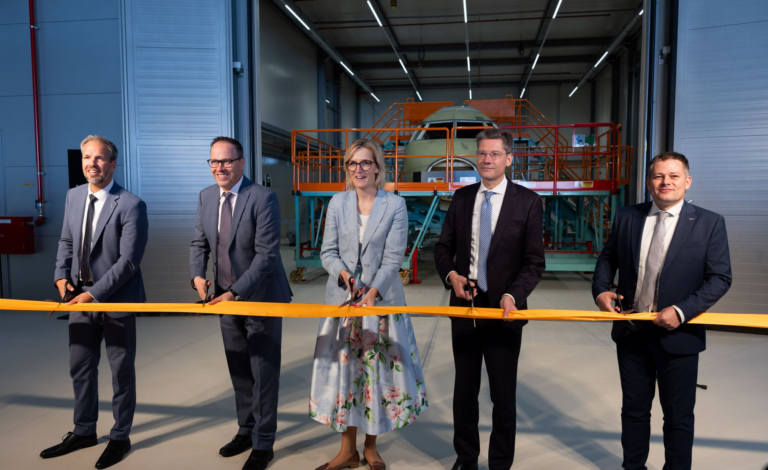
On September 29, Deutsche Aircraft inaugurated its Final Assembly Line (FAL) at Leipzig/Halle Airport in Saxony, marking the moment that a €100 million (approximately $112 million USD) investment in factory infrastructure, flight testing, and supply-chain development translated into a production-ready facility on German soil. It is the first CS25-certified regional aircraft assembly line to open in Germany since Fairchild Dornier ceased production of the original Dornier 328 turboprop in 2002 — a gap of 24 years.
The significance runs beyond a single factory opening. When De Havilland Canada halted production of the Dash 8-400 in 2022, ATR became the only Western manufacturer capable of delivering new turboprops in the 40-plus-seat class. The D328eco, Deutsche Aircraft’s 40-seat turboprop built on the DNA of the Dornier 328, is the first aircraft with a credible path to commercial service that changes that calculation.
A Turboprop Reborn With New Technology
The D328eco is not a clean-sheet aircraft. Its airframe descends from the original Dornier 328, which first flew in 1991 and became a workhorse of short-haul European and North American regional aviation before production ended following Fairchild Dornier’s 2002 insolvency. 328 Support Services GmbH, the type-certificate holder, was acquired by Sierra Nevada Corporation (SNC) in February 2015. In 2019, SNC formed Deutsche Aircraft — initially called Deutsche Regional Aircraft GmbH — specifically to develop an updated variant for commercial production.
What emerged is a recognizable platform with a substantially upgraded interior. The fuselage has been stretched by approximately 2 meters (6.6 ft) compared to the original 328-100 to accommodate 40 passengers in a 2+1, three-abreast cabin layout. That configuration gives the D328eco a meaningful comfort edge over ATR’s 2+2 four-abreast seating on comparable routes.
Under the engine cowlings sit a pair of Pratt & Whitney Canada PW127XT-S turboprops — a customized variant of the PW127 family, which has accumulated more than 208 million flying hours across all variants. The “XT” designation stands for eXTended life: the engine incorporates a redesigned compressor and combustor that delivers a 3% improvement in fuel burn per flight cycle compared to the PW127E/M engines it succeeds. Critically, the PW127XT-S is engineered for full compatibility with 100% Sustainable Aviation Fuel (SAF), including Power-to-Liquid synthetic fuel derived from atmospheric CO2 and renewable electricity — a compliance pathway that matters increasingly as EU SAF-blending mandates tighten.
The cockpit has been fully overhauled. Deutsche Aircraft has selected Garmin’s G5000 Prime, announced in June 2025 as the company’s most advanced integrated flight deck for Part 25 transport-category aircraft, making the D328eco its first application in this category. The G5000 Prime features multi-core processors, gigabit system connectivity, touchscreen Primary Display Units that are edge-to-edge and sunlight-readable, and Secondary Display Units with 40% more screen area than prior-generation Garmin touch controllers. Integrated autothrottles, an emergency descent mode, and an emergency return capability are standard. Both pilots can interact with the flight deck simultaneously — the system accepts up to 10 simultaneous touchscreen inputs.
What the Leipzig Factory Actually Does
The FAL sits on a 60,500-square-meter (651,000 sq ft / about 15 acres) site at Leipzig/Halle Airport, roughly the footprint of eight football fields. At full output, it is designed to produce up to 48 D328eco aircraft per year. Between 250 and 350 permanent, skilled manufacturing jobs are expected to materialize as the program scales from development into serial production.
Construction proceeded through a groundbreaking ceremony in May 2023, a cornerstone ceremony in April 2025, and a Richtfest (topping-out ceremony) in November 2025. Deutsche Aircraft partnered with Weerts Group, an industrial construction specialist, to develop the site; Deutsche Aircraft holds full financial responsibility for it.
The facility has been designed from the ground up around Industry 4.0 principles: augmented-reality assembly guidance for technicians, battery-powered tooling throughout, automated and driverless logistics systems, paperless production processes, and a target of carbon-neutral operations. Unusually for an OEM facility, customers will be able to observe their individual aircraft being assembled in real time — a level of production transparency that serves both as marketing and as an early-warning mechanism for delivery disputes.
While Leipzig handles final assembly, flight testing, and customer deliveries, Deutsche Aircraft’s existing headquarters at the Air Tech Campus in Oberpfaffenhofen, Bavaria, remains home to engineering and EASA certification activities. The TAC 1 test aircraft — Deutsche Aircraft’s first D328eco prototype — rolled out at Oberpfaffenhofen in May 2025; a legacy D328 airframe has been flying as a dedicated landing gear testbed since August 5, 2026, while TAC 1 itself continues ground preparations ahead of its own maiden flight.
What Comes Before Any Passenger Boards
Between the Leipzig FAL inauguration and a passenger stepping onto a D328eco, Deutsche Aircraft still has to thread the certification needle.
The company targets type certification under both EASA CS25 and FAA Part 25 rules before the end of 2027, with entry into service in Q4 2027. That dual-certification path is non-negotiable commercially: without FAA Part 25 approval, no US carrier — including charter operators and regional airlines in Canada or India that use American operating frameworks — can put the aircraft in revenue service.
The certification campaign is well underway. On September 8, Deutsche Aircraft confirmed a key milestone in its landing gear program: the landing gear flight tests passed, including Low-Speed Taxi (LST), High-Speed Taxi (HST), and the initial phase of flight testing using a legacy D328 airframe as a dedicated flying testbed. As of the announcement, the test aircraft had accumulated more than 15 hours of ground and flight testing with the new landing gear system. Deutsche Aircraft also changed landing gear suppliers during development and acquired full intellectual property rights for the new system — a move that improves parts availability and supply-chain resilience but added complexity to the test campaign.
What makes the timeline tight is not the certification ambition itself but its compression. If entry into service is truly Q4 2027, that leaves fewer than 15 months from when the landing gear flight testing began in August 2026 to full dual-certification — a schedule that would require an unusually smooth test campaign for a new aircraft type. Deutsche Aircraft has already revised its target once, from an original 2025 entry-into-service goal to the current 2027 target, attributing the slip to stricter regulatory requirements and a program review.
What Is Different About the D328eco vs. the ATR 42
The D328eco enters a market where ATR — the Franco-Italian joint venture between Airbus and Leonardo — has been the sole source of new Western-built turboprops in the 40-plus-seat class since 2022. ATR entered 2026 with a backlog of more than 160 aircraft and recorded 60 gross orders during 2025 alone, including a landmark 40-aircraft firm order from India’s FLY91 for the ATR 72-600 placed in September 2026. ATR’s leadership has described new market entrants as operating in a “niche” of its broader range.
The technical distinctions between the two aircraft are real. The PW127XT-S engines on the D328eco deliver 3% better fuel burn than the PW127E/M models in older ATR aircraft; ATR’s own PW127XT-equipped current-production aircraft also achieve this improvement. The D328eco’s 3-abreast cabin gives passengers a seat width similar to narrow-body jets. And the G5000 Prime avionics represent a leap beyond any cockpit currently offered on ATR production aircraft.
What the D328eco does not yet have is a substantial commercial order book. Deutsche Aircraft has disclosed Letters of Intent from Private Wings, a German charter operator, for five aircraft, along with additional undisclosed LOIs. Letters of intent are not firm orders. Markets that Deutsche Aircraft has identified as primary targets — Canada, India, and operators seeking to replace aging Saab 340s and early Dash 8-100s — represent genuine demand, but converting market interest into binding commitments requires an operating aircraft, not a factory.
How the D328eco Gets Built
The supply chain is largely secured. Deutsche Aircraft says more than 95% of supplier contracts are in place. Pratt & Whitney Canada delivers the PW127XT-S engines; Garmin supplies the G5000 Prime avionics; Spanish aerospace manufacturer Aernnova produces the composite empennage, horizontal and vertical stabilizers, and metallic tail cone; Dynamatic Technologies in Bangalore manufactures the rear fuselage; HEGGEMANN AG provides the new landing gear system. Flight data recorders are supplied by Acron Aviation, which signed a long-term supply agreement with Deutsche Aircraft in July 2026.
The aircraft’s multi-role variants — the D328 MR (Multi-Role) platform targeting special missions, medevac, and military applications — provide Deutsche Aircraft with a sales channel separate from the commercial airline market. The US Air Force is among the world’s largest operators of legacy Dornier 328 aircraft, suggesting a potential upgrade path that would diversify Deutsche Aircraft’s customer base beyond commercial operators.
What the Saxony Milestone Means Beyond Airplanes
For Germany, the Leipzig FAL is something more than a production facility. It is the first time in more than two decades that an aircraft carrying a CS25 type certificate has been assembled on German soil — and the first time in more than 60 years that a final assembly line for aircraft has been built in the eastern German states, specifically in Saxony.
The Saxon state government contributed approximately €3.2 million (approximately $3.6 million USD) to the project through the Federal-State GRW program; the Free State of Saxony cited the facility as a complement to existing aerospace research institutions and supplier companies in the region. Federal government support came in the form of backing through Germany’s national aerospace policy, with the German government’s aerospace coordinator having described Deutsche Aircraft as “a strategic partner for the sustainable development of the aviation industry.”
The question that the next 15 months will answer is whether the program that opened its factory doors last week can also deliver an aircraft that passes regulators’ scrutiny — and whether the airlines that have expressed interest in the D328eco are willing to convert that interest into purchase agreements once a certified aircraft exists to buy.
Currency conversions in this article are based on exchange rates at the time of publication and are approximate.
Frequently Asked Questions
What makes the D328eco different from its predecessor, the Dornier 328?
The D328eco is a modernized evolution, not a replacement. The fuselage is stretched by about 2 meters (6.6 ft) to seat 40 passengers rather than the original 32-33. The engines are new Pratt & Whitney Canada PW127XT-S turboprops that deliver 3% better fuel burn than earlier variants and are designed for 100% SAF compatibility. The cockpit is entirely new, built around Garmin’s G5000 Prime avionics suite — the first installation of this system in a transport-category aircraft — replacing the older glass cockpit of the original 328. The fuselage and wing structure retain the certified aerodynamic baseline, which speeds development compared to a clean-sheet design.
Why does Germany need its own regional aircraft manufacturer?
Germany does not strictly need one, but the reopening of a national production line has strategic and economic dimensions. Regional turboprops serve thin routes that larger jets cannot operate economically — connecting secondary cities and remote communities to hub airports. Germany’s aerospace industry had been entirely dependent on Airbus for original civil aircraft production, with no domestically assembled airliner since the Dornier 328 line closed. Beyond national prestige, the facility creates 250 to 350 skilled engineering and manufacturing jobs in Saxony, a region that historically has had fewer high-technology industrial anchors than western Germany. The German government has backed the project through both direct funding and policy statements.
What is the D328eco’s biggest competitive challenge before it enters service?
Certification speed. Deutsche Aircraft is targeting both EASA CS25 and FAA Part 25 type certification by late 2027, with first deliveries in Q4 2027. That leaves fewer than 15 months of flying tests — for both the primary test aircraft and the ongoing landing gear campaign — before the company needs a certified aircraft to hand to customers. The company has already moved its target date once, from 2025 to 2027. If the 2027 certification campaign encounters unexpected test findings, which are common in new aircraft programs, the timeline could slip again. The compressed schedule, combined with a commercial order book that still consists largely of Letters of Intent rather than firm orders, means the transition from “factory open” to “aircraft in revenue service” is the critical risk phase of this program.
How does the D328eco fit into sustainable aviation trends?
The PW127XT-S engine is engineered for full compatibility with 100% Sustainable Aviation Fuel, including Power-to-Liquid SAF produced from CO2 and renewable electricity. This positions the D328eco ahead of EU mandates that require increasing SAF blending percentages in aviation fuel sold at European airports, starting at 2% in 2025 and rising over subsequent years. The Leipzig assembly line is itself designed to be carbon-neutral in operation, using battery-powered tooling, renewable energy sources, and paperless processes. Longer term, Deutsche Aircraft has indicated interest in a hydrogen-powered variant of the D328 platform. For now, the practical sustainability case rests on the turboprop’s inherent structural advantage: at routes below roughly 500 km (311 miles), turboprops burn significantly less fuel per passenger than regional jets covering the same distance.