


October 2, 2026:


Tennessee is reviewing its lethal injection process after a botched execution attempt left 50-year-old Christa Pike in critical condition.
Pike was receiving “lifesaving care” at a Nashville hospital on Thursday, having survived two shots of the lethal drug pentobarbital, her attorneys said in a press conference. It is the first time in the modern era of the U.S. death penalty that a person received lethal injection drugs and survived, according to the nonpartisan Death Penalty Information Center.
“This failed attempt is the worst we’ve ever seen and unlike any other botched execution in the modern era,” Robin Maher, the center’s director, said in a statement on Thursday.
Pike’s case has drawn scrutiny over the state’s decision to proceed with her execution, despite repeated warnings about its lethal injection protocol from her attorneys, who said she was subjected to “chemical torture.”
Gov. Bill Lee, a Republican, ordered an independent investigation of the lethal injection process late on Wednesday. Lee also suspended executions in the state till the end of the year, the second moratorium on executions during his time in office due to concerns over the state’s lethal injections.
“There is no one that wanted what happened last night to happen,” Lee told reporters on Thursday, describing the botched execution as a “tragedy.” But he stopped short of suggesting that he might heed renewed calls to commute Pike’s sentence to life in prison.
“The people of Tennessee have determined that the death penalty is the appropriate penalty for the most heinous crimes in the state,” Lee said. “The people of Tennessee make that decision, and my job is to make sure then that those sentences are carried out.”
Lee had denied Pike’s clemency request to commute her sentence to life in prison without the possibility of parole on Monday.
Pike, convicted of the 1995 murder of then-19-year-old Colleen Slemmer, has been on death row for more than 30 years. She would have been the first woman executed in Tennessee in more than 200 years. Only 18 women have been executed in the U.S. since 1976, according to the Death Penalty Information Center.
The Tennessee Department of Correction said in a statement to media outlets late Wednesday that it “had followed every step of the state’s lawful, established execution protocol approved by the attorney general’s office.” It described the lethal injection as “consistently effective.”
Lee defended the agency, saying it followed protocol.
TIME has reached out to the state’s Department of Correction and Pike’s attorneys for comment.
“There was no reason to expect it to not work,” Lee said. “But something didn’t go well or right last night, and we need to find out why.”
Randy Spivey, an attorney with the Tennessee Office of the Post-Conviction Defender, said Pike endured a “torturous” experience in the execution chamber. Pike’s left arm was pierced by at least seven needles, and her right arm turned purple, he said. She said her arm felt like it was “about to explode,” her attorneys said.
Pike’s attorneys suggested that the drugs may have entered her arm tissue instead of directly into her bloodstream. They described it as “chemical torture.”
Pike remained cooperative throughout the multiple execution attempts and tried to help her executioners, her attorneys said. “She over and over again said, ‘Please try up on my shoulder higher. Please try here. Please try here,’” Spivey said.
“We may never know what all she was suffering through, either because she can’t remember it, she can’t tell it, or it overwhelms her,” said Stephen Ferrell, from the Federal Defender Services of Eastern Tennessee. Pike’s greatest fear was not of dying but “of a prolonged, painful, traumatic death.”
“And that’s what happened,” Ferrell said. “Minus the death.”
Witnesses to the execution said late Wednesday that Pike could still be heard breathing and snoring an hour after her executioners administered two rounds of pentobarbital, including when the curtain closed and when witnesses were escorted out of the chamber.
Tennessee switched to a one-drug lethal injection of the barbiturate pentobarbital as its execution protocol in December 2024. Pike’s lawyers previously raised concerns about the source of the drugs, while Reuters reported on Thursday that that information had been withheld. E.U. law bars pharmaceutical companies from selling drugs for use in executions, leading some U.S. prison systems to procure the drugs from compounding pharmacies in processes often shielded by state secrecy laws.
In legal filings, Pike’s lawyers had raised concerns that Pike’s execution by lethal injection might be compromised by her small veins and medical history of thrombocytosis. But their petitions to the state to use alternative execution methods, like death by hanging, were denied.
Pike’s lawyers said in a statement that their concerns proved true: “difficult vein access, blown veins, degraded pentobarbital, no emergency medical care available when things inevitably go wrong, all under a protocol that remains veiled in secrecy.”
In a June court filing, Pike’s attorneys pointed to the state’s failed execution of Tony Carruthers in May, when medical staff failed to find a vein. Lee granted Carruthers a one-year reprieve.
The American Medical Association and American Nurses Association prohibit doctors and nurses from participating in executions under their professional ethics standards. Some states have used execution personnel without current medical licenses. Tennessee, however, requires the participation of physicians, or other medically trained personnel in an execution.
After the botched execution of Carruthers, more than 40 doctors and nurses penned a letter to Lee, calling on him to redesign the protocol to exclude health care workers, arguing that it is at odds with their commitment to preserve life.
Lee also paused executions and ordered an independent review in 2022 after it was discovered that prison officials failed to properly test lethal injection drugs for endotoxins in the lead-up to the planned execution of Oscar Franklin Smith. Smith was ultimately killed in May 2025, three years after Lee issued a temporary reprieve.
The review resulted in the one-drug protocol that was used on Wednesday. It also showed that officials had skipped proper endotoxin testing for multiple prior executions.
Pike’s attorneys have publicly called on the state’s governor to reconsider commuting Pike’s sentence to life in prison. Pike, who was sentenced in March 1996 at age 20, has expressed remorse for the torture and murder of her classmate. Her legal team had asked courts to review mitigating claims of sexual abuse and rape as a child, which they said Tennessee had disputed in earlier proceedings. They also separately argued that aspects of the execution process could trigger PTSD related to that abuse, constituting cruel and unusual punishment.
Hours before the scheduled execution on Wednesday, a federal appeals court issued an eleventh hour stay of execution to review the case. The state asked the Supreme Court to vacate the lower court’s ruling, which it did in a 6-3 decision, allowing Tennessee officials to proceed. The Supreme Court did not explain its decision.
In her dissent alongside liberal justices Elena Kagan and Ketanji Brown Jackson, Justice Sonia Sotomayor wrote, “I see no reason to short-circuit the ordinary process of appellate review, particularly in light of the grave consequences of an erroneous decision. Tennessee’s desire to expedite Pike’s execution by a few days or even weeks cannot outweigh her ‘fundamental interest in [her] own life.’”
Pike’s underlying case remains pending before the U.S. Court of Appeals for the Sixth Circuit.
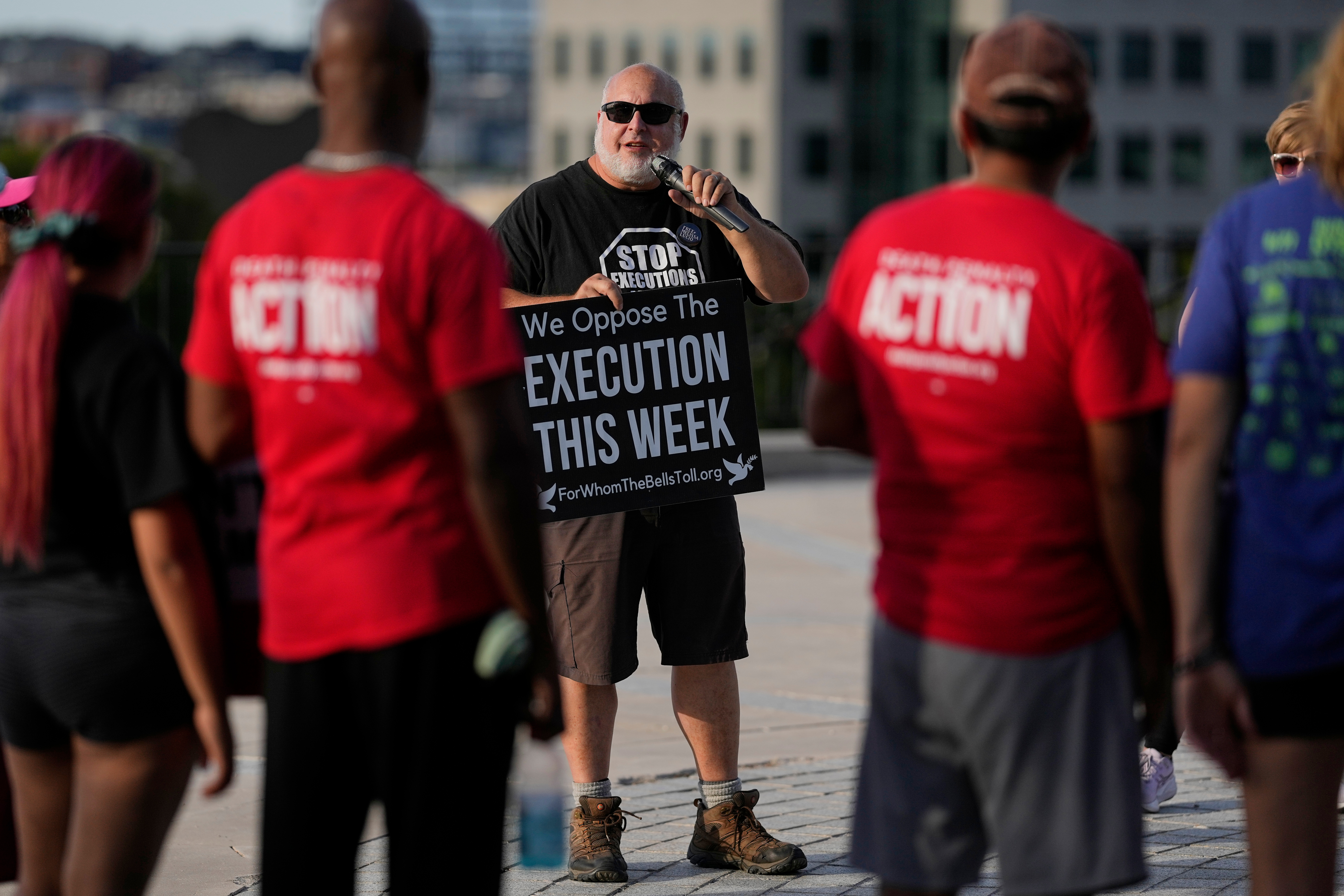
Pike’s case has also renewed calls to abolish the death penalty.
“I have always opposed the death penalty. It is irreversible and applied unequally, and it has never made Tennesseans safer,” said Democratic state senator Heidi Campbell in a social media post. “But you don’t have to share my view to be appalled. If the state claims the power to kill, it has a basic duty to be competent, transparent, and humane.”
Campbell described the incident as a “moral catastrophe” that cost the state $500,000.

Jerri Green, the Democratic nominee to replace Lee as governor when his term ends in January, said that, if elected, she would extend the moratorium on executions throughout her time in office.
U.N. human rights chief Volker Turk said on Thursday that “the case of Christa Pike lays bare multiple reasons why the death penalty should be abolished.” Calling for the state to stop any further attempt to execute Pike, he said, “the prolonged suffering—physical and mental—arising from multiple failed execution attempts is abhorrent and cruel.”
Tennessee is one of 27 states where the death penalty is legal, according to the Death Penalty Information Center, although governors in four states—California, Ohio, Oregon, and Pennsylvania—have halted all executions.
Others have instead said the failed execution demonstrates the need for a different, more effective execution protocol.
Sen. Marsha Blackburn (R, Tenn.), who is running for governor, called for the state to “bring back the electric chair.” Tennessee allows prisoners whose crimes occurred before 1999 to choose electrocution, although lethal injection is its primary execution method. Pike’s attorneys argued that opting for electrocution would go against her religious beliefs of not participating in her own death. They explained they had presented hanging as an alternative execution method in her challenge to lethal injection as legally required.
Cameron Sexton, Republican speaker of Tennessee’s House, said the General Assembly would investigate ways to ensure future executions do not fail, including expanding alternative methods and changing current medications to include potassium chloride.
“Justice wasn’t carried out last night due to an error,” Sexton said. “Thirty years is too long for justice.”
Slemmer’s mother, May Martinez, who had driven from Florida to Nashville to witness the execution, said Thursday that the execution process was an injustice to her family. “Here we are, 31 years, and you’re laughing in my face again,” she told First Coast News, expressing frustration that she and her husband were kept in the prison for hours and were not allowed to leave without an escort. The victim’s family had long supported Pike’s execution.

Martinez said the prison gave her few answers about what would happen after the execution attempt failed, and that she disagreed with the decision to take Pike to an off-site hospital. “Now I have to worry about her being out,’” Martinez said. “And then I brought up, ‘Is she going to come back to the prison?’ ‘I don’t know what we’re doing with her yet.’ That’s the answer I got.”
While Pike appears to be the first person in the U.S. to survive lethal injection drugs, she is not the only person to have experienced botched execution attempts, nor the first whose attorneys have argued that multiple attempts could violate the Constitution.
On May 3, 1946, Louisiana officials strapped Willie Francis, a 17-year-old Black teenager convicted of murder, into the portable electric chair nicknamed “Gruesome Gertie.” But Francis survived the first jolt when the electric chair malfunctioned. Francis’s lawyer challenged the state in an attempt to stop a second execution attempt, arguing that subjecting him to a second electrocution would amount to cruel and unusual punishment and violate the Eighth Amendment. His lawyer also argued that it would amount to double jeopardy—punishing him twice for the same offence, in violation of the Fifth Amendment.
The Supreme Court, however, ruled in a 5-4 decision that a state can attempt a second execution, finding that an unintentional equipment malfunction did not violate the Constitution.
The landmark ruling has been cited in subsequent cases, including State v. Broom (2016), when the Ohio Supreme Court permitted another execution attempt after officials failed to establish an IV line.
Still, Pike’s lawyers are urging the governor to spare her another execution attempt after what they said caused “unnecessary agony.”
“The state of Tennessee has shown us again that they are not capable of carrying out an execution consistent with basic human dignity,” Spivey said. “Last night was not just inefficient. It was cruel, and it was torturous.”