October 2, 2026:


Hyundai has officially pulled the cover off the next-generation Tucson, giving the public its first full look at a redesign the brand is calling its boldest SUV yet.
The reveal took place in New York City, set against the Manhattan skyline, and it lays out everything from a reworked exterior to a completely new hybrid system.
Hyundai President and CEO Jose Munoz framed the new Tucson as a turning point for the model, which remains the brand’s best-selling SUV worldwide. “Millions of families around the world count on the Hyundai Tucson, and this is the best one we have ever built,” Munoz said. “Its combination of bold design, generous cabin space, seamless infotainment, and available hybrid efficiency sets a new standard for what customers should expect in this segment.
Tucson opens the most ambitious product offensive in our history, including more than 100 new and refreshed vehicles globally by 2030, 58 in North America alone.”
The new Tucson is built around what Hyundai calls its Art of Steel design language, leaning into muscular fenders and a more commanding road presence. The body has grown in every direction compared to the outgoing model, measuring 185 inches long, 75 inches wide, and 66.3 inches tall in its US spec long wheelbase form. That puts it slightly longer and wider than the Honda CR-V, currently the top-selling model in the segment.
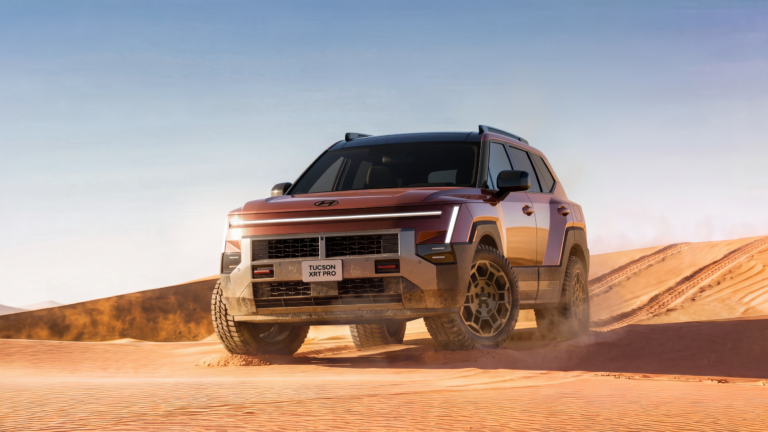
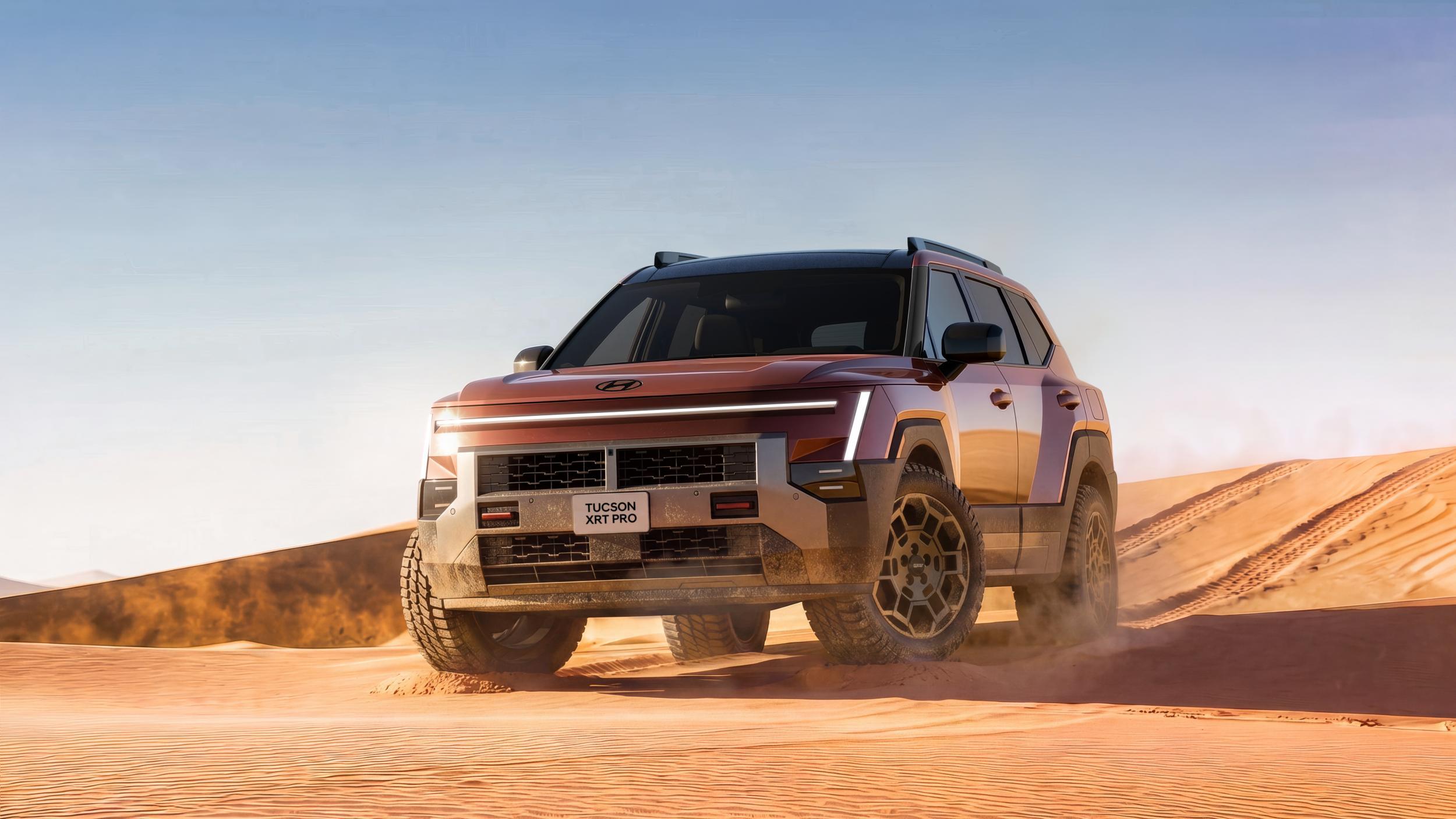
A rugged XRT trim adds exclusive cladding and skid plate styling, while the XRT PRO variant pushes further with All Wheel Drive, all-terrain tires, and raised ground clearance built for off-road use. Hyundai confirmed a new sport-oriented variant of the Tucson will debut separately at the Paris Motor Show on October 12.
Under the hood, Hyundai is offering buyers more choice than before. The base gasoline option is expected to be a 1.6-liter turbocharged four-cylinder producing 184 horsepower, paired with an eight-speed automatic transmission, a notable step up from the outgoing naturally aspirated engine.
The standard hybrid produces a combined 233 horsepower, reaches 60 miles per hour in 8.5 seconds, and targets up to 42 miles per gallon. Towing capacity on the hybrid also climbs to 3,000 pounds, a 1,000-pound jump over the previous generation. A plug-in hybrid variant sits above both, producing 292 horsepower combined, hitting 60 miles per hour in 7.9 seconds, and offering roughly 50 miles of all-electric range through a 7.2-kilowatt onboard charger.
Inside, the cabin centers on Hyundai’s new Pleos Connect infotainment system, running on Android Automotive OS. Drivers get a 9.9-inch display paired with either a 12.9-inch or 17-inch center touchscreen, backed by Gleo AI, an assistant built to handle natural conversation requests like finding a nearby trail with parking. Hyundai kept physical buttons for climate and volume controls rather than moving everything to the touchscreen, and the steering wheel uses real buttons instead of touch-sensitive panels. Cargo space grows to 41.7 cubic feet, ahead of the CR-V’s 39.3 cubic feet, while rear legroom reaches 41.9 inches.
The compact crossover segment has gotten more competitive over the past year, with updated models from Toyota and Mazda putting pressure on the Tucson’s position. Autoblog noted that the Mazda CX-5 has long carried a reputation as the most premium-feeling vehicle in the class, but that its latest generation has slipped in quality, leaving an opening, as per Autoblog.
With its redesigned cabin, added power across every engine option, and a more complete tech package, the new Tucson appears positioned to take that premium reputation for itself, assuming its driving dynamics hold up against the rest of the redesign.
Pricing has not been confirmed, though the outgoing Tucson starts at $29,700, suggesting the new model will likely land somewhere above $30,000 once US pricing is announced.
The 2027 Tucson is available in three separate powertrain configurations. Buyers can choose a standard gasoline ICE engine, a hybrid HEV model, or a plug in hybrid PHEV variant, with the PHEV currently limited to select markets outside North America. This mirrors the approach of the outgoing Tucson, which also offered gas and hybrid options, though the new lineup brings more power and improved fuel economy across the board.
The new Tucson launches first in Korea later this year. North America, Europe, and other global markets will follow afterward, with Hyundai confirming a 2027 arrival for those regions. An exact on sale date for the US market has not yet been announced.
Hyundai has not released official pricing for the 2027 Tucson. For reference, the outgoing 2026 model starts at $29,700 in the US. Given the added technology, larger dimensions, and updated powertrains, industry observers expect the new generation to start somewhat above that figure once pricing is confirmed closer to launch.
Yes. The Tucson has long been one of Hyundai’s best selling models in the United States, with more than 160,000 units sold in the US so far this year alone despite nearing the end of its current generation. The redesigned 2027 Tucson is confirmed for North America, arriving as the long wheelbase version exclusively, which is the larger of the two body configurations Hyundai is offering globally.