HomeAuto Pentagon’s $20.7B AMRAAM Deal Is Also History’s Largest NASAMS City-Defense Resupply
Pentagon’s $20.7B AMRAAM Deal Is Also History’s Largest NASAMS City-Defense Resupply
September 30, 2026:
GEOFFROY VAN DER HASSELT/AFP via Getty Images
The Pentagon awarded Raytheon a $20.7 billion contract last Thursday for the AIM-120 Advanced Medium-Range Air-to-Air Missile — a five-year deal that is not only the largest single AMRAAM procurement in the weapon’s four-decade history but also the largest simultaneous resupply of two fundamentally different weapons categories: a beyond-visual-range fighter missile and the primary interceptor for NASAMS, the ground-based air defense system that defends Washington, D.C., and Ukrainian cities from cruise missiles and drones. The contract was awarded and announced September 2026 — formally on September 25 and publicly a day later alongside RTX.
The same AIM-120 missile that NATO pilots launch from F-16s and F-22s with the brevity code “Fox Three” is the baseline interceptor in NASAMS batteries from Washington to Kyiv. When Raytheon delivers missiles against this contract, it is simultaneously resupplying allied fighter fleets and allied city-defense networks — without building or buying anything twice. That architectural fact, embedded in the AMRAAM’s original 1991 design, is the strategic reason a single contract at a single Tucson factory has become the focal point of Western air power’s response to a two-front munitions crisis.
The contract carries a ceiling value of $20.7 billion — nearly six times the prior record AMRAAM award, a $3.5 billion contract issued in July 2025. The deal covers production of AMRAAM All Up Rounds, Guidance Sections, Direct Charge, and Foreign Military Sales offsets for the U.S. Air Force, the U.S. Navy, and 16 international partner nations. Its base term runs five years, with two additional option years extending potential coverage to 2033.
What Pentagon Got for Its Largest-Ever Missile Buy
The $20.7 billion is a maximum ceiling, not funds already disbursed. At award, roughly $154.3 million in foreign military sales funding and approximately $85,715 in Fiscal Year 2026 Air Force weapons procurement funds were obligated. The remainder will flow in tranches through annual appropriations.
Michael P. Duffey, the Pentagon’s Under Secretary for Acquisition and Sustainment — the department’s top weapons buyer, confirmed by the Senate 51-46 in June 2025 — framed the award in direct terms: it “strengthens our ability to equip the Joint Force and our allies with a proven air-to-air capability, ensuring our warfighters maintain a decisive advantage.”
How the AMRAAM’s “Fire and Forget” Architecture Works
The AIM-120 uses a three-phase guidance system that distinguished it from its predecessor, the AIM-7 Sparrow, when it entered service in September 1991. Where the Sparrow required the launching aircraft to maintain a continuous radar lock on the target — forcing the pilot to fly toward the threat while the missile was in flight — the AMRAAM uses an active transmit-receive radar in its seeker head. The missile illuminates the target itself.
This “fire and forget” capability operates in three stages. Before launch, the aircraft’s fire control system programs the missile’s inertial navigation unit with the target’s location, speed, and heading. Midcourse, if the launching aircraft or a partner system (an AWACS, another fighter, or a ground radar) continues tracking the target, it sends periodic updates to the missile via a two-way datalink. When the AMRAAM closes to within terminal homing range, its active radar seeker takes over completely.
The result is that a single aircraft can engage multiple targets simultaneously and maneuver defensively while missiles guide themselves to intercept. The AIM-120D-3, the variant being produced under the current contract, adds GPS-aided inertial navigation and an improved two-way datalink that allows third-party targeting at long ranges — meaning an F-35 that cannot see a threat with its own radar can still engage it using target data from an AWACS or a partner aircraft.
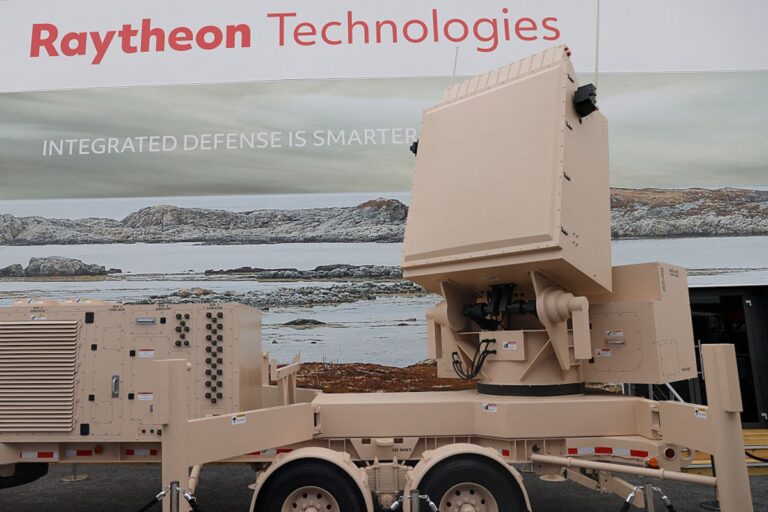
The same active radar seeker that makes AMRAAM effective from aircraft makes it equally effective from the ground. NASAMS — the National Advanced Surface-to-Air Missile System, jointly developed by Kongsberg of Norway and Raytheon — was the world’s first surface-based application of the AIM-120, and remains the only Western short-to-medium-range air defense system built around an active-homing missile. A standard NASAMS unit fires the same AIM-120 against drones, cruise missiles, helicopters, and fixed-wing aircraft, achieving intercept ranges of approximately 25 miles (40 km) in NASAMS 2 configuration and up to 37 miles (60 km) with the AMRAAM-ER (Extended Range) variant in NASAMS 3 configuration.
Why Iran and Ukraine Broke the Original Production Plan
The scale of this contract reflects a dramatic reversal of the Pentagon’s prior planning. As recently as 2019, Air Force weapons program head Brig. Gen. Anthony Genatempo told reporters that AMRAAM production would “tail off” in FY2026 as the AIM-260 JATM replacement — AMRAAM’s longer-range successor being developed by Lockheed Martin — ramped up.
That plan collapsed under the weight of two simultaneous high-intensity conflicts. The Center for Strategic and International Studies found that the 39-day U.S. bombing and air defense campaign against Iran, which began in late February 2026, depleted key U.S. munitions stockpiles faster than more than three years of arming Ukraine had on its own. Approximately 200 THAAD interceptors were fired during that 39-day campaign — more than were expended in all of 2025. CSIS researchers Mark Cancian and Chris Park estimated it will take one to four years to rebuild what the Iran campaign burned through, and several years more to expand inventories to the levels a potential Pacific conflict would require.
Raytheon had already been accelerating. The company stated it nearly doubled AMRAAM production in 2025 compared to 2024, crediting in part a $972 million contract awarded in 2022 to modernize the missile through the Form, Fit, Function Refresh (F3R) program. In February 2026, RTX signed five framework agreements with the Pentagon formally committing to a production rate of at least 1,900 AMRAAMs per year, alongside comparable ramp targets for the Tomahawk cruise missile (more than 1,000 per year) and Standard Missile-6 (more than 500 per year). RTX CEO Chris Calio said the agreements “redefine government-industry partnering to speed the delivery of critical technologies.”
Twelve days before this contract was announced, Lockheed Martin signed a separate framework agreement with the Pentagon on September 17, 2026, to accelerate AIM-260 JATM production. The two programs are now ramping simultaneously — a hedge against the supply chain pressures that neither missile program alone could resolve.
Arsenal of Freedom: Buying Missiles the Way the Pentagon Used to Buy Ships
The AMRAAM award flows from the Pentagon’s “Arsenal of Freedom” initiative, the Trump administration’s campaign to rebuild domestic munitions production capacity through long-term multiyear contracts (MYPs). MYPs give manufacturers the financial certainty to invest in factories, tooling, and supplier networks — commitments they would not responsibly make on the strength of year-by-year congressional appropriations alone.
Congress codified multiyear procurement authority for major weapons systems in 1981, but its systematic application to high-volume munitions like AMRAAM is more recent. The FY26 defense bill explicitly approved eight munitions for MYP authority, including AMRAAM, Tomahawk, PAC-3, SM-6, THAAD, LRASM, JASSM-ER, and SM-3 IB. That authorization created the legal framework this contract executes.
Raytheon President Phil Jasper described the company’s commitment: “We continue to make significant investments in our workforce, technology, supply chain and facilities to rapidly scale production capacity and meet surging demand.” At a target of 1,900 AMRAAMs per year, that investment ripples through hundreds of small and mid-sized American suppliers providing guidance electronics, propulsion components, active radar seekers, fusing systems, and airframe materials. Without multi-year demand certainty, those subcontractors would not build out capacity against demand that could disappear in a single budget cycle.
The contract structure is a fixed-price incentive, firm-fixed-price undefinitized contract action — a mechanism that allows production to begin before final pricing is locked in, accepting some financial flexibility in exchange for getting missiles into production faster.
NASAMS: From Norway to D.C. to Kyiv
What makes the AMRAAM’s dual-role architecture particularly significant is the geography of NASAMS deployment. The system — developed jointly by Kongsberg of Norway and Raytheon — is the only air defense network permanently protecting Washington, D.C. It is also deployed across Ukraine, where NASAMS batteries have been the primary means of intercepting Russian cruise missiles and drones targeting population centers. Ukraine’s F-16 fleet simultaneously fires AMRAAM in air-to-air engagements.
When Belgium announced in May 2026 that it was requesting approval to purchase more than €3.13 billion (approximately $3.6 billion) in U.S. missiles — including AMRAAMs for its F-35 fleet and NASAMS systems for ground-based air defense — it was explicitly buying one weapon that would serve both roles. Negotiations are underway with more than 30 Belgian companies to establish a component supply chain, part of Raytheon’s broader push to diversify production beyond its Tucson factory.
In July 2026, at the NATO Summit in Ankara, Turkey, Raytheon and the Pentagon announced a series of feasibility studies to qualify additional European suppliers for priority AMRAAM components, funded by participating NATO allies. Sam Deneke, president of Air & Space Defense Systems at Raytheon, described the initiative as proof that “industry and governments can work together to strengthen the transatlantic defense industrial base.” The Netherlands is separately pursuing its own co-production arrangement, and additional nations are expected to join the multinational effort.
Raytheon has also indicated it is exploring moving its AIM-120C-8 production line to Europe entirely, which would free its Tucson facility to focus exclusively on the newer AIM-120D-3 variant.
Sole Source and Scale: What Past Raytheon Contracts Reveal
One structural feature of the contract demands scrutiny: it was a sole-source acquisition — no competing bids were received, reflecting both the proprietary nature of the AMRAAM program and the absence of any alternative supplier capable of fulfilling the requirement.
In 2024, Raytheon agreed to pay over $950 million to resolve Department of Justice investigations — including a $428 million civil settlement over allegations of submitting inflated cost data on sole-source government contracts and double-billing on a weapons maintenance contract between 2009 and 2020. Raytheon did not admit wrongdoing as part of the settlement. The DOJ alleged the prior misconduct involved different programs — Patriot missiles and radar maintenance, not AMRAAM — but the structural risk that sole-source procurement creates is the same: a single supplier with no competition has limited incentive to restrain pricing.
GAO has historically documented unit cost growth of 10 to 30 percent in multiyear procurement programs compared to original estimates, attributing overruns to changes in labor and material costs, requirements, and funding. Whether Raytheon can deliver 1,900 AMRAAMs annually at the contract’s fixed price — and sustain that rate against a supplier base that will itself need to invest — is the central unanswered industrial question the contract leaves open.
What Comes After 2033
The $20.7 billion award marks the most significant single AMRAAM procurement action in the missile’s history. It reflects a structural shift in how the Pentagon buys weapons: away from efficiency-focused just-in-time procurement toward a capacity-focused posture designed for sustained high-intensity conflict.
For NATO allies watching stockpile levels with concern, the contract signals that the U.S. industrial base is moving to a production footing appropriate for the current security environment — even as diplomatic and operational pressure in Ukraine and the Middle East shows no sign of easing. The parallel acceleration of AIM-260 JATM production under the September 17 Lockheed Martin framework suggests the Pentagon is also hedging toward AMRAAM’s eventual successor, building durable industrial infrastructure rather than simply filling an immediate inventory shortfall.
Whether Raytheon hits and sustains 1,900 missiles per year will depend not only on its Tucson production lines, but on the depth and resilience of a supply chain stretching across hundreds of American manufacturers — and, increasingly, across the Atlantic. Both of those factors, the domestic supply chain and the European co-production initiative, are less proven than the missile itself.
Frequently Asked Questions
What is NASAMS and why does the AMRAAM contract matter for it?
NASAMS, the National Advanced Surface-to-Air Missile System, is a ground-based air defense network developed by Kongsberg of Norway and Raytheon that uses the same AIM-120 AMRAAM as its primary interceptor. It is deployed in Washington, D.C., Ukraine, and more than a dozen other countries to shoot down drones, cruise missiles, and aircraft. Because the $20.7 billion contract produces a single missile that serves both fighter jets and NASAMS batteries, it simultaneously resupplies two different defense capabilities — air combat and city-level air defense — from one production line.
Why is the Pentagon buying so many more AMRAAMs now if a newer missile was supposed to replace them?
The Air Force originally planned to stop buying AMRAAMs around 2026 as the AIM-260 Joint Advanced Tactical Missile (JATM) ramped up. That plan was reversed by the twin drain of U.S. operations against Iran and ongoing weapons support to Ukraine. A May 2026 CSIS report found the 39-day Iran campaign depleted U.S. precision munitions stockpiles faster than three years of Ukraine support had, creating what analysts described as a window of vulnerability in the Western Pacific. With the AIM-260 still ramping, the Pentagon expanded AMRAAM production dramatically to close that gap while the next-generation missile comes online.
What is the Arsenal of Freedom and how does this contract relate to it?
The Arsenal of Freedom is the Trump administration’s initiative to rebuild domestic munitions production through long-term multiyear procurement contracts. Rather than negotiating a new production contract every year — which gives manufacturers no certainty to invest in factories or supply chains — multiyear contracts commit the government to several years of planned purchases under one agreement. Congress authorized AMRAAM for multiyear procurement in the FY26 defense bill. The $20.7 billion award is the most substantial execution of that authority to date.
Is there any independent oversight concern about a $20.7 billion sole-source contract going to a single supplier?
Yes. The contract was sole-source — Raytheon is the only AMRAAM manufacturer and received the award with no competing bids. In 2024, Raytheon paid over $950 million to settle DOJ allegations of inflated pricing on prior sole-source contracts, without admitting wrongdoing; those allegations involved Patriot missile programs, not AMRAAM. GAO research has documented that multiyear procurement programs frequently see unit cost growth of 10 to 30 percent above initial estimates. Advocates of MYP authority argue the savings from long-term planning more than offset those risks; critics note that a single supplier facing no competitive pressure has structural incentive to push costs upward, particularly as the contract’s full $20.7 billion ceiling remains to be obligated through future congressional appropriations.