HomeAuto USTR Section 301 Chinese Ship Fees Still Expire November 9 Despite Bessent’s Truce Extension
USTR Section 301 Chinese Ship Fees Still Expire November 9 Despite Bessent’s Truce Extension
September 30, 2026:
CN-STR/AFP via Getty Images
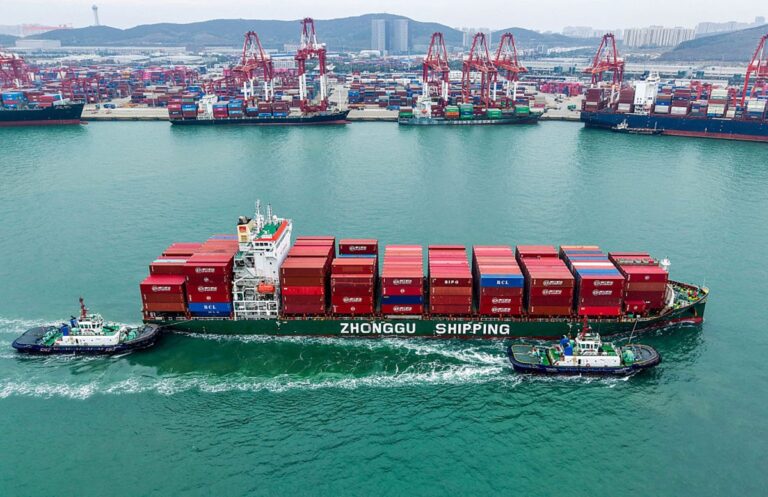
Treasury Secretary Scott Bessent announced last week that the U.S. and China have extended their bilateral trade truce to January 10, 2027, pushing back the expiration date on a one-year suspension of punishing port surcharges on Chinese-built and Chinese-operated ships — but carriers and importers have one more step to wait on before they can fully relax: a formal USTR Federal Register notice that, as of Monday, has not been published. Bessent announced the Busan Agreement extension on Fox News on September 23.
“This is a positive signal that a further longer-term extension is at least possible,” Matthew Thomas, an international trade and maritime law expert at the firm Blank Rome, told Seatrade Maritime News on Monday. That measured optimism captures precisely where the industry stands: encouraged, but not yet protected — at least not in the legal sense that counts when ships are booking routes and freight rates are being set.
The Section 301 maritime fee suspension, formalized in Federal Register notice FR Doc 2025-19873 last November, expires at 11:59 p.m. ET on November 9, 2026. The verbal extension Bessent announced on September 23 — the day Chinese President Xi Jinping’s plane landed at Joint Base Andrews — does not automatically move that date. Under U.S. administrative law, an obligation created by a Federal Register notice can only be modified or suspended by another Federal Register notice. Until USTR publishes one, November 9 remains the legal deadline.
What Bessent Actually Announced — and What He Didn’t
The Washington summit between President Trump and President Xi, held September 23–25, produced a two-month rollover of the broader “Busan Agreement” — the trade détente first struck in South Korea in October 2025. Speaking on Fox News shortly after Xi’s arrival, Bessent said the agreement would be extended “until January 10 to give us more time to see what we can do on the economic front.”
What the summit did not produce was a new Federal Register notice from USTR. The Busan Agreement, like the original one-year suspension before it, was never a single document — it was a set of parallel administrative actions by each government, each implemented through its own legal instrument with its own expiry date. USTR’s port-fee suspension carries its own Federal Register stamp, its own effective date, and its own termination clause. Bessent’s statement creates a clear diplomatic signal, but it does not rewrite regulatory text. FreightWaves confirmed as of September 28 that no formal Federal Register notice extending the fee pause had been issued.
That distinction is not academic. When the original Busan suspension was formalized in November 2025, there was a roughly one-day gap between the prior deadline and the moment the Federal Register notice took legal effect — meaning companies that happened to enter goods during that window were technically exposed to full duties until the extension notice published. Trade practitioners are watching for the same scenario in the coming weeks.
Why This Article Exists Today
On September 23 — one day before the Trump-Xi bilateral talks formally opened — a coalition of more than 200 importers, exporters, carriers, and transportation groups sent USTR Ambassador Jamieson Greer a joint suspension extension letter urging him to extend the suspension before the November 9 expiration. The signatories included the National Retail Federation, the American Apparel & Footwear Association, the Footwear Distributors & Retailers of America, the World Shipping Council, the International Chamber of Shipping, and the Agriculture Transportation Coalition, among many others.
The timing was deliberate. The coalition wanted a decision made during the summit. The summit came and went — and while the broader truce extension was announced, the maritime fee suspension was not separately addressed in the White House fact sheet. It is subsumed within the Busan Agreement extension Bessent described, but the regulatory mechanism to make that legally real has not been triggered.
A Fee Structure With Real Teeth — Even If Currently Suspended
To understand what is at stake, it helps to understand the fee structure that sits dormant beneath the suspension. The USTR’s April 2025 Section 301 notice established a phased schedule targeting Chinese-owned and Chinese-operated vessels at $50 per net ton per voyage, escalating by $30 per net ton annually through 2028. Non-Chinese operators using Chinese-built ships face lower but still significant fees: $18 per net ton or $120 per discharged container, whichever is higher.
A standard transpacific containership carrying roughly 50,000 net tons of cargo would face a per-voyage surcharge of approximately $2.5 million at the base rate. At the $80-per-net-ton rate that was scheduled to take effect in April 2026 but was suspended before it did, that same ship would face a $4 million charge. For COSCO Shipping, the world’s largest container carrier by capacity, HSBC analysts projected annual fee exposure of up to $1.5 billion — roughly 74 percent of the company’s projected 2026 earnings before interest and taxes. COSCO’s subsidiary Orient Overseas Container Line (OOCL) faced an estimated additional $654 million in annual fees. Across the entire top-10 container shipping sector, Alphaliner estimated total annual exposure at $3.2 billion.
Carriers did not simply absorb those costs when the fees were briefly in effect in October 2025 — they passed them through as freight surcharges to importers and cargo owners almost immediately. If the fees resume at any rate, the same pass-through mechanism would apply, and American companies importing goods from Asia would see those charges reflected in their freight invoices within weeks.
Why the Notice-Publication Gap Matters for Supply Chains
Industry practitioners have identified two scenarios worth planning for, depending on what USTR does and when.
In the more likely outcome — given the diplomatic momentum from the summit — USTR publishes a new Federal Register notice extending the suspension to January 10, 2027, or beyond, in the coming weeks. That notice would give carriers and importers the legal certainty they need to book freight contracts without hedging against a November 9 resumption. The pattern from November 2025 suggests USTR would publish the notice within roughly two weeks of the diplomatic announcement — but “roughly two weeks” still leaves room for a gap.
In the contingency scenario, USTR delays the notice past November 9, or publishes it after a brief gap. Under that scenario, any ship operating under a Chinese flag, owned by a Chinese entity, or built in a Chinese shipyard that calls at a U.S. port on or after November 10 would legally owe fees — at whatever rate USTR specifies in the new notice — even if the diplomatic agreement intends to waive them. The industry response would almost certainly be to park ships, divert routes, or hold cargo offshore until the legal picture is clear.
For importers, the practical move is the same regardless of which scenario materializes: watch the USTR press page, track carrier surcharge advisories (which typically move before the Federal Register does), and keep bonded-warehouse plans on standby for goods arriving in the November 9–10 window.
The Broader Stakes: January 10 Is a Harder Cliff
If and when USTR publishes the extension notice, the next strategic question will be what happens on January 10, 2027. The Bessent announcement moved the cliff, but it did not remove it. January 10 lands during the pre-Lunar New Year peak shipping season — Chinese New Year 2027 falls on February 6 — which means factory output is at its highest, container space is tight, and freight rates are typically elevated. A January cliff would land at the worst possible moment for the supply chains that depend on transpacific ocean freight.
Moreover, Bessent was explicit that he does not know whether January will produce a larger deal or simply another rollover. At the time of his Fox News appearance, Beijing had not publicly confirmed the extension, and Bessent described Chinese deliverables as not having been “perfect.” The two-month leash is short by design. It gives negotiators runway through the November APEC summit and December G20, but it does not guarantee the outcome they are working toward.
For the 200-plus groups that signed the September 23 coalition letter, the goal has always been a durable solution — one that strengthens U.S. shipbuilding and maritime capacity without imposing near-term cost burdens on the American freight users who depend on affordable ocean shipping. A two-month extension toward January 10 is progress, but it is not that.
What This Means for Shipbuilding — and U.S. Tech-Industrial Policy
The Section 301 maritime investigation was never just about port fees. It was conceived as part of a broader U.S. strategy to counter China’s dominance in a sector it spent decades building through state subsidies, cheap state-bank financing, and domestic demand from state-owned carriers like COSCO. China’s share of global shipbuilding tonnage rose from less than 5 percent in 1999 to more than 50 percent in 2023, and the USTR’s April 2025 investigation found that rise was “unreasonable” and burdened U.S. commerce.
Ambassador Greer — who has separately pledged an aggressive digital trade agenda targeting foreign discrimination against U.S. technology companies — has framed the maritime investigation as part of the same U.S.-vs-China industrial competition that shapes AI, semiconductor, and supply-chain policy. The fees, in his framing, are not just a revenue instrument but a demand signal for U.S.-built ships.
While the fees have been suspended, that strategy has not stopped. The U.S. has leveraged the threat of reimposition to extract shipbuilding investment commitments from South Korea (a $150 billion component of a $350 billion total investment package, with a South Korea-U.S. shipbuilding MOU signed in May 2026) and Japan (a ¥1 trillion domestic shipbuilding fund, or approximately $6.3 billion, plus a larger cooperation pledge to U.S. shipyards). Whether those commitments translate to ships in the water is a question that will take years to answer — but the diplomatic architecture is being built during the suspension window.
Is This a Solution or a Delay?
A Section 301 fee suspension is not a trade deal. It is a regulatory pause, formalized in a Federal Register notice, covering a defined period, subject to renewal, modification, or expiration on whatever terms USTR specifies in the next notice. The suspension creates breathing room — but it does not resolve the underlying investigation, rewrite the fee schedule, or establish any permanent mechanism for managing the structural conflict between Chinese maritime dominance and U.S. shipping costs.
Industry groups have said consistently that they support the goal of rebuilding U.S. maritime capacity. Their objection has been to the mechanism: fees imposed on all carriers using Chinese-built ships, regardless of their nationality or origin, impose costs on European, Asian, and American freight users who did not choose Chinese-built ships out of preference but out of the practical reality that Chinese yards build more than half the world’s commercial vessels.
A durable resolution — if one is possible before January 10 — would require either a longer, more stable suspension through a formal USTR notice, or a negotiated framework within the U.S.-China Board of Trade that creates alternative pathways for addressing Chinese maritime dominance without a broad-based fee on the global fleet.
For now, the industry has a positive signal, a short leash, and a watchlist. The USTR’s Federal Register page is the next thing to check.
Frequently Asked Questions
Does Bessent’s announcement mean the Section 301 port fees won’t resume in November?
Not automatically. Bessent announced that the broader U.S.-China trade truce has been extended to January 10, 2027, and that extension is understood to include the port-fee suspension. But the fee suspension was created by a USTR Federal Register notice (FR Doc 2025-19873), and under U.S. administrative law it can only be legally extended by a new Federal Register notice from USTR. Until that notice is published, the suspension still technically expires on November 9, 2026 at 11:59 p.m. ET. Trade practitioners recommend treating the diplomatic announcement as a strong indicator of intent — but not as a legal guarantee.
Who actually pays these fees, and how do they end up affecting consumer prices?
The fees are assessed on vessel operators — the shipping companies that operate the ships. When the fees were briefly in effect in October 2025, carriers passed them through almost immediately as line items on freight invoices to cargo owners (importers). Those costs then filter through the supply chain into retail prices. A Trade Partnership Worldwide cost study estimated that the fees, at their full scheduled rate, would increase container shipping costs by at least 25 percent, adding approximately $30 billion in annual costs to U.S. businesses and farmers — costs that would ultimately reach consumers in the form of higher prices on imported goods.
Why can’t the U.S. just build its own ships and avoid this problem?
U.S. shipbuilding capacity is a fraction of what it was during its mid-twentieth-century peak. There are only about 80 U.S.-flagged vessels engaged in international commerce, compared to more than 5,500 China-flagged vessels. The U.S. lacks the shipyard capacity, trained labor, and supply chain to quickly replace Chinese-built tonnage in global shipping lanes. The Section 301 investigation was specifically designed to create financial pressure on Chinese maritime dominance while simultaneously signaling demand for U.S.-built ships and leveraging cooperation deals with South Korean and Japanese shipbuilders, whose combined market share is approximately 40 percent of global production. That strategy may take a decade to produce results — which is why the near-term question is about managing the transition, not replacing Chinese ships overnight.
What happens if USTR publishes the extension notice after November 9 — is there a gap?
Yes, and it has happened before. When the first suspension was formalized in November 2025, the Federal Register notice was published a few days after the White House announcement — long enough that companies with goods in transit during the gap technically had exposure until the notice published. If the same pattern repeats this time, any covered vessel that calls at a U.S. port between November 10 and the date the new notice publishes would technically owe fees. Freight practitioners recommend routing covered shipments through bonded warehouses if possible, so that goods can be entered for consumption after the new notice takes effect, rather than at the full fee rate during any gap window.