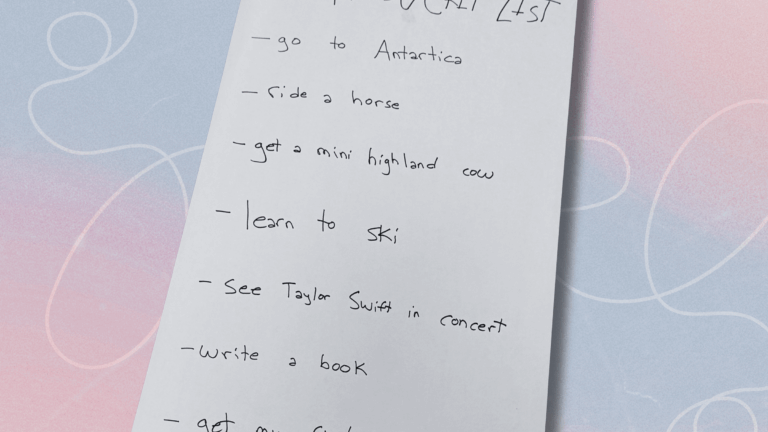

Why You Should Make a Reverse Bucket List

September 29, 2026:

Why You Should Make a Reverse Bucket List

—Photo-Illustration by TIME

Your bucket list is probably full of big dreams: go sky-diving, learn to speak Italian, finally take that trip to see the northern lights. You might think that all that possibility should give you something to look forward to—but spend enough time staring at everything you haven’t done, and your yet-to-be-checked off aspirations can start to feel like more proof you’re somehow behind.

That’s what bothered Simon Sinek, who hosts the podcast A Bit of Optimism and is the author of books including Start With Why, about the concept of a bucket list. “You’re staring at a list of things you’ve never done, and it’s kind of depressing,” he says. “Even if you make your way through the list and things come off, you die with a list of things you’ve never done. And that just leads to disappointment and regret.”

About 15 years ago, in a small act of rebellion, Sinek started keeping a reverse bucket list: a log of all the wonderful things he’d already experienced, like the time he saw a complete rainbow instead of just part of one.

Sinek keeps his list on his phone, where he sometimes stumbles across it while searching for something else. Then he gets sidetracked revisiting his own life and remembering experiences he’d forgotten about. “It’s joy scrolling,” he says. “Why shouldn’t I get credit for these things that showed up organically in my life?”

Here’s how to take stock of the big milestones and small moments worth remembering—and give yourself a chance to enjoy them all over again.

How a reverse bucket list can help you feel more fulfilled

A reverse bucket list works because it interrupts one of your brain’s most stubborn habits: always looking ahead to what’s next instead of pausing to appreciate what’s already happened. “So much of daily life is focused on the next goal, the next milestone, or the next thing we haven’t done yet,” says Rachel Needle, a psychologist in West Palm Beach, Fla. That translates into rarely stopping long enough to notice “everything we’ve already experienced, survived, learned, or built.”

Making the list gives you a reason to notice the lovely, surprising, unexpectedly funny things that happen in the middle of an ordinary day, which are easy to miss when you’re already thinking about what’s next. When you start actively seeking out these moments, you may find that you spend more time celebrating what’s already part of your life, rather than dwelling on what’s missing. 

“Instead of thinking, ‘I’m not there yet,’ you begin noticing, ‘Look how much is already part of my story,’” Needle says. “That shift alone can change how you see your life.” 

Keeping track of these experiences can be especially helpful for people who feel perpetually behind or tend to compare themselves with others. “We get lost in what everyone else is doing, so we forget what we’re actually doing,” says Alyssa Kushner, a licensed clinical social worker in New York. Writing down your own personal highlights gives you something to revisit when it feels like everyone else is having a better time. She keeps her old journals for precisely that reason: They remind her of the friends, trips, and fun she might otherwise overlook. Rereading them gives those memories a little more time and attention. “You’re feeling it and you’re savoring it,” she says.

Those reminders may lift your mood and support your self-esteem, too—especially when you recognize your own role in making something good happen. As Kushner puts it: “I did take that risk. I did build that friendship. I did get through that season.” When it’s easier to focus on what’s going wrong, the list offers concrete reminders of what’s gone right.

What to put on your reverse bucket list

Aim to make your entries specific, whether the experience was big or small. For example, you might record a Tuesday dinner with friends: “Everyone stayed at the table chatting for three hours.”

There’s room for big milestones (an awe-inspiring trip or promotion at work) as well as what Kushner describes as “micro moments of joy.” “These are the daily things that happen that we might kind of gloss over, but that are just as important,” she says. “Maybe it was a beautiful morning and you got to soak in the sun, and you had your coffee or your matcha, and you just felt content. It could be a random five-minute exchange with a stranger that was a really nice moment of connection. It could be something you felt proud of yourself for.” Every time she sees flowers, for example, she feels happy.

Include a few details that help you return to the scene, Kushner suggests: what you saw, heard, or felt, and what made it worth remembering. Maybe you caught the scent of flowers on your walk or laughed so hard with a friend that you forgot what started it.

You can also give yourself credit for things that didn’t come with a souvenir or a celebration. Needle suggests including challenges you’ve overcome, relationships you’ve nurtured, and moments when you did something that took courage. “You’re more resilient than maybe you’re giving yourself credit for on a regular basis,” she says. On her own list: finishing her book proposal, reconnecting with friends, and planning a trip to London with her mom. 

The point is to choose what mattered to you. As Needle puts it: “You’re not trying to prove anything to yourself or anyone else that you lived an impressive life.”

How to make—and revisit—a reverse bucket list

Keep track of these memories in a journal or notebook, or on your phone—whatever you’re most likely to return to. Treat it as a living document that grows as you have new experiences and remember old ones you’d almost forgotten.

If you like a little structure, Needle suggests a weekly check-in: Add whatever comes to mind, then spend some time rereading old entries.

Or take Sinek’s approach and skip the schedule. He adds things when they happen. “There’s no rules here,” he says. 

Whatever your system, make sure you periodically revisit what you’ve written. Linger over an entry long enough to remember what made you laugh, who was there, or how you felt. As Needle puts it, the point is “letting yourself feel good about it again.”

Source link