HomeAuto Avatar: Seven Havens Arrives October 9 as First Avatar Series Built on Sanskrit Cosmology
Avatar: Seven Havens Arrives October 9 as First Avatar Series Built on Sanskrit Cosmology
September 29, 2026:
Paramountplus.com
Paramount+ confirmed on September 28 that Book One of Avatar: Seven Havens carries the title “Survival,” and the name turns out to be an exact description of what this series is doing intellectually. The franchise that borrowed the word “avatar” from Sanskrit has, for the first time, built an entire series around the Hindu cosmological system that word comes from — and the STEM worldbuilding underneath that choice is more rigorous than anything the Avatar universe has previously attempted.
Bryan Konietzko said it plainly in a Variety interview via Timeout.com: “The concept and even the word ‘avatar’ all come from Indian culture and tradition and Sanskrit. It was very deliberate with Seven Havens to code Pavi as a South Asian-inspired character.” In Hindu theology, “avatar” means “descent” — a divine being descending into the material world at a moment of maximum disorder. That is not a metaphor. It is a structural description of what Pavi is: the ten-episodes-into-October answer to a world in what scholars would recognize as Kali Yuga, the age of maximum moral collapse that precedes the arrival of Kalki, the final avatar of Vishnu.
Avatar: Seven Havens premieres on Paramount+ on Friday, October 9, 2026, with the first three chapters of Book One: “Chapter One: On the Horizon,” “Chapter Two: Into the Storm,” and “Chapter Three: The Order.” Three additional episode batches will follow on October 16, October 23, and October 30, completing the 13-episode first book.
Pavi, Kalki, and the Descent Into Maximum Disorder
In Hindu Yuga Cycle cosmology, time moves through four descending ages — Satya, Treta, Dvapara, and Kali — each with diminishing dharma (righteousness). The Kali Yuga is the fourth and worst: full of strife, discord, and moral inversion. Its Sanskrit name, “Kali,” means “quarrel” or “contention” — not the goddess Kali, but the demon of disorder. At the end of the Kali Yuga, Kalki, Vishnu’s tenth avatar, descends on a white horse to destroy the age of unrighteousness and begin a new Satya Yuga.
The world of Seven Havens is a textbook Kali Yuga state. A cataclysm shattered the civilizations built by Aang and Korra. Civilization has contracted into seven isolated strongholds. The Avatar — formerly a symbol of cosmic balance — is now regarded as humanity’s destroyer, not its savior. Moral order has inverted. EP Sehaj Sethi confirmed to Polygon that the series takes place 225 years after The Legend of Korra ends.
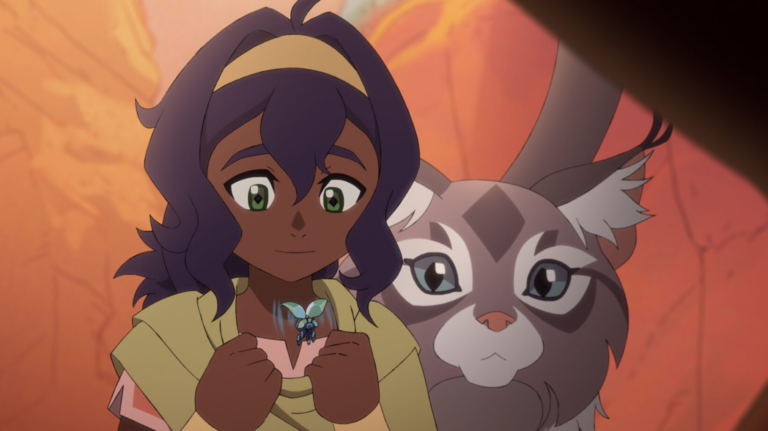
Pavi is nine years old, missing a leg, living in hiding inside the canyon city of Ellora. The choice to make her an underdog in a world that sees her title as a curse maps precisely onto Kalki’s structural function: the restorer who arrives precisely when the age is at its worst, not to continue the old order, but to remake it. Co-creator Michael DiMartino confirmed this framing directly in an interview, stating that the show intends to keep audiences hungry to know more. That tension — the apparent destroyer who is actually a restorer — is the Kalki premise, and it is no accident. “Avatar” in Sanskrit has always meant exactly this.
The show’s cast is drawn primarily from South Asian performers, with Saheli Khan leading as Pavi alongside Aishu Devan as Nisha, Akshay Khanna as Karthik, and Sakina Jaffrey as Agam. This is not window dressing. It is the natural consequence of building a series whose cosmological architecture is Hindu.
The Ellora Caves and the Physics of Cliff Cities
The show’s primary setting is named Ellora — not coincidentally. The Ellora Caves of Maharashtra, India, are a UNESCO World Heritage Site: 34 monasteries and temples carved directly into basalt hillsides between 600 and 1000 CE, representing Buddhist, Hindu, and Jain traditions in harmonious coexistence. Sethi confirmed the direct borrowing: “The name Ellora is inspired by the ancient Indian complex of monasteries and temples known as the Ellora Caves. Just as this ancient complex is a harmonious mix of several religious practices, Ellora [in the show] is a harmonious blend of all bending practices.”
The real Ellora Caves model the core engineering logic of the fictional Ellora: that a city carved into rock faces and slot canyons provides passive shelter against surface threats. This is not fantasy architecture; it is one of the most documented survival strategies in human history. The Ancestral Puebloans built cliff dwellings at Mesa Verde, Colorado, from the 6th century onward, using overhanging sandstone alcoves as passive thermal mass and wind shelter. The Cappadocian underground cities of Derinkuyu and Kaymakli, Turkey, sheltered tens of thousands below the volcanic tuff plateau against surface threats for centuries.
The atmospheric physics underlying this choice are equally real. Canyon topology creates what meteorologists call a sheltered microclimate: canyon walls attenuate wind velocity through friction and turbulence at the rim, while deep canyon floors can run 10 to 20 degrees Celsius (18 to 36 degrees Fahrenheit) cooler than the open plateau in daytime while retaining heat at night. If the energy storms in Seven Havens carry electromagnetic or kinetic charge analogous to a severe supercell storm, canyon walls would significantly attenuate both pressure gradients and electrical charge differentials. The seven surviving havens are not arbitrary safe zones. They are the specific geological formations that happened to have the right topology to outlast whatever atmospheric disruption the cataclysm produced.
What Those Permanent Auroras Are Actually Telling You
The most immediately striking visual feature of Seven Havens’ sky — permanent, non-dissipating auroras in reds, purples, and greens at what appears to be a warm desert latitude — is scientifically legible once you know what it references.
Normal auroras occur when charged solar-wind particles are funneled along Earth’s magnetic field lines toward the poles, where they collide with oxygen and nitrogen at altitudes of 100 to 300 kilometers (62 to 186 miles) and emit photons. They are temporary, lasting hours to days, and concentrated near the geomagnetic poles. Seeing them at equatorial latitudes is abnormal. Seeing them permanently is extraordinary.
The reference point is the Laschamp geomagnetic excursion study, approximately 41,000 years ago, when Earth’s magnetic field weakened to approximately 10% of its modern strength and the poles shifted dramatically away from the geographic poles. A 2025 study by Agnit Mukhopadhyay of the University of Michigan and colleagues, published in Science Advances, reconstructed the global space environment during this period for the first time using paleomagnetic records and plasma modeling. Their findings confirmed that the auroral ovals expanded toward equatorial latitudes throughout the excursion — which lasted roughly 2,000 years, with the most intense phase spanning about 300 years.
During the Laschamp Event, our ancestors would have seen ubiquitous, far stronger auroras than any alive today have ever witnessed. They would also have been exposed to substantially elevated cosmic ray flux at the surface, as the magnetosphere shrank to approximately 3.8 times Earth’s radius. A Seven Havens scenario — a civilizational cataclysm producing a permanent atmospheric saturation — maps precisely onto a protracted Laschamp-type event: the sky never recovered because whatever the cataclysm did to the world’s electromagnetic environment has not fully resolved. The permanent aurora is not aesthetics. It is a diagnostic reading of a planet whose protective field is still compromised.
The cataclysm’s origins remain among Seven Havens’ central mysteries — and this article will not speculate on them. What the aurora tells a scientifically literate viewer is that the question to bring to the screen is not merely “what happened?” but “what is the physics of a world still living inside the aftermath?”
Why Collapse Produced Seven Havens, Not One
The contraction of a shattered civilization into seven isolated city-states is not a convenient number. It is a historically documented pattern. Joseph Tainter, professor in the Department of Environment and Society at Utah State University, argued in his foundational 1988 work The Collapse of Complex Societies that societies collapse when their investments in social complexity reach a point of diminishing marginal returns — when the energy cost of maintaining interconnected systems exceeds what the system can deliver. The specific post-collapse settlement pattern that emerges in nearly every documented case is contraction to defensible geographic nodes.
The Bronze Age Collapse of roughly 1200 BCE provides the most striking real-world parallel. The Mycenaean Greek palace economies, the Hittite Empire, Kassite Babylonia, Ugarit, and a dozen other civilizations all failed within a generation — a multi-causal collapse involving drought, disrupted trade networks, and external pressures that researchers still debate. What followed was centuries of isolated survival in geographically defensible micro-communities. International trade nearly ceased. Literacy declined. Each surviving community developed its own governing philosophy, its own interpretation of prior history, and its own mythology about what had caused the catastrophe.
That last pattern is directly relevant to Seven Havens. When civilizations collapse, survivors need a coherent narrative for why. The most psychologically available narrative is almost always a named agent — a person, a category of person, or a mystical office. The Avatar, as the most powerful individual in the pre-collapse world, is the obvious candidate. This is not mythology. Historians recognize it as a documented psychological response to systemic collapse: blame displacement. The Avatar didn’t cause the cataclysm. But in a world that has survived it for 225 years in isolated city-states, with no shared historical record, the Avatar title itself has become the explanation. “The Order” — whose agenda the series will reveal in its early episodes — almost certainly enforces this narrative, because controlling the cataclysm’s story means controlling what people are afraid of.
Crystals That Do Real Physics
The large, geometrically regular red crystals visible throughout the Seven Havens world are not purely decorative. Several documented mineral properties map onto the role they appear to play as repositories of spiritual energy.
Crystals with the piezoelectric voltage-generation effect — including quartz, tourmaline, and several feldspars — generate measurable electrical voltage when mechanically stressed. This property underlies sonar transducers, precision oscillators, and medical ultrasound technology. Triboluminescent minerals — including quartz and corundum — emit visible light when fractured or crushed. Several radioactive minerals, including autunite and torbernite, produce their own persistent glow via radioluminescence.
The diamond-shaped, octahedral crystal habit shown in the show is consistent with the natural crystallization geometry of magnetite and fluorite under high-pressure formation conditions — exactly the kind of conditions a cataclysm-scale physical event would produce in the Earth’s crust. If Pavi as an Earthbender and Avatar can sense and interact with these formations, they function geologically as nodes in a network of stored energy — distributed repositories of whatever force the cataclysm released into the physical substrate. The science is not decorative. It is structurally coherent with the world’s premise.
Can Two People Be One Avatar?
The show’s central question about whether Pavi and her twin Nisha both carry the Avatar spirit simultaneously has no precedent in Avatar franchise lore. The Avatar cycle is explicitly singular: one soul, one body per lifetime.
But the concept has a parallel in quantum physics worth noting as a framework, not a prediction. The physics of quantum particle entanglement describes a state in which two particles share a quantum state such that measurement of one instantly determines the state of the other, regardless of the physical distance separating them. If the Avatar spirit is understood as a quantum of cosmic energy — rather than a discrete soul-object — then a cataclysm powerful enough to fracture both the physical and Spirit Worlds might theoretically produce an entangled splitting of the Avatar state across two simultaneous carriers.
Whether this is what the show is doing is one of the central questions of Book One. This analysis does not assert an answer. What the physics does provide is a framework for why the show might treat Pavi and Nisha’s shared condition not as a paradox but as a consequence: something that has never happened before because the conditions for it — a cataclysm of sufficient magnitude — have never happened before.
Premieres October 9: the Questions to Bring to the Screen
Avatar: Seven Havens premieres on Paramount+ on Friday, October 9, 2026, with episodes one through three of Book One: Survival streaming simultaneously. New batches of three episodes will follow on October 16, October 23, and October 30. The full first book runs 13 half-hour episodes; Book Two has been ordered.
A premiere-day panel will take place on October 9 at 11:15 AM ET, moderated by Janet Varney — the voice of Korra — alongside creators DiMartino and Konietzko and cast members Saheli Khan, Aishu Devan, and Major Curda.
The series is co-created and executive produced by Michael Dante DiMartino and Bryan Konietzko, with Ethan Spaulding as executive producer and Sehaj Sethi as co-executive producer.
The version of Avatar arriving on October 9 is doing something none of its predecessors attempted: it is returning to the Sanskrit source of its own title. Viewers familiar with the Yuga Cycle will recognize what Pavi’s world is asking for. Viewers familiar with the Laschamp Event will understand what the sky is saying. The science and the cosmology are not two separate layers applied to an adventure premise. They are the same argument, in different languages, about what happens at the end of an age — and what has to come next.
Frequently Asked Questions
What is Avatar: Seven Havens, and how does it connect to the earlier Avatar series?
Avatar: Seven Havens is the third animated series in the Avatar franchise, following Avatar: The Last Airbender and The Legend of Korra, and is the first created specifically for Paramount+. Set 225 years after the events of The Legend of Korra, the series follows Pavi — a nine-year-old Earthbender who discovers she is the next Avatar — in a post-cataclysm world where civilization has contracted to seven isolated city-states. Unlike Aang and Korra, who were celebrated as saviors, Pavi lives in a world that regards the Avatar title as a mark of destruction rather than salvation, per the official series synopsis.
What does “avatar” actually mean in Sanskrit, and why does that matter for this show?
In Sanskrit, “avatar” (avatāra) means “descent” — specifically the descent of a divine being into the material world during an age of maximum disorder. In Vaishnava Hindu theology, each of Vishnu’s ten avatars descends in response to an age of declining dharma, with Kalki, Vishnu’s final avatar, appearing at the end of the Kali Yuga, the age of maximum chaos, to restore cosmic order and begin a new age. Pavi’s structural position in Seven Havens maps directly onto the Kalki role: she arrives in a world where moral order has inverted, her title is feared rather than revered, and her function — whether she knows it or not — is not to continue the prior age but to remake it. Bryan Konietzko confirmed that this was a deliberate creative choice, making Seven Havens the first Avatar series to explicitly center its South Asian cultural source material.
What real scientific events are most similar to what the permanent auroras in Seven Havens suggest?
The closest real-world parallel is the Laschamp Event, approximately 41,000 years ago, when Earth’s magnetic field weakened to roughly 10% of its modern strength and the geomagnetic poles shifted dramatically toward equatorial latitudes. A 2025 study published in Science Advances by Agnit Mukhopadhyay (University of Michigan) and colleagues found that during this event, the auroral ovals expanded globally, auroras appeared at what would normally be mid-latitude and equatorial regions, and Earth’s magnetosphere shrank to approximately 3.8 times the planet’s radius. If Seven Havens’ cataclysm produced a permanent or prolonged version of such a disruption — a sky that has not recovered — the persistent aurora is the atmosphere’s continuing record of that unresolved event.
Why does civilizational collapse so often produce isolated city-states rather than gradual recovery?
Joseph Tainter’s framework in The Collapse of Complex Societies (1988) explains this: when interconnected systems collapse simultaneously, the survivors lack the resources, personnel, and institutional knowledge to rebuild those connections. The energy cost of re-establishing long-distance trade, shared governance, and specialized labor division is higher than the immediate benefit to isolated survivors, so communities contract to the minimum viable unit — a defensible geographic node. The Bronze Age Collapse of 1200 BCE produced exactly this pattern: the interconnected palace economies of the Eastern Mediterranean all failed within a generation, and what followed were centuries of isolated micro-communities developing their own cultures, myths, and explanations for what had happened. The seven havens of Pavi’s world are not a storytelling convenience. They are what collapse archaeology predicts.