HomeAuto New China Dinosaur Species Sets Tooth Record; Hints at Niche-Splitting in Ancient Ecosystem
New China Dinosaur Species Sets Tooth Record; Hints at Niche-Splitting in Ancient Ecosystem
September 29, 2026:
Tandfonline.com
A new species of feathered, plant-eating theropod — the largest and most anatomically unusual therizinosaur ever recovered from one of China’s most celebrated fossil beds — has been formally described by an international team of paleontologists, overturning what scientists thought they knew about how these bizarre dinosaurs shared their world. The discovery is detailed in the Journal of Systematic Palaeontology.
The discovery, reported widely this week, challenges the default assumption that therizinosaurs were ecological generalists who coexisted by occupying similar niches — and instead suggests the group was far more ecologically specialized than the fossil record has previously shown.
What Kind of Dinosaur Is a Therizinosaur?
Even among dinosaurs, therizinosaurs have always been the odd ones out. They belong to Theropoda — the same broad lineage that includes T. rex, Velociraptor, and modern birds — yet they evolved into large, pot-bellied, slow-moving herbivores with elongated necks, leaf-shaped teeth, and claws so outsized they were initially mistaken for turtle forelimbs when first described in 1954.
They remained an enigmatic, contested group for decades, their mosaic of features — bird-like pelvis, sauropod-like neck, theropod-like overall skeleton — placing them in disputed evolutionary company. It was not until the description of Beipiaosaurus in 1999 and a comprehensive phylogenetic analysis published in 2010 by Dr. Lindsay Zanno that their classification as basal maniraptorans was fully resolved.
Today, therizinosaurs are understood as the maniraptoran clade that made the most complete and anatomically thoroughgoing shift toward herbivory — abandoning the carnivorous lifestyle of their ancestors entirely and evolving a body plan that multiple paleontologists have compared to chalicotheres, ground sloths, and giant pandas.
A Record-Breaker from the Jehol Biota
The specimen at the center of this study was recovered from the Yixian Formation in western Liaoning Province, northeastern China — a geological deposit forming part of the Jehol Biota fossil ecosystem, a fossil-rich Early Cretaceous assemblage approximately 125 million years old.
The Jehol Biota is one of paleontology’s most productive Lagerstätten — sites of exceptional preservation where articulated skeletons, feathers, stomach contents, and even color patterns have been recovered. The fossils owe their remarkable condition largely to phreatomagmatic eruptions that periodically killed and deposited organisms into oxygen-poor lakebeds, preventing decomposition.
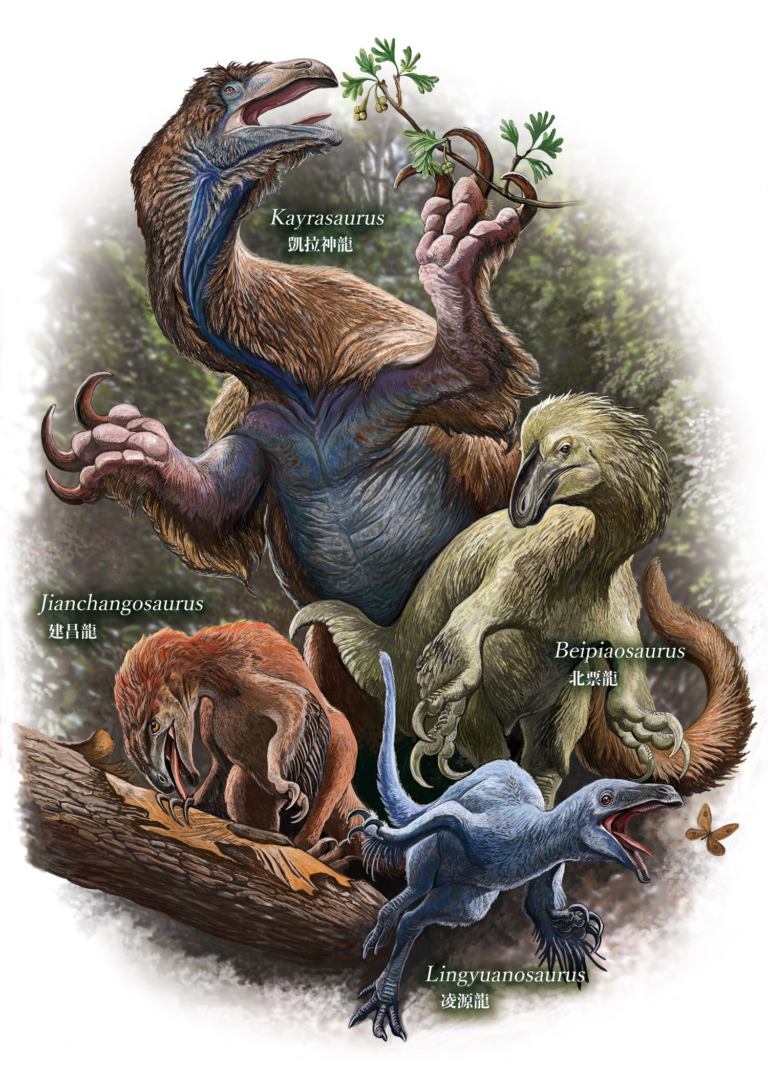
Three therizinosaurs were previously known from the Jehol Biota: Beipiaosaurus inexpectus, Jianchangosaurus yixianensis, and Lingyuanosaurus sihedangensis. The new species, named Kayrasaurus changliensis by lead author Chun-Chi Liao, co-authors William J. Freimuth, Lindsay E. Zanno, and Xing Xu, is now the largest therizinosaur known from this ecosystem.
The individual described measured more than 3.6 meters (11.8 feet) long and is estimated to have weighed between 117 kilograms (258 pounds) and 274 kilograms (604 pounds) — a body mass comfortably in the range of an adult male grizzly bear. It was also, at the time of its death, a subadult: open sutures between the neural arches and centra of the neck, trunk, and early tail vertebrae, along with incomplete fusion along the skull’s midline, indicate the animal had not yet reached full skeletal maturity. A fully grown adult could have been larger still.
Overall, the researchers calculate that K. changliensis was at least 1.6 times larger than Beipiaosaurus inexpectus, the second-largest therizinosaur previously known from the Jehol Biota. That is not a marginal improvement — Beipiaosaurus reaches only about 2.2 meters (7.2 feet) in body length. The size gap between the two is the equivalent, roughly, of the difference between a German shepherd and a black bear.
Something Strange in the Jaw — and a Record No Other Therizinosaur Holds
Size alone would have made Kayrasaurus newsworthy. But it is the animal’s skull that has scientists most animated.
CT scans of the holotype skull — specimen IVPP V 18597, permanently accessioned at the Institute of Vertebrate Paleontology and Paleoanthropology in Beijing — reveal it to be severely flattened by taphonomic compression, just 3–5 millimeters (0.12–0.20 inches) thick. Despite that distortion, the dental anatomy is exceptionally clear.
The lower jaw contained at least 45 small, densely packed alveoli (tooth positions), restricted to the first two-thirds of the dentary — the highest mandibular tooth count documented in any known therizinosaur. The next closest species — Beipiaosaurus, Alxasaurus, and Eshanosaurus — all fall below 40. The upper jaw carried approximately 32 tooth positions in the maxilla, packed at a rate of 3.5 to 4 alveoli per centimeter.
The teeth themselves were lanceolate (leaf-shaped), posteriorly inclined, and show evidence of homodont structure — roughly uniform in size across most of their length, consistent with the pattern seen in other therizinosaurs adapted for processing plant material.
But the jaw’s most novel feature is its shape. In all other known therizinosaurs, the external mandibular fenestra — an opening at the rear of the lower jaw bone — is narrow or slit-like. In Kayrasaurus, it is distinctly sub-triangular: pointed toward the front and deepening toward the rear. No other therizinosaur shows this configuration. The researchers note that it remains unknown what functional advantage, if any, this shape provided.
“Therizinosauria is an anatomically bizarre and rare group of theropod dinosaurs,” said Xing Xu, a paleontologist with the IVPP at the Chinese Academy of Sciences and Yunnan University, and a co-author of the paper. Late-branching members of the clade, Xu noted, evolved features including a relatively small head, an elongated neck, leaf-shaped teeth, enlarged manual claws, a broad opisthopubic pelvis, shortened tibia, and a four-toed foot — a paradoxical combination on an otherwise theropod body plan that produced one of the most complicated evolutionary histories within Dinosauria.
A Neck Built for Reaching High
Beyond the skull, Kayrasaurus displays several additional anatomical traits that distinguish it from its Jehol relatives.
Its ten preserved neck vertebrae — articulated in their natural sequence in the fossil — are all substantially longer than the longest of its trunk vertebrae, a configuration the authors identify as a possible autapomorphy (a unique derived feature of this species alone). Ten neck vertebrae is the same count as in the closely related Jianchangosaurus; more derived therizinosaurs evolved up to 14 cervical vertebrae. The elongated neck architecture suggests Kayrasaurus was capable of reaching higher vegetation than its contemporaries — a hypothesis that aligns with the life reconstructions prepared for the study, which show the animal browsing well above the level accessible to its smaller relatives.
The forelimbs also set it apart. The humerus is unusually robust, more similar to derived therizinosaurs like Erliansaurus and Nothronychus graffami than to its phylogenetically closer relatives. The dorsal ribs are notably more robust than those of Beipiaosaurus. And the claw on digit IV carries a prominent lip oriented proximodorsally (upward and toward the body) — contrasting with the more posterior orientation of the same feature in all other therizinosaurs.
Two Strategies, One Ecosystem — and Why That Matters
Perhaps the most significant scientific contribution of this paper lies not in the anatomy itself but in what it implies about how multiple therizinosaur species managed to share the same floodplain for millions of years.
The study’s authors — whose team includes Dr. Lindsay Zanno, Head of Paleontology at the North Carolina Museum of Natural Sciences and one of the world’s leading experts on therizinosaur evolution — applied ecomorphological analysis to the four Jehol species. Ecomorphology is the study of how an organism’s physical features reflect its ecological role: essentially, reading the body to infer the lifestyle.
Their analysis identified what appears to be at least two distinct ecological strategies operating within the same ecosystem at the same time. Kayrasaurus and Beipiaosaurus share features associated with stronger bite force and a more robust, less cursorial (running-adapted) body plan — characteristics consistent with processing tougher, more fibrous plant material and browsing at higher elevations. Jianchangosaurus and Lingyuanosaurus, by contrast, display lighter builds and limb proportions more consistent with cursoriality and forelimb-based foraging — possibly indicating lower-level feeding or more mobile foraging strategies among the Jehol species.
This matters because the prior default assumption in therizinosaur ecology was that the group’s rarity in the fossil record reflected genuine ecological scarcity — specialists occupying narrow niches. Finding four species in one formation already challenged that picture. Finding evidence that at least two of them differed meaningfully in body plan and likely in diet and foraging height suggests something more specific: niche partitioning, the ecological process by which competing species reduce direct competition by specializing into different resource spaces.
The authors are appropriately cautious. They describe the ecological interpretation as “provisional” and note that more complete fossils — and in particular, more complete hindlimb material, which is missing from the Kayrasaurus specimen — are needed to test it rigorously.
“The integration of morphological, biomechanical, and body size data suggests the presence of at least two distinct ecological strategies among Jehol therizinosaurians: one favoring oral processing and robust body builds, and the other emphasizing agility,” the authors wrote. “While these ecological interpretations remain provisional, they underscore the importance of continued fieldwork, new fossil discoveries and biomechanical analyses to further illuminate the evolutionary pathways and paleoecological diversity of this enigmatic group.”
How the Phylogenetic Analysis Places This Animal
The paper includes the most comprehensive phylogenetic matrix of early therizinosaurs constructed to date, synthesizing characters and taxa from Zanno (2010), Senter et al. (2012), and Yao et al. (2019) with new additions.
The analysis places Kayrasaurus changliensis as an early-diverging (basal) member of Therizinosauria — specifically as the sister taxon to the Therizinosauroidea, the group containing all more derived therizinosaurs. This makes it phylogenetically intermediate between the more basal Jianchangosaurus and the more derived Beipiaosaurus (the basalmost therizinosauroid), both of which also come from the Yixian Formation.
In practical terms: Kayrasaurus sits at an important transition point in therizinosaur evolution, at the base of the radiation that would eventually produce the enormous, scythe-clawed giants of the Late Cretaceous. Its anatomy bridges morphological gaps between forms — filling in a part of the lineage’s evolution that was previously blank in the Jehol record.
What’s in a Name
The genus name Kayrasaurus combines the Ancient Greek word for lizard (saûros) with a reference to Kayra — the creation deity in Turkic shamanism, regarded as the father of Erlik, the god of death. This is a knowing nod to another therizinosaur: Erlikosaurus, named for that very death god and one of the group’s earliest and best-known members. The species name changliensis derives from Changli, the historical Three Kingdoms-era name for the region that includes the type locality in western Liaoning.
What Comes Next
The Kayrasaurus specimen was discovered in outcrops of the Yixian Formation in Dabangou village near Beipiao in Liaoning Province. It was prepared by Ding Xiaoqing and is now permanently housed at the IVPP in Beijing, where it will remain available for further study. A 3D digital model of the skull and left mandible has been deposited in the Archives of Digital Morphology and is publicly accessible.
The missing hindlimbs and much of the pelvis mean some questions — most critically, a definitive body mass estimate from femoral circumference — cannot yet be answered from this specimen alone. Future fieldwork in the Yixian Formation may turn up additional Kayrasaurus material, or specimens of the existing Jehol therizinosaurs, that can fill in the ecological picture the authors have sketched here.
For now, Kayrasaurus changliensis stands as the largest known inhabitant of one of Earth’s most extraordinary ancient ecosystems — and as evidence that the world’s most paradoxical dinosaur lineage was stranger, and more ecologically diverse, than even its long history of surprising science had suggested.
Frequently Asked Questions
What makes Kayrasaurus changliensis different from other therizinosaurs already known from the Jehol Biota?
Three things set it apart. First, it is substantially larger — at least 1.6 times bigger than Beipiaosaurus, the next-largest Jehol therizinosaur — even though the known specimen was still a subadult. Second, its lower jaw holds more than 45 tooth positions, more than any known therizinosaur; the closest competitors fall below 40. Third, the shape of the external mandibular fenestra (a bony opening at the rear of the lower jaw) is distinctly sub-triangular, unlike the narrow, slit-like opening seen in all other members of the group. Together, these features point to a feeding apparatus unlike anything previously documented in the Jehol therizinosaur community, as detailed in the full comparative anatomy published this week.
What is ecomorphology, and why does it matter for understanding this discovery?
Ecomorphology is the study of how an animal’s physical features reflect its ecological role — its diet, habitat use, and competitive relationships. Researchers apply it in paleontology because behavior cannot be directly observed in extinct species, but anatomy can. In the Kayrasaurus study, the team used body size, jaw robustness, and limb proportions to infer that the four Jehol therizinosaurs may have divided their ecosystem into at least two ecological strategies: a robust, strong-jawed, high-browsing strategy (associated with Kayrasaurus and Beipiaosaurus) and a lighter, more agile, ground-level strategy (associated with Jianchangosaurus and Lingyuanosaurus). This provisionally suggests niche partitioning — different species specializing to reduce direct competition — rather than coexistence through mere geographic or temporal separation. The framework was applied to therizinosaurs prominently in Zanno’s 2009 herbivory research, which remains foundational to the field.
Were therizinosaurs really related to T. rex and Velociraptor despite being plant-eaters?
Yes. Therizinosaurs belong to Theropoda — the same broad clade that includes all carnivorous dinosaurs and their living descendants (birds). They are specifically classified within Maniraptora, placing them as close relatives of dromaeosaurids (the raptor lineage), oviraptorosaurs, and troodontids. Their shift to herbivory was evolutionary, not taxonomic: the group descended from meat-eating ancestors and progressively shifted their anatomy — widening the pelvis, lengthening the neck, modifying the dentition — toward plant-processing. Dr. Lindsay Zanno’s landmark 2009 herbivory evolution study established that this shift likely began with dietary flexibility (omnivory) in ancestral maniraptorans before becoming a fully herbivorous specialization in the derived members of the clade.
What happened to the skeleton, and how was it preserved well enough to study in detail?
The Kayrasaurus specimen (IVPP V 18597) consists of a nearly complete skeleton — skull, articulated vertebral column, forelimbs, and most of the trunk — preserved in the Yixian Formation’s characteristic lakebeds. The Jehol Biota’s exceptional preservation is attributed to phreatomagmatic eruptions that periodically killed and deposited organisms in low-oxygen lacustrine (lake-bottom) environments where normal decomposition could not proceed. This has produced hundreds of articulated specimens across many species, but the Kayrasaurus holotype is notable for retaining enough cranial material that CT scanning could reveal fine dental anatomy even though the skull was flattened to just 3–5 millimeters (0.12–0.20 inches) thick by taphonomic compression.