HomeAuto Amazon Swamp Birds Face Highest Extinction Risk as Conservation Funds Wrong Forests, Study Reveals
Amazon Swamp Birds Face Highest Extinction Risk as Conservation Funds Wrong Forests, Study Reveals
September 29, 2026:
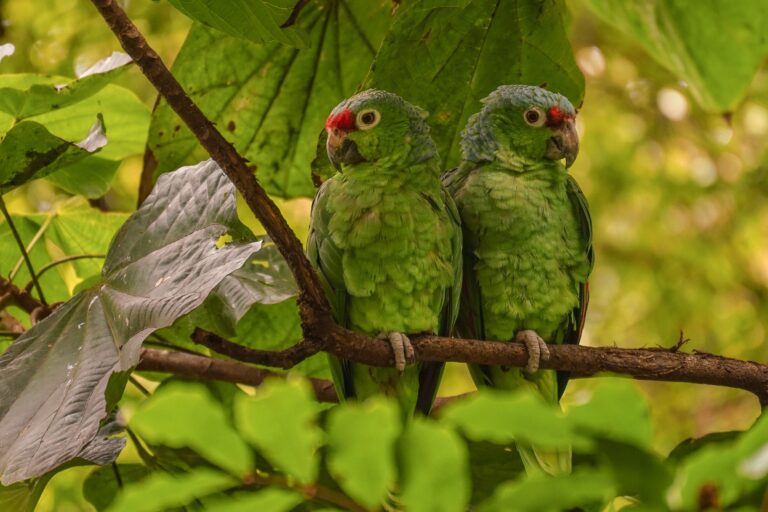
Alexa Bonilla/pexels.com
A new study published in Nature Communications has found that the chemical makeup of Peru’s forest canopy — measurable from aircraft — reliably predicts which bird communities face the steepest extinction risk, exposing a critical flaw in how conservation dollars are currently allocated across the Amazon Basin. The implications are unsettling: forests that appear protected on any conventional map may be quietly losing their most ecologically irreplaceable birds, because those birds’ vulnerability is written in the forest’s leaf chemistry — not in species counts.
The research was led by George Olah, a research fellow at the Australian National University, and Greg Asner, director of the Arizona State University Center for Global Discovery and Conservation Science. It combines airborne imaging spectroscopy — a technology that reads the chemical signatures of forest leaves from a flying aircraft — with ecological data on more than 1,492 forest-dependent bird species found in Peru.
What Canopy Chemistry Reveals That Tree-Cover Maps Cannot
Conventional conservation maps tell planners where forests exist. They do not explain what kind of forest it is, how chemically and structurally diverse it is, or which bird communities it can sustain — let alone which of those communities are the most biologically fragile.
The Global Airborne Observatory (GAO), formerly the Carnegie Airborne Observatory developed by Asner’s team, carries three integrated instruments: a visible-to-shortwave infrared (VSWIR) imaging spectrometer, a waveform LiDAR scanner, and a visible-to-near infrared imaging spectrometer. The VSWIR spectrometer reads how leaves scatter and absorb light at hundreds of distinct wavelengths. Because different leaf chemicals — foliar nitrogen, water content, phosphorus, calcium, polyphenols, lignin, and leaf mass per unit area — interact with light in characteristic ways, each patch of forest produces a unique spectral fingerprint. That fingerprint can be read, quantified, and mapped from an altitude where the human eye sees only unbroken green.
Using this technology across Peru’s forests, Asner’s team previously grouped forests into six functional types — mapping seven canopy chemical traits and clustering the country’s woodlands into 36 forest functional classes, which they further reduced to six forest functional groups (FFGs). The new study by Olah, Evans, and Asner overlaid these FFG maps with the geographic ranges of 1,492 forest-dependent bird species from BirdLife International’s distribution database, then matched those ranges to morphological data from AVONET — measurements drawn from more than 90,000 individual birds.
“By combining advanced airborne imaging spectroscopy with ecological data, we aren’t just mapping where the trees are; we are mapping the diversity and composition of the canopy itself and how the ecosystem functions,” Asner told earth.com.
Why Species Richness Maps Get It Wrong
The study tested whether FFGs could explain bird community traits — body size, clutch size, foraging position, conservation status, population trend — after accounting for a comprehensive set of standard environmental predictors: elevation, cloud cover, aboveground carbon density, urbanization, bare substrate, photosynthetically active vegetation cover, and solar insolation.
They found that FFGs were informative for 10 of 16 trait axes examined, increasing baseline model variance explained by 16% to 102% on those axes. On several axes, the canopy functional group effect sizes were substantially larger than those of the standard environmental predictors — meaning the forest’s chemical identity told researchers more about the birds living in it than climate, elevation, or tree cover did.
That finding has direct consequences for how protected areas are designed. Most conservation frameworks rank candidate areas by species richness — how many species live there — or by the simple presence of tree cover. Under these criteria, a species-rich floodplain forest scores high for protection. A less species-diverse swamp forest might rank lower. But the study’s findings on extinction risk showed those rankings are functionally backwards when the goal is protecting the most ecologically vulnerable communities.
“By integrating habitat functionality with species traits, we can revolutionize conservation planning at the landscape scale,” Olah told earth.com.
Six Forests, Six Kinds of Fragility
Each of Peru’s six forest functional groups turned out to host a bird community with a characteristic vulnerability profile — and those profiles aligned with a fundamental principle of ecology called the fast-slow life-history continuum.
Species at the “slow” end of this continuum are large-bodied, long-lived, breed infrequently, and produce small clutches. They invest heavily in each offspring and have low annual mortality rates — but when their populations take a hit from habitat loss, disease, or hunting, recovery is extremely slow. Species at the “fast” end are small, short-lived, breed frequently, and can recover quickly. The distinction matters enormously for conservation: a slow-living bird community in a threatened forest is a ticking clock.
The Northern Amazonian swamp forests (FFG5 in the study’s notation) contained the most biologically fragile communities the researchers found. Birds associated with these waterlogged forests of northern Amazonia tended to be very large-bodied and terrestrially foraging, with slow life histories and small clutches characterized by long generation times. They are also dominated by non-passerine orders — the ancient evolutionary lineages that include herons, trumpeters, and curassows — rather than the more recently evolved, generally faster-reproducing songbirds.
The Fitzcarrald Arch forests of the southern Amazon (FFG1) showed a similar pattern: large-bodied, non-passerine-dominated assemblages with long generation times and small clutches — low ecological resilience written in their biology.
By contrast, the Amazonian floodplain forests (FFG3) supported small-bodied, fast-reproducing, passerine-dominated communities with greater resilience. These birds showed a greater tolerance for urbanization and human disturbance. Their populations can bounce back. A conservation framework that over-protects floodplain forest and under-protects swamp forest is not protecting the birds most at risk — it is doing the opposite.
The colluvial lower Andes (FFG4) showed the highest cumulative exposure to multiple anthropogenic threats — a different kind of vulnerability than life-history fragility, but equally significant for planning. Montane and submontane Andean forests (FFG6) hosted smaller, faster-reproducing species that were also more sensitive to temperature and humidity shifts driven by climate change.
How the Technology Works — and Where It Is Headed
Peru is home to roughly 18% of the world’s bird species, with forests covering more than 60% of its territory. This made it the ideal country-scale proof of concept for the approach: large enough to matter, data-rich enough to analyze.
The GAO’s VSWIR spectrometer reads hundreds of spectral bands per pixel. The seven leaf chemical traits mapped in Asner’s prior work are retrieved after calibration against more than 400 ground-level field plots distributed across Peru, using a technique validated in the scientific literature against direct laboratory leaf chemistry analysis. These calibrated trait maps were then subjected to unsupervised cluster analysis — grouping forest pixels by their chemical similarity, without any prior knowledge of where species or ecosystems are — to produce the 36 FFCs and 6 FFGs that underpin the new study.
The statistical robustness of the finding is noteworthy. Because the FFG effects were measured after controlling for seven environmental predictors that already capture most of the standard variation in bird diversity, the canopy chemistry signal is genuinely independent — not a proxy for elevation or rainfall.
The practical challenge is that airborne spectroscopy is logistically demanding and expensive at Amazon scale. The pathway to broader deployment runs through satellites. The ESA’s CHIME satellite mission, planned for launch in 2028, will collect visible-to-shortwave infrared hyperspectral data at 30-meter resolution globally. NASA’s Surface Biology and Geology mission and the commercial Planet Tanager system are additional upcoming platforms. Combined with existing spaceborne LiDAR data, these missions could enable the kind of canopy functional mapping demonstrated over Peru to be extended to the entire Amazon Basin — and ultimately to other biodiverse tropical regions.
“Mapping the biological and functional diversity of the Amazon canopy is essential to safeguard the full spectrum of avian ecological roles, preventing the silent loss of animals as the forest is either protected or deforested,” Asner told earth.com.
How Is Brazil’s Amazon Deforestation Trending?
Brazil’s Amazon deforestation — the dominant driver of habitat loss across the basin — has fallen sharply in recent years under the Lula government’s enforcement policies. Deforestation alerts fell 36% year-on-year in the 12 months through July 2026, reaching a decade low. In the first half of 2026, only 1,295 square kilometers was cleared in the Brazilian Amazon, down 38% from the same period in 2025. Environment Minister Marina Silva has said 2026 could deliver the lowest deforestation rate in Brazil’s historical record.
The declining deforestation trend makes the Olah et al. finding more — not less — important. As the acute emergency of gross forest removal slows, the subtler problem comes into focus: even forests that are retained, and even forests that are formally protected, may be harboring the wrong conservation priorities if their protection decisions were based on species counts alone. The swamp forest bird communities most at risk in the new study are not necessarily in deforested areas; they may be in forests that conservation maps already show as green, protected, and intact.
Frequently Asked Questions
What is a forest functional group, and why does it matter more than species richness for conservation?
A forest functional group is a cluster of forest types that share similar chemical and structural properties — leaf nutrient levels, water content, structural complexity — measured by airborne spectroscopy. Two forests may each hold 200 bird species, but one may harbor mostly small, fast-reproducing songbirds while the other harbors large, slow-breeding birds that cannot recover quickly from disturbance. Species richness counts treat these forests as equivalent. Functional canopy maps reveal that they are not: the second forest’s bird community is far more fragile, and it requires different, more urgent protection. The full methodology is described in the Nature Communications study.
Why are swamp forest birds in northern Amazonia considered the most at risk?
The study found that northern Amazonian swamp forest bird communities are dominated by very large-bodied species with slow life histories — long generation times, small clutch sizes, and infrequent breeding. These are the traits associated with the “slow end” of the fast-slow life-history continuum in ecology: populations that grow slowly and, crucially, recover slowly from any reduction in numbers. A large frugivorous bird that produces one chick per year cannot rebound from habitat loss the way a small passerine with a clutch of four eggs can. The swamp forest communities studied also showed elevated exposure to invasive species and ecosystem integrity threats — a combination that makes them particularly vulnerable.
Could satellites eventually replace airborne surveys for this kind of biodiversity mapping?
Potentially, yes. The study authors note that upcoming satellite-based imaging spectrometers — including ESA’s CHIME mission planned for 2028 and NASA’s Surface Biology and Geology mission — could provide the spectral data needed to generate canopy functional maps at continental scale. These instruments will collect data at 30-meter resolution globally, a dramatic expansion from the aircraft-based coverage that currently exists for Peru. Combined with existing spaceborne LiDAR data for forest structure, future satellite constellations could make bird vulnerability mapping across the entire Amazon Basin routine rather than extraordinary.
If species-richness maps are flawed, which communities are being over-protected and which are being missed?
The study’s findings suggest that conservation frameworks built on species richness or generic forest cover may systematically over-protect Amazonian floodplain forests — which host small, fast-reproducing, urbanization-tolerant bird communities — while chronically under-protecting northern Amazonian swamp forests and the Fitzcarrald Arch of the southern Amazon, where large-bodied, slow-breeding, evolutionarily ancient non-passerine birds are concentrated. Protecting the former at the expense of the latter is not a neutral conservation choice; it is a systematic misallocation of limited resources that could accelerate the silent loss of the Amazon’s most ecologically irreplaceable bird communities even as overall forest cover remains nominally stable. The study’s full conservation implications are detailed in the Nature Communications paper.