HomeAuto Boeing Starliner Is Now America’s Only Planned Crew Vehicle; Dragon Retiring
Boeing Starliner Is Now America’s Only Planned Crew Vehicle; Dragon Retiring
September 28, 2026:
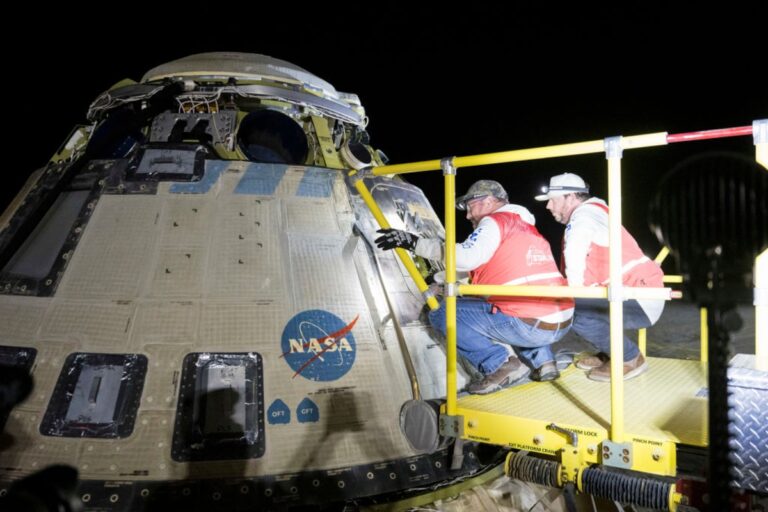
Aubrey Gemignani/NASA via Getty Images
NASA and Boeing will hold a high-stakes joint news conference at Kennedy Space Center at 3 p.m. ET on Monday, September 28, to discuss the future of Boeing’s CST-100 Starliner — a spacecraft that has transformed, through two years of grounding and more than $2 billion in accumulated losses, from a redundant crew taxi into something far more consequential: the only planned American vehicle capable of carrying astronauts to low Earth orbit once SpaceX retires Crew Dragon before the end of the decade. The NASA-Boeing news conference is being livestreamed at nasa.gov/live. The gap that Starliner was designed to fill as optional backup has become a gap it may be required to fill alone.
The briefing will feature NASA Administrator Jared Isaacman alongside Dana Weigel, manager of NASA’s Low Earth Orbit Program; NASA astronaut Woody Hoburg; and John Mulholland, vice president and program manager for Boeing’s Commercial Crew program. The appearance of Isaacman — who delivered a pointed public reckoning of both Boeing and NASA’s institutional failures just seven months ago — signals that today’s update is not a routine progress briefing.
What SpaceX’s Crew Dragon Exit Means for US Human Spaceflight
The context that defines this briefing arrived in mid-September, when Ars Technica and Gizmodo reported that SpaceX retirement of Crew Dragon is planned before 2030, when the International Space Station is scheduled for decommission and controlled reentry. SpaceX COO Gwynne Shotwell, appearing on the All-In podcast, was characteristically direct: “They should fly their capsule. The government paid a lot of money for that. They should be able to use it.”
Those comments came the same week NASA awarded SpaceX a three additional crewed ISS missions contract worth $946 million through 2030 — an award that extends Dragon’s operational life but does not alter SpaceX’s stated retirement timeline. The distinction matters. NASA has bought time; it has not solved the underlying problem. Once Dragon’s last mission is complete, the United States’ ability to independently crew low Earth orbit depends on Starliner being human-rated, operational, and flying on a rocket that has not yet been retired.
That last point is not incidental. United Launch Alliance plans to retire its Atlas V rocket after expending the six remaining Atlas V inventory flights, all of which are committed to Starliner missions. After those flights, Starliner will need to be recertified to fly on Vulcan Centaur — an additional certification step that adds to an already burdened timeline.
Sources told Ars Technica in the week before today’s briefing that NASA plans to announce two additional crewed Starliner missions beyond its current contract, cover part of the cost of fixing the spacecraft’s thrusters, and provide financial support to certify Starliner for Vulcan.
Why Starliner Has Not Flown Since June 2024
Boeing’s CST-100 Starliner last left the ground on June 5, 2024, when it launched NASA astronauts Butch Wilmore and Suni Williams on what was supposed to be an eight-day Crew Flight Test to the ISS. The mission went immediately off-script.
During the docking approach, five RCS thrusters tripped fail-off protection — a safety mechanism designed to shut down a thruster if it detects anomalous behavior — temporarily leaving the capsule without full six-degree-of-freedom control. Engineers traced the failure to two-phase oxidizer flow combined with Teflon poppet extrusion inside the thruster valves, occurring under duty cycles that qualification testing had never accounted for. Separately, seven of the eight helium manifolds on the service module leaked during the flight; helium provides pressurant for the propellant tanks.
Four of the five failed thrusters were recovered in orbit, allowing the docking to proceed. But with astronauts aboard, the math for return-to-Earth looked different. On August 24, 2024, NASA concluded it could not certify Starliner as safe enough to bring the crew home, and the capsule Starliner returned uncrewed to Earth on September 7, 2024. Wilmore and Williams came home nine months later, on March 18, 2025, aboard a SpaceX Crew Dragon.
In February 2026, NASA released a full investigation report classifying the mission as a Type A mishap investigation report — the agency’s most severe safety category, reserved for events in which a different set of circumstances could have resulted in loss of vehicle or crew. Administrator Isaacman used the report’s release to deliver his most pointed assessment of the program to date, as confirmed by coverage of his February 2026 remarks: “Starliner has design and engineering deficiencies that must be corrected. But the most troubling failure revealed by this investigation is not hardware. It’s decision-making and leadership — and, if left unchecked, it could create a culture incompatible with human spaceflight.”
Starliner’s Propulsion Fix: What Still Has Not Been Solved
The propulsion problems were not a single malfunction that could be fixed in one engineering cycle. They revealed multiple systemic gaps. Boeing’s corrective work includes new thermal barriers inside the enclosed thruster sections known as “doghouses,” revised in-flight thruster pulse profiles to manage heat buildup, and updated helium seal designs. But two unresolved propulsion challenges — helium leaks and propulsion system failures — remained as of March 2026, according to a NASA Office of Inspector General audit published June 30, 2026.
That OIG report, designated IG-26-011, audited NASA’s entire Commercial Crew Program and found the agency NASA uncertain on certification date as to when human-rating certification for Starliner would be obtained. The report documented that Boeing’s flight tests had uncovered numerous unexpected issues resulting in an additional six years of delays and identified three longstanding technical challenges blocking certification: helium leaks, propulsion system failures, and parachute anomalies. The auditor also recommended NASA defer payments to Boeing for Starliner-3 until human-rating certification is complete, and questioned $127.9 million in questioned payments already made.
At the Aerospace Safety Advisory Panel’s public meeting on June 23, 2026, a NASA participant reported that six anomalies under active investigation — including the doghouse overheating issue — and that the Starliner-1 uncrewed cargo mission could be “up to a year away.” As of July 30, 2026, NASA’s Bill Spetch, deputy manager of the Commercial Low Earth Orbit Program, described progress as good but declined to give a launch date.
Boeing CEO Kelly Ortberg offered the program’s most optimistic public framing on the company’s July 2026 earnings call, telling investors that the redesign work is going well and that the primary remaining obstacle is coordinating the mission schedule with NASA rather than any outstanding hardware problems. Boeing’s latest SEC filing put Boeing targeting Q4 2026 NET launch for Starliner-1, though NASA has not confirmed that window.
Does Starliner’s Financial Collapse Explain Its Technical Failures?
Understanding what went wrong with Starliner’s propulsion system requires understanding the financial structure within which it was built. The 2014 Commercial Crew Transportation Capability (CCtCap) contract was a fixed-price award: Boeing received a $4.2 billion fixed-price contract to design, build, qualify, and fly Starliner, with all cost overruns borne by Boeing, not NASA. That structure was intended to drive commercial discipline. Instead, across a decade of delays and failures, it has driven roughly $2 billion in Boeing-absorbed losses — while also, critics argue, creating incentives to cut testing rigor in order to control cost escalation.
Boeing recorded a $523 million reach-forward loss in 2024, the largest single-year charge on the program to date, pushing total cumulative losses past $2 billion. The company’s 2024 Form 10-K cited “schedule delays and higher testing and certification costs” as the driver. Additional charges in future periods remain possible, the company noted in its SEC filing. Since 2014, $9.8 billion total NASA investment across both Commercial Crew providers stands at approximately $9.8 billion, per the OIG audit.
Starliner’s losses belong to a broader pattern at Boeing Defense, Space and Security. In 2024 alone, five troubled Boeing fixed-price programs generated $5.013 billion in combined losses: the KC-46A tanker, the T-7A Red Hawk trainer, Commercial Crew, the VC-25B presidential aircraft, and the MQ-25 Stingray drone. Starliner’s share of that figure underscores that the program’s failures are embedded in a systemic problem with how Boeing manages long-duration fixed-price government contracts.
What Must Happen Before Starliner Can Carry Astronauts Again
Under the restructured contract NASA and Boeing agreed to in November 2025, the program’s next flight — Starliner-1 — has been redesignated as uncrewed cargo mission. The number of ISS missions NASA is contractually obligated to purchase from Boeing was also missions reduced from six to four, with two additional flights remaining as options. All previously assigned crew members have been reassigned to SpaceX missions; the most recent, Canadian Space Agency astronaut Joshua Kutryk reassigned to SpaceX Crew-13 in April 2026.
Before a crewed Starliner mission can fly, the Starliner-1 cargo mission must succeed, proving that the propulsion corrections hold up in actual spaceflight conditions. Only then will NASA certify the system for human flight, allowing up to three or possibly four crewed ISS rotations before the station’s planned 2030 decommission. With ISS compatibility limited to two docking ports on the Harmony module — one typically occupied by a Crew Dragon and the other by cargo vehicles — the scheduling constraints for any Starliner return are tight even in a best-case scenario.
In May 2026, NASA acknowledged the time pressure explicitly, awarding SpaceX sole-sourced additional SpaceX missions six additional post-certification missions, stating that the sole-sourced contract was “essential for NASA to fulfill its responsibility of maintaining uninterrupted flight access for ISS’s safe operation” in light of Boeing’s delayed certification.
Isaacman’s Role: From Astronaut to Accountability
NASA Administrator Jared Isaacman brings a different profile to this program than any of his predecessors. confirmed by 67-30 Senate vote in December 2025, he was sworn in less than two years after commanding the Polaris Dawn private spaceflight mission — making him a sitting NASA administrator who has directly experienced the operational stakes of human spaceflight certification failures. His “Project Athena” strategic plan, drafted in May 2026, emphasizes commercial partnerships, reducing bureaucracy, and refocusing NASA toward Mars and deep space missions.
On Starliner, his February 2026 statement was notable for assigning blame to both Boeing and the agency he now leads: NASA’s oversight model, he said, failed to catch the accumulation of unchecked risks before the crewed test flight. That public accountability — directed inward at NASA as much as outward at Boeing — marks a shift from the agency’s prior communications on the program, which tended to frame setbacks as technical challenges rather than institutional failures.
Whether today’s briefing produces that roadmap will be clear by 3 p.m. ET. What is already clear is the terrain: Boeing’s capsule, once one option among two, has become the load-bearing pillar of an American strategy for human presence in low Earth orbit past the end of the decade — a position it currently occupies while grounded, uncertified, and under the most stringent safety review of any US crew vehicle in recent history.
What Happens If Starliner Fails to Certify?
The post-2030 scenario, if Starliner cannot reach certification, presents a specific risk. SpaceX has stated it intends to retire Crew Dragon in coming years as it transitions to Starship as the primary crew transport vehicle. If Starship’s crewed certification slips — a real possibility given the complexity of human-rating an entirely new vehicle architecture — and Starliner remains unflown, the United States could face a period with no domestically certified crew vehicle capable of reaching low Earth orbit. New commercial space stations under development, including those from Axiom Space and other commercial partners, are planning on having a NASA-certified crew transport available. That supply assumption is now less certain than it appeared two years ago.
Has Starliner Been Canceled?
No. NASA has made clear it remains committed to certifying Starliner, and Isaacman’s February 2026 statement explicitly declined to discuss cancellation as an option. Sources indicate the agency is planning additional mission orders rather than contract termination. But the OIG audit is clear that certification will not be achieved in 2026, and the program’s history — marked by every major milestone slipping — gives Boeing and NASA limited credibility margin on timeline projections. The program that set out to restore US “dissimilar redundancy” in crew transport has instead created a period of singular dependence on SpaceX, and the path back to redundancy runs directly through a vehicle that still has six unresolved anomalies.
Frequently Asked Questions
When will Boeing Starliner fly again?
Boeing’s SEC filings target the fourth quarter of 2026 as no earlier than (NET) for the Starliner-1 uncrewed cargo mission, but NASA has not confirmed that window. A June 2026 NASA Aerospace Safety Advisory Panel meeting stated the mission could be “up to a year away.” The NASA OIG’s June 30, 2026 audit found that human-rating certification is now expected to slip to 2027 at the earliest. No crewed flight can occur until after Starliner-1 succeeds.
Will Starliner replace Crew Dragon?
That is the question today’s briefing is meant to address. SpaceX has stated it plans to retire Crew Dragon before 2030, making Starliner the only planned US vehicle for crew rotation missions after that point — unless Starship is human-rated in time. Sources indicate NASA is planning to announce additional Starliner mission orders and financial support specifically to ensure Starliner can fill the post-Crew Dragon gap. Whether Starliner can be certified, and launch reliably enough, in the time available is the open question.
What went wrong with Boeing Starliner during the Crew Flight Test?
During the June 2024 crewed test flight, five of Starliner’s 28 reaction control thrusters tripped their fail-off protection during the docking approach, and seven of eight helium manifolds in the service module leaked. Engineers traced the thruster failure to Teflon poppet extrusion under two-phase oxidizer flow — a failure mode that Boeing’s original qualification testing had not accounted for. NASA classified the mission as a Type A mishap, its most severe designation, in February 2026. Six anomalies remain under active investigation.
What happens to US human spaceflight if Starliner is canceled or fails to certify?
NASA has no formally announced backup plan if Starliner fails to reach certification before Crew Dragon is retired. SpaceX’s Starship is intended as a future crew transport, but it only SpaceX Starship reached orbit today on its fourteenth flight test — September 28, 2026 — a prerequisite milestone on the long path to human rating. A certification gap between Crew Dragon’s retirement and Starship’s readiness — with Starliner also uncertified — would leave the US without a domestic crew vehicle for low Earth orbit, impacting not just the ISS closeout but the commercial stations that private companies are developing to follow it.