China’s EV Makers Race to Beat Tesla With Ultra-Fast Charging In Under 10 Minutes

September 28, 2026:

China’s EV Makers Race to Beat Tesla With Ultra-Fast Charging In Under 10 Minutes

China’s electric vehicle industry is keen to set a new path for its vehicles. This time, automakers are competing to make EV charging faster than ever.

Companies such as Geely, BYD, and Li Auto are developing charging systems that could bring EV charging closer to the convenience of refueling a gasoline-powered car—something even better than Tesla.

Some of their newest systems can deliver a large amount of energy in just a few minutes. That could help reduce one of the biggest concerns among EV drivers: long charging times.

How Fast Can Chinese EVs Charge?

CHINA-AUTOMOBILE-SHOW
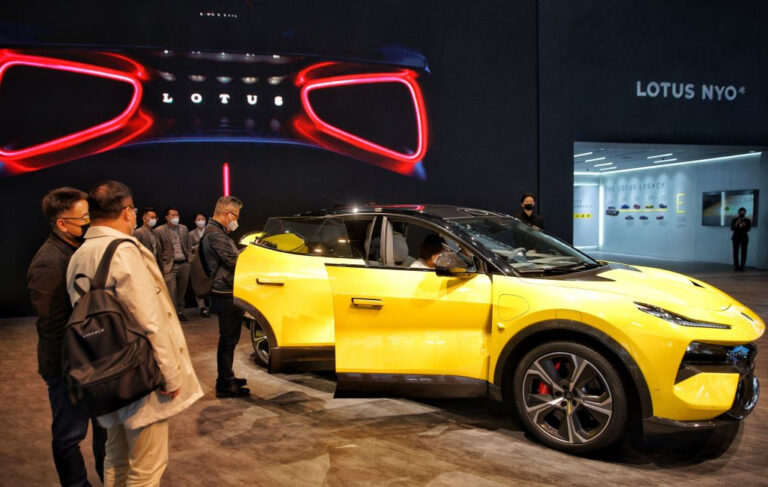
Visitors look at a Lotus car on the opening day of the 20th Guangzhou International Automobile Exhibition at Guangzhou, in China’s southern Guangdong province on December 30, 2022.
STR/AFP via Getty Images

Geely recently introduced an ultra-fast charging system with a peak output of up to 2.25 megawatts from a single charging gun.

Electrek reports that the company says the system can charge an EV from 10% to 70% in about 4.5 minutes. A 10% to 97% charge could take around 8 minutes and 40 seconds under room-temperature conditions.

BYD is also developing megawatt-level charging technology. Its latest Blade battery system is reportedly capable of charging from 10% to 97% in roughly nine minutes.

Li Auto has taken another approach by using CATL’s 5C Kirin battery in some of its flagship EVs. The battery can reportedly add up to 500 kilometers of driving range in about 12 minutes.

These charging times are considerably shorter than those offered by many existing fast-charging systems. For comparison, a typical Tesla Supercharger session from 10% to 80% can take roughly 15 to 25 minutes.

Why Is Ultra-Fast EV Charging So Difficult?

Charging an EV at extremely high power creates significant technical challenges.

According to NDTV, one of the biggest concerns is heat. Pushing large amounts of electricity into a battery within minutes can cause temperatures to rise quickly. Excessive heat can affect battery life and create safety concerns.

Automakers are therefore working on improved cooling systems.

Geely, for example, uses liquid cooling across parts of its charging system. This includes the charging equipment, cables and vehicle charging port.

Battery manufacturers are also modifying cell designs. Shorter cells and other structural changes can help manage heat during high-power charging.

Software plays a role, too. Geely is using artificial intelligence to predict temperature increases before they reach potentially dangerous levels.

Can Power Grids Support Megawatt Charging?

The challenge does not stop with the vehicle.

Ultra-fast charging stations can require enormous amounts of electricity. Widespread adoption could place additional pressure on local power networks.

Automakers are exploring different ways to manage this demand. Battery storage systems and solar power could help charging stations handle periods of high electricity use.

BYD has also announced plans to build 90,000 flash-charging stations by 2028. The company is also planning to install hundreds of charging stations in the United Kingdom.

The Future of EV Charging is Brighter

There may eventually be a practical limit to how quickly an EV battery can be charged.

Once charging times become short enough for everyday use, automakers may place greater attention on expanding charging networks rather than simply increasing charging power.

Battery swapping is another potential solution. NIO already operates thousands of battery-swap stations. These facilities allow drivers to replace a depleted battery with a charged one in roughly three minutes.

The competition in China’s EV market is therefore moving beyond battery size and driving range.

Source link