HomeAuto NASA Names Crew-14 as $946M SpaceX Deal Seals Dragon’s U.S. Spaceflight Monopoly
NASA Names Crew-14 as $946M SpaceX Deal Seals Dragon’s U.S. Spaceflight Monopoly
September 27, 2026:
Spacex.com
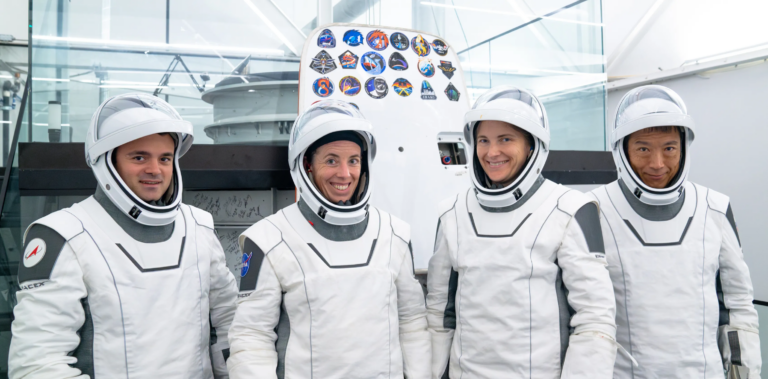
NASA on Thursday named the four astronauts who will fly Crew-14 to the International Space Station, targeting a spring 2027 launch from Florida and anchoring a mission built around three first-time flyers commanded by a Navy submarine warfare officer making her second trip to orbit. The announcement arrived six days after the agency awarded SpaceX a $946 million contract extension to fly three additional crew rotations — Crew-15, Crew-16, and Crew-17 — extending the company’s human spaceflight role through 2030 and bringing the cumulative value of its NASA crew contract to $5.92 billion.
That contract context matters: Boeing’s Starliner capsule, the other system NASA originally certified to carry astronauts, completed a troubled crewed test flight in June 2024 and has not flown NASA astronauts since, with crewed ISS flights from Boeing now expected no earlier than 2027 at the earliest. Until that changes, Crew Dragon is not one of two ways NASA gets people to the station. It is the only way. The Crew-14 announcement, paired with the $946M extension for flights stretching to at least Crew-17, formalizes a reality that has been building for two years: for practical purposes, SpaceX runs U.S. human spaceflight.
Who Is Flying on Crew-14?
Kayla Barron will command the mission, returning for her second stint aboard the station after her 2021 debut on Crew-3. During that six-month stay as part of Expeditions 66 and 67, she spent 177 days in space, completed two spacewalks totaling more than 13 hours, and served as lead robotics operator for a third. A commander in the U.S. Navy, Barron earned her submarine warfare officer qualification and deployed three times aboard the USS Maine. She holds a bachelor’s degree in systems engineering from the U.S. Naval Academy in Annapolis, Maryland, and a master’s degree in nuclear engineering from Peterhouse, Cambridge — where she studied as a Gates Cambridge Scholar — before NASA selected her as an astronaut in 2017.
Chris Birch will fly as pilot on her first spaceflight. She was selected as a NASA astronaut in 2021 after a career that included a PhD in biological engineering from MIT, teaching posts at UC Riverside and Caltech, and a separate career as a decorated track cyclist on the U.S. National Team. She was named to the U.S. Olympic Long Team for the Tokyo 2020 Games. At NASA, Birch served as a capsule communicator supporting both ISS crews and the Artemis II mission that took four astronauts around the Moon in March 2026, worked as crew lead for Expedition 72, and contributed to Orion Program development for Artemis.
Makoto Suwa of JAXA (Japan Aerospace Exploration Agency) will fly as a mission specialist on his first spaceflight. Before JAXA selected him in 2023, Suwa spent nearly a decade with the World Bank Group, previously served in Rwanda as a Japan Overseas Cooperation Volunteer, and worked with the United Nations World Meteorological Organization. He holds a doctorate in geosciences from Princeton University and completed basic astronaut training to earn his certification in 2024.
Arutyun Kiviryan of Roscosmos rounds out the crew as the fourth mission specialist, also flying to orbit for the first time. He studied at Baltic State Technical University, graduating in 2015 as a rocket science engineer, was selected for the Gagarin Research and Test Cosmonaut Training Center corps in 2021, and has served as a test cosmonaut since 2023. He was previously named as a backup crew member for Crew-13.
After docking, Crew-14 will join the ISS as part of Expedition 75/76, picking up from whichever crew rotation is onboard at the time of their arrival.
Why Crew Dragon Is Now NASA’s Only Astronaut Taxi
When NASA awarded CCtCap contracts in 2014, the plan was straightforward: two independent commercial providers — SpaceX and Boeing — would each develop a certified crew system, giving NASA redundancy and negotiating leverage. SpaceX delivered on schedule. Boeing did not.
SpaceX’s Crew Dragon first carried NASA astronauts on the Demo-2 test flight in May 2020 and earned full certification that November. Since then, it has completed 13 crew rotation missions without a loss of crew. The company’s Falcon 9 boosters have reached reuse counts of 20 or more flights, and individual hardware — nose fairings and Dragon capsules — are routinely reflown, with a fairing half recently achieving a 40-flight reuse record.
Boeing’s Starliner flew its first crewed test mission in June 2024, encountered thruster failures and helium leaks en route to the station, and ultimately returned to Earth uncrewed while its two astronauts completed their mission on Soyuz vehicles. NASA has not revealed a certified operational launch date for Starliner, and commercial crew missions have been awarded to SpaceX alone in the interim. The September 18 contract modification for Crew-15, Crew-16, and Crew-17 was explicitly issued as a sole-source award — meaning NASA did not seek competing bids because no other certified provider exists. The total contract value now stands at $5.92 billion, covering ground operations, launch, in-orbit operations, crew return, capsule recovery, cargo transport, and a lifeboat capability while Dragon remains docked.
How Crew Dragon Gets There: Autonomous Docking and Pressurized Cabin Life
A typical Crew Dragon mission from crew boarding to ISS docking takes roughly 24 to 28 hours. The flight profile runs as follows: a Falcon 9 rocket lifts off from one of SpaceX’s Cape Canaveral pads — either Launch Complex 39A or Space Launch Complex 40 — and deposits the Dragon capsule into low Earth orbit at approximately 250 miles (about 400 km) altitude above the International Space Station’s orbit.
From there, the spacecraft navigates autonomously. Crew Dragon uses the NASA Docking System (NDS), an androgynous low-impact docking mechanism that allows the capsule to approach and lock onto the ISS’s Harmony module forward port without requiring manual intervention or robotic arm capture. Pilots retain a manual override capability through a tablet-style touchscreen interface, but in normal operations the spacecraft handles the entire rendezvous and docking sequence on its own — a meaningful design departure from earlier capsule systems that required either manual piloting or robotic berthing via the Canadarm2 arm.
Once docked, the 16 Draco hypergolic thrusters used for orbital maneuvering go dormant, and the capsule’s Environmental Control and Life Support System (ECLSS) takes over maintaining cabin atmosphere. The ECLSS regulates cabin temperature — crew members can set the interior between 65 and 80 degrees Fahrenheit (18 to 27 degrees Celsius) — CO2 levels using lithium hydroxide scrubbers, oxygen concentration, and cabin pressure. The system is designed for fault tolerance, remaining safe under single failures, and the capsule is rated to remain docked at the station for up to 180 days in a standard rotation, or 210 days maximum — matching the Russian Soyuz spacecraft’s capability.
For emergencies during launch and ascent, eight SuperDraco engines provide abort capability. These engines are notable for their manufacturing method: the combustion chambers are 3D-printed in Inconel, a nickel-iron superalloy, using direct metal laser sintering, and the engines are housed in protective nacelles designed to prevent one engine’s failure from cascading to others.
What Crew-14 Will Actually Do in Space
Scientific research is the primary purpose of every ISS rotation mission, and Crew-14 will enter a research environment with more than 25 years continuous occupation behind it. NASA’s priorities for upcoming Expeditions center on understanding long-duration spaceflight’s effects on the human body — bone density loss, muscle atrophy, cardiovascular shifts, fluid redistribution toward the head, and Spaceflight-Associated Neuro-ocular Syndrome (SANS), a condition in which intracranial pressure changes affect astronauts’ vision — all of which must be solved before NASA can safely send crews to Mars.
For three of Crew-14’s members, every day in orbit will be their first, making them new data points in NASA’s longitudinal studies of first-time exposure to microgravity. Birch’s background in biological engineering — studying how cells and proteins behave under different physical conditions — positions her well to understand and contribute to the biological research program aboard the station.
Barron, as commander, will oversee station operations and the handover from whatever crew precedes Crew-14. That crew is expected to be Crew-13, targeting a net October 1 launch from Cape Canaveral. Crew-13’s original September 12 launch was scrubbed after engineers found an oxidizer leak in Dragon’s Grace propulsion system during routine prelaunch checks. The repair — described by NASA Administrator Jared Isaacman as “a very reasonable turnaround time” — took approximately three weeks, and underscored the preflight inspection protocols that govern every Crew Dragon mission before a crewed vehicle is cleared to fly.
ISS Cooperation Across Geopolitical Lines
The U.S.-Japan-Russia crew composition of Crew-14 is not unusual in the history of Crew Dragon — Crew-7 in 2023 carried a similar three-agency mix — but it is worth noting that this cooperation persists while U.S.-Russian relations remain strained in other arenas. The bilateral cross-flight agreement NASA and Roscosmos signed in July 2022 provides the legal framework for Russian cosmonauts to fly on Dragon and American astronauts to fly on Soyuz, ensuring the ISS keeps operating with multinational crews even as political relations outside the station have deteriorated.
That arrangement runs on a ticking clock. NASA plans to deorbit the ISS in the early 2030s, with operations winding down through 2030. Each crew rotation — Crew-14 among them — is simultaneously a routine science mission and a contribution to a program whose remaining runway is measured in single-digit years.
Does Crew Dragon Need a Backup?
The $946 million sole-source award to SpaceX is an acknowledgment that it currently has no effective competitor for the NASA crew mission. That is a normal state of affairs for aviation and aerospace programs — single-provider dependencies are common in military and civil aviation alike — but it does change the risk calculus when a Dragon oxidizer leak or a range scheduling conflict could delay a crew rotation with no fallback option.
Boeing’s path back into the program runs through a second crewed test flight, certification, and then an operational mission — a sequence that, given Starliner’s 2024 difficulties, is unlikely to produce a certified operational competitor before 2027 at the earliest. Until then, Crew-14, Crew-15, Crew-16, and Crew-17 all ride the same Dragon.
Frequently Asked Questions
Who is on the Crew-14 crew, and when do they launch?
NASA has named four crew members for Crew-14: commander Kayla Barron and pilot Chris Birch (both NASA), mission specialist Makoto Suwa (JAXA), and mission specialist Arutyun Kiviryan (Roscosmos). They are targeting a launch no earlier than spring 2027 from Kennedy Space Center in Florida. A specific launch date has not been announced.
Why is SpaceX the only option for NASA crew flights right now?
Boeing’s Starliner capsule — the other system NASA funded under its Commercial Crew Transportation Capability program — flew a crewed test mission in June 2024 that encountered thruster failures and helium leaks. The two NASA astronauts aboard returned on Russian Soyuz vehicles, and Boeing has not completed Starliner’s operational certification since. NASA issued a sole-source award to SpaceX for Crew-15, Crew-16, and Crew-17 in September 2026 precisely because no other certified crew provider currently exists. Boeing’s crewed ISS flights are not expected until 2027 at the earliest.
How does Crew Dragon actually get astronauts to the ISS?
A Falcon 9 rocket carries the Dragon capsule into low Earth orbit — approximately 250 miles (about 400 km) up — typically delivering the crew to the ISS’s Harmony module within 24 to 28 hours of launch. The spacecraft docks autonomously using the NASA Docking System without requiring crew intervention or robotic arm capture, though pilots can take manual control at any point. On board, a life support system (ECLSS) maintains cabin temperature, scrubs CO2, and regulates pressure. For emergencies during launch or ascent, eight SuperDraco abort engines — with combustion chambers 3D-printed in a nickel-iron superalloy — can fire in under a second to pull the capsule away from the rocket.
What does it mean for the ISS that its primary crew rotation partner is Russia, given current geopolitics?
NASA and Roscosmos signed a bilateral cross-flight agreement in July 2022 under which Russian cosmonauts can fly on Dragon and American astronauts can fly on Soyuz. That agreement has held through significant geopolitical tensions, and Crew-14 is one of several missions that will carry a Roscosmos cosmonaut alongside NASA and JAXA crewmates. The ISS’s multinational framework — built on a 1998 intergovernmental agreement among 15 nations — was specifically designed to be durable enough to survive political friction at lower levels. The station is planned for deorbit in the early 2030s; the cross-flight cooperation is expected to continue until then.