HomeAuto Rocket Lab Electron Nears 100 Flights on Synspective SAR Mission Tonight
Rocket Lab Electron Nears 100 Flights on Synspective SAR Mission Tonight
September 27, 2026:
JIJI PRESS/AFP via Getty Images
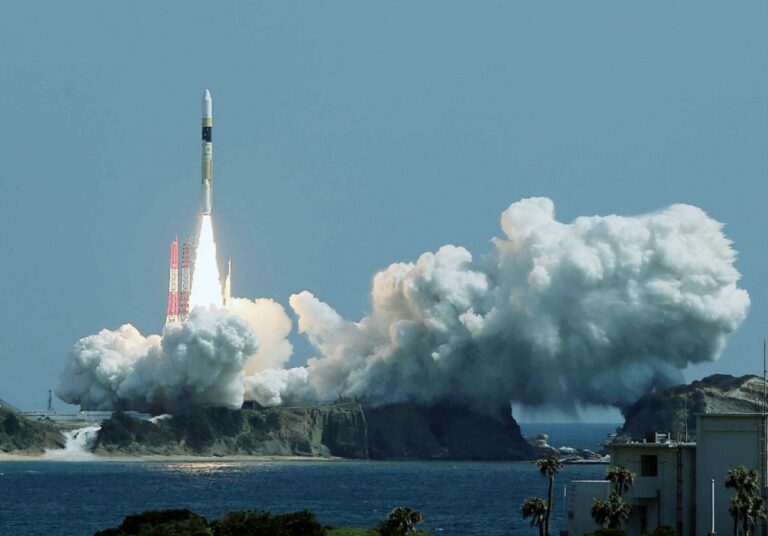
Rocket Lab’s Electron rocket is scheduled to lift off from New Zealand’s Māhia Peninsula tonight, carrying its 13th satellite for Japanese Earth-observation company Synspective and pushing Electron within three flights of its 100th launch — a cadence milestone built on an engine architecture that no other rocket in the world has replicated. The launch window for the mission, dubbed Owlright Owlright Owlright on Spaceflight Now’s launch schedule, opens at 8:15 p.m. ET tonight (0015 UTC on September 26). Electron is set to deliver a single StriX synthetic aperture radar (SAR) satellite to a 572-kilometer (355-mile) low Earth orbit. Tonight’s mission will be Electron’s 97th flight overall and its 18th launch of 2026, according to Rocket Lab’s official press release confirming the preceding 96th mission.
What makes that cadence possible is an engineering decision Rocket Lab made before Electron’s first orbital flight in January 2018: power the rocket’s turbopumps not with a gas generator — the industry-standard approach used in virtually every other orbital rocket — but with lithium-polymer battery-driven electric motors. The result, the Rutherford engine, is the world’s first electric pump-fed orbital rocket engine, and it is also the world’s first orbital rocket engine whose primary components — combustion chamber, injectors, pumps, and propellant valves — are entirely 3D printed components. Because the full component set prints in roughly 24 hours, Rocket Lab can sustain a launch tempo that traditional machined-and-cast hardware simply cannot match. Rocket Lab has now manufactured more than 1,000 Rutherford units at its Long Beach, California facility, making it one of the most produced orbital rocket engines on Earth.
Tonight’s mission is the latest chapter in one of the most durable dedicated launch partnerships in the small-satellite sector. Rocket Lab has flown for Synspective across every mission in the StriX constellation’s history — 12 successes before tonight’s flight, with 100% mission success across all of them — and has 15 more missions contracted through the end of the decade to complete the constellation.
Rutherford’s Hidden Role in Making This Partnership Possible
When a constellation operator chooses dedicated launch over rideshare, the decision comes down to orbital control. A rideshare customer places its satellite on an orbit defined by the mission’s primary payload; the customer gets the orbital altitude but cannot specify the orbit plane’s precise angular orientation — specifically, its Local Time of the Ascending Node, the parameter that determines which part of the planet the satellite passes over at which times of day. For a SAR constellation, where the revisit-rate geometry and coverage pattern depend on orbit-plane spacing, that control matters enormously.
Electron’s dedicated service solves the problem. Because Synspective is the sole payload on every flight, it can specify the exact orbit it needs, and Electron’s Kick Stage — an optional third stage powered by Rocket Lab’s 3D-printed Curie engine — can then circularize the orbit to precise parameters. For the StriX missions specifically, the Kick Stage performs an additional maneuver that no rideshare provider offers: it shields the satellite from the sun during transit to orbit, reducing radiation exposure before payload deployment. Rocket Lab also fabricates a custom Electron fairing tailored to the StriX satellite’s dimensions for each mission — a form of hardware customization that further distinguishes dedicated launch from commodity rideshare.
The electric pump architecture that powers this cadence replaces the gas turbines found in traditional rocket engines with brushless DC motors. Nine sea-level Rutherford engines drive Electron’s first stage, each producing 24 kilonewtons (5,400 pounds-force) of thrust, with a single vacuum-optimized variant on the second stage, according to Encyclopedia.pub’s Electron rocket entry. The motors are powered by lithium-polymer batteries that are “hot swapped” on the second stage — two of the three battery packs are jettisoned mid-flight once depleted to shed mass, a technique that balances energy efficiency against structural weight in a way gas-generator designs cannot. The outcome is an engine that can go from printed metal powder to flight-ready hardware in a fraction of the time required by conventional rocket propulsion, and a rocket that has grown its annual cadence by 1,700% since its first orbital flight in less than a decade, by Rocket Lab’s own accounting.
What StriX Satellites Actually Do — and How They Do It
A StriX satellite does not take photographs. It transmits active microwave pulses toward Earth’s surface and measures the reflected signals — a technique that makes it entirely independent of sunlight and capable of imaging through cloud cover, rain, and any atmospheric condition that would blind an optical satellite. This is synthetic aperture radar: by moving across the sky while transmitting and receiving signals, the satellite synthesizes a virtual antenna far larger than its physical hardware, producing imagery with resolution competitive with satellites carrying antennas many times larger.
Each StriX satellite weighs approximately 100 kilograms (220 pounds) and is capable of imaging Earth’s surface at one-to-three-meter resolution, as confirmed by Synspective’s satellite specifications. The key hardware innovation is a foldable deployable antenna — a parallel-plate slot array that expands in orbit to an aperture equivalent to a five-meter (16-foot) dish. That expanded aperture, combined with a high-output 1-kilowatt amplifier, enables wide-area imaging across three modes: Stripmap, Sliding Spotlight, and Staring Spotlight, each trading swath width for resolution in different proportions. The constellation’s name is a nod to this all-seeing quality: StriX derives from Strix Uralensis, the scientific name of the Ural owl — a species common in Japan — symbolizing the satellites’ ability to observe in total darkness, as Asia Times reported in February 2026.
The core technology originated in Japan’s Impulsing Paradigm Change through Disruptive Technologies (ImPACT) program, a government-led initiative to promote high-risk, high-impact scientific and technological research, developed in collaboration with the University of Tokyo, the Institute of Science Tokyo, and the Japan Aerospace Exploration Agency (JAXA), according to Synspective’s satellite documentation. Synspective was founded in 2018 as a commercial venture to deploy that research at scale, listed on the Tokyo Stock Exchange Growth Market in December 2024, and reported revenue of approximately 6.14 billion yen (approximately $38 million USD) in fiscal year 2025, according to the company’s financial disclosures.
Watching the World: StriX’s Defense Leap
Synspective’s constellation has crossed a threshold that its early-stage Earth-observation framing does not fully capture. In December 2025, the company was selected as a partner company in Japan’s Ministry of Defense Satellite Constellation Project — a Private Finance Initiative through which the Japanese government is building a persistent imagery intelligence network using private-sector satellite infrastructure, as announced in Synspective’s December 2025 press release. The service contract between Japan’s Ministry of Defense and the project’s Special Purpose Company — Tri-Sat Constellation Co., Ltd., established by Mitsubishi Electric, SKY Perfect JSAT, and Mitsui & Co. — was executed in February 2026, with a total contract value of 283.1 billion yen (approximately $1.76 billion USD) over a project period running through March 31, 2031. As a partner company, Synspective contributes satellite imagery data to the project alongside Axelspace, Mitsui Bussan Aerospace, and Institute for Q-shu Pioneers of Space.
Earlier, Synspective also won a Japan Air Self-Defense Force contract to develop security standard guidelines for space systems, in partnership with defense technology firm Skygate Technologies, for a contract value of approximately 99,990,000 yen (approximately $621,000 USD), according to Synspective’s official announcement. The company has also established relationships with NATO and the U.S. space and defense establishment, according to Asia Times reporting on the Ministry of Defense partnership.
A SAR constellation moving from civilian Earth-monitoring to formal defense intelligence participation is not merely a customer diversification story. Persistent imagery intelligence — the stated goal of the Ministry of Defense project — means a satellite network capable of repeatedly imaging any location on Earth at time intervals short enough to detect changes in military infrastructure, maritime positioning, or logistics movements. Synspective’s planned 30-satellite constellation, targeting completion by the late 2020s, is being designed explicitly to achieve that revisit cadence. Tonight’s launch adds the 13th satellite to that build-out.
Electron’s Path to 100
Rocket Lab’s progress toward the symbolic 100th Electron flight has been the product of a manufacturing philosophy, not a coincidence of scheduling. The company launched 21 Electron missions in 2025, setting a company record, and has completed 17 of what is now tracking to be its highest-volume year in 2026. In the first quarter of 2026 alone, Rocket Lab signed 36 new launch contracts — 31 for Electron and its HASTE suborbital variant, and five for the upcoming Neutron medium-lift rocket.
The Rutherford production line in Long Beach directly enables this pace. Because each engine’s major components are additively manufactured in roughly 24 hours and assembled in-house, Rocket Lab can produce rockets at a rate that traditional manufacturing schedules simply cannot match. The company passed its 1,000th Rutherford engine off the production line in 2025, achieving a volume that places the Rutherford among the most manufactured orbital rocket engines on Earth. The 3D printing architecture also enables rapid design iteration — changes that would require months of retooling in conventional manufacturing can be implemented in days — though Rutherford’s current design has proven mature enough that the primary focus has shifted from iteration to throughput.
Synspective is not relying exclusively on Electron to close out the constellation. The company has signed a launch agreement with SpaceX for five satellites, including two StriX satellites on a rideshare mission targeted for 2027, according to multiple industry tracking sources. But Electron remains the primary provider: with 15 missions still contracted and Synspective’s mass production facility in Kanagawa Prefecture — designed to produce 12 satellites per year, as Asia Times reported — Rocket Lab is set to remain the workhorse of the constellation’s deployment for the rest of the decade.
Mission Snapshot
Detail
Value
Mission Name
Owlright Owlright Owlright
Vehicle
Rocket Lab Electron
Launch Site
Launch Complex 1B, Māhia Peninsula, New Zealand
Window Opens
0015 UTC, September 26 (8:15 p.m. ET, September 25)
Target Orbit
572 km (355 miles) low Earth orbit
Payload
Synspective StriX SAR satellite (~100 kg / ~220 lbs)
Mission Count
13th dedicated Electron launch for Synspective; 18th of 2026; 97th Electron overall
Rocket Lab is expected to webcast the launch approximately 30 minutes before liftoff on its official YouTube channel.
Currency conversions are based on an approximate rate of 1 USD to 161 JPY as of September 25, 2026; converted figures are approximate.
Frequently Asked Questions
What makes Rocket Lab’s Rutherford engine different from other rocket engines?
The Rutherford is the world’s first orbital rocket engine to use electric pump-fed propellant delivery — replacing the gas generators or turbopumps found in virtually every other orbital rocket with battery-powered electric motors. It is also the first orbital engine whose primary components (combustion chamber, injectors, pumps, and propellant valves) are 3D printed, a manufacturing approach that compresses the full component-set production time to roughly 24 hours. This combination allows Rocket Lab to sustain a launch cadence — now approaching the 100th flight — that would be difficult to achieve with conventional manufacturing timelines.
Why does Synspective use Electron for dedicated launches instead of ridesharing with other companies?
Dedicated launch gives Synspective full control over orbital parameters — specifically the orbit plane’s angular orientation (called the Local Time of the Ascending Node), which determines when the satellite passes over which parts of the planet. For a SAR constellation, precise orbit-plane spacing is essential to the coverage pattern and imaging repeat cycle. Rideshare missions place the orbit plane at the primary customer’s specified angle. Additionally, Electron’s Kick Stage performs a sun-shielding maneuver unique to the Synspective partnership — shielding the StriX satellite from radiation exposure during transit — and Rocket Lab builds a custom fairing for each mission to the satellite’s exact dimensions. These mission-customization capabilities are not available on rideshare launches.
What is synthetic aperture radar, and why can it image through clouds while optical satellites cannot?
Optical satellites are essentially cameras — they require reflected sunlight and a clear atmosphere to capture images. Synthetic aperture radar works differently: the satellite transmits its own microwave pulses toward Earth, then measures the reflected signal. Because microwaves are largely unaffected by cloud cover, rain, or darkness, SAR can operate in any weather condition and at any time of day or night. The “synthetic aperture” comes from the satellite’s motion: by transmitting and receiving signals from many positions as it flies, the system synthesizes a virtual antenna far larger than the physical hardware, producing high-resolution imagery that rivals much larger physical antenna systems.
What is Synspective’s relationship with Japan’s Ministry of Defense, and what does it mean for the constellation?
Synspective was selected in December 2025 as a partner company in Japan’s Ministry of Defense Satellite Constellation Project — a government initiative to build persistent imagery intelligence infrastructure using private-sector satellites. The project’s total contract value is 283.1 billion yen (approximately $1.76 billion USD), with the service contract executed in February 2026 and running through March 2031. Synspective will contribute SAR imagery data to the project. This partnership means that the StriX constellation — being built out primarily through Rocket Lab Electron launches — is now formally part of Japan’s national defense surveillance network, not only a commercial Earth-observation service. The implications extend beyond commercial use: a 30-satellite SAR network designed for persistent, all-weather, day-and-night Earth imaging is also, by design, a persistent intelligence asset.