HomeAuto Auroras Hit Fairbanks Three Days After September Equinox: SOLAR-1 Saw It Coming
Auroras Hit Fairbanks Three Days After September Equinox: SOLAR-1 Saw It Coming
September 26, 2026:
Jonathan NACKSTRAND/AFP via Getty Images
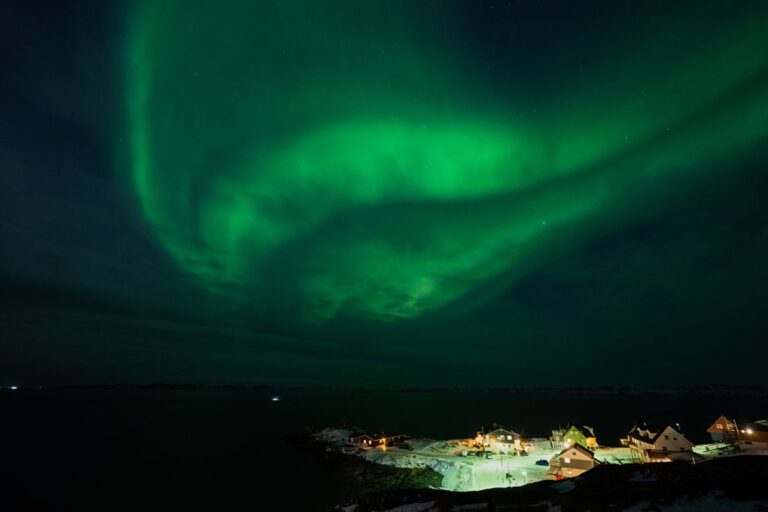
A canyon-shaped gap in the Sun’s outer atmosphere launched a pulse of fast solar wind toward Earth on September 22, 2026, and that pulse arrived on schedule at the start of September 25 — stirring our planet’s magnetic field to active levels and painting the Alaskan sky green for 19 minutes before dawn. What made the event worth watching was not just the aurora: it was the timing, the mechanism behind it, and what it revealed about America’s brand-new space weather sentinel.
What Happened Overnight in Fairbanks
Early on September 25, the UAF Geophysical Institute all-sky camera captured a 19-minute aurora display running from approximately 1:38 a.m. to 1:57 a.m. local time. The fisheye lens, which takes in the entire sky from horizon to zenith, recorded broad green bands opening the sequence, then a mid-display intensification into bright folded curtains and swirling ribbons, before the aurora spread out and faded — all of it visible despite a bright moon washing out the upper sky.
The driver was a coronal hole high-speed stream — fast solar wind from a region of the Sun where magnetic field lines open outward into space rather than looping back to the surface. That stream arrived at Earth on September 24–25, and the interplanetary magnetic field it carried pointed southward for the entire period, a configuration that allows solar wind energy to pour into Earth’s magnetosphere through a process called magnetic reconnection. The EarthSky September 25 sun news report confirmed the Bz component stayed southward throughout.
The planetary Kp index — a global 0–9 scale measuring geomagnetic disturbance — reached Kp 4 (active) at midnight UTC on September 25 and again at 2:57 a.m. UTC, holding at that level for three consecutive three-hour measurement windows. Forecasters had predicted a minor G1 geomagnetic storm (Kp 5), but the event fell one step short — what appears to have been either the core of the stream arriving weaker than forecast, or the strongest portion still en route when this article was written.
What Is a Coronal Hole, and How Does One Light Up Alaska?
Coronal holes are regions in the Sun’s corona — its outer atmosphere, burning at millions of degrees — where plasma is relatively cool and rarefied compared to surroundings. According to NOAA’s coronal hole explainer, they appear as dark patches in ultraviolet and soft X-ray imaging because the magnetic field lines there point outward and open into interplanetary space, rather than arching back to the solar surface as they do elsewhere. That open topology acts like a pressure valve: solar wind escapes at speeds typically two to three times faster than the ambient slow solar wind — commonly 500 to 800 km/s (300,000 to 500,000 miles per hour).
The physics chain from the Sun to a Fairbanks camera runs like this. When the stream’s embedded magnetic field points southward (the Bz component goes negative), it aligns anti-parallel to Earth’s northward-facing magnetopause. That geometry triggers magnetic reconnection at the magnetopause — the two opposing field structures snap together and release energy, opening a portal into Earth’s magnetic bubble. Energized electrons race down toward the poles along field lines and collide with oxygen and nitrogen molecules at altitudes of roughly 90 to 150 km (55 to 93 miles). The collisions excite those atoms, and as electrons cascade back to lower energy states, they release photons — green at 557.7 nanometers, from atomic oxygen, is the color most aurora photographers recognize.
Ahead of the fast wind itself, a structure called a co-rotating interaction region (CIR) played a role in the event’s onset. A CIR forms where the leading edge of a fast solar wind stream catches up to the slower ambient solar wind that left the Sun earlier, compressing the plasma into a density wave with strengthened magnetic fields — a process NOAA documents in its CIR overview. It is usually the CIR’s arrival that produces the sharpest initial spike in geomagnetic activity; the high-speed stream behind it then sustains the disturbance for days. That is why forecasters anticipated that unsettled conditions would persist through September 26–27 even after the stream’s peak passed.
Why Did September’s Timing Give This Stream Extra Punch?
The event occurred three days after the September equinox, and that proximity almost certainly boosted the aurora potential of what was, by objective measures, a fairly modest stream.
This amplification has a name: the Russell-McPherron effect. Published by geophysicists Christopher Russell and Robert McPherron of UCLA in 1973, the theory explains why geomagnetic activity peaks near equinoxes — around the March and September equinoxes — rather than simply tracking the ups and downs of the 11-year solar cycle.
The mechanism is geometric. The solar wind carries the Sun’s magnetic field outward in a characteristic orientation shaped by the Sun’s rotation — a structure called the Parker spiral. Earth’s magnetic axis is tilted relative to both its orbital plane and the direction of the solar wind flow. At the equinoxes, that tilt puts Earth’s magnetic field in the exact orientation that makes the critical Bz component of the incoming solar wind most likely to point southward — the configuration that opens the magnetosphere to geomagnetic activity. Scientists have known about the equinox aurora season for far longer than the R-M explanation: the pattern was first documented statistically by British scientist Edward Sabine in 1856 and discussed in Sydney Chapman and Julius Bartels’ authoritative 1940 textbook Geomagnetism. Russell and McPherron provided the physical mechanism for aurora seasons in their 1973 paper.
A complementary geometric factor, the equinoctial effect, adds a secondary boost. During equinoxes, Earth’s magnetic poles fall at right angles to the flowing solar wind for two intervals daily, making the solar wind effectively more potent for geomagnetic coupling during those periods. The two effects together mean that a stream arriving in late September will consistently outperform an equivalent stream arriving in July or December, as EarthSky’s aurora season overview explains.
C. Alex Young, Associate Director for Science in the Heliophysics Science Division at NASA Goddard Space Flight Center and co-author of EarthSky’s September 25 reporting, noted directly that the R-M effect likely provided the boost that allowed Kp 4 to produce visible high-latitude auroras where a forecaster might otherwise have expected little more than a quiet sky.
SOLAR-1’s First Big Operational Test — and What the Numbers Mean
None of the above would have been as useful for infrastructure protection without advance warning, and that is where SOLAR-1 enters the story.
SOLAR-1 — formally Space weather Observations at L1 to Advance Readiness-1 — is the first US dedicated space weather satellite designed exclusively for continuous, operational space weather monitoring. Launched on September 24, 2025, aboard a SpaceX Falcon 9 from Kennedy Space Center and initially known as SWFO-L1, it completed its journey to the Sun-Earth Lagrange Point 1 (L1) on January 23, 2026, and reached full operations by June 2026. The September 25 coronal hole event was therefore one of the satellite’s first major operational tests — arriving only about three and a half months into full service.
L1 is a gravitational equilibrium point between the Earth and the Sun, located approximately 1.5 million km (930,000 miles) upstream of Earth — roughly 1% of the Earth-Sun distance of about 150 million km (93 million miles). At that position, SOLAR-1 monitors solar wind from L1: it samples the solar wind and interplanetary magnetic field before they reach Earth, providing a 10- to 60-minute advance warning window. Solar wind plasma data arrives at NOAA’s Space Weather Prediction Center within 5 minutes of measurement, and coronal mass ejection imagery from the onboard compact coronagraph reaches forecasters within 30 minutes — compared to up to 8 hours for older observatory systems such as SOHO.
For the September 25 event, SOLAR-1’s Solar Wind Plasma Sensor (SWiPS) tracked the speed, density, and temperature of the incoming coronal hole stream in real time, while its magnetometer measured the Bz component that ultimately governed whether the aurora appeared. That combination — solar wind plasma data plus the magnetic field orientation — is what allowed NOAA’s Space Weather Prediction Center to issue its G1 watch on September 23, two days before the Kp 4 readings materialized. Power grid operators, satellite controllers, and high-altitude flight dispatchers all had time to prepare.
Is Anyone Watching the Sun Right Now?
SOLAR-1’s reading of the September 25 stream matters beyond this specific event. The planet still has a second concern to monitor: active sunspot region AR4536, which gained a delta magnetic configuration — the most complex sunspot polarity arrangement, with opposite magnetic poles packed into the same region — during the same period the coronal hole stream was arriving. A delta configuration signals the magnetic stress that can snap and release energy as a powerful M-class or X-class flare. As of this writing, NOAA forecasters estimate a 20% chance of M-class activity; the EarthSky September 25 report covers AR4536’s evolving status in detail. An M-class flare from AR4536 could produce its own solar radiation storm and potentially trigger coronal mass ejection effects separate from the ongoing coronal hole stream.
Why This Event Is a Preview of Space Weather’s Next Chapter
There is a broader context to this week’s aurora that the numbers alone do not fully convey.
Solar Cycle 25 peaked in October 2024 and is now declining. During the years around solar maximum, spectacular coronal mass ejections — the billion-tonne magnetized plasma clouds that launched the May 2024 G5 storm, the strongest in two decades — dominate the geomagnetic activity landscape. But as activity winds down, a structural shift occurs: coronal hole high-speed streams, not CMEs, become the primary drivers of geomagnetic storms during the declining solar cycle phase. This is a documented pattern across solar cycles. During solar minimum, CIRs are the main cause of geomagnetic storms.
That shift has a direct consequence for which part of SOLAR-1 matters most. During solar maximum, forecasters lean on the compact coronagraph to image incoming CMEs and estimate their arrival time. During the declining phase and eventual solar minimum — which is where the next three to five years will take us — the Solar Wind Plasma Sensor and magnetometer become the mission’s most operationally critical instruments, because they measure the steady, recurrent streams coming off long-lived coronal holes. SOLAR-1’s September 25 performance — tracking a coronal hole high-speed stream in real time and giving forecasters the lead time they needed — is precisely the use case that will define the satellite’s daily value for the remainder of this solar cycle.
Geomagnetically induced currents (GICs), which can damage long-distance power transmission infrastructure by exploiting the same physics behind an electric generator, require sustained disturbed conditions, not a single explosive event. North American power grids face concentrated GIC risk because they span enormous distances, run near the polar cap, and often run parallel to latitude lines — exactly the geometry that concentrates induced current. Coronal hole high-speed streams last for days, not hours; that persistence, not their peak intensity, is what GIC risk models track most carefully.
Can You See Auroras This Weekend?
Forecasters expected unsettled to active conditions to continue through September 25 during the day, with the coronal hole’s fast solar wind still affecting Earth. Through the weekend of September 26–27, isolated active periods up to Kp 4 remain possible, as noted in the latest NOAA aurora forecast. Thanks to the Russell-McPherron effect, the equinox season amplification will remain active for the next several weeks, meaning that aurora watchers at high latitudes — Alaska, northern Canada, Scotland, Iceland, Scandinavia — should watch NOAA’s SWPC Kp forecast in the days ahead.
At Kp 4, auroras are generally confined to the auroral oval: the ring-shaped band encircling the magnetic poles at around 74° geomagnetic latitude. Fairbanks, Alaska, sits deep inside that oval and will remain the most reliable US viewing site for this event. At Kp 5 — what was forecast but not quite achieved — the oval expands to reach the northern US border states.
The best nightly window is roughly 10 p.m. to 2 a.m. local time, when the auroral oval positions most favorably over any given location. Dark skies away from city lights matter more than a marginally higher Kp number when you are already inside the auroral zone.
Frequently Asked Questions
Why are auroras more common in September and March than in midsummer?
This is the Russell-McPherron effect at work. Around the March and September equinoxes, Earth’s orientation relative to the incoming solar wind puts the magnetic field geometry in its most favorable configuration for reconnection — the process that transfers energy from the solar wind into Earth’s magnetosphere. The north-south component of the solar wind’s magnetic field (Bz) is statistically more likely to point southward during these windows, which is the orientation that opens Earth’s magnetic field to solar wind energy and drives aurora production. This geometric alignment was first noticed statistically in 1856 and given its physical explanation in a 1973 paper by Christopher Russell and Robert McPherron of UCLA. Read about the equinox aurora season in detail.
What is SOLAR-1, and why does it matter for predicting auroras?
SOLAR-1 is the United States’ first satellite dedicated exclusively to continuous, operational space weather monitoring. Positioned about 1.5 million km (930,000 miles) upstream of Earth at the Sun-Earth Lagrange Point 1, it samples the solar wind and interplanetary magnetic field before they reach us — providing a 10- to 60-minute advance warning window. Its Solar Wind Plasma Sensor delivers data to NOAA’s forecasters within 5 minutes of measurement. That lead time allows power grid operators to reconfigure transmission infrastructure, satellite controllers to put spacecraft in protective modes, and aviation dispatchers to reroute polar flights away from heightened radiation exposure. SOLAR-1 became fully operational on June 10, 2026, making the September 25 event one of its first major real-world tests. Learn more at the SOLAR-1 Wikipedia mission page.
What is AR4536, and should people be watching it?
AR4536 is an active sunspot region currently on the Earth-facing side of the Sun. On September 25, it developed a delta magnetic configuration — the arrangement in which opposite magnetic polarities are packed into the same sunspot group, creating the internal stress that can release energy as a powerful solar flare. NOAA forecasters estimate a 20% chance of M-class flares from AR4536 as of this writing. An M-class flare can trigger a short-duration radio blackout on the sunlit side of Earth and, if accompanied by a coronal mass ejection, could produce a separate round of geomagnetic activity that adds to the ongoing coronal hole stream effects. Follow updates at EarthSky’s daily sun report.
Why do coronal hole streams matter more as the sun gets quieter?
Solar activity follows an 11-year cycle. At solar maximum — which Solar Cycle 25 reached in October 2024 — coronal mass ejections are the dominant drivers of large geomagnetic storms. As the cycle declines toward solar minimum, expected in the late 2020s, CMEs become rarer and coronal hole high-speed streams take over as the primary source of geomagnetic disturbance. Scientists have observed this pattern across multiple cycles: at solar minimum, co-rotating interaction regions (CIRs), the compressed shock structures that lead coronal hole streams, become the main cause of geomagnetic storms. The September 25 event is an early illustration of this transition — SOLAR-1’s real-time plasma monitoring capabilities become the most operationally critical part of the US space weather observation system for this reason. More detail is available at NOAA’s coronal holes page.