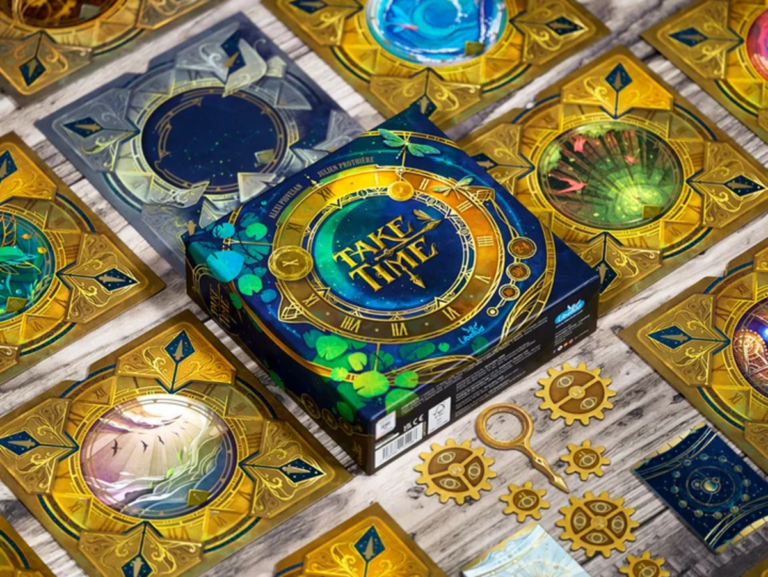
HomeAuto Three-Award Cooperative Game Take Time Launches Mirage Expansion in One Week
Three-Award Cooperative Game Take Time Launches Mirage Expansion in One Week
September 26, 2026:
Store.asmodee.com
With its first expansion — Take Time: Mirage — due at US retail on October 2, the award-decorated silent cooperative card game from Libellud is making a case that it has become a franchise, not just a breakout. Three independent international jury prizes later, and with what Asmodee has described as a record-breaking commercial run (specific sales figures pending independent verification), the $32.99 base game is entering an expansion era that will test whether its core mechanic can carry a growing universe.
Why Silent Cooperative Games Keep Winning Awards
If you want to understand why Take Time has accumulated three award wins in less than a year, start with the problem it solves that most cooperative games don’t.
The classic failure mode in cooperative board games — a genre that grew dramatically through the success of Pandemic (2008) and its kin — is what game designers call the alpha player problem. In a cooperative game where all information is visible and communication is unrestricted, one confident player can effectively direct all the others. The result is a game that feels less like teamwork and more like watching one person play while everyone else asks permission to act.
The limited-communication subgenre emerged as the most elegant solution. Hanabi (2010), which took the Spiel des Jahres prize in 2013, forced players to describe their own hand cards in a constrained code. The Mind (2018), designed by Wolfgang Warsch, stripped coordination to its absolute minimum: players simply had to play numbered cards in ascending order without speaking at all, relying entirely on synchronized timing and intuition. The game was nominated for the Spiel des Jahres, though its detractors argued it was more psychology experiment than game. Sky Team, the two-player dice placement co-op from Scorpion Masqué, won the Spiel des Jahres in 2024 with the same core concept applied to aviation. Bomb Busters, a deductive cooperative game, took the 2025 prize. The awards trail is not an accident — juries keep returning to this subgenre because it consistently produces experiences that a general audience finds both accessible and surprising.
Take Time, designed by Alexi Piovesan and Julien Prothière and illustrated by Maud Chalmel, advances the mechanic in a specific architectural direction that critics have noted makes it feel more like a strategy game than its predecessors.
How the Clock-Placement System Works
The game is built around a deceptively simple constraint system. A shared clock-face board sits at the center of the table. The deck consists of 24 cards: 12 Solar cards (numbered 1–12, identifiable by their white backs) and 12 Lunar cards (numbered 1–12, identifiable by their dark blue backs).
Each session begins with a “clock challenge” — one of 40 increasingly complex scenarios distributed across 10 chapters progressing from “Awakening” to “Rebirth.” Players study the challenge together and discuss strategy before cards are dealt. Once cards are distributed to each player — three cards per player in a four-player game, four cards each in a three-player game, or stacks of four and two in a two-player game — all verbal communication stops.
In silence, each player takes turns placing their cards face-down into sectors around the clock face. The universal rule is that each of the six clock sectors must receive at least one card. The specific challenge then layers additional constraints on top: some sectors must have cards totaling within a certain range; others require the Solar sum to exceed the Lunar sum; some demand that no single card exceeds a certain value. Cards are placed, not seen, until everyone has played all their cards — and then the group reveals and checks.
What distinguishes this architecture from The Mind is that players are reasoning probabilistically, not just synchronizing instinctively. Because you know the deck composition (24 cards, 1–12 in each suit), and because you spent the planning phase identifying where your group’s vulnerabilities are, placing cards in silence involves genuine inference: if you hold a Solar 3 and a Lunar 11, you can reason about where to put them based on what you discussed before the deal. The silence is informed, not purely intuitive. Austria’s jury cited this specifically in its Austrian Spiel der Spiele ruling, calling the game “a highly engaging, strategic cooperative game” that rewards both logic and intuition while remaining accessible to families.
A typical session takes around 30 minutes. The game is designed for two to four players, ages ten and up.
What Three Awards Mean for a Buyer’s Decision
Before the expansion arrives, here is what the award trail tells you.
Take Time won the Swiss Gamers Award 2026 — an audience-voted prize organized by Ludesco, Switzerland’s largest board game festival, voted by members of board game clubs, toy libraries, and gaming associations across the country. This second consecutive Libellud title to win the award; Harmonies won in 2025. The Swiss award tends to reward games with proven table appeal over critical buzz.
In July 2026, it won the Austrian Spiel der Spiele — Austria’s game of the year — defeating Florian Maas’ city-building game Project Skyline and Hjalmar Hach and Lorenzo Silva’s Railroad Tiles. The Austrian jury praised it as “easy to understand yet still providing depth of play” and specifically noted that it “captivates nearly all players.”
The Spiel des Jahres jury — the most scrutinized annual recognition in the global board game industry, founded in Germany in 1979 and now covering 571 new releases per year — placed Take Time on its 2026 Recommended list, which sits one tier below the main nomination. A Recommended citation from the Spiel des Jahres is meaningful: according to the Spiel des Jahres wiki, even a nomination (not a win) can push a game from 1,000–3,000 copies to roughly 10,000; a recommendation carries measurable commercial weight, particularly in the European market where the award carries institutional authority. The 2026 winner was Dito! (marketed in the US as JinxO), a word-association game from Indonesian publisher Tabletoys Games. Take Time was on the recommended list alongside Hot Streak, Master Makatsu, Toriki, Toy Battle, and Wilmot’s Warehouse.
The combined weight of three independent jury processes — two wins and one recommendation — from bodies with different evaluation criteria and voter populations is the strongest third-party validation a $32.99 game can carry. Each jury independently arrived at the same conclusion about a game with a 1.8 out of 5 complexity rating (per BGG) that the game delivers meaningfully beyond its apparent simplicity.
Libellud, Asmodee, and the Game’s Commercial Context
Libellud, founded in 2008 in Poitiers, France and acquired by Asmodee in the summer of 2020, is best known as the publisher of Dixit, the evocative image-association game that won the Spiel des Jahres in 2010. Take Time is one of the studio’s first fully cooperative titles with a progressive campaign structure.
Asmodee — listed on Nasdaq Stockholm (ticker: ASMDEE B) — reported record quarterly net sales of €524.1 million (approximately $705 million USD) for the October–December 2025 period, its third fiscal quarter, driven primarily by trading card games. The company’s board game publishing division saw a 12.7% decline during that same quarter, though recovery appeared underway by April–June 2026, when Asmodee’s own published-title sales grew 1.8% year-over-year.
Within that context, a verified commercial breakout in the cooperative card game segment is significant for the studio. The specific copies-sold figure cited for Take Time has not been independently confirmed as of this article’s publication; the figure circulating in trade coverage should be treated as a company-attributed claim pending external verification.
Libellud’s track record at the Austrian awards extends back over a decade: Dixit won the Austrian Spiel der Spiele family prize in 2010. Take Time co-designer Julien Prothière also won two Austrian awards in 2024 — the family game category with Featherweight Fiesta and the friends game category with March of the Crabs.
The Global Board Game Market in Which This Lands
Take Time‘s commercial moment arrives during a sustained period of board game industry growth. The global board games market was valued at approximately $15.83 billion in 2025 and is projected to grow to $17.45 billion in 2026, according to Fortune Business Insights, with a CAGR of 10.70% projected through 2034. North America accounts for roughly 42% of the global market. Analyst estimates for the market size vary — IMARC Group placed the 2025 figure at $20.3 billion with an 8.59% CAGR — but the directional consensus is consistent: the sector is growing, driven by demand for offline, in-person social entertainment.
The limited-communication cooperative subgenre specifically carries structural word-of-mouth advantages. When a game’s central tension is shared silence and collective success or failure, the social performance of the experience is inherently memorable and retellable — which drives the social media shareability that sustains sales long after a launch spike.
What the Mirage Expansion Offers
Take Time: Mirage, the first expansion for the base game, is scheduled for release at US retail on October 2, 2026, at a price of $9.99. The French-language edition was available from late August 2026.
Mirage introduces new clock boards with “unique mechanisms” and, according to Libellud’s product description, a standalone twist that can be played independently from the base game — meaning buyers who have not yet purchased the base game can enter the Take Time universe through the expansion alone, though the base game experience remains the primary product. The expansion adds a new thematic layer: a “Sandbird,” an elusive creature born from a moment frozen in time, as the narrative frame. New temporal-manipulation mechanics and a module for increased replayability using the base game’s clocks are included.
The expansion weighs approximately 150 grams (5.3 oz) and is marketed as a tuckbox-format supplement. Contents: one rulesheet, one acrylic pawn, one sleeve containing four clocks, one leaflet, and one punchboard.
Is Take Time Worth Buying Before the Expansion Arrives?
The honest answer depends on who is at your table. The game earns its awards when played with people who are willing to engage with the planning phase genuinely — who will think carefully about strategy when they can, and trust each other when they can’t. Its 1.8 complexity rating accurately reflects how little rules overhead is required; the cognitive work is in the coordination, not the rulebook. Groups who found The Mind frustrating because it felt too abstract will likely find Take Time more satisfying, because there is actual reasoning to do before the silence falls. Groups who loved The Mind‘s pure psychological minimalism may find the added structure welcome or unnecessary depending on preference.
The expansion’s $9.99 price point is low enough that the buying decision for an existing Take Time owner is straightforward. For a first-time buyer, the base game at $32.99 delivers 40 distinct challenges across a graduated 10-chapter structure — enough content for sustained play well past a single session. The combination of awards validation, confirmed replayability design, and an imminent expansion demonstrates that Libellud is treating the property as a continuing platform, not a one-off release.
Frequently Asked Questions
What is the difference between being “Recommended” and “Nominated” for the Spiel des Jahres?
The Spiel des Jahres jury announces three nominated games per category, plus a longer Recommended list of additional titles it considers excellent but did not shortlist. The 2026 Spiel des Jahres nominated games were Cozy Stickerville, JinxO/Dito!, and Morty Sorty Magic Shop; Take Time appeared on the SdJ 2026 Recommended list. A recommendation carries meaningful commercial weight, particularly in European retail, but the nominated games receive the most visibility in the weeks before the winner is announced. The 2026 winner was Dito!/JinxO.
How does Take Time’s silent mechanic differ from The Mind, the game it’s most often compared to?
The Mind requires players to play numbered cards in ascending order without any communication at all — success depends entirely on timing intuition. Take Time adds a structural planning phase before silence falls: players study the challenge and discuss strategy before they see their cards, then proceed in silence once cards are dealt. This means the silent phase in Take Time involves genuine probabilistic reasoning about where to place cards rather than pure intuitive synchronization.
Can the Take Time: Mirage expansion be played without owning the base game?
The English-language Mirage expansion (releasing October 2, 2026, $9.99) is described by Libellud and Asmodee as capable of being enjoyed independently, making it accessible to players who do not own the base game. However, the French-language edition on play-in.com specifies that the expansion requires the base game, which is in apparent tension with the English-language product listing. Buyers who want to confirm standalone playability before purchasing should verify with their retailer before the October 2 release.
What is driving cooperative board game growth, and where does Take Time fit?
The global board games market was valued at approximately $15.83 billion in 2025 and is projected to grow at a CAGR above 10% through 2034, driven by demand for offline, social entertainment. Within that growth, cooperative games benefit from a structural word-of-mouth advantage: the shared experience of winning or losing together is inherently social and memorable in ways that competitive games aren’t, which sustains long-term sales beyond initial launch windows. Take Time specifically addresses the longstanding “alpha player” problem in cooperative games — where one dominant player effectively runs the group’s strategy — by building in a silence requirement that levels the decision-making field.