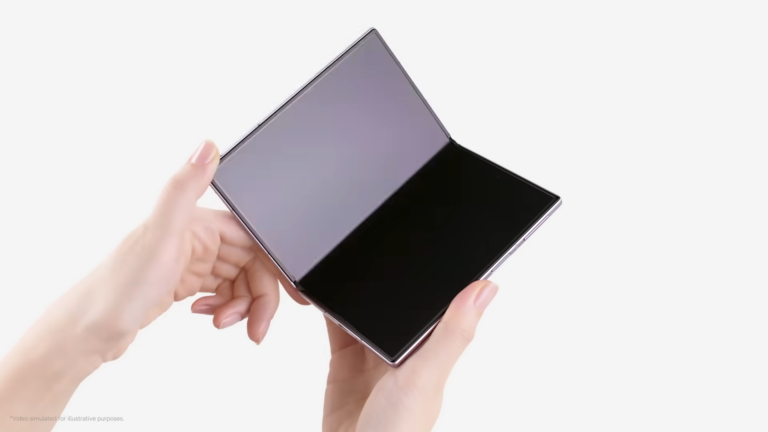
HomeAuto Samsung Galaxy Z Fold 8 Cover Screen Has Power Users Skipping Inner Display
Samsung Galaxy Z Fold 8 Cover Screen Has Power Users Skipping Inner Display
September 25, 2026:
Samsung.com
The Galaxy Z Fold 8’s most consequential software upgrade isn’t the three-way split-screen multitasking on its 7.6-inch (29.9 cm diagonal) inner display — it’s the cover screen that’s making owners forget to unfold at all. Two months into real-world use, a behavioral pattern has emerged among power users: routine tasks that previously demanded a flip to the inner display are now handled entirely from the 5.5-inch (14 cm) cover screen, thanks to a unified gesture architecture introduced with One UI 9 FlexWindow gestures. A September 24, 2026 editorial from MakeUseOf documented the shift, finding that early adopters had largely stopped reflexively unfolding their phones for messaging, calendar checks, media playback, and quick-settings changes.
Samsung unveiled the Galaxy Z Fold 8 at Galaxy Unpacked 2026 in London on July 22 and put the device on sale August 7 at $1,899, according to the Galaxy Unpacked 2026 London announcement. The phone represents the company’s most fundamental rethink of the Fold line’s form factor in six years, moving from a tall, narrow aspect ratio to a shorter, wider “passport-style” 10:16 cover screen and a 4:3 inner display. At 201 grams (7.1 oz), it is Samsung’s lightest Galaxy Z Fold ever. But it is the software that has proven most transformative in the hands of buyers — and that software story is now running on a compressed timeline, with Apple having unveiled the iPhone Ultra at its Apple Surprise and Shine event in Cupertino.
What One UI 9 Actually Changed on the Cover Screen
The reason cover-screen usage has shifted is architectural, not cosmetic. One UI 9 introduces a unified gesture namespace between the cover display and the inner display — meaning every swipe interaction a user has learned on the main screen now works identically on the cover screen, with no gesture remapping required. Swipe down from the left: notifications. Swipe down from the right: Quick Panel. Swipe across: widgets. Swipe up: the app drawer. Pinch to customize layouts in place. The interaction model is the same object at two different scales — a design Samsung confirmed via its One UI 9 FlexWindow gestures documentation.
This is a significant departure from One UI 8, which maintained a widget-first model on the cover screen that kept notifications, app access, and quick settings behind different interaction patterns than the inner display. The practical effect of that mismatch was muscle-memory friction: users who wanted to do something real — not just glance at a notification — found it faster to just unfold the phone. Stable One UI 9 ships preinstalled on all three 2026 foldables, removing that friction entirely.
When a user unlocks the Fold 8’s cover screen, they arrive at a home screen anchored by a Now Brief card — an AI-generated summary that surfaces the day’s calendar events, weather conditions, and contextual privacy alerts — alongside a launcher for frequently used apps. Swipe access to a full widget grid, unified notification and Quick Panel behaviors, and contextual AI actions via Now Nudge (which surfaces quick actions when an address, phone number, or calendar event appears in a message thread on screen) are all present without unfolding. The cover screen now functions as a standalone smartphone experience, not a lobby to the “real” device inside.
Gizmodo’s reviewer, testing the device for multiple weeks, noted that the cover screen’s shorter, wider footprint meant the urge to unfold the phone largely disappeared, according to the Gizmodo Galaxy Z Fold 8 review. SamMobile’s Flip 8 cover screen review coverage of the Galaxy Z Flip 8 — which received an equivalent software treatment on its FlexWindow cover display — explicitly noted that the interface redesign means “you need to unfold the phone less often.”
How the New Dual-Rail Hinge Works — and Why Fewer Folds May Not Be a Downside
The engineering story underneath the cover-screen shift is worth understanding for any prospective Fold 8 buyer, because it directly intersects with long-term durability planning.
The Galaxy Z Fold 8 introduces a new dual-rail hinge durability analysis, replacing the single-rail design used through the Galaxy Z Fold 7. In a single-rail hinge, all folding stress concentrates along one central spine. The dual-rail design routes that stress across two parallel rails, reducing localized delamination at the display crease over long-term use and enabling a 0.6 mm (0.02 in) reduction in folded thickness compared to the Fold 7.
Samsung rates the Fold 8’s hinge at 200,000 fold cycles, per the same dual-rail hinge durability analysis. At 100 folds per day — checking a notification, answering a call, opening a document — that rating works out to roughly 5.5 years of normal use. The average smartphone replacement cycle is two to three years, which means the vast majority of Fold 8 owners will replace the device before the hinge approaches its rated limit through normal folding.
If a cover-screen-first usage pattern reduces the daily fold count from, say, 100 to 40, the mechanical math changes: the same rated lifecycle now translates to somewhere between 13 and 14 years at the reduced rate. That is well beyond any reasonable ownership window, and it means the cover-screen shift — while driven entirely by software — has a material mechanical side effect: it meaningfully reduces the primary wear mechanism on a device whose most expensive engineering challenge is its hinge.
One tradeoff of the Fold 8’s redesigned hinge architecture is that Flex Mode absent Fold 8 — the ability to hold the device at intermediate angles, which allowed certain apps like YouTube to display video above the crease and controls below. Flex Mode remains exclusive to the Galaxy Z Fold 8 Ultra on the 2026 lineup. Buyers who rely on that feature should budget for the Ultra model.
Does the Cover Screen Have Real Limitations?
The cover screen improvement is genuine, but it comes with tradeoffs that reviews have documented consistently.
The most commonly cited complaint: the 5.5-inch, 16:10 cover screen is so wide — slightly wider than both the Galaxy S26 Ultra and iPhone 17 Pro Max when the Fold 8 is closed — that one-handed thumb typing becomes a stretch for users with average or smaller hands. Swipe-to-type keyboards reduce this friction significantly, but it is a hardware constraint that software can only partially compensate for. Samsung overcorrected on width after years of criticism that prior Fold cover screens were too narrow.
Additionally, some Fold 8 owners reported in September 2026 that the soft inner display corners report showed slightly more give when pressed than expected. Samsung subsequently clarified that this behavior is intentional: a cushioning structure applied to the outer corners is designed to reduce pressure on internal display components, and the company confirmed the behavior does not affect display performance. The reports appear isolated rather than widespread, a determination Samsung confirmed following review of user-submitted cases.
The Fold 8’s silicon-carbon battery 4,800 mAh specs supports 45W wired charging and 20W wireless charging, with Samsung rating the chemistry at 1,200 charge cycles. In sustained GPU workloads, Smartprix testing found the Snapdragon 8 Elite Gen 5 for Galaxy chip dropped to 45.9% performance stability — a limitation worth noting for users who intend to use the 7.6-inch inner display for extended gaming sessions.
What the Cover Screen Shift Means for the Competitive Landscape
The timing of this behavioral shift is pointed. Apple unveiled the iPhone Ultra at its Apple iPhone Ultra September announcement — a book-style foldable starting at approximately $2,000. iPhone Ultra pre-orders September 12 opened on that date. IDC’s Nabila Popal projected the iPhone Ultra would ship more than 10 million units in its first year, with Counterpoint Research estimating Apple could capture up to 46 percent of the US foldable market by end of 2026. The iPhone Ultra features a 5.5-inch outer display and a 7.8-inch (19.8 cm) inner display, and Apple’s cover screen implementation — and how it handles the same cover-screen-first usage pattern Samsung has now demonstrated — will be the central competitive variable for buyers comparing both devices.
Samsung’s position is, paradoxically, complicated by its own software success. As of 2026, the company ranks second in the global foldable market Q2 2026, having ceded the global top spot to Huawei in Q2 2026, while Motorola holds the leading US foldable market share position with its Razr line. The case for book-style foldables over cheaper clamshell foldables has historically rested on the inner display’s utility. If that inner display increasingly becomes an occasional tool — for deep multitasking and productivity sessions — rather than the default mode of phone use, the question a buyer must answer is whether the $1,899 investment reflects the premium value of those deliberate, high-value moments.
Samsung’s head of its Device eXperience Division, Roh Tae-moon, described the Fold 8 at Galaxy Unpacked 2026 as designed to “move easily from quick interactions on the cover screen to deeper viewing, reading and gaming on the main display” — a framing that explicitly places the cover screen first in the interaction sequence, consistent with Samsung’s stated One UI 9 FlexWindow gestures philosophy. What early users have discovered is that for a substantial portion of their day, the “deeper” moment on the inner display never needs to arrive at all.
Is the Galaxy Z Fold 8 Worth Buying Right Now?
For prospective buyers, the September 2026 moment is genuinely interesting: the Fold 8 has been in the hands of real users long enough to generate honest behavioral data, and the iPhone Ultra has just entered the market as a $100 to $600 more expensive direct competitor whose cover-screen approach will not be independently verified for weeks or months. Buyers who value proven, in-market software behavior over first-generation hardware promise will find the Fold 8’s cover-screen-first profile compelling. Buyers who are committed to the Apple ecosystem may prefer to wait for iPhone Ultra reviews to confirm whether Apple’s implementation produces a comparable behavioral shift.
What is not in question is that One UI 9 has, in two months, produced something Samsung has been attempting to achieve since the original Galaxy Fold in 2019: a foldable smartphone whose cover screen is good enough that the fold itself feels optional. Whether that optionality ultimately serves or undermines the product’s $1,899 value proposition is the question every buyer should sit with before deciding.
Frequently Asked Questions
Does the Galaxy Z Fold 8 have Flex Mode?
No. The standard Galaxy Z Fold 8’s redesigned dual-rail hinge opens fully once it reaches a certain angle and does not hold at intermediate positions, which means Flex Mode — the split-screen experience where content appears above the crease and controls below — is not available on this model. Flex Mode remains exclusive to the Galaxy Z Fold 8 Ultra. Buyers who rely on Flex Mode should select the Ultra, which also carries a larger 8-inch (20.3 cm) inner display and a 200-megapixel main camera.
Why are Fold 8 users using the cover screen instead of unfolding — and does that undermine the $1,899 price?
One UI 9’s unified gesture architecture makes the cover screen feel identical to the inner display for routine tasks: the swipe gestures, the notification pull-down, the app launcher, and AI context actions all work the same way on both displays. For messaging, calendar, media controls, and quick settings, there is simply no reason to unfold. Whether this undercuts the purchase case depends on how a buyer values the inner display moments that remain: three-way split-screen multitasking, extended document editing, video consumption, and reading — all of which genuinely benefit from a 7.6-inch (19.3 cm) canvas. The cover screen efficiency and the inner display capability are not in competition with each other; they are the same device at two different levels of engagement.
How does the Fold 8 cover screen compare to the iPhone Ultra’s?
Apple unveiled the iPhone Ultra at its September 9, 2026 “Surprise and Shine” event. The iPhone Ultra’s outer display measures approximately 5.5 inches (14 cm) — matching the Fold 8’s cover screen size — and Apple has emphasized hinge engineering and app optimization as priorities. Independent review-based comparisons of the two cover-screen experiences will emerge as reviewers gain time with the iPhone Ultra over coming weeks. The Fold 8’s advantage entering this comparison is two months of proven, real-world behavioral data demonstrating that its cover screen has changed how owners use the device. The iPhone Ultra enters as an announced product whose claims are not yet verifiable from sustained real-world use.
Is the Galaxy Z Fold 8 hinge durable enough for daily use?
Samsung rates the Fold 8’s dual-rail hinge at 200,000 fold cycles — equivalent to 100 folds per day for approximately 5.5 years. Since the average smartphone replacement cycle is two to three years, the hinge’s rated durability substantially exceeds the expected ownership period for typical use patterns. If cover-screen-first usage reduces daily fold count below 100, that margin grows further. The phone also carries an IP48 rating for dust and water resistance.