HomeAuto GTA 6 Turned Miami Into Vice City: Sign, Album, and Netflix Record Eight Weeks Out
GTA 6 Turned Miami Into Vice City: Sign, Album, and Netflix Record Eight Weeks Out
September 25, 2026:
Rockstargames.com
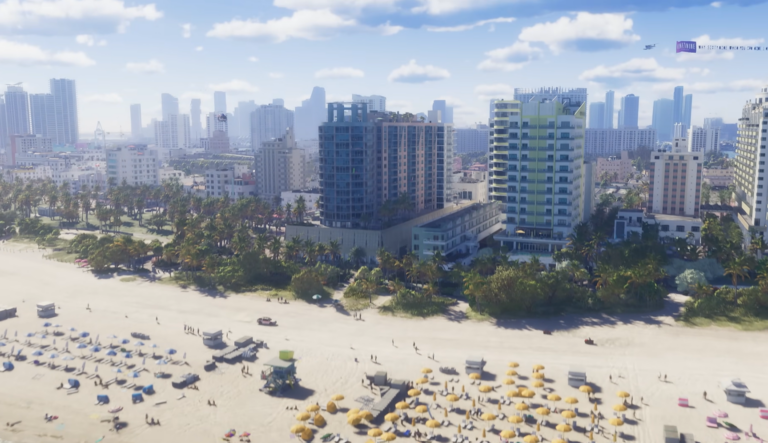
Two days ago, a helicopter lowered the last pink-and-white letter of a giant “Welcome to Vice City” sign installed by helicopter onto the roof of Miami’s Kaseya Center, the publicly owned arena that Rockstar Games first depicted in the fictional Vice City during GTA 6’s inaugural Trailer One in December 2023. That detail closes a loop — reality shaped the fiction, and now the fiction is rebranding the reality — and it marks the point at which Take-Two Interactive’s final eight-week push for the November 19 launch has moved from anticipation into spectacle.
GTA 6 Already Appeared in GTA 6’s First Trailer
Rockstar’s decision to center the Kaseya Center campaign is not accidental. The arena, home court of the Miami Heat, appeared in Trailer One as a recognizable Miami landmark rendered in the game’s Vice City setting, drawing immediate attention from Heat fans and gaming communities. When Rockstar returned to the same physical building to install a nearly million-dollar sign, it was not simply buying real-estate advertising — it was completing a mirror.
The deal, worth approximately $975,000, was arranged between Rockstar and Miami-Dade County, which owns the arena and whose mayor signed the agreement. Because the amount came in under the $1 million threshold, Miami-Dade Mayor Daniella Levine Cava’s chief of staff Christopher Hudtwalcker announced the deal at approximately 1:30 a.m. without requiring a full commission vote — a speed that itself generated controversy. Miami-Dade Commissioner Juan Carlos Bermudez publicly criticized the arrangement, arguing that Grand Theft Auto promotes violence and the killing of police officers, a position shared by Miami-Dade Sheriff Rosie Cordero-Stutz. The sign was installed regardless, on September 22, with each letter airlifted separately by helicopter and secured to the arena’s waterfront roof by ground crews. At approximately 4,700 square feet, the display is visible from aircraft approaching Miami International Airport.
The Kaseya Center is not the only real-world canvas Rockstar has acquired. Miami Beach’s city commission voted 4-3 on September 10 to allow Rockstar to advertise Grand Theft Auto VI along the seafront from October 15 through December 31, in a deal that could be worth close to $4 million to the city. The campaign uses the subdued approach: “Vice City” and the Roman numeral “VI” will appear on beach chairs and umbrellas managed by Boucher Brothers, the city’s licensed operator, rather than on buildings or landmarks. The words “Grand Theft Auto” are specifically prohibited from public spaces under the agreement’s terms. Separately, downtown Miami is advancing an ordinance — currently through its first reading, with paperwork filed on Commissioner Damian Pardo’s sponsorship — that would give Rockstar signage waivers for downtown banners typically reserved for events of the scale of the FIFA World Cup, allowing up to six large banners from October 15 through December 31. The Upperdeck heritage trail under the I-395 bridge would receive the permit revenue from the ordinance.
The combined value of the Miami real-estate campaign — the Kaseya Center sign, the Miami Beach seafront deal, and the potential downtown banners — represents something no previous gaming company has attempted: the systematic conversion of a real American city’s public and commercial spaces into a living advertisement for a fictional version of that city.
What Makes This Campaign Different From GTA V’s
Rockstar’s 22-month marketing campaign for Grand Theft Auto V, which ran from a first trailer in November 2011 through its September 2013 launch, relied on network television, print magazine covers, radio spots, and five major trailers — the media infrastructure of a different era. GTA 6’s campaign spans approximately five months and has deliberately avoided network television. “Thirteen years ago we were still buying network television. We won’t be buying a lot of network television,” Take-Two CEO Strauss Zelnick told GamesIndustry.biz in May 2026, describing the replacement as a “very significant broad-based marketing campaign that reflects where audiences and attention are today.”
What that shift looks like in practice is a campaign built on three structural pillars: streaming platform exclusivity, coordinated social media amplification across the music industry, and physical place-based installations that generate their own social media content. Each pillar is designed to work in the same media ecosystem rather than against it — the helicopter installation at Kaseya Center was itself engineered to be filmed and uploaded by bystanders, producing a day’s worth of earned media across X, Instagram, and TikTok without Rockstar spending a dollar on distribution.
The math behind this is specific. When Rockstar gave Netflix a six-hour exclusivity window on Grand Theft Auto VI: An Extended Look — a 27-minute gameplay showcase filmed entirely on PlayStation 5 — it handed the streaming service content it did not produce and did not pay to create, while Netflix gained what Sensor Tower data showed was an outsized opportunity for re-engagement and new subscriptions. According to Sensor Tower data, Netflix’s mobile app usage during the premiere hour (3:00–4:00 p.m. ET on August 27) rose nearly 50% compared to the average across the previous 12 Thursdays. Web traffic climbed more than 125% over the same baseline, briefly crashing the platform before recovery.
The Extended Look drew 31.1 million views in four days — August 27 through August 30 — and ranked number one on the platform’s English-language film chart in 87 of the 93 countries Netflix tracks. It ranked in that category despite being a video game showcase rather than a film, because Netflix had no existing category for what it was. The next most-watched title that week was The Whisper Man, a conventional theatrical film, which finished at 23.2 million views — nearly 8 million behind.
Is a Third Trailer Coming Before Launch?
What the campaign has conspicuously not yet delivered is a third official narrative trailer — the type of cinematic, story-focused reveal that GTA V’s July 2013 trailer provided roughly 10 weeks before that game’s September launch. Rockstar released Trailer One in December 2023 and Trailer Two in May 2025; as of September 24, 2026, no third trailer has arrived. With eight weeks until November 19, the gap to launch is narrower than the precedent from GTA V suggests is necessary for a conventional trailer release cycle. Whether a Trailer Three arrives before launch or the Extended Look serves as the equivalent of a third major campaign beat is, as of now, unconfirmed.
Music Industry Plugs In, Then Commits Fully
On September 15, eight musicians posted coordinated artwork on Instagram and X simultaneously, all rendered in GTA 6’s signature visual style and each tagging Rockstar Games. The roster included Travis Scott, who captioned his post “Phase 1” and tagged Rockstar directly; Morgan Wallen, who posted poolside imagery; Future and Metro Boomin appearing together; Swedish rapper Yung Lean; Puerto Rican singer Rauw Alejandro; Argentine duo Ca7riel and Paco Amoroso; and Rolling Stones guitarist Keith Richards, whose post featured an iguana rendered in the game’s visual style. The eight artists posting in coordination confirmed a formal Rockstar partnership through their posts’ simultaneous timing and consistent aesthetic, though neither Rockstar nor any artist specified the nature of the collaboration.
Two days later, on September 17, Rockstar ended the ambiguity. The studio announced the official album — Grand Theft Auto VI: The Album — a 34-track collection of original songs commissioned for the game, created in partnership with Atlantic Records, and scheduled for release on November 19 alongside the game itself. The first six tracks were made available immediately across all major streaming platforms. The opening batch includes Travis Scott’s “RHYNO,” produced by Daft Punk’s Guy-Manuel de Homem-Christo; Yung Lean’s “That’s It” featuring Future and Metro Boomin; Morgan Wallen’s “Last Thing You Need”; Keith Richards’ “Bright Lights, Big City”; Rauw Alejandro’s “Macacoa 2000”; and a collaboration among Ca7riel, Paco Amoroso, PinkPantheress, Fred again.., and Etienne de Crécy. The tracklist across six debut singles was made available September 18. The remaining 28 tracks are to be announced before launch. Vinyl editions, priced between $50 and $125, sold out rapidly after pre-orders opened.
This represents a structural shift from how Grand Theft Auto has historically handled music. Prior games, including the original Vice City in 2002 whose 1980s Miami soundtrack became a defining element of the game’s cultural reception, assembled their audio identity primarily through licensed radio stations playing existing tracks. The GTA VI: The Album model — original music commissioned across hip-hop, country, reggaeton, classic rock, and electronic pop simultaneously, released on a partner label ahead of launch — transforms the game’s soundtrack from a curation exercise into a cultural product in its own right.
Spotify Gets On Board
The day before the album announcement, on September 16, co-branded Spotify billboards carrying GTA 6 artwork appeared simultaneously in Los Angeles, New York, and Miami — the same images the eight artists had posted a day earlier, now stamped with the Spotify logo and displayed on large outdoor digital screens. Spotify posted photographs of the installations on its own social media accounts with no accompanying text. Neither Rockstar nor Spotify officially confirmed the scope of their arrangement as of September 24, though a formal announcement is expected shortly. The most discussed theory among industry watchers is a streaming exclusivity deal for the album’s first-week period; a less certain theory involves in-game Spotify integration allowing players to stream personal playlists through the game’s radio system.
Pre-Orders Already Set Records
By the time the Kaseya Center sign was lifted into place on September 22, the commercial machinery behind it had already produced record numbers. In the final week of June 2026 — the first week pre-orders were open — digital pre-order spending reached approximately $180 million across the United States and five major European markets (the UK, France, Germany, Italy, and Spain), according to analysis by market intelligence firm Newzoo. Scaling that regional figure by GTA 5’s historical player distribution, Newzoo estimated the global opening week at approximately $260 million globally — describing it as “the strongest pre-order campaign ever recorded” in the firm’s dataset. Newzoo Management Consultant Ronan Patrick separately pushed back on viral social media claims that GTA 6 had already crossed $1 billion in pre-orders, calling that figure implausible given how pre-order curves behave historically.
The game is priced at $79.99 for the standard edition and $99.99 for the Ultimate Edition. Both editions include the Vintage Vice City Pack for buyers who purchase before November 20, and digital pre-orders include a free month of GTA+. The $79.99 standard price represents the industry’s most commercially significant test of whether the AAA game price ceiling can shift from $69.99 to $79.99 permanently, given the scale at which GTA 6 is selling.
Analyst Expectations: History in the Making
Morgan Stanley analyst Matthew Cost told investors in May 2026 that Take-Two “remains uniquely well positioned heading into one of the largest entertainment launches in history,” forecasting 40 million units sold through Take-Two’s fiscal year 2027 — which ends March 31, 2027, giving roughly four and a half months from launch. Separately, Newzoo’s most aggressive scenario projects 51 million first-week sales, which would make it the fastest-selling entertainment product in history, with launch-week revenue estimated between $3.3 billion and $5.2 billion. Looking further out, analysts from Ampere Analysis and Wedbush Securities projected GTA 6 could generate approximately $10 billion over its lifetime, including ongoing GTA Online revenue.
For context, the predecessor — Grand Theft Auto V — launched in September 2013, sold more than 215 million copies across its 13-year lifespan, and continues to generate hundreds of millions of dollars annually through GTA Online, which Zelnick has described as a top-performing portfolio asset even as it approaches its own sunset.
What Comes Next
With eight weeks remaining, the campaign’s intensification is already scheduled. Miami Beach marketing begins October 15. Downtown Miami signage, pending a final commission vote, would follow in the same window. The NBA season opens in late October, placing the Kaseya Center sign on national broadcasts for weeks before launch. Rockstar has the remaining 28 tracks of Grand Theft Auto VI: The Album to announce. The Spotify partnership scope has not yet been publicly disclosed. And the question of whether a conventional narrative Trailer Three arrives before November 19 remains open.
What distinguishes this campaign from any prior gaming launch is not primarily its scale — though the scale is unprecedented — but its structural logic. Real-world activations generate their own social media documentation. Streaming platform deals create subscriber-acquisition events while distributing content Rockstar produced. An official album creates an independent cultural artifact that lives beyond the game’s launch weekend. Artists from six genres activate simultaneously, reaching audiences that individual genre marketing could not. Each element amplifies the others without Rockstar paying for distribution.
GTA V spent 22 months on billboards and television. GTA 6 spent five months putting a sign on a building that was already in the game.
Frequently Asked Questions
What is the “Welcome to Vice City” sign on the Kaseya Center?
The “Welcome to Vice City” sign is a large promotional installation on the roof of the Kaseya Center in downtown Miami — the arena used by the Miami Heat for NBA games. Rockstar Games paid Miami-Dade County, which owns the arena, approximately $975,000 for the temporary placement. The letters, rendered in GTA 6’s signature pink-and-white style, were lifted onto the roof by helicopter on September 22, 2026. The sign is notable not only for its size — approximately 4,700 square feet and visible from aircraft — but because the Kaseya Center itself appeared in GTA 6’s original Trailer One in December 2023, creating a feedback loop between the game’s fictional Vice City and the real Miami building it modeled.
What artists are on the official GTA 6 album?
Rockstar Games announced the official album on September 17, 2026 — Grand Theft Auto VI: The Album — a 34-track collection of original songs created in partnership with Atlantic Records, releasing November 19 alongside the game. The first six tracks released immediately: Travis Scott’s “RHYNO” (produced by Daft Punk’s Guy-Manuel de Homem-Christo), Yung Lean’s “That’s It” featuring Future and Metro Boomin, Morgan Wallen’s “Last Thing You Need,” Keith Richards’ “Bright Lights, Big City,” Rauw Alejandro’s “Macacoa 2000,” and a Ca7riel, Paco Amoroso, PinkPantheress, Fred again.., and Etienne de Crécy collaboration. The remaining 28 tracks have not yet been announced.
How many people watched the GTA 6 Extended Look on Netflix?
The Grand Theft Auto VI: An Extended Look — a 27-minute gameplay showcase that premiered exclusively on Netflix at 3:00 p.m. ET on August 27, 2026 — drew 31.1 million views in four days (August 27–30). It ranked number one on Netflix’s English-language film chart in 87 of the 93 countries the platform tracks globally. Netflix’s mobile app usage during the premiere hour was up nearly 50% compared to the average of the prior 12 Thursdays, and overall website traffic spiked more than 125%, briefly crashing the platform, according to Sensor Tower data.
Can I still pre-order GTA 6, and does it include anything extra?
Pre-orders for Grand Theft Auto VI are live at $79.99 for the standard edition and $99.99 for the Ultimate Edition. Buyers who purchase before November 20, 2026 — the day after launch — receive the Vintage Vice City Pack. Digital pre-orders additionally include a free month of GTA+. Pre-loading begins November 12 for those who pre-order. GTA 6 launches exclusively on PlayStation 5 and Xbox Series X/S on November 19, 2026. No PC release date has been announced.