HomeAuto IBM, Duke, and QuEra Quantum Computers Each Independently Simulated Proton Formation
IBM, Duke, and QuEra Quantum Computers Each Independently Simulated Proton Formation
September 24, 2026:
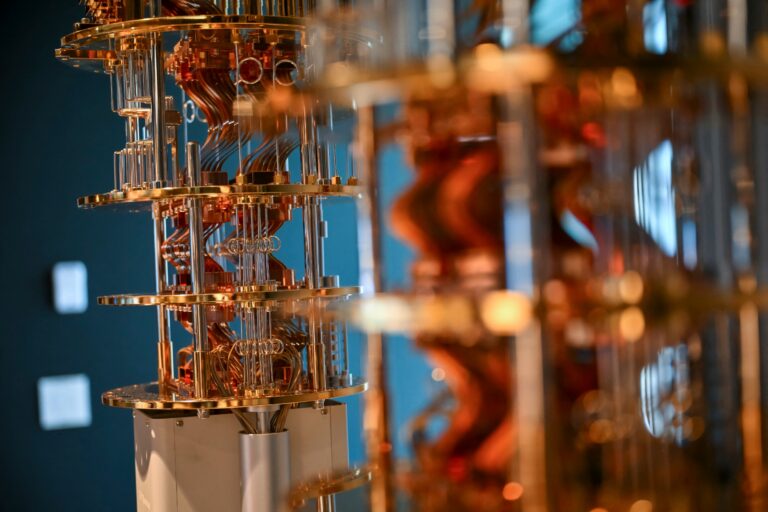
Parts of the IBM Quantum System Two are displayed at IBM Thomas J. Watson Research Center on June 6, 2025 in Yorktown Heights, New York. ANGELA WEISS/AFP via Getty Images
Three independent quantum computing platforms converged last week on the same fundamental physics result: the real-time simulation of gluon string-breaking, the process that creates every proton and neutron in the universe. On September 23, the Duke Quantum Center published a Nature Physics paper on trapped-ion string-breaking showing a trapped-ion quantum simulator observing string-breaking dynamics; that result joins an earlier superconducting experiment from Lawrence Berkeley National Laboratory (LBNL) published in Physical Review D and a parallel effort by QuEra Computing on neutral-atom hardware. Each platform independently overcame the same classical barrier — the sign problem, a fundamental computational obstacle that has blocked physicists from simulating how matter forms in real time for half a century — and the simultaneous success from three architecturally distinct machines suggests the barrier is not a hardware-specific hurdle but an algorithmically solvable one that is now systematically falling.
The LBNL experiment is the anchor study. In work led by research scientist Anthony Ciavarella and published in Physical Review D at DOI 10.1103/PhysRevD.111.054501, Ciavarella ran a real-time simulation of gluon string-breaking dynamics using 104 active qubits on IBM’s 156-qubit Heron processor — accessed remotely via the Quantum Computer User Program (QCUP), a federal cloud-access framework managed by the Oak Ridge Leadership Computing Facility (OLCF) at Oak Ridge National Laboratory. The results, drawn from a deliberately simplified model, reproduced key features of string-breaking that classical supercomputers cannot access in real time — and surfaced a transient thermal phenomenon inside the gluon string itself that was visible at this scale for the first time.
Why Classical Computers Cannot Simulate How Protons Form
Every proton and neutron in every atom of your body was assembled through hadronization — the process by which quarks, liberated in high-energy collisions, bind back into composite particles called hadrons. The whole process takes roughly 10⁻²³ seconds, far below the resolution of any detector, so physicists rely on computer simulations to fill in what experiments cannot observe. The trouble is that those simulations have never been derived from first principles.
The theory governing hadronization is quantum chromodynamics (QCD), which describes how the strong nuclear force binds quarks through the exchange of force-carrying particles called gluons. QCD is mathematically exact; the problem is computational. Accurately tracking the real-time evolution of even a modest quark-gluon system on a classical computer requires storing and manipulating every possible quantum state of every interacting particle simultaneously, and the number of states doubles with every new particle or time step added. The memory requirement grows exponentially. For real-time dynamics specifically, this becomes intractable through what physicists call the sign problem: Monte Carlo sampling methods — the workhorses of classical lattice QCD — cannot handle the oscillatory, complex-valued quantum amplitudes that govern out-of-equilibrium time evolution. The result is a Millennium Prize Problem in mathematics — confinement, the phenomenon from which hadronization flows, remains unproven analytically — and a decades-long experimental gap in particle physics.
Kenneth Wilson, who invented lattice QCD in 1974 and won the Nobel Prize in Physics in 1982 for his work on phase transitions, formulated the lattice approach specifically to make QCD tractable for numerical calculation. Lattice QCD has since computed the proton mass to within two percent of the measured value and predicted the temperature at which quark-gluon plasma forms at approximately 150 million electronvolts, roughly 1.7 trillion degrees Celsius (3.1 trillion degrees Fahrenheit). What it cannot do, by construction, is simulate what happens between the start and end states of a collision in real time.
“In principle, we know the theory that describes hadronization, but we are unable to make predictions using it because the calculations have been too difficult for a classical computer,” Ciavarella said in the ORNL press release accompanying the paper. “However, on a quantum computer, we should be able to directly make predictions for the details of how hadronization occurs, which will help with the searches for new physics performed at colliders such as the LHC.”
Quantum computers sidestep the sign problem entirely. Because qubits naturally exist in superpositions of states — mirroring the quantum behavior of the particles being modeled — their computational power grows exponentially with each additional qubit rather than the memory overhead doing so. The simulation is not a workaround of the classical barrier; it is a replacement of the classical framework with one that is natively suited to the problem.
A Simplified Model, Carefully Built to Avoid Fooling Itself
Ciavarella’s simulation is not a full QCD calculation, and he was explicit about that. Three deliberate simplifications made the problem tractable on current hardware while preserving the physical features of greatest interest.
First, the heavy quark limit: the simulation focused on quarks with significantly higher mass than those typically produced in collider events. Heavier quarks are more localized — they spread out less during time evolution — which allows them to be represented as discrete points on a simulation grid rather than extended probability distributions. This reduces the Hilbert space, the mathematical landscape of all possible quantum states, while preserving gauge invariance, the fundamental symmetry of the strong force. Results can then be extrapolated toward lighter, more physically realistic quarks.
Second, one spatial dimension: particles in the simulation move along a single axis. This is a significant constraint compared to the three-dimensional reality of a particle collider, but it allows the simulation to map cleanly onto qubits without the additional overhead of encoding spatial degrees of freedom. Ciavarella has indicated the next iteration will add a second spatial dimension, contingent on access to more capable hardware.
Third, the SU(2) gauge group instead of real QCD’s SU(3): real quantum chromodynamics governs three “colors” of color charge; the simulation uses a two-color version. SU(2) is qualitatively similar — it produces string-breaking and confinement — at dramatically lower computational cost. This is a standard stepping stone in lattice gauge theory research with a well-established track record.
Together these choices produce a 1+1-dimensional SU(2) lattice gauge theory in the heavy quark limit: a minimal but physically meaningful model of the process that makes hadrons. Classical lattice QCD studies of this class of theory have successfully described many static properties; real-time dynamics have remained inaccessible.
How 104 Qubits Prepared the Quantum Vacuum
The hardest technical problem was not running the simulation — it was starting it correctly. Any quantum simulation of a physical system must begin from a physically meaningful initial state, in this case the quantum vacuum, the lowest-energy configuration of the field from which particles emerge. Preparing this vacuum state accurately across more than 100 qubits is non-trivial: the circuits encoding the vacuum’s quantum structure are complex, and optimizing them naively requires resources that scale poorly with system size.
Ciavarella’s solution was the scalable circuit concurrent variational quantum solver (SC-ADAPT-VQE), a technique he co-developed during his doctoral work at the University of Washington. According to the ORNL press release on the work, the method optimizes vacuum-preparation circuits on small systems of 10 to 12 qubits classically, studies how the circuit parameters change as system size increases, and extrapolates that scaling relationship to construct circuits for systems of hundreds of qubits without re-running the full optimization on large hardware.
“The idea is to optimize these vacuum preparation circuits on a small system size,” Ciavarella explained. “Then you do it slightly bigger and slightly bigger and slightly bigger. So, by doing this, you can understand how the parameters of your circuit depend on the system size, and you can then extrapolate that out to doing it for a large system. For example, you can optimize this on up to 10–12 qubits and then extrapolate that out to hundreds if you choose to do so.”
The technique had been demonstrated previously in a 112-qubit Schwinger model simulation published by Ciavarella and colleagues at the University of Washington — Farrell, Illa, and Savage — in a 2024 paper in Physical Review D. The new hadronization paper is the first application of this scalable initialization approach to real-time gluon string-breaking specifically.
The hardware itself is IBM’s 156-qubit Heron processor, which uses a heavy-hexagonal lattice architecture in which each qubit connects to two or three neighbors to reduce crosstalk errors compared to more densely connected architectures. The Heron delivered a threefold to fivefold improvement in gate error rates compared to IBM’s earlier 127-qubit Eagle processors, making it practical to run circuits deep enough to track string-breaking dynamics in real time. Ciavarella used 104 of the chip’s 156 qubits — a deliberate choice reflecting the 1D lattice layout and the need to avoid regions of the chip with elevated error rates. For details on IBM’s Heron processor architecture and specifications, IBM’s quantum documentation provides a full technical breakdown.
What the Simulation Observed: A Glow Before the Snap
After error mitigation — post-processing to correct for residual noise — the quantum simulation reproduced early-stage string-breaking dynamics in agreement with classical reference calculations. That agreement is the validation that the approach is physically correct and the hardware is performing as intended.
The more striking finding was not a confirmation of known results. It was something classical methods have only glimpsed in highly restricted approximations.
“One of the findings that we reproduced here is that, in the middle of the gluon string, it starts to look like it’s gasifying at a finite temperature before it separates,” Ciavarella said in the press release announcing the experiment.
This “gasifying” effect is a localized thermal excitation in the interior of the gluon string just prior to breaking. The string, which carries significant potential energy as the quarks separate, appears to thermalize internally — behaving transiently like a gas at finite temperature — before the global string-breaking event occurs. The phenomenon is consistent with theoretical predictions about how gluon strings behave near the confinement-deconfinement transition, but it had never been directly observed in a real-time quantum simulation at this qubit scale.
“This is exciting because, if we see this reproduced across a wide range of different simplified models, then it should be more likely it’s an actual feature of QCD that describes the world we live in,” Ciavarella said. If confirmed across models and eventually in simulations closer to physical QCD, it would represent a direct quantum-mechanical observation of collective, thermodynamic behavior in the strong-force field — with implications for understanding the quark-gluon plasma that filled the universe in the first microseconds after the Big Bang.
Convergence Across Three Quantum Platforms
The LBNL result does not stand alone. The Duke Quantum Center paper, published in Nature Physics on September 23, 2026, reported that a team led by Christopher Monroe — the Gilhuly Family Presidential Distinguished Professor of Electrical and Computer Engineering and Physics at Duke — observed analogous string-breaking dynamics on a 13-trapped-ion quantum platform as described in the Duke Pratt School press release.
“Quantum computer simulations provide the best platform to investigate complex questions like matter formation, short of having witnessed the Big Bang itself,” Monroe said. The Duke experiment encoded string-breaking dynamics into a chain of 13 ions, controlled by precisely tuned laser beams, tracking how a stretched string of charge evolved and snapped in real time. An international collaboration including the University of Maryland, Oxford, Caltech, Cornell, and KU Leuven contributed to the paper.
Zohreh Davoudi, an associate professor of physics at the University of Maryland who participated in the Duke effort, put the stakes plainly in the Duke announcement of the results: “As a physicist, it is incredibly exciting to investigate the conditions of the early universe in an atomic-level computing machine. Even the slightest insights from an out-of-equilibrium physics model will guide us in the future.”
Monroe noted that the three platforms now converging on the same physics — IBM’s superconducting Heron qubits, Duke’s trapped ions, and QuEra Computing’s neutral-atom arrays — represent the three leading technologies in quantum computing, and their parallel success is itself a scientific signal, as detailed in the Duke Pratt School press release. Each platform has its own error profile and hardware constraints. Superconducting qubits scale well but accumulate gate errors more quickly than trapped ions; trapped ions offer higher fidelity per gate but slower clock speeds; neutral atoms offer reconfigurability. When all three independently arrive at the same physical result, it is strong evidence that the result reflects the physics rather than the hardware. That convergence is what makes the sign problem’s apparent retreat meaningful.
“These are the three platforms leading the charge in quantum computing, so it’s a nice benchmark and comparison for the quantum community,” Monroe said.
Why Does This Matter for Particle Physics at the LHC?
Current Monte Carlo hadronization models used by experiments like ATLAS and CMS at CERN’s Large Hadron Collider are fitted to empirical data rather than derived from QCD first principles, as earlier LBNL quantum simulation work by Christian Bauer and colleagues demonstrated. Discrepancies have been documented: the ALICE collaboration at CERN has reported cases where Monte Carlo generators predict incorrect baryon correlations, because those generators encode classical probabilistic distributions rather than genuine quantum entanglement. A quantum computer that could derive hadronization directly from QCD would provide independent theoretical predictions to test and refine those models — and could identify where existing generators fail in ways that purely classical computation cannot.
The path from a 1+1D SU(2) simulation to full three-dimensional SU(3) QCD remains long. The next iterations for Ciavarella’s approach include adding a second spatial dimension and moving toward more realistic quark masses — both goals that will require advances in qubit count, coherence time, and gate fidelity. IBM’s public quantum roadmap targets a fault-tolerant quantum system called Starling — capable of running 100 million quantum operations across 200 logical qubits — by 2029, with a larger system called Blue Jay, targeting 1 billion gates across 2,000 logical qubits, following by 2033. Whether those milestones arrive on schedule will significantly shape how quickly first-principles QCD simulations move from simplified models to LHC-relevant predictions.
For now, the signal from three quantum hardware platforms, arriving in the same year, pointing at the same underlying physics, is the most concrete evidence yet that the tools to decode matter’s origins are not a distant theoretical aspiration — they are here, running in the cloud, and they have already glimpsed something classical computers cannot.
Frequently Asked Questions
What is the sign problem, and why does solving it matter for particle physics?
The sign problem refers to a fundamental computational failure in classical Monte Carlo methods when applied to quantum field theories in real time: the mathematical amplitudes that describe quantum dynamics are complex-valued and highly oscillatory, which makes them impossible to sample statistically in the way that works for equilibrium physics. For particle physics, the sign problem means classical computers can calculate static properties of protons and neutrons to high precision but cannot simulate what happens between the start and end of a collision — the very dynamics that produce the particles detectors actually measure. If quantum computers can systematically overcome the sign problem, as this week’s convergence across three hardware platforms suggests, it would open the door to first-principles predictions of LHC collision outcomes that are currently derived only from fitted empirical models.
How does the SC-ADAPT-VQE algorithm make it possible to initialize 104 qubits in a physically meaningful state?
The central challenge in any quantum simulation of a field theory is setting up the correct initial state — in this case, the quantum vacuum from which particles emerge. Naively optimizing the initialization circuit for 100+ qubits would require computational resources that grow exponentially with system size, defeating the purpose of using a quantum computer. Ciavarella’s SC-ADAPT-VQE avoids this by optimizing vacuum-preparation circuits on systems of 10 to 12 qubits where classical computers can still handle the optimization, then studying how the circuit parameters scale as system size increases, and extrapolating those parameters to larger systems. The technique was developed during Ciavarella’s doctoral work at the University of Washington and had previously been applied in a 112-qubit Schwinger model simulation before the LBNL hadronization work.
Why are three different quantum hardware platforms converging on gluon string-breaking experiments now?
The convergence reflects both hardware maturity and algorithmic progress arriving simultaneously. Superconducting processors like IBM’s Heron have improved error rates enough to sustain the depth of circuits needed for real-time string-breaking; trapped-ion systems like Duke’s offer higher per-gate fidelity that reaches the same threshold through a different path; neutral-atom arrays like QuEra’s bring reconfigurability. On the algorithmic side, scalable initialization techniques — the class of methods Ciavarella’s SC-ADAPT-VQE exemplifies — solved the vacuum preparation problem that blocked earlier attempts. The fact that all three hardware approaches are now succeeding with the same physics suggests the remaining barriers are neither fundamental nor hardware-specific, and are narrowing simultaneously.
What does the gluon string thermalization finding mean for physics?
Before breaking, the interior of the gluon string connecting two separating quarks appears to thermalize locally — it briefly behaves like a gas at finite temperature rather than a purely quantum-mechanical wave. This transient thermal behavior had been predicted theoretically and seen in highly restricted classical approximations, but the LBNL simulation is the first to observe it at scale in a real-time quantum simulation. If the effect reproduces across multiple simplified models — the next test — it becomes increasingly likely to be a genuine feature of QCD rather than an artifact of the simplified model used here. The physics implication connects directly to the quark-gluon plasma produced in heavy-ion collisions at RHIC and the LHC, and to the thermalization of the early universe in the first microseconds after the Big Bang.