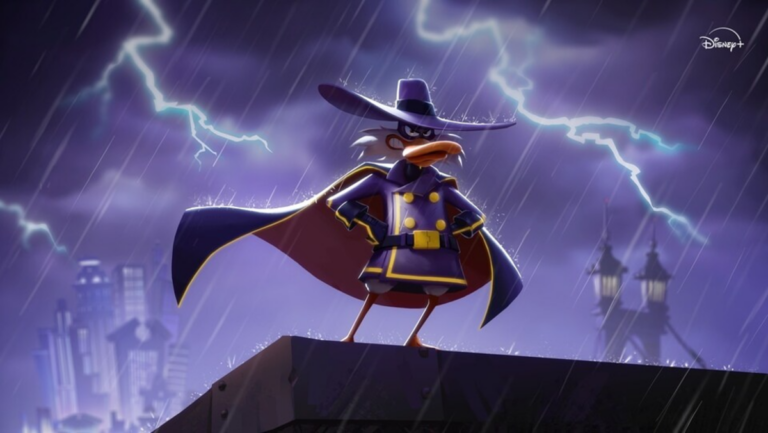
HomeAuto Mark Hamill Cast as Darkwing Duck: Voice of Batman’s Joker Joins His 1992 Rival Show
Mark Hamill Cast as Darkwing Duck: Voice of Batman’s Joker Joins His 1992 Rival Show
September 23, 2026:
Disneyplus.com
Mark Hamill — the actor who has voiced The Joker in every significant DC animated production since 1992 — has been cast as the lead of Disney+’s newly Disney greenlit new Darkwing Duck revival, a series whose original run began the very same year Hamill’s Joker defined what animated villainy could be. The convergence is not incidental. When Batman: The Animated Series premiered on Fox Kids in September 1992 and Darkwing Duck was already in its first syndicated season on ABC, those two shows represented opposite poles of the animated superhero genre — one earnestly dark, one knowingly comedic. Hamill gave voice to the former’s most celebrated villain; he will now voice the latter’s self-aware, ego-driven hero.
Disney+ greenlit the new Darkwing Duck series on September 22, 2026, announcing a full 11-person voice ensemble and revealing an official premise that marks a significant creative departure from anything previously reported. The series comes from showrunners Sean Tretta (Star Trek: Picard) and Borja Peña Gorostegui (Lost & Crowned), with Seth Rogen, Evan Goldberg, James Weaver, Alex McAtee, and Gabby Grantham producing for Point Grey Pictures. Original series creator Tad Stones consulted on the development.
Darkwing Duck Is Back — and He Has Been Lost for Decades
The official premise of the new series reaches further back in the franchise’s mythology than expected. Disney+ describes the show this way: “For the last 35 years, Darkwing Duck has been trapped in his worst nightmare: an alternate world that’s never heard of his superhero exploits. Now a rebellious teen named Duckie who knows all about his heroic past shows up to pull this ego-fueled vigilante back into battle. Together, this unlikely duo will get dangerous to fight old enemies like Negaduck and Megavolt and reunite with allies Launchpad, Gosalyn, and Morgana to save the entire universe.”
The show’s structural engine, in other words, is not Drake Mallard alone — it is the partnership between an exiled hero who has spent three and a half decades forgotten and a teenage girl who has never forgotten him. Duckie, voiced by Lilimar (Inside Out 2), is effectively the audience surrogate: a fan of Darkwing Duck in a world where Darkwing Duck has ceased to exist, who pulls the hero back into relevance by knowing who he used to be. This premise places the series squarely in the tradition Tad Stones himself described: “Robin Hood, Zorro, and Sherlock Holmes — heroes whose lore has been reinterpreted by multiple creators in multiple mediums.”
Full Cast of Disney+’s Darkwing Duck
The lead cast as announced by Disney+ September 22:
Mark Hamill (Batman: The Animated Series, Batman: Arkham Asylum) as Drake Mallard aka Darkwing Duck; Seth Rogen (The Muppet Show) as Launchpad McQuack; Lizzy Caplan (Party Down) as Gosalyn Mallard; Lilimar (Inside Out 2) as Duckie; Dan Stevens (Onslaught) as Glade McTowers; Tiffany Shepis (Star Trek: Picard) as Rosa; Kathryn Newton (Avengers: Doomsday) as Firecracker; Teo Briones (Final Destination Bloodlines) as Timb; Tyler Dean Flores (Neon) as Pondsy; Katie Rich (Saturday Night Live) as Officer Shanks; Nat Faxon (The Descendants) as Officer Webb.
The show marks the first full animated revival of the property since the original 91-episode run concluded in 1992, after which the character appeared in the 2017–2021 DuckTales reboot but did not headline his own series.
Why Mark Hamill Completes a Loop Three Decades in the Making
Hamill’s casting is not merely clever meta-commentary — it is the closing of a specific historical circuit in American animation. His Joker in Batman: The Animated Series premiered on Fox Kids on September 5, 1992, the same month Darkwing Duck was in its second broadcast season on ABC and in syndication. The two shows ran simultaneously on competing networks, serving the same age demographic, with inverse philosophies about what a superhero show should feel like.
Batman: The Animated Series was dark, psychologically layered, and emotionally earnest — its Joker a genuinely menacing figure capable of real dread beneath the comedy. Hamill has spoken about designing the Joker’s laugh like color on a canvas, with sinister, joyful, and malevolent varieties calibrated for different scenes. Darkwing Duck, created by Tad Stones, was the opposite: a genre parody in which every episode trafficked in explicit references to superheroes and pulp heroes, and in which the protagonist’s defining quality was his ego and his theatrical self-presentation. The city of St. Canard is a direct parody of Gotham City — canard is French for duck.
Hamill’s Joker ran from 1992 through Batman: Arkham Asylum (2009) and multiple animated series and games, a run widely recognized as the longest portrayal of The Joker by any actor in any medium. He has now been cast as the lead of the show that, in 1991, was Batman: TAS’s tonal mirror. The man who defined the dark pole of animated superhero storytelling will now voice the comedic pole’s most enduring protagonist.
What Happened to Jim Cummings
The original voice of Drake Mallard/Darkwing Duck across the 1991–1992 run, the 2017 DuckTales crossover episodes, and the Chip ‘n Dale: Rescue Rangers film (2022 mid-credits scene) is Jim Cummings — who has voiced over 400 Disney characters across four decades and won Annie Award for television for his Darkwing performance.
Cummings will not reprise the title role. In a 2026 interview with Screen Rant, he described the project as still active, saying “we’ve only recorded basically one offshoot so far,” and spoke about it as a continuation with older versions of the characters. The September 22 announcement confirmed the recasting without explanation. As of that date, Cummings had confirmed his involvement only in a limited capacity, and his earlier public comments — including a widely shared post about being omitted from the 2026 Disney Legends inductee class — had generated fan debate. Disney has offered no public explanation for the recasting, and no confirmed connection to any extraneous matter has been established.
Cummings’ four decades at Disney and his specific Annie Award-winning history with this character make his exclusion from the title role a meaningful element of the announcement — one the production has not yet explained.
What Science Lurks Inside St. Canard
For TechTimes readers, the casting announcement reopens a question the original series posed and then filed away: how accurate was Darkwing Duck’s villain science, and what has happened to it in the 35 years since?
Megavolt and Bioelectricity
Elmo Sputterspark, a high schooler whose science fair project was sabotaged until a surge rewired his nervous system to the electromagnetic spectrum, is the show’s most scientifically grounded villain. The premise — a nervous system permanently altered by high-voltage electrical trauma — has genuine medical analogues. Electric eels (Electrophorus electricus) generate up to 860 volts through stacked electrocyte cells that discharge via coordinated ion-channel gating, essentially operating as biological batteries. Megavolt’s powers are that same mechanism scaled to absurdity.
His recurring memory loss — a running gag in the original series — accidentally maps onto a documented neurological consequence. Repeated high-voltage electrical discharges through brain tissue produce effects analogous to electroconvulsive therapy, which is clinically associated with both retrograde and anterograde amnesia. The show’s writers did not intend it, but Megavolt’s memory problems are physiologically plausible.
Bushroot and Synthetic Photosynthesis
Dr. Reginald Bushroot attempted to integrate plant chloroplasts into animal cells to grant humans the ability to photosynthesize — and succeeded, at the cost of his own human form. In 1991, this was pure fantasy. As of 2026, synthetic photosynthesis and horizontal gene transfer in eukaryotic organisms are active research domains. The sea slug Elysia chlorotica sequesters functional chloroplasts from algae and retains them for months, using genes it has incorporated through horizontal gene transfer — making it, in a narrow biological sense, the real-world organism closest to what Bushroot was supposed to be.
The Liquidator and Non-Newtonian Fluids
Bud Flud’s transformation into a being of “living water” — one who could control water’s viscosity and state — maps onto non-Newtonian fluid dynamics. Shear-thickening fluids (dilatant fluids) become rigid under applied stress; shear-thinning fluids (thixotropic fluids) flow more easily when agitated. Military body armor using shear-thickening fluid systems is commercially deployed — the same physics principle Flud’s powers invoke, taken to its extreme.
Negaduck and the Many Worlds
The Negaverse — Darkwing Duck’s evil mirror dimension — is a children’s-media rendering of many-worlds interpretation of quantum mechanics first formulated by Hugh Everett III in 1957, in which every quantum event produces a branching of the universal wavefunction and every possible outcome occurs in some branch. The Tronsplitter device that originally created Negaduck by separating Darkwing’s “positive” and “negative” moral charges is a forced quantum decoherence — collapsing a superposition into two eigenstates. The show did not know it was illustrating quantum mechanics. The physics, regardless, fits.
Taurus Bulba/Steerminator and Neuroprosthetics
Taurus Bulba’s progressive reconstruction from flesh to cyborg to full robot raises the Ship of Theseus problem in the domain of neuroprosthetics: at what point of biological-to-synthetic replacement does personal identity cease to persist? This is no longer a philosophical thought experiment. Current brain-machine interface technology — including Utah electrode arrays, cochlear implants, and research-stage neural implants — represents the first steps of the trajectory Bulba’s character arc depicted. The ethical and legal questions around personhood and progressive neural replacement are live debates in bioethics.
The 2026 revival does not arrive into a world where this science is still speculative. It arrives into a world where the gap between St. Canard’s villain science and peer-reviewed research has narrowed to the point that several of the Fearsome Five’s origin stories could plausibly appear in a grant application.
How the New Series Compares to What Fans Expected
The new series departs from what Jim Cummings had described through mid-2026. Cummings, as recently as August 2025, compared the project to The Dark Knight Returns — an older Batman returning after years away — and described an aging Darkwing with a grown-up Gosalyn resuming heroism after retirement. The official greenlit premise is structurally similar but significantly different in execution: Darkwing’s exile is not retirement but dimensional displacement, and the mechanism of his return is a teenage fan rather than personal motivation.
The new series also introduces a substantial new character — Duckie — who appears to be the second lead and the narrative engine. This is the most significant creative departure from fan expectations: Darkwing Duck 2026 is not a solo revival but a buddy series, with a Gen Z co-lead anchoring the story alongside a 35-years-dormant hero.
Point Grey team confirmed the greenlight with characteristic concision: “Disney said ‘Let’s get dangerous’ and we said ‘hell yeah.'”
No premiere date has been announced. Production is in early stages.
Frequently Asked Questions
Why was Jim Cummings not brought back to voice Darkwing Duck?
Disney has not offered a public explanation for the recasting. Cummings voiced Drake Mallard/Darkwing Duck across the 1991–1992 original series, the 2017–2021 DuckTales crossover in a related role, and a mid-credits Chip ‘n Dale: Rescue Rangers cameo in 2022. As recently as 2026, he described the project to Screen Rant as still active, and spoke about it as though he expected to continue in the role. The September 22, 2026 announcement confirmed Mark Hamill’s casting without addressing the change. Cummings has described a prior production update he gave as “misquoted” but has not elaborated on the terms of his departure from the lead role.
What makes Mark Hamill’s casting more than a celebrity stunt?
The cultural argument for Hamill is specific and historical. His Joker in Batman: The Animated Series premiered in September 1992, the same month Darkwing Duck’s second broadcast season was airing on ABC — meaning the two shows ran simultaneously, representing opposite poles of animated superhero storytelling in the same era. Hamill defined the dark, earnest pole as animation’s most celebrated villain voice. He will now voice the comedic, parodic pole’s lead character. No other casting choice would close that particular loop. The production’s citations of Hamill’s Batman: Arkham Asylum work in its press materials suggest the casting is intentional on exactly these terms.
What is the new Darkwing Duck series actually about?
The official Disney+ premise: Drake Mallard has spent 35 years trapped in an alternate world where no one has heard of his heroic exploits. A rebellious teenager named Duckie, who knows everything about his past, finds him and pulls him back into battle. Together they fight old enemies (Negaduck, Megavolt) and reunite with allies including Launchpad, Gosalyn, and Morgana, “to save the entire universe.” The show is co-led by Hamill as Darkwing and Lilimar as Duckie — a structure closer to a buddy series than a solo revival.
When can I watch the new Darkwing Duck on Disney+?
No premiere date has been announced. The series was greenlit on September 22, 2026, and is in early production. Based on typical Disney Television Animation production timelines of 12–18 months post-full-cast-recording, an earliest plausible premiere would be late 2027 at minimum. The original series is currently streaming on Disney+.