HomeAuto Godzilla Minus Zero Earns Franchise-First R Rating Before NYFF: Radiation Biology Required It
Godzilla Minus Zero Earns Franchise-First R Rating Before NYFF: Radiation Biology Required It
September 23, 2026:
Toho.co.jp
Toho’s Godzilla Minus Zero has received an R rating for this film from the Motion Picture Association for “some violent content and bloody images,” making it the first film in the franchise’s 72-year history to carry that classification — and if you understand the actual science underpinning Takashi Yamazaki’s Reiwa-era Godzilla, the rating makes biological and ethical sense in a way no previous entry in the series had to confront. The sequel to the Oscar-winning Godzilla Minus One is set to premiere this Friday, September 26, at Alice Tully Hall in Lincoln Center as the Spotlight Gala selection of the 64th New York Film Festival, three days ahead of the news that finally confirmed how dark this story was always going to have to be.
R Rating Breaks 72 Years of Franchise Restraint
Every Godzilla film released under the Motion Picture Association rating system — which began in 1968 — has remained within family-accessible territory. The most recent entries, including Godzilla Minus One (PG-13 for “creature violence and action”) and the entire Legendary Pictures Monsterverse slate, never ventured into R territory. Shin Godzilla (2016), Godzilla x Kong: The New Empire (2024), Godzilla vs. Kong (2021), and Godzilla: King of the Monsters (2019) all carried PG-13 ratings for creature violence. The original 1954 Gojira predates the rating system entirely.
Godzilla Minus Zero breaks that streak. The MPA cited “some violent content and bloody images” — language that is specifically distinct from the “creature violence” descriptor applied to prior entries. According to franchise history coverage, this is not merely more destruction; it is human suffering depicted at a fidelity that the franchise has never permitted itself before. The reaction across social media has been almost unanimously positive among longtime franchise fans, who read the rating as a signal that Yamazaki is delivering on his stated ambition to push further into authentic horror.
Why the Science Demanded It: Radiation Biology and the Recursive Trap
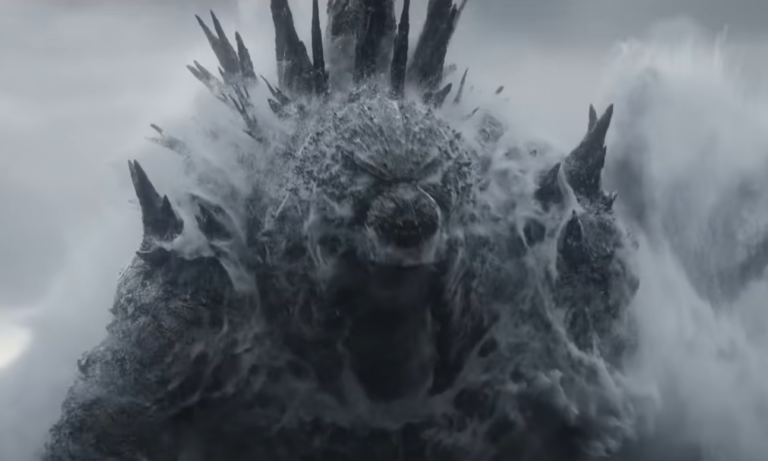
The Reiwa Godzilla’s origin is not metaphorical. Yamazaki’s continuity establishes the creature as a pre-existing deep-sea megafauna whose biological healing factor was not destroyed but amplified — permanently and catastrophically — by exposure to the U.S. Operation Crossroads nuclear tests at Bikini Atoll in July 1946. At the close of Godzilla Minus One, the monster appears destroyed, but the final frames show surviving tissue regenerating as it sinks toward the ocean floor. Godzilla Minus Zero picks up in 1949 — two years later — with Godzilla restored, measurably larger, and significantly more ferocious than its predecessor.
This is a scientifically provocative premise when you follow it to its logical end. Real radioresistant organisms — the bacterium Deinococcus radiodurans, first isolated in 1956, can survive doses of up to 5,000 gray of ionizing radiation, approximately 1,000 times the lethal dose for a human, as D. radiodurans research confirms — achieving this through multiple genome copies and extraordinarily efficient DNA repair via homologous recombination, rebuilding shattered chromosomes within 12 to 24 hours. Tardigrades survive roughly 4,000 gray via similar desiccation-resistance mechanisms. More strikingly, melanin-rich fungi discovered growing inside Chernobyl’s Reactor No. 4 appear to harvest Chernobyl radiation metabolically through a radiotropic process — growing toward radiation sources rather than away from them. The Reiwa Godzilla is best understood as the hypothetical extreme end of this radiotropic biology: a vertebrate-scale organism in which ionizing radiation does not damage but fuels the healing and growth machinery.
The ethical consequence flows directly from this biology. Godzilla Minus Zero is set in 1949, the precise year the Soviet Union conducted its first nuclear weapon test (August 29, 1949), completing the nuclear triangle that surrounded Japan — a nation constitutionally prohibited from developing nuclear weapons since May 1947, that had experienced atomic bombs in Hiroshima and Nagasaki just four years earlier, and that remained under American occupation until 1952. A character in the film’s trailer states, “Another moral boundary mankind shouldn’t cross,” as Japan contemplates deploying nuclear weapons against the returning monster. That is the recursive causation trap: the weapon that made Godzilla cannot logically be the weapon that destroys it, not if the mechanism that empowered it in the first place is radiation absorption and amplification. Godzilla Minus Zero is the first film in the franchise to set its story in the historical moment when that trap became geopolitically real, and to apparently depict it with the graphic seriousness that premise demands.
Whole-Organism Regeneration: Where Yamazaki’s Biology Gets Radical
Alongside radiobiology, Godzilla Minus Zero engages one of the most actively researched frontiers in developmental science: whole-organism regeneration from minimal surviving tissue. In reality, planarian flatworm whole-organism regeneration studies show that flatworms of the genus Dugesia can regenerate a complete organism from a fragment representing approximately 1/279th of their original body mass, including re-growing fully functional brain structures. Axolotls regenerate complete limbs with integrated neural and vascular networks. Hydra, essentially biologically immortal, can reconstruct their entire body plan from a small cluster of cells because their interstitial stem cells maintain pluripotency — the capacity to become any tissue type — throughout their adult lives.
Yamazaki’s sequel implies that surviving Godzilla cells retain something analogous to extreme cellular totipotency: the complete developmental program of the full organism, accessible across the entire cellular volume. In the film’s biology, when the organism is apparently destroyed, surviving cells eventually reactivate this total morphogenetic program — rebuilding not just tissues but a larger, more powerful configuration than the prior version. Trailers confirm the new form is substantially larger (appearing to dwarf the Statue of Liberty in footage), and an internal character speculates that the regenerated Godzilla can “withstand even a thermonuclear strike.” If nuclear irradiation acts as a developmental reset signal — paradoxically opening chromatin at master developmental loci across all somatic cells — then a more intense nuclear exposure would, within this biological logic, produce a more fully realized regenerative event. This is not simply a bigger Godzilla. It is the mathematical consequence of the premise applied consistently.
New to the franchise in this sequel is biologist Kanji Murakami, played by legendary Japanese dancer and actor Min Tanaka joins the cast, described as carrying “deep psychological scars from the war.” His presence signals that Godzilla Minus Zero intends to engage with this biology from within the narrative — a character who has professional expertise in the mechanism that makes Godzilla possible, and who is burdened by what that expertise reveals.
The Reiwa Era’s Commitment to Specific Trauma
What distinguishes the Reiwa-era Godzilla from every prior era of the franchise is its insistence on identifying, precisely, the Japanese historical wound that each monster embodies. Ishirō Honda’s original Gojira (1954) was produced within two years of the American occupation lifting its ban on public discussion of atomic bomb effects, and eight months after the Lucky Dragon No. 5 incident, in which a Japanese fishing crew was contaminated by fallout from a U.S. hydrogen bomb test at Bikini Atoll. As visual culture scholar Claude Estebe’s analysis of Gojira has noted, the film depicted the specific imagery of irradiated children in hospitals — content that had been suppressed under occupation censorship — within the safe container of a monster movie. Academic analysis (Shen’s 2013 Gojira analysis, “Monster of Mourning, Ritual of Remembering,” Reconstruction: Studies in Contemporary Culture, 2013) argues the film operated on multiple layers simultaneously: nuclear allegory, post-imperial guilt, and suppressed awareness of wartime biological weapons research.
Hideaki Anno and Shinji Higuchi’s Shin Godzilla (2016) updated this tradition for the March 11, 2011 Tohoku earthquake and Fukushima nuclear disaster — with Godzilla serving as a stand-in for governmental dysfunction and the specific horror of uncontrolled nuclear contamination. As Tanaka’s 2022 Godzilla Resurgence study of Tamagawa University has argued, the film “clearly inspired by the triple disaster” depicted “Japan’s changeless status since 1945” through its bureaucratic paralysis in the face of catastrophic mutation.
Yamazaki’s Godzilla Minus One (2023) located its trauma in the kamikaze program: protagonist Koichi Shikishima is a failed kamikaze pilot whose survival is treated as cowardice, and whose PTSD-driven guilt is externalized as the returning monster he must finally confront. In his translation of the original Shigeru Kayama Godzilla novellas, Jeffrey Angles observed that Kayama used the creature to suggest that “humanitarian values, especially when coming from the postwar generation, will be what Japan needs to guide the country through its ethical dilemmas” — an observation, as noted in the SFRARev Godzilla Minus One review, that applies equally to Yamazaki’s entire Minus era.
Godzilla Minus Zero selects 1949 with surgical precision. This is the year Japan faces: constitutional pacifism recently enacted (Article 9, effective May 1947), the Soviet nuclear capability newly established, American occupation continuing, and the Korean War months away. The film’s ethical recursive trap — that using nuclear weapons against a nuclear-created monster violates the very logic that makes the monster mortal — maps onto Japan’s real 1949 situation as a non-nuclear nation in a newly bipolar nuclear world. The R rating is what that specific historical moment, rendered honestly, produces in a film.
What Is Godzilla Minus Zero’s Story?
Koichi Shikishima (Ryunosuke Kamiki) is a man who should not be alive. A former kamikaze pilot who could not bring himself to die as his duty demanded, he has spent the years since the war building a fragile peace alongside his wife Noriko (Minami Hamabe) and their adopted daughter Akiko — a found family assembled from the rubble of postwar Japan. Two years have passed since Godzilla seemed to be defeated, torn apart at the end of Godzilla Minus One through an act that finally allowed Koichi to live for something rather than waiting for the death the war never delivered. That peace fractures the moment Godzilla reappears — larger, fully regenerated from surviving cells, and apparently impervious to the weapons that barely stopped it before. The official synopsis reads: “War reduced Japan to zero, and Godzilla plunged it into minus. Two years have passed since then, and the country has faced agonizing struggles to achieve recovery and finally reclaim its daily life. Just as humanity managed to cling to a hard-won peace, a new threat strikes, crushing hope in an instant. There is no third time. Everything ends here.”
The story operates in the register of war-trauma horror rather than action spectacle — the darkness of a man who built his first reasons to survive, now watching them threatened by the very consequence of the one survival that still haunts him. King Ghidorah is confirmed to appear, introducing a second kaiju whose nature and role remain deliberately unspecified ahead of the premiere. The threat, whatever its full shape, has driven the film to an R rating that no prior Godzilla entry required — because Yamazaki is apparently unwilling to soften what happens to human beings when monsters of this scale and origin come back.
IMAX as Scientific Instrument: Engineering the Experience of Scale
Godzilla Minus Zero is the first Japanese production Filmed for IMAX, using IMAX-certified digital cameras that capture imagery at an IMAX Expanded Aspect Ratio format of 1.90:1 rather than the standard 2.39:1 widescreen format used by most commercial films. The engineering decision is directly connected to the film’s thematic ambitions.
Human size perception depends on a set of visual heuristics that function well within the range of normal experience: vergence (the degree to which eyes converge), motion parallax, and the angular size of known reference objects in the field of view. When a subject is large enough that its structure exceeds the normal range of these heuristics — when, for example, Godzilla’s foot fills the entire vertical extent of the visual field — the brain’s size-estimation system cannot produce a reliable reading. The perceptual result is not “that is very large.” It is something closer to cognitive vertigo: the experience of encountering a scale that cannot be categorized.
IMAX’s taller format specifically addresses this by filling more of the viewer’s peripheral vision vertically. An IMAX GT screen measures approximately 22 meters by 16 meters (72 feet by 52 feet), filling peripheral vision in a way a standard multiplex screen cannot. The “Filmed for IMAX” certification means the cameras were specifically calibrated to make use of that vertical expansion — producing an image in which Godzilla’s height can fill the available frame height rather than being letterboxed to fit a widescreen ratio. Yamazaki has described his goal as getting “up close, personal, and detailed” with the creature “at the level of the toes stomping the ground,” with detailed modeling at every scale. IMAX is the delivery mechanism for that ambition: not just showing Godzilla at a distance, but placing the audience inside the physical impossibility of its size.
The IMAX format also carries a specific implication for the R-rated content. Violence depicted at that scale, with that resolution, and within peripheral-vision-filling frames, does not register as cinematic spectacle in the normal sense. It registers as something closer to immersive physical experience. An R rating that might feel optional in a standard theatrical presentation becomes essentially mandatory if the film is shot and designed to make its violence feel physically real rather than representationally contained.
What This Means for Your Viewing Decision
For audiences who saw Godzilla Minus One with children younger than 13, the R rating changes the calculus entirely — this is not the same audience experience, and MPA’s specific rating description of “bloody images” suggests human casualties are depicted with a directness that went beyond the PG-13 precedent.
For adult audiences, the NYFF premiere this Friday represents the first opportunity to see the film anywhere in the world, with Yamazaki and members of the cast and crew expected to attend. Public single tickets went on sale September 15 at noon ET through the Film at Lincoln Center website. The film then premieres in Japan on November 3, 2026 — Godzilla Day, the anniversary of the original 1954 film’s Japanese release — followed by the GKIDS November 6 North America release on November 6, 2026. IMAX screenings will be available at launch; given the film was shot specifically for the format, this is the version Yamazaki designed.
The franchise has spent 72 years depicting nuclear terror in metaphor. What it apparently needed to make the metaphor explicit was to set the story in the specific year when the metaphor became geopolitically literal — and to follow the logic of its own biology to wherever that led.
Frequently Asked Questions
Why is Godzilla Minus Zero rated R when no prior Godzilla film has been?
The MPA cited “some violent content and bloody images” — language distinct from the “creature violence and action” descriptor applied to prior PG-13 entries. The R rating reflects Yamazaki’s decision to depict human casualties at a level of graphic fidelity that the franchise has historically avoided. In the context of the film’s premise — a nuclear-amplified organism that grows larger each time it regenerates, set against Japan’s 1949 ethical situation regarding nuclear weapons — depicting the monster’s impact without that graphic fidelity would require softening the premise itself.
Is Godzilla Minus Zero a direct sequel to Godzilla Minus One, or can I watch it without having seen the first film?
It is a direct sequel, continuing the story of Koichi and Noriko Shikishima and their adopted daughter Akiko, with most of the principal cast reprising their roles. The emotional and scientific logic of the sequel — particularly why Godzilla is larger and apparently more resilient — depends on understanding how the first film ended. Godzilla Minus One is available on Netflix worldwide and runs approximately 124 minutes. Watching it first is strongly recommended.
What is IMAX “Filmed for IMAX” and why does it matter for this specific film?
“Filmed for IMAX” means the cameras used were IMAX-certified digital cameras calibrated for the format’s expanded 1.90:1 aspect ratio, which is significantly taller than standard widescreen. For a kaiju film specifically, this means more of Godzilla’s height fills the available frame — the creature can appear to exceed the vertical boundaries of a standard screen, which is directly connected to the perceptual experience of scale the format is designed to produce. Standard screenings will still show the film, but they will see a cropped or adapted version of an image designed for a larger canvas.
The franchise has always used Godzilla as a metaphor for specific Japanese historical traumas. What trauma does Godzilla Minus Zero engage?
The original Gojira (1954) encoded Hiroshima, Nagasaki, and the Lucky Dragon No. 5 fallout incident. Shin Godzilla (2016) engaged the Tohoku earthquake and Fukushima nuclear disaster. Godzilla Minus One engaged the kamikaze program and postwar survivor’s guilt. Godzilla Minus Zero is set in 1949 — the year the Soviet Union first tested a nuclear weapon, completing the Cold War nuclear triangle and leaving Japan constitutionally pacifist and surrounded. The film’s ethical recursive trap — the weapon that created Godzilla cannot logically destroy it without amplifying it further — maps onto Japan’s actual geopolitical situation in the specific year Yamazaki chose. That is the trauma: the moment when Japan discovered that the nuclear lesson of 1945 had not, in fact, been learned by anyone who mattered.