HomeAuto Compact Comics Arrive for Power Rangers: Higgins Multiverse Runs Stranger Than Monsters
Compact Comics Arrive for Power Rangers: Higgins Multiverse Runs Stranger Than Monsters
September 23, 2026:
Boom-studios.com
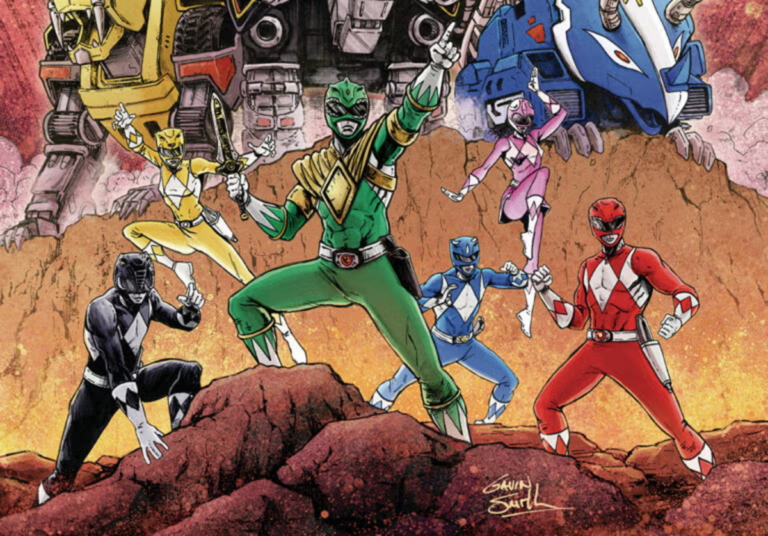
The compact comics movement — which turned DC’s Watchmen into a bestseller three times over and reshaped how publishers think about shelf placement — reaches one of its best test cases today: BOOM! Studios’ Mighty Morphin Power Rangers Compact Comics Edition Vol. 1, a 288-page volume collecting Kyle Higgins and Hendry Prasetya’s issues #0 through #12, is priced at $14.99 in a 5.5-inch-by-8.5-inch (14-centimeter-by-22-centimeter) paperback format. The eBook edition is available today, September 22, 2026; print copies will arrive at comic shops on Wednesday, September 23. What makes this specific compact release editorially interesting is not the format or the nostalgia: it’s that Higgins built something into this run that franchise comics almost never attempt — a multiverse architecture that is structurally coherent with actual quantum physics — and that architecture is now available to an entirely new class of reader for the first time.
How Compact Comics Conquered a Format That Didn’t Exist Three Years Ago
DC Comics announced the compact format in 2023 and launched it in June 2024, reprinting classics like Alan Moore and Dave Gibbons’ Watchmen and Grant Morrison and Frank Quitely’s All-Star Superman at a trim size borrowed from paperback publishers — 5.5 by 8.5 inches (14 by 22 centimeters), the most widely circulated softcover dimension in the United States. The gamble worked immediately. By September 2024, DC Compact Comics accounted for four of the ten best-selling graphic novels of 2024, with Watchmen alone going to a third printing.
DC president and COO Jim Lee, speaking at a San Diego Comic-Con 2026 panel, identified two factors behind that success: price and recognition. “I think Compact Comics change things for a couple of reasons,” he said. “One is the more low price point. It’s much more affordable.” The second factor, he continued, was the format itself: “I think the fact that it resembles the format of manga comics makes it recognizable for people that aren’t accustomed to western comics. I think that form factor makes it more attractive.”
By September 2026, the format is industry-wide. ICv2, the trade publication of record for comics and collectibles retail, reported format-wide industry adoption this month: DC, Marvel, BOOM! Studios, Vault Comics, Oni Press, Dynamite Entertainment, and Rebellion have all adopted the format or announced compact editions. The dimension matters for a reason that isn’t about nostalgia: a 5.5-by-8.5-inch (14-by-22-centimeter) book fits on manga shelves. Standard North American comic trade paperbacks run 6.6 by 10.2 inches (16.8 by 25.9 centimeters) — big enough to require their own section. The compact edition can sit next to a Demon Slayer volume at a bookstore or airport newsstand and not look out of place. That is a distribution-channel unlocking, not a cosmetic change.
BOOM! Studios has priced its MMPR compact at $14.99 — higher than DC’s $9.99 anchor price, but at the same level as Marvel’s Premier Editions, reflecting the cost of full-color printing. A black-and-white manga volume typically retails between $10 and $13; $14.99 for 288 pages of full-color sequential art is competitive within that range.
What Higgins Put Inside: Tommy Oliver, Guilt, and the Weight of Having Been Used Against Your Friends
The compact edition collects three story arcs written by Kyle Higgins with art by Hendry Prasetya. It begins with Tommy Oliver — the Green Ranger — on the day after his liberation from Rita Repulsa’s psychic control. Tommy had, under that control, attacked the Rangers he now stands beside. He remembers every moment of it. Higgins frames this not as a standard “hero overcomes villain brainwashing” arc but as something closer to an abuse recovery narrative: Tommy’s body was used as a weapon against people who now have to decide whether to trust him, and Tommy himself is not sure he deserves that trust. The lingering psychic intrusions — flashes of Rita’s commands, involuntary and unwanted — read less like a supervillain’s residual control than like intrusive ideation. For a franchise property aimed at broad audiences, this is an unusually precise psychological register.
The central dramatic question of the volume is not “will Tommy earn his place” — that resolves relatively early — but rather: who is the intelligence behind the Black Dragon, the massive robotic vessel that deploys in arc two and does something novel for a Power Rangers villain, severing the Rangers’ connection to the Morphing Grid rather than simply attacking them physically? And why does it seem to know exactly how Ranger powers work from the inside?
The answer, delivered across issues #9 through #12, is one of the more structurally elegant reveals in modern franchise comics. The Black Dragon is not the villain. It is a remote-controlled chassis, operated across dimensional boundaries by a consciousness that turns out to be an alternate-timeline version of Tommy Oliver — one who never broke Rita’s control, killed his teammates instead, and spent decades building an authoritarian empire from the ruins. Lord Drakkon, as he names himself, is the hero of the story played as a villain, which means the Rangers are not fighting an external threat but a mirror: the version of themselves that emerges when the one moment that mattered goes the other way.
The volume closes with the Morphing Grid established as the connective tissue between these timelines, dimensional travel confirmed as possible, and the multiverse cracked permanently open. Everything that follows in the BOOM! Studios Power Rangers universe — the Shattered Grid crossover event, the Ranger Slayer arc, the franchise-wide multiversal storylines — is built on the architecture Higgins laid in issues #0 through #12.
Does Higgins’ Multiverse Hold Up to Physics? Mostly, and More Than You Would Expect
The Morphing Grid, as depicted in this run, behaves like a quantum field: it permeates all space including the spaces between dimensions, particles (Rangers) acquire their defining properties by interacting with it, and disrupting that interaction — as the Black Dragon does by severing individual Ranger connections — does not destroy the field but does deny those Rangers their defining characteristic. This is the structural logic of quantum field theory.
Every fundamental particle in the Standard Model of physics is not an independent object but a localized excitation of a corresponding field permeating all of spacetime: the electron field, the quark field, the Higgs field. Particles “borrow” energy from these fields to exist in their observed configurations. The Higgs field is the closest functional analog to the Morphing Grid: it permeates spacetime, particles acquire their masses through interaction with it, and an entity that lost its Higgs coupling would not be destroyed — it would simply lose the property that makes it what it is. That is precisely what happens when Rangers lose Grid access. They lose the thing that makes them Rangers, not their existence.
The Grid’s multiversal dimension maps onto theoretical physics at a more speculative but not baseless level. In the many-worlds interpretation of quantum mechanics, formalized by physicist Hugh Everett III in his 1957 Princeton dissertation and extended by David Deutsch in The Fabric of Reality (1997), every quantum event produces branching timelines that are mutually causally isolated once they diverge — they are, in physicist David Wallace’s formulation, “emergent” structures in a single universal wavefunction rather than separate physical universes. A field that could connect these branches would need to exist at a level of description above any single spacetime — analogous to the higher-dimensional “bulk” in Lisa Randall and Raman Sundrum’s 1999 braneworld string theory scenarios, where multiple universe-branes float within a higher-dimensional bulk through which gravity (and, in some models, information) can propagate.
The pocket dimensions — Rita’s Dark Dimension and Zordon’s Command Center anchor — behave as semi-stable interstitial spaces that degrade when their energy source weakens. This is consistent with what theoretical physics requires for stabilized exotic geometries: a continuous power input to maintain the field tension that prevents the compactified geometry from collapsing to its ground state. The Casimir effect’s negative energy — confirmed experimentally in 1997 by Steve Lamoreaux, building on Hendrik Casimir’s 1948 theoretical prediction — is the only known real-world demonstration of negative-energy-density phenomena, the same class of physics that exotic-geometry stabilization would require. At the scales the effect is confirmed, it is nanoscopic and useless for structural engineering. But the principle is real.
The Black Dragon as remote-controlled proxy vessel maps onto the ethics of BCI-driven telepresence, which has moved from science fiction to clinical reality in the intervening decade. Companies including Neuralink have demonstrated bidirectional neural interfaces capable of controlling external robotic systems at meaningful bandwidth. The moral philosophy question — does an agent operating through a remote physical body bear full moral responsibility for the harms that body inflicts? — is explicitly addressed by philosopher Bradley Jay Strawser in Killing by Remote Control (Oxford University Press, 2013), in the context of drone warfare. Higgins’ comic implicitly adopts what Strawser’s opponents argue: Drakkon is fully morally responsible for his Black Dragon’s actions, with no mitigation from physical distance. Whether that answer is correct in international humanitarian law remains genuinely contested.
What Is the Compact Edition Actually Like to Read?
The compact format does not compromise the readability of Western comics in the way that critics of the format initially feared. Panel density in the Higgins/Prasetya run is relatively conservative — Prasetya’s pages rarely exceed six panels, and splash pages and double-page spreads are used for action set pieces. At 5.5 by 8.5 inches (14 by 22 centimeters), the panel detail is legible without a magnifier. The trade-off is that this is a full-color, detailed artistic work that benefits from a larger viewing area; manga readers accustomed to the expressive line economy of black-and-white work will notice the difference.
The 288-page count means this is not a light read. It covers three complete arcs — an unusual amount of content for a $14.99 entry-level volume, and competitive with the 300-to-350-page counts typical of manga omnibus editions at similar prices.
How Does This Compare to Starting at Issue One on a Digital App?
Why is the compact edition a different product from just reading issues #0–12 on ComiXology or Marvel Unlimited?
The physical artifact is the primary answer. The compact edition is an owned, archival object at a format that is shelf-stable alongside a manga collection. Digital issues are format-fragile — they depend on platform continuity, subscription status, and device availability. For readers building a permanent library of Power Rangers material, the compact edition is the entry-point architecture.
For readers who want to sample before committing, the digital platforms offer lower cost and immediate access. The compact edition’s value proposition is physical permanence, format legibility on manga shelves, and the complete three-arc narrative in one volume.
What Should Readers Know About the Compact Comics Format Before Buying?
Publishers implementing the compact format vary significantly on two factors that matter: page count per dollar, and color. DC’s $9.99 editions average 160 to 200 pages in black-and-white-adjacent line work, making them price-comparable with manga on a per-page basis. BOOM!’s $14.99 for 288 full-color pages offers more content and higher production cost. Marvel’s Premier Editions occupy the same $14.99 tier as BOOM! but at a similar or slightly lower page count.
None of these compact editions replace deluxe hardcover editions for readers who want the largest possible art reproduction. They are specifically designed as accessible entry points — physically, economically, and ergonomically — for readers who have not already committed to the Western comic trade paperback ecosystem.
Frequently Asked Questions
Does the MMPR Compact Edition include all of the Lord Drakkon storyline?
It includes his origin. The compact edition collects issues #0 through #12, which establishes Lord Drakkon’s alternate-timeline identity and the core Black Dragon arc. The full Drakkon saga — including the Shattered Grid crossover event across multiple Power Rangers titles — extends well beyond these issues and is not collected here. Vol. 1 is the foundation; the complete arc requires subsequent volumes.
Is the compact format actually readable, or are the panels too small?
The 5.5-by-8.5-inch (14-by-22-centimeter) trim is the same size as a standard mass-market paperback novel and very close to a manga tankōbon volume (approximately 5 by 7.5 inches, or 12.7 by 19 centimeters). For the Higgins/Prasetya run, which uses relatively open page layouts and rarely exceeds six panels per page, readability is not significantly compromised compared to the full trade paperback format. Readers accustomed to highly detailed splash pages in European bandes dessinées may prefer larger formats.
What makes the Morphing Grid different from a standard superpower source like the Speed Force?
The Morphing Grid’s distinguishing structural feature in the Higgins run is that it appears to function as a substrate connecting multiple timelines — not just as an energy source within a single continuity. The Speed Force in DC Comics is a single-universe energy conduit; the Morphing Grid is depicted as the connective tissue of the Power Rangers multiverse, which is why severing a Ranger’s Grid access in one timeline can be operationalized by a villain in another. That cross-timeline function is what makes it a more ambitious worldbuilding construct and what grounds the physics analogy to string theory’s braneworld bulk scenarios.
How does the compact comics format benefit readers who already own the original trade paperbacks?
It largely does not, unless portability is a specific need. The compact edition is aimed at readers who do not own the material — either new readers entering the Power Rangers comics universe, or manga readers for whom the standard North American trade paperback format is unfamiliar or inconvenient. Existing owners of the Higgins/Prasetya trades are not the target audience, though the format’s portability has driven some repurchases among readers who want a subway or travel copy.