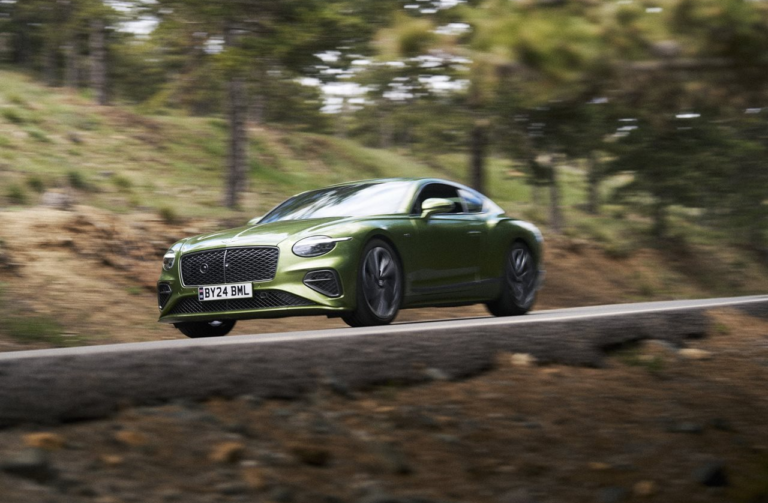
Bentley Torcal Production Begins; Shared Porsche Platform Pays for 800V Charging

September 19, 2026:

Bentley Torcal Production Begins; Shared Porsche Platform Pays for 800V Charging
Bentley Torcal
Bentleymotors.com

Bentley Motors has begun assembling the Torcal — its first fully electric car — at its historic headquarters in Crewe, England, five days before the vehicle’s global reveal on September 23 in London. The production milestone is enabled by a critical piece of engineering infrastructure that Bentley shares with Porsche and Audi: Volkswagen Group’s Premium Platform Electric (PPE), an 800-volt architecture whose development cost is spread across millions of VW Group vehicles and whose performance specs would have been economically out of reach for a brand building roughly 10,000 cars a year on its own.

Crewe Gets a New Production Line Inside an 88-Year-Old Building

The Torcal is being assembled by hand on a purpose-built production line in Crewe, created inside one of the original factory buildings completed in 1938. The structure has held several previous functions — first a machining shop, most recently Bentley’s R&D workshop — before being stripped down, fitted with a precision-level floor, and refitted for the new electric model.

That floor-leveling work is not cosmetic. It is required by the Autonomous Guided Vehicles (AGVs) that move Torcals through the facility as assembly progresses. AGVs use laser or vision-based navigation to self-position on flat surfaces, and their accuracy degrades on uneven ground. The result is a manufacturing approach that Bentley has resolved: automated logistics combined with hand assembly. The AGVs position each car body at precisely the right location and height for artisans to work in consistent ergonomic conditions — replicating, in an EV context, the precise positioning that a traditional pit or fixed conveyor would have provided without any of their inflexibility.

This production capability is part of Bentley’s self-funded £350 million investment (approximately $469 million) that Bentley has made in its Crewe operations, which also includes a new paint shop, a Design Studio opened in 2025, and a broader renewal program spanning the 521,111-square-meter Crewe campus (approximately 129 acres) that employs more than 4,000 people.

What Is the PPE Platform, and Why Does It Matter for the Torcal?

The PPE is a modular electric vehicle platform developed jointly by Audi and Porsche for Volkswagen Group vehicles too large or too premium for the VW Group’s volume MEB platform. It runs at 800 volts — twice the nominal voltage of most EV architectures — which is what enables ultra-fast DC charging: the 800V system can accept current at much higher rates without dangerous heat buildup than a 400V system would allow at the same power delivery.

The batteries are designed to split into two parallel 400-volt sections, allowing compatibility with 400V chargers even while the primary design is optimized for 800V infrastructure. In production use since 2024 in the Audi Q6 e-tron and Porsche Macan EV, and extended to the 2026 Porsche Cayenne Electric with peak charging rates up to 400kW, the PPE is a mature platform by the time Bentley applies it to the Torcal.

Bentley is targeting a peak charging speed of approximately 390kW for the Torcal, which the company says will add roughly 100 miles of range in about seven minutes. That claim rests on a battery pack expected to be approximately 113kWh — the same figure used in the Porsche Cayenne Electric — paired with dual permanent-magnet synchronous motors driving all four wheels.

The economic logic of this arrangement cannot be overstated. The PPE platform’s development cost runs into the billions of euros, spread across the Audi Q6 e-tron and Porsche EVs — vehicles built collectively in volumes far exceeding Bentley’s annual output. By joining that platform family, Bentley gains access to 800V charging capability and a proven electric drive system without bearing anything close to the full development cost. For a brand whose annual production sits around 10,000–14,000 cars, funding a proprietary 800V architecture from scratch would have added thousands of dollars per vehicle in engineering amortization — an impossible proposition even at Bentley prices.

What the Torcal Is, and What It Is Not Yet

The Torcal will be Bentley’s fourth production model line, joining the Continental GT, Flying Spur, and Bentayga. Bentley describes it as a Luxury Urban SUV — designed to be somewhat more compact than the Bentayga, and intended to be the car Bentley’s customers use in cities rather than on grand tours. The global reveal is scheduled for 19:19 on September 23, 2026, in London, at which point Bentley will release full specifications.

Until that reveal, Bentley has confirmed the Torcal will be its most powerful Bentley ever built and the fastest-accelerating, with automotive press widely reporting a target of more than 838 horsepower (approximately 850 metric horsepower) — placing it well above the Rolls-Royce Spectre Series II’s 601 horsepower AWD configuration. Bentley has also confirmed a 0-60 mph time below three seconds, and Bentley design director Robin Page has said the target range is over 300 miles — noting that the company’s research found customers regard 300 to 350 miles as the relevant sweet spot, beyond which they would, as Page put it, simply take the private jet.

US buyers should note that European range figures given in WLTP terms typically exceed real-world and EPA-rated range by 10-20%. The car will not be on sale in the United States until it enters the market as a 2028 model, with deliveries beginning in 2027, allowing time for EPA certification.

What Is WLTP, and What Does It Mean for Range Estimates?

WLTP, the Worldwide Harmonised Light Vehicle Test Procedure, is the official European and UK laboratory standard for measuring electric range and emissions. It is more realistic than the older NEDC test cycle it replaced, but still typically overstates the range most drivers will achieve in real-world conditions by roughly 10-20%. When the Torcal launches in the United States, Bentley will publish an EPA-rated range, which is generally the more conservative and more representative figure for American driving conditions.

How the Torcal Compares with Its Direct Competitor

The Rolls-Royce Spectre is the only ultra-luxury production BEV currently on sale when the Torcal enters production. Its updated Spectre Series II, announced June 2026, produces 601 horsepower in its all-wheel-drive configuration, achieves 390 miles on WLTP range from a 101.7kWh battery, and supports DC fast charging at a maximum of 200kW. The Spectre is a coupe, not an SUV, and is priced from approximately $397,750 in the United States.

The Torcal, if Bentley’s published targets hold, will arrive with substantially more power, a similar or greater WLTP range from a larger battery, and charging speeds roughly twice as fast — attributes that flow directly from the PPE platform’s 800V architecture. The Spectre runs Rolls-Royce’s proprietary “Architecture of Luxury” platform, which predates 800V charging as an industry standard. Price for the Torcal has not yet been announced; automotive journalists have estimated it may launch around £170,000 (approximately $228,000) in the UK, positioning it below the Spectre while competing on performance.

Bentley’s Honest Reckoning with Luxury EV Demand

Not all of the Torcal story is straightforward confidence. Bentley’s original Beyond100 strategy, announced in 2020, pledged an exclusively electric lineup by 2030. That target has since been pushed back five years, to 2035 — a revision publicly attributed to slower-than-anticipated EV demand growth among Bentley’s traditional customer base. CEO Frank-Steffen Walliser has acknowledged publicly that the luxury EV market has not grown at the pace early projections suggested, with Bentley committing to producing one new plug-in hybrid or battery-electric model each year through 2035 rather than switching entirely to BEV.

This context matters for buyers and investors watching the luxury EV segment. The Rolls-Royce Spectre, Mercedes-AMG EQ, and Porsche Taycan occupy adjacent spaces, and all have faced the same structural market reality: luxury buyers have not rushed to replace their combustion vehicles with electric ones at the rate the industry’s 2020-era projections assumed. Bentley’s candor on this point, unusual among premium OEMs, is either a sign of healthy realism or a signal that the Torcal faces a steeper adoption challenge than its performance figures suggest.

British Supply Chain and Crewe Identity

The decision to build the Torcal in Crewe — rather than routing production to another VW Group facility with existing EV manufacturing — is as much a brand statement as a logistics choice. Bentley has occupied the Crewe site since 1946, and the current facility handles all design, engineering, and final assembly for every production Bentley.

The Torcal’s supply chain reinforces that identity. Somerset-based Fox Brothers — a heritage textile mill — supplies the wool used in the car’s interior, continuing Bentley’s commitment to British materials even in a vehicle built on German platform architecture. The Torcal’s interior was previewed through a series of press releases earlier this year, including a “Modern Materials” dispatch from August 2026 and a “Curation Engine” announcement in August describing a system that adjusts vehicle ambiance based on how the driver wants to feel.

Is the Torcal Name Connected to What Powers It?

The name derives from El Torcal de Antequera — a dramatic limestone rock formation in Andalusia, southern Spain, shaped by millions of years of geological activity into stacked cliffs and labyrinthine passages. Bentley has drawn its naming convention from natural landmarks for its models — the Bentayga (Atlas Mountains), Bacalar (Mexican lagoon), and Batur (Balinese volcanic caldera).

The name carries a second layer. “Torcal” is derived from the Latin torquere, meaning “to twist” — the etymological root of the modern word “torque.” The connection to an EV powertrain’s defining characteristic is deliberate, signaling what distinguishes this Bentley from every other in 107 years.

Currency conversions in this article are approximate, based on exchange rates as of August 2026.


Frequently Asked Questions

When will the Bentley Torcal go on sale in the United States?

Bentley plans to begin delivering the Torcal to US customers in 2027, with the car entering the market as a 2028 model year vehicle. Full specifications — including EPA range ratings, which will differ from the European WLTP figures — are expected to be released at or after the September 23, 2026, global reveal in London.

Why is sharing a platform with Porsche significant for the Torcal?

Developing a proprietary 800-volt EV architecture from scratch costs billions of euros and makes economic sense only when that investment can be spread across very high production volumes. Volkswagen Group’s PPE platform is shared between the Audi Q6 e-tron, Audi A6 e-tron, Porsche Macan EV, and Porsche Cayenne Electric — collectively far higher-volume vehicles than anything Bentley builds. Bentley’s participation in the PPE family means the Torcal inherits 800V charging capability (enabling charge rates up to approximately 390kW and roughly 100 miles of range in seven minutes) without Bentley having to fund that system alone. Without this arrangement, offering 800V charging in a hand-assembled car built in volumes of a few thousand units per year would likely be uneconomical even at Bentley’s price points.

How does the Torcal compare to the Rolls-Royce Spectre?

The Spectre Series II is the only production ultra-luxury BEV currently on sale and is a direct benchmark. The Spectre offers 601 horsepower, a maximum DC charging speed of 200kW, and approximately 390 miles of WLTP range from its 101.7kWh battery. The Torcal is targeting more than 838 horsepower, approximately 390kW DC charging (nearly double the Spectre’s maximum), and a range of over 300 miles WLTP — with full figures to be announced September 23. The Torcal is also an SUV while the Spectre is a coupe, and Bentley has not yet confirmed pricing.

Why did Bentley push back its all-electric deadline from 2030 to 2035?

Bentley revised its Beyond100+ strategy in 2024 after acknowledging that demand for electric vehicles among its established customer base had not grown as quickly as originally projected. The company will now release one new plug-in hybrid or battery-electric vehicle each year through 2035, maintaining combustion-engine and hybrid options in its lineup during the transition rather than exiting them on a fixed 2030 schedule.

Source link