HomeAuto IMTS 2026 Makes History: Single-Polymer Carpet Eliminates 900,000 Sq Ft of Show Waste
IMTS 2026 Makes History: Single-Polymer Carpet Eliminates 900,000 Sq Ft of Show Waste
September 18, 2026:
Imts.com
The International Manufacturing Technology Show is in its fifth day at McCormick Place in Chicago, closing out the conference program that ran September 14–17 and entering today — Friday, September 18, 2026 — as the final day before Saturday’s 3:00 p.m. CT (4:00 p.m. ET) close. But the story most likely to reshape the industry after the 86,000-plus registrants leave is underfoot: for the first time in the show’s 99-year history, every square foot of carpet across IMTS’s entire four-building campus is now 100% recyclable for the first time — a deployment that closes what the trade show flooring industry has quietly treated for decades as an irreducible landfill problem.
What IMTS 2026 Is
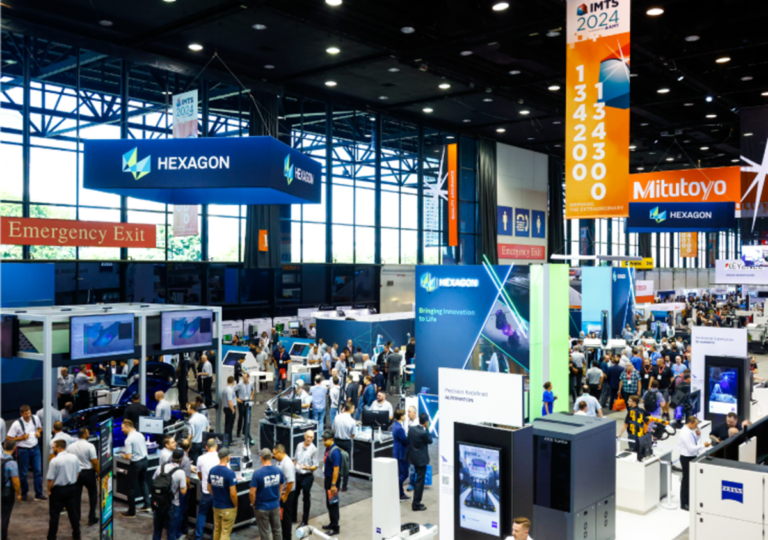
Owned and produced by AMT – The Association for Manufacturing Technology, IMTS spans more than 1.2 million square feet (111,484 square meters) across McCormick Place’s Lakeside Center, North, South, and West Buildings. This year’s edition brought in more than 1,800 exhibitors and, as of the September 14 opening day, had already registered more than 80,000 attendees, with AMT Vice President of Exhibitions Michelle Edmondson projecting final figures north of 86,000 visitors from the United States and approximately 119 other countries.
The backdrop is a manufacturing sector generating genuine momentum. Through the first four months of 2026, U.S. manufacturing technology orders totaled $2.19 billion — a 28.9% increase over the same period in 2025, according to AMT’s U.S. Manufacturing Technology Orders (USMTO) report. The show itself spans ten Technology Sectors: Machining, Additive Manufacturing, Automation, Controls & CAD/CAM, Lasers & Waterjet, Quality Assurance, Tooling & Workholding, Metal Forming, Fabricating & Welding, and the newly launched Industrial AI Arena. Major exhibitors on the floor include FANUC America, Mazak, Okuma, Haas Automation, DN Solutions, JTEKT, Matsuura Machinery, Tsugami America, Index Corp., KUKA, Universal Robots, Mitsubishi Electric, Renishaw, ZEISS Industrial Quality Solutions, Amazon Web Services, Google Cloud, and EOS.
The Engineering Story: Why Traditional Carpet Can’t Be Recycled
Here is what trade show sustainability reporting almost never explains: why traditional event carpet ends up in landfills even when organizers try to avoid it.
Most commercial carpet — including conventional trade show carpet — is a multi-material composite. Face fibers (typically nylon 6, nylon 6,6, polyester, or polypropylene) are tufted through a primary polypropylene backing fabric, then bonded to a secondary backing using a latex adhesive — most commonly a styrene-butadiene rubber (SBR) compound. The latex acts as the problem. Its chemical properties prevent clean separation of the polymer streams: send mixed carpet to a recycler, and the economics collapse — sorting, cleaning, and separating the fiber from the latex-contaminated backing costs more than the recovered material is worth. As Will Estes, Sustainability Manager at Emerald Carpets, put it directly: “Traditionally, carpets have been difficult to recycle due to multiple raw materials used in the manufacturing process. Recycling is a business, and although traditional carpets or their components can be recycled, the cost most times makes it prohibitive for most recyclers.”
The result, for decades, has been a structurally unavoidable landfill stream at every major trade show — including, until now, IMTS.
How ExpoMax™ Ends the Landfill Loop
Emerald Carpets’ ExpoMax™ backing technology solves the recyclability problem at its root: by eliminating the dissimilar materials entirely. Both ExpoMax™ product lines deployed at IMTS 2026 — Genesis and Infinity — are built from a single-polymer system throughout. Face fiber, backing structure, and bonding are all the same polymer family, with no latex compound involved. When the carpet reaches end of useful life, there is nothing to sort or separate: the entire assembly goes back into the recycling stream as a unified polypropylene feedstock, recovered and reprocessed into new material rather than directed to landfill.
The Infinity line carries an additional engineering advantage: it is 30% lighter than traditional carpet, reducing both shipping weight (and associated transport emissions) and the physical labor of installation and removal. Genesis is specifically designed for maximum reuse life, achieving four to five uses per roll before entering the recycle stream.
“With Genesis and Infinity, we’ve redesigned the carpet around single-polymer, 100% recyclable constructions, which allows the material to be recovered after its useful life and recycled back into feedstock rather than automatically becoming waste,” said Patrick Putzer, President of Emerald Carpets. “For the organizer, it’s about making sustainability easier. They can reduce waste and support their sustainability goals simply through the flooring specification, without changing the attendee experience. This is the future of carpet in trade shows.”
The deployment at IMTS 2026 is not a pilot or a partial rollout. General contractor GES and Emerald Carpets carpeted the full McCormick Place campus — approximately 1.9 million square feet in total — with ExpoMax™ products. Of that total, GES and Emerald Carpets will reuse more than 1,000,000 square feet and recycle the remaining 900,000 square feet, including all show site waste generated during the event. The recycled portion represents the change: at IMTS 2024, the same partners reused more than 1,000,000 square feet, but a portion of the remaining 900,000 square feet was landfilled. ExpoMax™ closes that gap entirely.
“Carpet left behind at show site has given carpet a black eye when it comes to sustainability,” Estes said.
The technology took years to reach commercial deployment. “We have been working on our ExpoMax™ technology for many years and are now able to supply carpet for the show with 100% recyclable carpet options,” said Putzer. “GES presented the new products produced with ExpoMax™ technology and AMT jumped at the chance to convert the show over to the new product offering.”
What the Venue Itself Is Doing
McCormick Place provides a notable sustainability backdrop. The venue became the first facility in the world to achieve Cleaning Industry Management Standard (CIMS) Green Building + Sustainability Certification with Honors from ISSA, The Association for Cleaning and Facility Solutions — a milestone announced in June 2026 that recognized measurable, third-party-verified sustainable practices across the campus.
The ExpoMax™ carpet deployment layers a material-circularity achievement on top of an already-certified sustainable operations program.
Where Industrial AI Is Now
The show’s other structural headline is the Industrial AI Arena — a dedicated zone housing more than 25 AI-focused vendors demonstrating deployed systems for quality inspection, predictive maintenance, process optimization, and autonomous production. The Arena is new to IMTS 2026 and launched alongside a full-day practitioner-focused Industrial AI Conference held Wednesday, September 16. Ryan Kelly, AMT’s Vice President of Technology, framed the distinction between how AI has been discussed at past IMTS editions versus what the Arena is built to deliver: “We created the IMTS Industrial AI Conference to help manufacturers move beyond experimentation and understand where AI can deliver measurable business value.”
The keynote speaker was Dr. Jay Lee of the A. James Clark School of Engineering at the University of Maryland, who addressed the three recurring barriers to AI adoption on the factory floor: finding usable data, selecting the right tools, and deciding whether to process at the edge or in the cloud. A featured case study demonstrated how manufacturers can deploy low-cost edge AI devices to monitor CNC machines using a stream-of-quality (SoQ) methodology — a real production technique, not a research proof of concept.
How Automation Changes Manufacturing Economics
The data point most likely to move actual capital decisions for the 1,800 exhibitors and 86,000 visitors isn’t coming from the AI Arena — it comes from the Job Shops Workshop, held Tuesday, September 15.
According to Ryan Kelly, 71% of high-performing job shops now run some form of unattended operation. Those shops average 15 hours of machine utilization per day, versus 8.5 hours for shops without automation — a 76% utilization gain. The revenue difference is proportionally larger: shops with automation generate $350,000 in annual revenue per machine, versus $183,000 for comparable non-automated shops — a 91% revenue gap. Kelly cited AMT research on shop productivity comparing automated and non-automated operations: automated shops also show lower scrap rates (0.9% vs. 2.4%), higher first-pass yield (95% vs. 90%), and better on-time delivery (94% vs. 86%).
The Automation Sector at IMTS 2026 returned for its second edition as a standalone Technology Sector, now with more than 260 exhibitors. The organizing theme is accessibility: cobots with teach-to-program interfaces requiring no prior automation experience, zero-capital automation service models, and CNC machine-tending packages priced below $1,000 per month.
Has Anyone Asked Whether WAAM Is Production-Ready?
The AMT Emerging Technology Center in Booth 236700 (North Building) has been the show’s most technically ambitious exhibit, running a live end-to-end manufacturing cell every day across the full six show days. The cell — developed in partnership with Oak Ridge National Laboratory’s Manufacturing Demonstration Facility, Mazak, and FANUC America, with participation from Sandia National Laboratories — producing, assembling, testing, and flying quadcopter drone airframes continuously in a live loop.
The manufacturing platform integrates a Fronius Wire Arc Additive Manufacturing (WAAM) machine with two Mazak VC-Ez 20X five-axis vertical machining centers. The WAAM step uses electric arcs and standard welding wire to build metal structures layer by layer at speed and low cost; the Mazak centers then provide finish machining to dimensional tolerance. The hybrid approach is specifically designed for “emergent operations” — rapid translation from design to production without the lead times of traditional forging or casting.
Thomas Feldhausen, a research staff member at ORNL, noted that drones were selected for the ETC not only for their defense relevance — a prominent concern on the floor amid current geopolitical pressures — but because the production cell illustrates scalable hybrid manufacturing principles applicable across sectors.
Closing the Manufacturing Workforce Gap
Running the full six days of IMTS, the Smartforce Student Summit has reached approximately 25,000 square feet (2,323 square meters) in North Building Hall C and is free for all students, educators, administrators, and chaperones from K-12 and postsecondary institutions. Attendance has grown from approximately 12,000 registrants in 2022 to nearly 15,000 in 2024, with projections for 2026 estimating more than 16,000 participants from a broader national geographic mix.
A key 2026 addition is Smartforce Career Pathways — a digital installation connecting students directly with entry-level job opportunities posted by IMTS exhibitors through interactive job boards and digital listings.
“The Smartforce Student Summit reflects what’s possible when industry, educators, and organizations like SME and AMT come together with a shared purpose,” said Jeannine Kunz, Executive Director and CEO of SME. “By connecting students with hands-on technologies and real career opportunities, we’re strengthening the talent pipeline and helping more young people discover where their ambitions can take them in manufacturing.”
IMTS at 99 — and What Changes After Today
IMTS was first held in 1927 and has been staged at McCormick Place since the show moved to Chicago, running every even-numbered year with the sole exception of 2020, when the COVID-19 pandemic forced cancellation. The 2018 pre-pandemic edition — the last full show before COVID-19 — drew 129,415 registrants and 2,563 exhibitors across 1,424,232 square feet (132,315 square meters) of space.
FANUC America President and CEO Mike Cicco, who serves as AMT Chairman of the Board, summarized the industry’s current posture at IMTS 2026’s opening ceremony: “Production demands and workforce constraints are pushing manufacturers to take a closer look at technologies like AI, digital twins, additive, and advanced automation — all of which are woven through the manufacturing ecosystem at IMTS.”
The show closes Saturday, September 19, with exhibit hall hours running through 3:00 p.m. CT (4:00 p.m. ET) at McCormick Place, 2301 S. Lake Shore Drive, Chicago, IL 60616. The next edition, IMTS 2028, returns to McCormick Place in September 2028.
For the carpet that covered the floor for six days: after the show strikes, approximately 900,000 square feet (83,613 square meters) will be recycled rather than landfilled — recovered as polypropylene feedstock for the first time in IMTS history. The reuse-and-recycle loop that Emerald Carpets and GES began building at IMTS 2024 is now closed.
Frequently Asked Questions
What makes ExpoMax™ carpet recyclable when traditional trade show carpet is not?
Traditional trade show carpet is a multi-material composite: nylon or polyester face fibers bonded to a polypropylene backing using a styrene-butadiene rubber (SBR) latex adhesive. The latex contaminates the polymer streams and makes separation economically impractical — recyclers cannot profitably recover clean material from mixed-polymer carpet. ExpoMax™ eliminates this problem by using a single-polymer system throughout: face fiber, backing, and bonding are all the same polymer family, so the entire carpet can be recovered and reprocessed as a single feedstock without sorting or separation.
What is Wire Arc Additive Manufacturing (WAAM), and why does IMTS’s drone demonstration matter?
WAAM is a metal additive manufacturing process that uses electric arcs and standard welding wire — not expensive metal powder — to build parts layer by layer. It is faster and significantly cheaper than powder-bed fusion for large or medium-scale components. The IMTS 2026 ETC demonstration paired a Fronius WAAM machine with Mazak VC-Ez 20X five-axis machining centers to produce complete drone airframes in a hybrid additive-subtractive workflow: WAAM builds the near-net shape, then CNC machining finishes it to tolerance. The significance is not the drone itself — it is the demonstrated capability to surge from design to finished, flight-ready part in a continuous cell, which has direct implications for defense production speed and domestic manufacturing resilience.
How much does automation actually improve a machine shop’s financial performance?
According to AMT data cited by Ryan Kelly, Vice President of Technology at AMT, shops running unattended operations average 15 hours of daily machine utilization versus 8.5 hours for non-automated shops — a 76% increase. Revenue per machine jumps from $183,000 annually to $350,000 — a 91% increase. The productivity gains flow directly to competitiveness: automated shops show lower scrap rates (0.9% vs. 2.4%), higher first-pass yield (95% vs. 90%), and better on-time delivery (94% vs. 86%). These figures explain why AMT’s Automation Sector grew to more than 260 exhibitors at IMTS 2026 and why vendors have restructured pricing toward zero-CapEx and sub-$1,000/month monthly service models.
When does IMTS 2026 close, and what comes next?
IMTS 2026 closes Saturday, September 19, 2026, with exhibit hall hours running through 3:00 p.m. CT (4:00 p.m. ET) at McCormick Place, Chicago. The next edition, IMTS 2028, will return to McCormick Place in September 2028. Organizations interested in exhibitor space for 2028 can contact AMT directly; the Smartforce Student Summit Exhibit Partner Prospectus for 2028 is already available on request. For more information, visit the IMTS frequently asked questions page.