HomeAuto Supercar Suspension in $28K EV: BYD’s DiSus-M Makes Its Mass-Market Debut
Supercar Suspension in $28K EV: BYD’s DiSus-M Makes Its Mass-Market Debut
September 18, 2026:
Byd.com
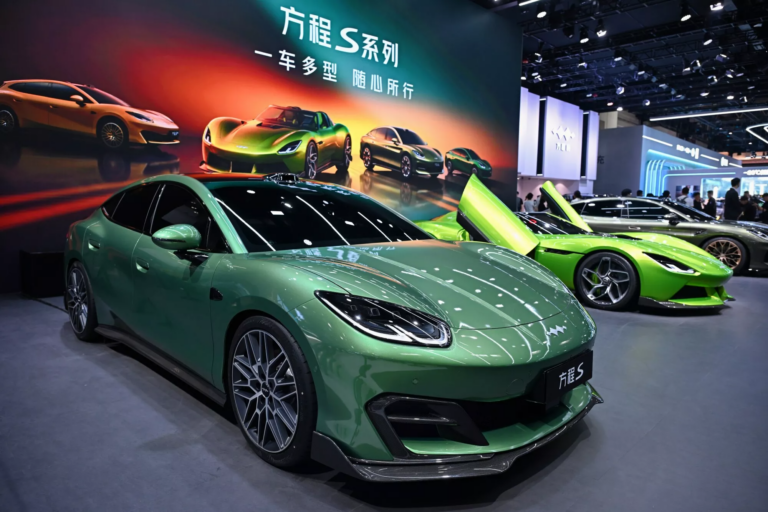
When BYD’s performance sub-brand Fang Cheng Bao launched its Formula S sedan in Shanghai on September 16, the company made two announcements simultaneously — and the engineering one may prove more consequential than the pricing one. The Formula S series became the first mass-market production vehicle to offer BYD’s DiSus-M intelligent magnetorheological suspension system, a technology previously found exclusively on Ferraris, Lamborghinis, and six-figure luxury performance cars, starting from ¥209,900 (approximately $31,040 USD).
The series starts at ¥189,900 (approximately $28,080 USD), with the entry-level rear-wheel-drive variant using BYD’s DiSus-C intelligent damping system. DiSus-M is available on all variants priced from ¥209,900 (approximately $31,040 USD) upward, where it is offered at the same price as the conventional DiSus-A air suspension alternative — meaning buyers at that tier choose chassis philosophy rather than pay a premium for the exotic hardware.
Magnetorheological Suspension: What It Is and Why It Mattered Only to Ferraris Before Now
Magnetorheological suspension takes its name from a class of smart fluids whose properties change dramatically under the influence of a magnetic field. A magnetorheological — or MR — damper is filled with oil that holds microscopic iron particles, typically between 0.1 and 10 micrometers in diameter, in suspension. Under normal conditions the fluid behaves like ordinary oil and passes freely through the piston channels inside each shock absorber. When the suspension control unit applies an electromagnetic field, those iron particles align themselves along the field lines within milliseconds, causing the fluid to stiffen from a liquid into a near-solid viscoelastic state. The stronger the field, the stiffer the fluid — and the stronger the damping force. When the field is switched off, the fluid returns to its low-viscosity state, also within milliseconds.
The critical engineering advantage over conventional semi-active systems is the absence of mechanical valves. Traditional electronically controlled dampers use tiny mechanical valves to regulate oil flow and therefore damping; those valves have physical response times and wear over time. An MR damper has no valves at all — it is just fluid, iron particles, and an electromagnet — so its response is governed only by electromagnet switching speed. The practical result, as BWI Group Senior Advisor Doug Carson confirmed in a 2025 interview, is a system that can adjust damping force approximately 1,000 times per second.
This technology entered automotive production in 2002 when General Motors installed a system called MagneRide — developed by Delphi Automotive and now managed by BWI Group — in the Cadillac Seville STS. Ferrari adopted it next, using the instant-response damping to sharpen handling without sacrificing ride quality. Lamborghini, Audi, Honda, and Ford’s Mustang followed. By 2025, BWI Group reported that over 10 million MagneRide-equipped dampers had been installed across more than two decades of production. Throughout that period, MR suspension remained essentially a feature of vehicles costing well above $50,000. A leading automaker recently signed a MagneRide supply deal for 400,000 vehicles annually — a sign the technology is finally scaling — but BYD has moved it to a lower price point than any Western supplier has reached.
BYD’s DiSus-M is the company’s proprietary MR suspension implementation, developed in-house. It uses the same core principle — MR fluid, electromagnets, millisecond response — but is not a licensed MagneRide product. The Chinese-developed version debuts in the Formula S family, which is the first product line in BYD’s portfolio to receive it.
Launch Price Nobody Saw Coming
Pre-orders for the Formula S series opened August 20 at an announced range of ¥230,000 to ¥280,000 (approximately $34,020 to $41,410 USD), already below analyst expectations of ¥250,000–¥300,000. At the September 16 Shanghai launch event, Fang Cheng Bao went further still.
The Formula S sedan series starts at ¥189,900 (approximately $28,080 USD) with five variants priced up to ¥229,900 (approximately $34,000 USD). The Formula S GT shooting brake adds a more steeply raked roofline and starts at ¥219,900 (approximately $32,520 USD), with four variants up to ¥239,900 (approximately $35,490 USD).
The base Formula S undercuts the Tesla Model 3 RWD’s China price of ¥235,500 (approximately $34,830 USD) by roughly $6,750. It also directly targets Xiaomi’s SU7, which has been one of the most prominent arrivals in the premium Chinese EV sedan segment in recent years.
The ¥189,900 starting price is 17.4% below the lower bound of the pre-sale range that buyers had been given just weeks earlier — a rare move in an industry where launch prices typically confirm pre-order figures rather than undercut them.
Full Specification Breakdown
The lineup is structured around three powertrain tiers:
The entry-level Formula S uses a 76.744 kWh lithium iron phosphate (LFP) Blade Battery 2nd generation, a single 245 kW (329 hp) rear motor, and DiSus-C suspension. Its CLTC-rated range is 730 km (454 miles).
The long-range rear-wheel-drive Formula S steps up to a 92.093 kWh Blade Battery 2nd generation, a 300 kW (402 hp) rear motor, and CLTC-rated range of 900 km (559 miles). At this tier buyers choose between DiSus-A dual-chamber air suspension and DiSus-M magnetorheological suspension, both at ¥209,900 (approximately $31,040 USD).
The all-wheel-drive Formula S uses the same 92.093 kWh pack, combines a 190 kW front motor with a 300 kW rear motor for a total system output of 490 kW (657 hp), and delivers CLTC-rated range of 750 km (466 miles). DiSus-A and DiSus-M are again offered at equal pricing.
The Formula S GT uses the 92.093 kWh pack across its entire range. Rear-wheel-drive GT variants achieve 850 km (528 miles) CLTC range; all-wheel-drive variants deliver 730 km (454 miles) CLTC. DiSus-A and DiSus-M are available on all GT configurations.
All range figures above are CLTC ratings — China’s domestic EV test standard, which simulates heavier urban stop-and-go patterns and lower average speeds than the US EPA cycle or the European WLTP standard. In independent road tests of existing BYD models, real-world range has typically fallen 20 to 30 percent below CLTC figures at highway speeds. The Australian Automobile Association found BYD’s Atto 3 SUV delivered 23 percent less range than its CLTC-equivalent advertised figure under real-world conditions. The Formula S has not been independently tested at highway speeds. As a rough guide, the 900 km CLTC rating translates to an estimated 630–720 km (391–447 miles) of real-world range, comparable to or slightly better than the EPA range of a long-wheelbase Tesla Model S.
Flash charging is standard across all variants: 10% to 70% in 5 minutes and 10% to 97% in 9 minutes. Achieving 97% from 10% in 9 minutes implies an average charging power approaching 550 kW, which requires BYD’s ultra-fast charging infrastructure and is not achievable on standard public Level 2 or DC fast chargers.
Driver assistance is handled by the LiDAR-equipped God’s Eye B system, supporting urban and highway navigation assistance as well as automated parking.
Both bodystyles share a 2,960 mm (116.5 in) wheelbase. The Formula S sedan measures 5,060 mm (199.2 in) long, 1,967 mm (77.4 in) wide, and 1,483 mm (58.4 in) tall. The GT is 5,025 mm (197.8 in) long. These dimensions put the car in a class with European executive saloons rather than compact sedans.
How DiSus-M Compares to DiSus-A and What the Choice Means
Buyers who configure a long-range or AWD variant face a genuine engineering decision, since DiSus-A and DiSus-M are identically priced.
DiSus-A is BYD’s dual-chamber air suspension with variable-damping shock absorbers — a proven, high-quality system found in premium EVs worldwide. Air suspension allows ride height adjustment and can be tuned across a wide range of softness and firmness. Its response time is governed by the physical movement of air between chambers, which takes longer than an electromagnetic field change.
DiSus-M replaces the variable air chambers with MR fluid dampers. Its theoretical advantage is response speed: the millisecond electromagnetic switching time means the system can react to road surface inputs before the wheel has fully transmitted that input to the chassis. In a conventional semi-active system — including DiSus-A — the damper is always slightly behind the road. In an MR system, the gap is small enough to matter at speed and over sharp inputs. The tradeoff is that air suspension can adjust ride height; DiSus-M cannot.
For buyers primarily concerned with urban comfort and variable road surfaces, DiSus-A is likely the more practical choice. For buyers who prioritize dynamic response on country roads and performance driving, DiSus-M is the engineering argument to make. The fact that BYD prices them identically suggests it views the two systems as genuinely comparable in value — rather than positioning MR as a premium add-on.
A Brand in Sharp Acceleration
Fang Cheng Bao sold 41,568 vehicles in August 2026, up 155.57% year-on-year. The brand delivered 242,255 vehicles in the first eight months of 2026, up 165.66% year-on-year and already above its full-year 2025 total of 234,637. Cumulative FCB sales surpassed 500,000 units in under three years, with an average transaction price above ¥223,000 (approximately $33,000 USD).
FCB is BYD’s fifth sub-brand, alongside Denza, Yangwang, and the Dynasty and Ocean series. Where Yangwang targets ultra-luxury buyers and Denza competes in the premium European segment, FCB has established a niche built around personality and capability — initially through off-road SUVs, now expanding into sport sedans.
FCB General Manager Xiong Tianbo said at the Beijing Auto Show in April that entering the sedan market was not a departure from the brand’s positioning, adding that consumers are increasingly rejecting conventional sedans for more distinctive alternatives.
What This Means for the Market
The Formula S launch illustrates how rapidly Chinese automakers have been compressing the gap between supercar-grade hardware and mass-market pricing. Magnetorheological suspension — once a $10,000–$15,000 option on a $200,000+ Ferrari — now ships as a no-cost alternative to air suspension on a $31,040 sedan. LiDAR-based driver assistance, once the preserve of $100,000+ autonomous test vehicles, is standard equipment. Flash charging at speeds requiring industrial-grade power delivery is presented as a basic feature rather than a differentiator.
BYD has begun selling Fang Cheng Bao vehicles outside China under the Denza badge — the Ti 7 recently launched in the UK and Europe as the BYD Ti7. FCB vehicles are sold overseas under Denza and BYD badges. CarNewsChina has reported that the Formula S and GT are poised to enter international markets under the Denza brand, following the visual design language of the Denza Z sports car shown at Goodwood. No launch dates or pricing for international markets have been confirmed.
Data Privacy: What Buyers Outside China Need to Understand
The Formula S is a connected vehicle equipped with LiDAR, multiple cameras, internet connectivity, and a comprehensive driver assistance suite. These systems collect continuous data including GPS location, driving behavior, camera and sensor feeds, and potentially voice and cabin audio. This data profile is relevant for any buyer considering a Denza-badged variant when the car enters European or other international markets.
BYD is headquartered in Shenzhen, China, and is subject to Chinese law regardless of where it sells vehicles or where it incorporates subsidiaries. Three laws are directly relevant to buyers outside China:
China’s National Intelligence Law (2017), Article 7 requires that “any organization or citizen shall support, assist, and cooperate with state intelligence work in accordance with the law.” This requirement applies extraterritorially — meaning a Chinese company operating overseas remains bound by it — and cannot be overridden by a company’s stated privacy policy, its European data protection compliance certificates, or the physical location of its servers.
The Cybersecurity Law (2016) includes data localization requirements, and the Data Security Law (2021) grants government authorities access to data for national security purposes. Taken together, these laws mean that vehicle data collected by a BYD-manufactured car — including location history, driving patterns, and sensor recordings — can be lawfully demanded by Chinese intelligence authorities, and the company is legally required to comply.
BYD’s privacy documentation describes certifications under automotive cybersecurity standards R155 (CSMS) and R156 (SUMS), which address cybersecurity management and software update management respectively. These are legitimate industry certifications. They do not, however, address the jurisdiction question: compliance with automotive cybersecurity standards does not modify a company’s obligations under national intelligence law.
No independent security audit of the Formula S’s specific data collection and transmission architecture has been published. Buyers who purchase Denza-badged variants in European markets can limit their exposure using in-vehicle privacy settings and network segmentation, but no technical mitigation fully removes the structural legal risk established by Chinese law.
Should US Buyers Pay Attention?
The Formula S is a China-only product. No US market launch has been announced or is likely in the near term given existing tariffs and the ongoing US investigation into Chinese connected-vehicle data security. US buyers cannot purchase one.
The car matters to American readers for two reasons. First, it establishes what BYD considers achievable at $28,000–$34,000 in engineering terms — a benchmark that will inform competitive expectations in every market BYD enters and that will pressure Western OEMs competing at similar price points. Second, the technology democratization it represents — MR suspension, LiDAR ADAS, flash charging — at this price tier signals how fast Chinese engineering costs are falling and how rapidly that gap will reach markets where Chinese EVs do compete directly.
Currency conversions in this article are approximate, based on a rate of 6.7628 CNY per USD as of September 16, 2026, the date of the Formula S launch event.
Frequently Asked Questions
What is magnetorheological suspension, and why does it matter that it’s in a $28K car?
Magnetorheological suspension uses a special fluid filled with microscopic iron particles. When an electromagnetic field is applied, those particles align within milliseconds and the fluid stiffens dramatically, increasing damping force. The system has no mechanical valves, so it can adjust 1,000 times per second — far faster than conventional semi-active suspension. Until now, this technology was primarily found in Ferraris, Lamborghinis, and other six-figure performance cars, where it has been in production since the early 2000s. The Formula S makes it available at under $32,000, at the same price as the conventional air suspension alternative on the same car. That price compression is the story.
The Formula S claims 900 km of range. What would that actually mean in real-world driving?
The 900 km figure is a CLTC rating — China’s domestic test standard, which tends to be 20–30 percent higher than real-world highway driving results. An independent road test of the BYD Atto 3 by the Australian Automobile Association found that vehicle came up 23 percent short of its official range claim under real conditions. Applying a similar adjustment to the Formula S’s 900 km CLTC figure gives a rough estimate of 630–720 km (391–447 miles) of real-world range, which remains genuinely impressive but is meaningfully different from the headline figure. No independent highway test of the Formula S has been published. US readers should not compare CLTC figures directly to EPA-rated range without this context.
Can the Formula S be purchased in the US or Europe?
The Formula S is currently a China-only product. No US launch is planned or likely given existing trade policy. BYD has indicated that Fang Cheng Bao models enter international markets under the Denza brand — the Ti7 has already launched in the UK and Europe — and CarNewsChina has reported that the Formula S and GT are likely to follow the same path. Confirmed launch markets, timing, and pricing for an international Formula S have not been announced.
What are the data privacy implications for buyers in Europe or other markets where Denza-branded versions may launch?
The Formula S collects continuous GPS location, driving behavior, camera and sensor data, and potentially cabin audio. BYD is subject to China’s National Intelligence Law (2017), which legally requires the company to cooperate with intelligence requests from Chinese authorities — a requirement that applies regardless of where the car is sold or where BYD incorporates subsidiaries. This is not a theoretical risk; it is a fixed legal condition of operating under Chinese jurisdiction. Buyers of Denza-badged variants in Europe should be aware that in-car privacy settings can limit but cannot eliminate this structural exposure. No independent security audit of the Formula S’s data architecture has been published.