HomeAuto Vossloh Adds Ultrasonic Defect Detection to LiDAR Rail Stack with Australian RTI Buy
Vossloh Adds Ultrasonic Defect Detection to LiDAR Rail Stack with Australian RTI Buy
September 18, 2026:
Vossloh.com
For the first time in European rail infrastructure, a single supplier now controls a technically closed loop: scan the geometry of the track from above using laser light, probe for invisible cracks inside the steel from below using ultrasonic waves, and deploy tamping machinery to fix what the data reveals. Germany’s Vossloh AG assembled that loop in eight months — and the final piece snapped into place this week.
Vossloh completed its acquisition of Rail Technology International (RTI), a Melbourne-based Australian specialist in automated rail defect detection, on or around September 15, 2026, adding 38 years of ultrasonic and eddy current sensing expertise to a digital portfolio that already includes British LiDAR-AI specialist Cordel and Swedish ballast tamping contractor Nordic Tamping Service. Together, the three acquisitions give the Werdohl-based rail infrastructure group something no European competitor currently offers: a system that detects both surface-geometry faults and subsurface material defects, then has the physical capability to intervene and correct them — all within a single Lifecycle Solutions division.
Financial terms of the RTI deal were not disclosed.
Why Surface Scanning and Subsurface Sensing Are Different Things
Understanding why this combination matters requires understanding what each technology physically does — and what it cannot do.
Cordel, which Vossloh acquired for €33 million (approximately $37 million USD) in a deal made effective August 13, 2026, uses LiDAR — Light Detection and Ranging — to scan rail infrastructure from above. Miniaturized laser scanners mounted on in-service trains fire pulsed light at millions of points per second; by measuring the time of flight for each returning pulse, Cordel’s system generates dense three-dimensional point clouds of the track corridor. Combined with inertial measurement units and GNSS positioning, the system can detect uneven ballast beds, overhead-line sag, gauge violations, vegetation encroachment, and structural clearance problems — everything that affects track geometry and the environment around it. Cordel’s customers already include Network Rail in the United Kingdom and Amtrak in the United States.
What LiDAR cannot do is see inside the rail itself.
Steel rails fail from the inside out. Transverse fissures — cracks that propagate through the rail head perpendicular to the direction of travel — initiate internally under rolling contact fatigue stress and can grow to catastrophic size before any surface symptom appears. These are the defects that cause rails to snap under a passing train. Track defects account for roughly one-third of the approximately 2,200 annual train derailments in the United States, according to the Federal Railroad Administration. LiDAR, however sophisticated, produces no signal when the failure is brewing inside the steel.
RTI’s technology addresses exactly this layer. Founded in 1988, the company builds vehicle-based automated flaw detection systems that combine two complementary non-destructive testing methods. Ultrasonic inspection transmits acoustic energy — typically at 2.25 MHz — into the rail through piezoelectric transducers; when the pulse encounters a crack or void, the reflection pattern reveals both the presence and approximate depth of the defect. Eddy current testing works by electromagnetic induction: a probe coil generates alternating currents in the near-surface layer of the rail head, and surface-breaking or near-surface defects distort the eddy current field in ways the sensor detects as an impedance change. Where conventional ultrasonic methods operating at high frequency can be masked by surface conditions such as “shelling” — shallow horizontal fatigue cracks that block the signal before it can reach deeper transverse defects — eddy current picks up exactly the surface-initiated defects that ultrasonic misses, and vice versa. The practical significance of that complementarity was documented in a 1992 derailment in Superior, Wisconsin, where 14 freight cars carrying hazardous materials left the tracks and forced the evacuation of more than 40,000 residents — a failure attributed partly to the way shelling masked the transverse defect beneath it.
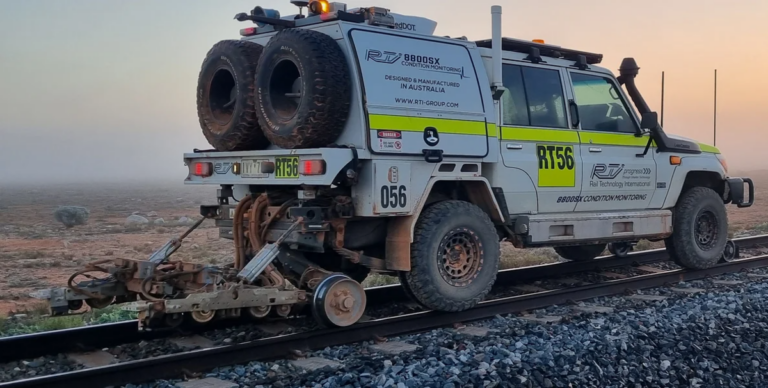
RTI’s systems can be installed on hi-rail road vehicles, dedicated inspection trains, or manual push trolleys, which means rail condition data can be collected continuously during normal operations rather than in dedicated inspection windows that take lines out of service.
How Vossloh Built the Stack — and Why Now
Vossloh opened 2026 with the January 9 acquisition of Nordic Tamping Service AB (NTS), a Borlänge, Sweden-based contractor that restores track geometry by tamping — compressing and leveling — the crushed-stone ballast bed beneath railway sleepers. Tamping is the physical intervention that corrects the geometry faults that Cordel’s LiDAR identifies; it is the action layer that turns inspection data into maintenance outcomes. NTS operates across Sweden, Norway, and Denmark.
With the physical intervention layer in place, Vossloh then announced a firm intention to acquire Cordel in May 2026, citing a 2025 joint pilot project in continental Europe that demonstrated the potential of combining Cordel’s LiDAR point-cloud analytics with Vossloh’s existing laser-based inspection capabilities. The Cordel deal was funded in part by a €250 million hybrid bond (approximately $280 million USD) that Vossloh raised earlier in 2026 specifically to strengthen its digital capabilities. Cordel CEO John Davis described the acquisition as “the natural next step in our success story,” and Erik Henderson, Cordel’s Global Head of Rail Solutions and a former technical director at CSX responsible for automation across 20,000 miles (32,187 km) of railroad network, called Cordel “a real tipping point for railroad inspection — the first model I’ve seen that actually works at scale.”
RTI’s arrival completes a three-layer architecture:
LiDAR and AI (Cordel): Geometry, clearances, environment — what is happening on the surface and around the track.
Ultrasonic and eddy current (RTI): Material integrity — what is happening inside the steel itself.
Ballast tamping (NTS): Physical correction — restoring geometry to specification once inspection data identifies a problem.
The only major component missing from a fully unified platform is software integration: a single data layer that combines RTI’s subsurface defect maps, Cordel’s 3D geometry scans, and NTS’s tamping records into one continuous condition model of any given track section. Vossloh has not publicly announced such a platform, but the strategic intent is implicit in assembling these three complementary capabilities under the same Lifecycle Solutions division.
What Is the Track in Your Rail?
Track geometry and rail material integrity are not the same maintenance problem, and treating them as one has historically produced gaps. A track section can have perfect ballast geometry and still harbor transverse fissures growing toward failure — invisible to a geometry-focused inspection pass. A section can have measurable ballast settlement (detectable by LiDAR) but sound steel. Each problem requires different sensing and different remediation.
The ATSB — Australia’s transport safety regulator — has documented cases in which ultrasonic inspection limitations allowed defects to progress: in one 2008 incident, an extra pulse echo was recorded during an ultrasonic inspection nine months before a derailment, but a handheld follow-up examination concluded no sizable defect existed. In a 2017 derailment near Dry Creek, South Australia, a vertical split head defect went undetected partly because poor surface condition of the railhead inhibited the ultrasonic test. RTI’s simultaneous use of both ultrasonic and eddy current methods is specifically designed to reduce this class of false-negative result.
Does Rapid Consolidation Create Its Own Risks?
How Does Vossloh Cover the Cost of Three Acquisitions in Eight Months?
Vossloh’s first-half 2026 results, published July 23, show revenue of €710.1 million (approximately $795 million USD), up 21.9 percent from the same period in 2025, and an order backlog that reached a record €1,140.7 million (approximately $1.28 billion USD) as of June 30. The company’s full-year 2026 guidance projects revenue in the €1,510 million to €1,610 million range (approximately $1.69 billion to $1.80 billion USD), supported by major contracts including high-speed rail work in China and the United States. The €250 million hybrid bond raised earlier this year provides additional non-dilutive capital specifically earmarked for digital expansion.
That financial cushion makes the pace of acquisition more legible. Vossloh is not stretching to acquire — it is deploying a pre-committed digital war chest into a market where the established specialists are small (RTI: approximately 50 employees; Cordel: 42 employees at acquisition; NTS: a small Scandinavian operator) and therefore accessible at prices that a company of Vossloh’s scale can absorb without financial stress.
The integration challenge is real nonetheless. Three acquisitions in eight months means three technology platforms, three management teams, and three sets of customer relationships to absorb into a group that employs approximately 5,500 people across more than 60 production sites in nearly 30 countries. Whether Vossloh can deliver a unified offering — rather than a holding company for loosely related inspection businesses — will depend on its ability to build a software data layer that actually connects RTI’s defect maps to Cordel’s geometry scans to NTS’s tamping records in real time.
CEO Oliver Schuster has framed the ambition clearly: “RTI’s intelligent inspection and data technologies are a perfect addition to our digital portfolio. Combined with our maintenance expertise, they will enable us to offer our customers even more efficient predictive maintenance solutions.”
The industry will be watching whether Vossloh can make that integration real — and whether a rail infrastructure company that built its reputation on steel fasteners and concrete sleepers can become the company that told operators which of those sleepers were sitting above a cracked rail before it failed.
Currency conversions in this article are approximate, based on exchange rates at the time of publication and subject to change.
Frequently Asked Questions
How does ultrasonic rail inspection actually detect cracks inside steel rails?
Ultrasonic inspection uses piezoelectric transducers to transmit acoustic pulses — typically at 2.25 MHz — into the rail head. When the pulse encounters a discontinuity such as an internal crack or void, it reflects back to the sensor. The timing and amplitude of the return echo reveal both whether a defect is present and approximately where in the rail’s cross-section it sits. The method is effective for internal transverse fissures but can be masked by surface conditions; eddy current testing, which uses electromagnetic induction to detect near-surface defects, is used alongside ultrasonics specifically to close that coverage gap.
What is the difference between what LiDAR sees and what ultrasonic inspection finds in a rail?
LiDAR scans the surface geometry and surrounding environment of the track — it measures ballast profiles, overhead-line positions, clearances, and vegetation. It can tell operators that a section of track has settled 12 millimeters (0.47 inches) out of specification. Ultrasonic inspection goes inside the rail material itself to find internal cracks growing toward failure that have no surface expression at all. Both types of information are needed for complete predictive maintenance; neither replaces the other. Vossloh’s acquisition of RTI and Cordel in the same year is a direct response to that complementarity.
Why do track defects cause so many train derailments if railways are regularly inspected?
Track defects account for approximately one-third of the roughly 2,200 annual train derailments in the United States, according to the Federal Railroad Administration. Several factors explain the persistence of the problem: inspection intervals are finite rather than continuous; conventional ultrasonic systems operating at high frequencies can be masked by surface conditions; defects in rail welds are particularly difficult to detect because coarse weld microstructure attenuates the ultrasonic signal; and the high cycle fatigue environment of a busy freight or passenger corridor can cause a crack to propagate significantly between inspection passes. Automated systems that collect defect data continuously during ordinary operations — rather than in dedicated inspection windows — are specifically designed to reduce this gap.
What does Vossloh’s acquisition strategy mean for how railways pay for maintenance?
Lifecycle Solutions contracts — which combine inspection, condition monitoring, and physical maintenance services into a single long-term agreement — allow rail operators to pay for track performance rather than for discrete maintenance events. For Vossloh, such contracts generate recurring revenue over the multi-decade lifespan of a rail network, which is structurally more valuable than one-time component sales. For operators, the benefit is predictability and reduced exposure to unplanned line closures caused by undetected track failures. Vossloh’s assembly of RTI, Cordel, and NTS into a single Lifecycle Solutions division is an attempt to offer this bundled model at a technical depth that competitors currently cannot match.