HomeAuto Falcon 9 Carries Classified Starshield Batch Tonight as Pentagon Bets $17B on Unkillable Satellites
Falcon 9 Carries Classified Starshield Batch Tonight as Pentagon Bets $17B on Unkillable Satellites
September 17, 2026:
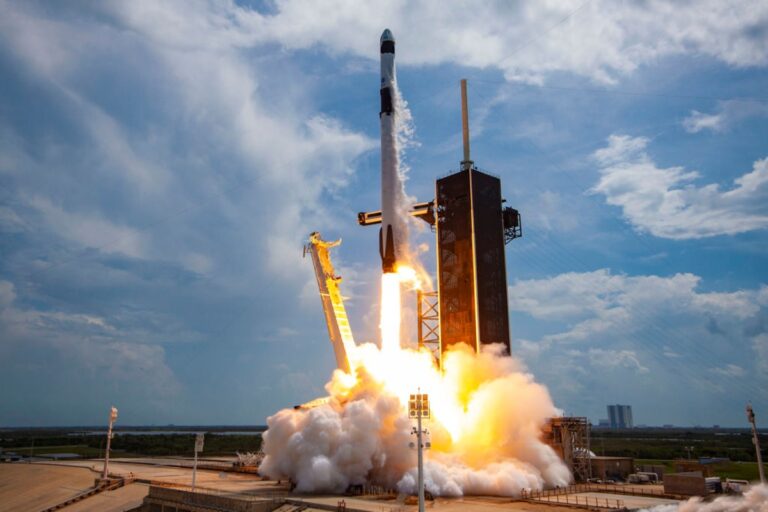
SpaceX via Getty Images
SpaceX is targeting a four-hour window opening at 9:00 PM ET (6:00 PM PDT) tonight, September 16, 2026, for a second attempt at launching the classified USSF-259 mission from Space Launch Complex 4E at Vandenberg Space Force Base, California — one day after a pre-fueling scrub on Tuesday ended without explanation, as is standard practice for national security payloads. Tonight’s flight will be Falcon 9’s 106th mission of 2026, a year on pace to surpass last year’s record-setting cadence of 165 orbital flights.
The mission is the third classified Space Force satellite launch SpaceX has executed in just over a month from a single pad, a pace that reflects the Pentagon’s accelerating bet on proliferated low Earth orbit as the cornerstone of American military space capability — a bet now worth $17 billion in contracted launch authority.
Why Hundreds of Cheap Satellites Beat a Few Expensive Ones
The strategic logic behind USSF-259 — and behind the cluster of classified launches that surrounds it — is not obvious from the mission designation alone. To understand it, consider what the U.S. military used to do: it built a small number of extraordinarily capable, enormously expensive satellites and parked them in geosynchronous orbit (GEO) roughly 22,236 miles (35,786 km) above Earth. The flagship missile warning system, the Space-Based Infrared System (SBIRS), cost more than $1 billion per satellite, took years to manufacture, and sat in a predictable orbit that adversaries have spent decades learning to target with anti-satellite (ASAT) weapons.
That architecture has a fatal weakness: each satellite is irreplaceable on any short timeline, so destroying one — or credibly threatening to — degrades a significant fraction of America’s missile warning capacity. China and Russia have demonstrated direct-ascent ASAT capability. The old approach of buying exquisite satellites and hoping adversaries would not shoot them is no longer a viable defense posture.
The answer, embodied in the Proliferated Warfighter Space Architecture (PWSA), is the opposite approach entirely: launch hundreds of smaller, cheaper satellites into low Earth orbit (LEO) at roughly 620 miles (1,000 km) altitude, networked in a mesh so dense that eliminating any single node changes nothing. Shooting one satellite wastes an ASAT missile. Shooting enough to actually degrade the constellation requires an attack on hundreds of targets simultaneously — a cost so high it fundamentally changes the adversary’s calculus. This is why the Pentagon is now spending at the scale it is, and why tonight’s launch is something more than a routine classified mission.
The Space Development Agency (SDA), the organization building PWSA under the U.S. Space Force, describes the architecture as providing low-latency data connectivity, beyond-line-of-sight targeting, missile warning and tracking, hypersonic glide vehicle detection, and alternate position, navigation, and timing capabilities. The LEO vantage point — far closer to Earth than GEO — provides better angular resolution for tracking fast-maneuvering threats such as hypersonic glide vehicles, which are designed specifically to defeat GEO-based early warning systems.
What’s on Board: Starshield’s Role in the Mesh
The USSF-259 payload is classified. The Space Force has confirmed only that the mission exists and that it targets a polar orbit — the standard inclination for surveillance and military constellations that need to overfly the entire Earth’s surface on a regular cycle. SpaceX has not published a post-separation timeline, and the live webcast will cut after the booster’s drone ship landing, disclosing nothing about payload deployment or the number of satellites aboard.
Independent analysts tracking the booster’s ascent-stage drop zones — the zones reserved during the FAA license process for where expended hardware might fall — note that tonight’s southerly trajectory and Pacific recovery profile closely match those of previous missions believed to carry Starshield satellites. Analysts at nextspaceflight.com and keeptrack.space matched the drop-zone signature of USSF-259’s ascent stage to previous SDA Transport Layer launches.
Starshield is SpaceX’s government-focused, hardened variant of its Starlink broadband platform, publicly unveiled in December 2022. It uses a flat-pack satellite bus derived directly from the Starlink hardware that has proven its durability across thousands of commercial launches — but with three additions that distinguish it for national security use. First, Starshield carries additional high-assurance cryptographic capability to host classified payloads and process data securely, meeting the most demanding government requirements, in SpaceX’s phrasing. Second, it uses the same inter-satellite optical laser links that Starlink satellites carry, enabling direct satellite-to-satellite connectivity without routing data through ground stations — a mesh capability that lets the network keep functioning even when ground infrastructure is disrupted or destroyed. Third, the satellite bus is modular, designed to accept a wide range of hosted government payloads: from signals intelligence sensors to Earth observation cameras to communications relay equipment.
Primary customers for Starshield include the Space Development Agency (for PWSA Transport Layer data connectivity), the National Reconnaissance Office (for hosted intelligence payloads), and the U.S. Space Force itself.
The Scrub and Tonight’s Window
Tuesday’s attempt ended quietly before fueling even began. SpaceX issued a brief public statement saying it was standing down from the attempt and targeting Wednesday as the backup opportunity, offering no technical or weather-related explanation. That level of communication is typical for classified missions, where operational security norms extend even to routine launch-day updates. The rocket remained vertical on pad 4E overnight. SpaceX subsequently confirmed the Wednesday window is “GO.”
Tonight’s four-hour window opens at 9:00 PM ET (6:00 PM PDT) and closes at 1:00 AM ET (10:00 PM PDT). If SpaceX hits the window and the launch proceeds, the payload will deploy into a low Earth orbit inclined approximately 80 degrees from the equator — a near-polar inclination that gives the constellation coverage of the Earth’s polar regions and regular overflight of every point on the planet’s surface.
Booster B1097: Reuse at National Security Tempo
The Falcon 9 first stage assigned to USSF-259 carries the tail number B1097 and is embarking on its 13th flight; its last use was 27 days prior. The booster debuted in September 2025 and has since launched a range of missions that illustrate how fluidly SpaceX moves the same hardware between commercial and national security work: prior flights include the NROL-172 classified reconnaissance mission and multiple Starlink batches including missions believed to have carried Starshield satellites.
Thirteen flights on a single booster is no longer extraordinary for SpaceX — the current fleet record stands at 37 flights, set by booster B1067 in August. But the fact that national security payloads now routinely ride on extensively used hardware represents a significant cultural shift from an era when the U.S. military insisted on flying classified satellites on fresh rockets, a posture that was relaxed for the first time in June 2021 and has steadily normalized since.
Following stage separation, B1097 will attempt a propulsive landing on the autonomous drone ship Of Course I Still Love You, positioned in the Pacific Ocean west of Vandenberg. A successful touchdown would be the 225th recovery on that vessel — a figure that makes the drone ship recovery itself a remarkable piece of operational infrastructure, essentially a sea-going spaceport that SpaceX operates continuously off the California coast.
A Month of Classified Launches: The Cluster in Context
USSF-259 is the third in a rapid sequence of Space Force missions that SpaceX has executed in roughly one month from a single pad:
USSF-366 launched from SLC-4E at Vandenberg on August 15, 2026, on booster B1088 flying its 18th mission. Independent analysts matched its drop zones to the Starshield bus signature.
USSF-153 lifted off September 10 from the same pad, carrying an undisclosed number of satellites on booster B1081, which was completing its 27th flight. That landing on Of Course I Still Love You was the 224th recovery on that vessel, per tracking records. Independent analysts’ drop-zone analysis pointed again to Starshield-bus satellites.
That cadence is not coincidental. The rapid cluster of missions demonstrates the operational tempo that the National Security Space Launch (NSSL) Phase 3 Lane 1 framework was specifically designed to enable. “The Phase 3 Lane 1 construct allows us to execute launch services more quickly for the more risk-tolerant payloads, putting more capabilities on orbit faster in order to support National Security,” said Brig. Gen. Kristin Panzenhagen, program executive officer for Assured Access to Space.
The $17 Billion Commitment
The scale of the Pentagon’s commitment to the PWSA strategy crystallized on July 17, 2026, when the Space Force raised the NSSL Phase 3 ceiling — from $5.6 billion to $17 billion, an increase of $11.4 billion. The modification covers an additional 110 launches, bringing the total expected missions under Lane 1 to 170 over the next decade. Seven launch providers currently hold Lane 1 slots: SpaceX, United Launch Alliance, Blue Origin, Rocket Lab, Stoke Space, Impulse Space, and Relativity Federal — all seven confirmed Lane 1 awardees.
The total U.S. national security launch budget across both Lane 1 and Lane 2 (the more complex, less risk-tolerant tier) now exceeds $30 billion across Lane 1 and Lane 2 combined. For context, in January 2026, the Space Force awarded SpaceX nine task orders worth approximately $739 million — nine task orders combined under NSSL Phase 3 Lane 1, covering Space Development Agency Tranche 2 Transport Layer satellites and a new NRO mission set. The full scope of military spending on proliferated LEO architecture now dwarfs any single legacy GEO satellite program.
What the GAO Found: The Architecture’s Known Risks
The PWSA strategy carries real technical risk, and a January 2026 Government Accountability Office report documented it candidly. The GAO found that the Space Development Agency was assessing technology maturity at the satellite level in a way that systematically under-identified the immaturity of enabling technologies — specifically infrared payloads for the Tracking Layer and optical communications terminals for the Transport Layer. “Both space and ground contractors said that they underestimated the complexity of PWSA development and integration,” the report found.
As of early 2026, the first two Tranche 1 launches (September and October 2025) had not finished on-orbit checkout and functional testing, and subsequent Tranche 1 launches were delayed. The Tranche 1 Tracking Layer satellites — the 28 spacecraft designed to detect and track hypersonic missiles — were built by L3Harris and Northrop Grumman under contracts worth approximately $700 million and $617 million respectively.
The delays and GAO concerns do not invalidate the strategic logic of proliferation — spreading risk across hundreds of satellites inherently tolerates individual delays better than a program built around five exquisite GEO nodes. But they do mean that the “unkillable” mesh is not yet fully operational, and the current cluster of NSSL Lane 1 launches partly reflects an effort to accelerate the in-orbit buildup on a program that is running behind its original schedule.
Sonic Booms and the View from the Coast
Observers on California’s Central and South Coasts may hear sonic booms tonight, generated as booster B1097 decelerates through the atmosphere ahead of its drone ship landing. The sonic signature depends on atmospheric conditions, but on previous southerly Vandenberg launches it has been audible as far inland as the Santa Ynez Valley and as far south as the Santa Barbara area. SpaceX’s live webcast will begin approximately 10 minutes before the window opens, streaming on the company’s official channels.
What Comes Next
USSF-259 marks Falcon 9’s 106th mission of 2026 — a pace that is on track to approach or match last year’s record of 165 orbital flights. Additional Space Development Agency Tranche 2 Transport Layer missions and National Reconnaissance Office flights remain in the queue for late 2026 and 2027 under the Lane 1 framework, part of the 170-mission cadence the expanded contract envisions.
Six days from tonight, on September 22, 2026, SpaceX is targeting Starship’s first orbital flight test — a mission that, if successful, would open an entirely new launch capacity tier for both commercial and national security missions. The window for that attempt opens at 8:15 AM ET.
For tonight, the Falcon 9 is the vehicle. The window opens at 9:00 PM ET.
Frequently Asked Questions
What is USSF-259 and who is on board?
USSF-259 is a classified mission for the U.S. Space Force launching September 16, 2026, from Vandenberg Space Force Base on a SpaceX Falcon 9. The payload is not publicly disclosed, but independent analysts tracking the rocket’s trajectory and stage drop zones believe it is likely a batch of Starshield satellites — SpaceX’s government-hardened variant of its Starlink platform, equipped with high-assurance encryption and inter-satellite laser links. The mission targets a polar orbit inclined approximately 80 degrees.
What does “proliferated” mean and why does the Pentagon prefer it now?
Proliferation in this context means deliberately building a constellation out of many small, cheap, individually replaceable satellites rather than a small number of large, expensive ones. The strategic logic is kill-hardening: a legacy GEO satellite that costs $1 billion and takes years to replace is an attractive target for adversary ASAT weapons. A LEO mesh of hundreds of Starshield satellites means that destroying any single node costs the attacker an expensive ASAT weapon while changing nothing about the constellation’s capability. The Proliferated Warfighter Space Architecture is specifically designed so that no individual satellite is worth shooting — the network is the weapon, and the network is unkillable at any reasonable attack cost.
Why was Tuesday’s launch scrubbed?
SpaceX issued only a brief statement saying it was standing down from the September 15 attempt before fueling had begun, with no technical or weather explanation offered. For classified missions, operational security norms typically suppress launch-day technical details, so the absence of an explanation is standard rather than a signal of a serious problem. SpaceX has confirmed the Wednesday window is “GO.”
Is the Falcon 9 booster for tonight’s launch new?
No. Booster B1097 is flying for the 13th time, with its last mission having been 27 days ago. The ability to fly the same booster on classified national security missions is itself a milestone — when the Space Force first permitted a reused Falcon 9 booster on a national security payload in June 2021, it was treated as a historic policy change. Today, a 13th-flight booster carrying classified Space Force hardware is routine, reflecting how thoroughly the economics of propulsive recovery have been accepted by the U.S. military.