NYC Teen Pregnancy Prevention Program In Limbo After Trump Funding Cuts: ‘Complete Shock’

September 16, 2026:

NYC Teen Pregnancy Prevention Program In Limbo After Trump Funding Cuts: ‘Complete Shock’

HHS abruptly cancelled $68 million in grants for dozens of sex education initiatives, forcing Children’s Aid to lay off staff and cancel programming.

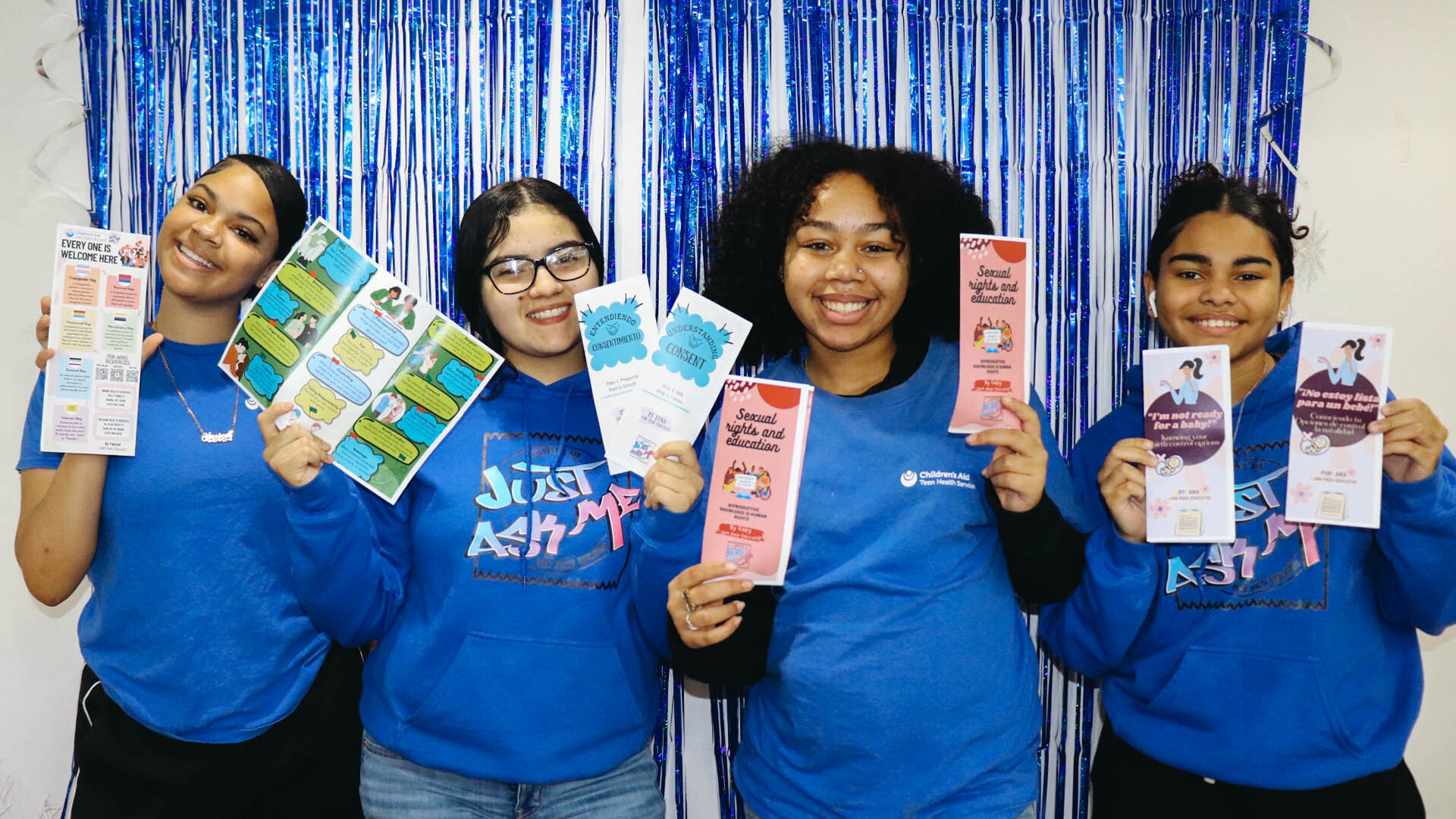
Adolescents hold up sexual health pamphlets in front of a blue backdrop.

Ridwaane Tchakala was in ninth grade when his school counselor shared an unusual job opportunity: He could get paid to help educate people his own age about sex, relationships, reproductive health, and health privacy rights. 

Tchakala, a Bronx native, attended an event put on by the Children’s Aid Society, a New York City nonprofit, and in the spring of 2023, decided to apply for a role in the Just Ask Me (JAM) Peers program. 

Now 18 years old and in his first semester at Boston University, Tchakala said he thought it would be helpful to have a job where he’d be “able to relay that message to my siblings or people that are not really knowledgeable in that area.”

“I never experienced a sex ed workshops or had any knowledge of sex ed,” he said of his experience before training with the program.

The Children’s Aid program through which Tchakala was hired and trained provided evidence-based sex education to an estimated 1,200 students each year. But in June 2026, the Trump administration abruptly cancelled the grant that funded it, along with more than 50 others. In total, about $68 million that had been awarded for evidence-based teen pregnancy prevention programming was cut off two years before the grants were set to expire. 

Now, experts and advocates warn that the future of the initiative that hired and trained Tchakala to talk about privacy rights, consent, and sex with fellow teens—and dozens of others like it—is in limbo.

Abrupt cancelation

Children’s Aid found out its five-year grant was cancelled on June 26, 2026, through a letter posted to the portal used to communicate with the Department of Health and Human Services, Pascale Saintonge Austin, the director of family planning and pregnancy prevention programs at the multi-service nonprofit, told Rewire News Group in an interview. 

“It was [a] complete shock. We had been in compliance the entire time, the entire three years,” Saintonge Austin said. “It was very surprising to cut with no path to reconcile what exactly in the shifted policy that we weren’t following.”

She said the letter cited HHS’ shifting priorities, but did not provide the group with any information about ways to align itself with the new changes. 

With two years left on the grant when it was cancelled, Saintonge Austin said, the organization lost nearly $2 million in federal dollars over two years—pledged money it had relied on when designing its programming through the next two years, all of which went to teaching New York City youth about their bodies and preventing unwanted pregnancies. 

The consequences were swift, Saintonge Austin said. 

“We had summer things planned with [partner organizations],” she said, “that had to be immediately cancelled.” 

How a ‘wildly successful’ bipartisan program came under fire

The federal grant program supporting the Children’s Aid teen pregnancy prevention programming dates back to 2010, when then-President Barack Obama signed into law a budget proposal allocating more than $114 million to combat teen pregnancy. The programs that got the grant funding typically address topics like personal hygiene, consent, healthy relationships, and STI prevention and treatment, Christina Piecora, a senior policy analyst at the National Health Law Program, said. 

Through the grant-funded JAM peer program at Children’s Aid, Tchakala said that he and others like him co-facilitated school sessions with sex educators and helped the program prepare related events.  

These educational programs meet adolescents where they are, including classrooms or after-school programs. But they also target kids in harder-to-reach places—for example, Children’s Aid had a program that brought pregnancy prevention programming to a foster care facility in Manhattan. 

When the teen pregnancy prevention legislation was first introduced in 2009, bipartisan support made it possible to get the funding passed, Piecora added. That trend continued into February 2026, when Congress last reauthorized the grant program. 

“Every time it’s been voted on and renewed, the statutory mandate is the same: evidenced-based education, age appropriate,” Piecora said. “And it’s been wildly successful.”

Recent provisional data from the Centers for Disease Control and Prevention suggests that between 2007 and 2025, pregnancy among U.S. teenagers has dropped more than 78 percent for teens aged 15 to 17 and 69 percent for those aged 18 to 19. 

“We don’t really see that immediate impact of a lot of federal programs like we’ve seen in this program,” Piecora said. 

Shortly after canceling these grants en masse, the Trump administration announced its new teen pregnancy prevention grant criteria. They included a focus on abstinence, sex-separated anatomy lessons, an emphasis on fertility and ovulation monitoring, and discussions about family planning goals. Applicants would also be required to pass an “alignment review” with Trump administration priorities. 

The change “basically tries to create a fundamentally different program, driven by ideological preferences and not by what Congress has mandated, which is scientifically accurate, age-appropriate, teen pregnancy prevention,” Piecora said. The funding cuts “undermine access to comprehensive reproductive health care, while ignoring the intent of Congress.”

Multiple organizations, including two county governments and a Planned Parenthood affiliate, have since sued, arguing the administration “abandoned statutory criteria established by Congress in favor of their own policy priorities.” 

On Aug. 19, 2026, a federal judge temporarily blocked the implementation of the new grant application requirements while the case proceeds in court. But the Obama-appointed judge stopped short of reinstating the terminated grant funding in the interim. 

Fighting to stay afloat

It’s unclear what will become of the unreleased $68 million as the lawsuit challenging the terminated grants plays out in federal court. But Children’s Aid has had to find other ways to buoy their sexual health programming for New York City teens. 

In a statement to RNG, Children’s Aid said it received an anonymous donation that would allow it to continue to employ Tchakala and its other peer educators—for now. The donation also allowed them to keep on three full-time and two part-time employees that would have otherwise been at risk of a layoff. 

But three full-time and one part-time positions were eliminated. And the donation the organization received will only last the organization through next summer, Children’s Aid Vice President of Health and Wellness Rhonda Braxton said in a statement.

“We are grateful for this support,” Braxton said. “However, private philanthropy is not a sustainable substitute for approximately $1 million in annual federal funding.”

Tchakala expressed confusion about the federal government’s decision to slash funding for sex ed. 

“People are trying to help the younger generation become better and have more knowledge,” he said. “I just don’t see why [the Trump administration] did it.”

Tchakala added that older colleagues who were laid off as a result of the cuts served as mentors to him and other teen sex educators could lean on for support. 

“People are losing their jobs,” he said. “And those people are people that we build bonds with.”

Source

Source link