HomeAuto SpaceX Starfall Customer Reveals Starship’s 2028 Commercial Launch Date
SpaceX Starfall Customer Reveals Starship’s 2028 Commercial Launch Date
September 16, 2026:
Brandon Bell/Getty Images
SpaceX has signed Luxembourg-based mission integrator Space Cargo Unlimited as an early commercial customer for Starfall, its reusable in-orbit manufacturing capsule — and the deal has disclosed something SpaceX had never announced publicly: its inaugural Starship commercial mission is planned for 2028. Space Cargo Unlimited will fly its BentoBox payload system inside a Starfall capsule on that mission, carrying up to one tonne (2,205 lbs) of customer experiments from the pharmaceutical, life science, and advanced materials sectors. At its target scale, the mission would be more than 30 times larger than any single payload return any rival capsule company has flown to date.
The deal is one of at least two commercial Starfall contracts now public. Redwire’s SpaceMD subsidiary announced in August 2026 that it too had signed for a 2028 Starfall mission, planning to carry 32 of its Pharmaceutical In-Space Laboratory containers on what would be the largest dedicated commercial microgravity research flight in history.
Together, the two contracts suggest SpaceX is accumulating a commercial manifest for Starfall before Starship has entered service — a strategic pattern that mirrors how the company built early Starlink demand before Falcon 9’s rideshare program matured.
What Starfall Is — and Why It Cannot Fly Alone
Starfall is a disc-shaped, uncrewed reentry capsule measuring 3.1 meters (10.2 feet) across and just 0.75 meters (2.5 feet) tall — roughly the shape and proportions of a very large hockey puck. According to the FAA Final Environmental Assessment published in May 2026, its empty mass is approximately 2,100 kilograms (4,630 lbs), and it can carry up to 1,000 kilograms (2,200 lbs) of payload. The vehicle splits into two sections: an aluminum upper plate housing the payload bay and flight control components, and a carbon fiber heat shield below that protects the vehicle during reentry and stores the compressed nitrogen gas used for attitude control and parachute deployment.
That last detail is important for understanding what Starfall actually is and is not. Unlike Dragon, Starfall carries no rocket engines and no hazardous propellants. It uses compressed inert gas exclusively — enough to orient its heat shield correctly for reentry, and to deploy parachutes for recovery. It cannot fire itself out of orbit. A host vehicle — currently Falcon 9, and eventually Starship — must supply the orbital mechanics: carrying the capsule to orbit, deploying it, and providing the de-orbit burn that puts it on a reentry trajectory. Starfall is retrieved by splashdown in the Pacific Ocean, with SpaceX planning to recover both sections of the vehicle.
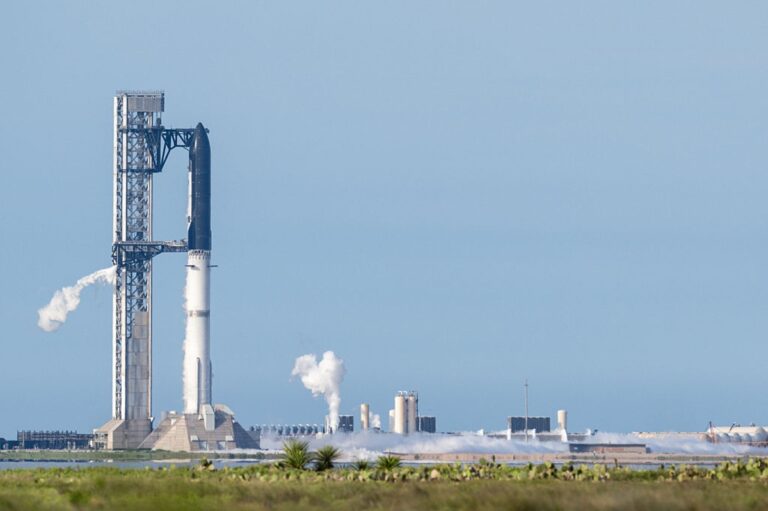
The design choice to eliminate propulsion is not a limitation so much as a deliberate tradeoff. Removing engines slashes vehicle mass, raises the payload fraction, eliminates explosion risk during reentry, and simplifies regulatory approvals. On Starship — which can carry more than 100 metric tons (220,460 lbs) to low Earth orbit — the economics become strikingly different: a single Starship mission could deploy dozens of Starfall capsules simultaneously, each returning a full tonne of manufactured materials. That is the “volume and rhythm” Space Cargo CEO Nicolas Gaume says he is buying into with this deal.
SpaceX conducted Starfall’s first test flight on June 23, 2026, launching aboard a Falcon 9 from Space Launch Complex 40 at Cape Canaveral Space Force Station, Florida. The capsule completed one and a half orbits and splashed down in the Pacific Ocean approximately 1,300 kilometers (808 miles) off the California coast. SpaceX ended its webcast shortly after the booster landed, offering few details — a level of secrecy more typical of classified national security missions than commercial demonstrations.
What Goes in the Box — and Why Orbit Helps
The rationale for flying experiments to orbit and back rests on a straightforward but non-obvious physics advantage. On Earth, gravity continuously disrupts manufacturing processes: it drives sedimentation in solutions, creates convection currents in liquids, and pulls growing crystals unevenly as they form. In microgravity, none of those forces operate. Protein crystals grow larger and more uniform. Metal alloys form without the compositional gradients that gravity-driven segregation imposes on Earth. Fiber-optic cables can be drawn with fewer defects. The persistent microgravity environment of low Earth orbit removes an engineering constraint that terrestrial manufacturers have been working around for centuries.
Space Cargo Unlimited has firsthand data to show. Between 2019 and 2021, the company flew two long-duration ISS missions, including an experiment that sent Merlot and Cabernet Sauvignon vine shoots into orbit. After months in microgravity, the vines were returned to Earth and replanted; the company reported the orbited vines showed earlier growth and biological changes that their ground-based counterparts did not. Nearly half of the company’s prospective customer base for its 2028 Starfall mission comes from life sciences and biotechnology — sectors where microgravity benefits are best documented.
That concrete track record is what distinguishes current in-space manufacturing companies from their predecessors. The market for in-space manufacturing has been discussed for decades, but until Varda Space Industries returned pharmaceutical crystals of ritonavir — an HIV/AIDS medication — from orbit in February 2024, no private company had ever demonstrated a commercial product returned from space. Varda has since flown six W-series missions, with its W-5 and W-6 both returning in 2026, and has raised $187 million in funding.
Varda’s 30-Kilogram Ceiling and Starfall’s Ceiling
The competitive stakes of Starfall’s arrival become concrete when measured in kilograms. Varda’s W-series reentry capsule is roughly 90 centimeters (35 inches) across and weighs under 90 kilograms (198 lbs) empty, carrying payloads in the tens of kilograms. Starfall’s 1,000-kilogram (2,200 lb) payload capacity is more than an order of magnitude larger.
The structural problem this creates for Varda and other capsule startups is not hard to see: every one of Varda’s W-series missions has launched on a SpaceX rideshare. SpaceX has now introduced a competing capsule with dramatically larger capacity, on a trajectory toward its own proprietary launch vehicle, while simultaneously indicating it intends to wind down Falcon 9 commercial rideshare bookings after 2028. That is not merely a competitive threat; it is a potential foreclosure of the launch access that rivals currently depend on.
For Space Cargo, aligning directly with SpaceX sidesteps that structural tension. The company is not building its own capsule or launch vehicle — it operates as a mission integrator, aggregating customer payloads and routing them to whichever return vehicle fits a given mission window. BentoBox is booked to fly on ATMOS Space Cargo’s Phoenix capsule and will also fly on ESA’s Space Rider in addition to Starfall. The first Phoenix/BentoBox mission, announced in November 2025, has slipped to early 2027. The Starfall deal is the largest vehicle in that portfolio, and the Starship version of that deal would be the largest payload any Space Cargo mission has ever attempted.
One Bet on Starship
The 2028 timing is the number that carries the most weight in the Space Cargo contract — and not only as a mission date. It aligns directly with a strategic inflection point SpaceX set for itself, without ever calling it a deadline until Bloomberg reported in July 2026 that the company had begun refusing Falcon 9 post-2028 bookings and had halted production of some Falcon 9 non-reusable components, including the upper stage. Companies that currently depend on Falcon 9 rideshare access will need an alternative by the time those orders sunset — and the only alternative SpaceX is offering is Starship.
This means every company now booking a Starfall 2028 slot is making an implicit concentrated bet on Starship’s commercial readiness. Starship has not yet entered commercial service as of September 2026, and its development has spanned years of test flights, explosions, and schedule revisions. SpaceX has completed at least 13 integrated test flights of the system; its next mission is expected to carry the first Starlink satellites aboard Starship to orbit before progressing to external commercial payloads. The path from test flight cadence to commercial service within the next two years is, by any standard assessment, demanding.
Gaume’s emphasis on “volume and rhythm” as the deal’s defining appeal takes on a different texture in that light. The volume comes from Starship’s 100-tonne (220,460 lb) payload capacity enabling multi-capsule deployments. The rhythm depends on Starship achieving a flight cadence high enough to offer routine commercial access — something Falcon 9 established over more than a decade, and something Starship has not yet demonstrated at all. The Space Cargo contract is a vote of confidence in that trajectory; it is also, necessarily, a wager on it.
What Comes Next
Space Cargo Unlimited has planned seven missions across multiple return vehicles between 2025 and 2028, covering pharmaceuticals, materials science, electronics, and agriculture. The 2028 Starfall flight is the most ambitious entry on that manifest — a one-tonne capacity on the most powerful rocket ever built, contingent on Starship meeting a commercial schedule that SpaceX itself has never publicly confirmed until now.
Redwire’s SpaceMD is making a parallel commitment, expecting to fly 32 pharmaceutical research containers on a separate 2028 Starfall mission. Its CEO has called the moment an inflection point for drug development in space.
Both contracts tell the same underlying story: the in-space manufacturing sector, which spent much of the past decade arguing for its own viability, is now writing checks against a 2028 deadline that SpaceX set without announcement — and that the commercial space industry has decided, for better or for worse, to make its own.
Space Cargo Unlimited, backed by European institutional investors including the European Innovation Council and the European Investment Bank, raised €27.5 million in Series A funding (approximately $31.8 million USD at exchange rates at time of research). Mission pricing for the 2028 Starfall flight has not been disclosed.
Frequently Asked Questions
What is SpaceX Starfall, and how does it differ from Cargo Dragon?
Starfall is a disc-shaped, uncrewed reentry capsule designed for returning manufactured goods and research samples from low Earth orbit. Unlike Cargo Dragon, which was built around servicing the International Space Station, Starfall is designed as a general-purpose return logistics platform with no crew capability, no rocket engines, and a focus on high payload mass at low cost. Its 1,000-kilogram (2,200 lb) payload capacity and propulsion-free design — attitude control comes from compressed nitrogen gas only — are optimized for the economics of orbital manufacturing rather than crew access or ISS resupply. The FAA’s May 2026 environmental assessment contains the most complete public technical specifications of the vehicle to date.
Will Starship really have a commercial mission in 2028?
That is now the operative commercial assumption across multiple signed contracts, but it has never been officially confirmed by SpaceX. Space Cargo Unlimited’s 2028 Starfall booking, which will fly on Starship, is the first public data point that implicitly names 2028 as Starship’s inaugural commercial flight date. SpaceX has also halted Falcon 9 rideshare bookings for post-2028 and stopped producing certain non-reusable Falcon 9 components, which makes 2028 a structural deadline for the company’s commercial launch business — not simply an aspiration. Starship, however, has not yet entered commercial service, and its flight history to date is a series of development tests. The schedule depends on technical progress that SpaceX has not yet demonstrated at operational commercial cadence.
What can microgravity actually produce that Earth cannot?
The clearest documented advantages fall into several categories. Pharmaceutical crystal growth in microgravity produces larger, more uniform protein crystals than Earth-based methods, enabling better structural analysis of drug targets and potentially different crystal polymorphs with improved stability or bioavailability. Fiber-optic cables made from fluoride glass (ZBLAN) develop fewer crystallization defects in microgravity, theoretically enabling far lower signal loss than current silica cables. Advanced metal alloys and semiconductor materials can be processed without the gravity-driven sedimentation and compositional gradients that affect Earth manufacturing. In all these cases, the challenge is demonstrating that the quality premium justifies the cost of orbital round-trips — a threshold the sector has been approaching but not yet fully crossed at commercial scale. The physics of space manufacturing and Varda’s first commercial orbital return of ritonavir crystals in 2024 offer the most concrete benchmarks available.
What happens to the in-space manufacturing sector if Starship is delayed past 2028?
Companies that have booked Starfall missions on Starship would face schedule uncertainty, but the more structural issue is access to launch vehicles generally. SpaceX has indicated it plans to retire Falcon 9 commercial rideshare bookings after 2028 and has stopped producing some non-reusable Falcon 9 components. If Starship is not commercially operational by then, a capacity gap emerges across the launch market — with Falcon 9 winding down and Starship not yet available. Other launch providers (United Launch Alliance’s Vulcan, European Ariane 6, Rocket Lab’s Neutron) could theoretically absorb demand, but none has the flight cadence or payload capacity to substitute for Falcon 9 at scale. The sector’s rapid growth in booked 2028 missions makes Starship’s timeline more load-bearing than any single contract might suggest. Bloomberg’s reporting on the Falcon 9 halt laid out the structural dynamics most clearly.