HomeAuto Higgs Decay Yields First Entangled Qutrits, Challenging Status of Virtual Particles
Higgs Decay Yields First Entangled Qutrits, Challenging Status of Virtual Particles
September 15, 2026:
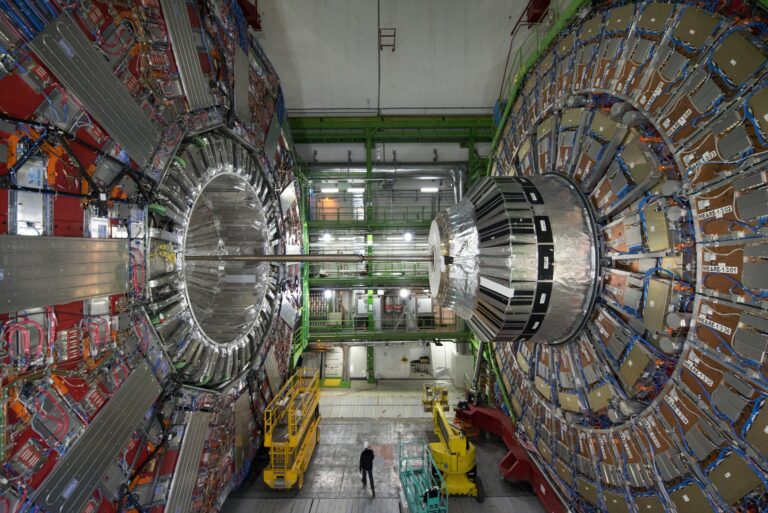
A picture taken on February 10, 2015 in Meyrin, near Geneva, shows the CMS (Compact Muon Solenoid) Cavern at the European Organisation for Nuclear Research (CERN). Richard Juilliart/AFP via Getty Images
Physicists at CERN have produced the first direct evidence of quantum entanglement between elementary particles that are qutrits — three-state quantum systems — a distinction that sets this measurement apart from every previous entanglement observation in particle physics and raises a genuinely unsettling question about whether “virtual” particles deserve the philosophical dismissal they have long received. The result is reported in a new paper published in Physical Review Letters on September 11.
The result comes from the ATLAS Collaboration at CERN’s Large Hadron Collider in Geneva. Major science outlets including ScienceAlert are now reporting on the paper. By examining the rare decay of a Higgs boson into two Z bosons — and then tracking the four leptons those Z bosons left behind — the team found that the two Z bosons’ spin states were so deeply correlated they could not be described independently of each other: they were entangled.
“The spins of the two Z bosons are extremely entangled, considerably more so than in the top-antitop case that was measured previously,” said physicist Juan Antonio Aguilar-Saavedra of the Institute of Theoretical Physics in Spain, who developed the theoretical framework the measurement builds on.
Why Three States Change Everything
The reason this measurement occupies different scientific territory than the 2024 top-quark result — which was itself the highest-energy observation of entanglement at the time — comes down to spin. A top quark is a spin-1/2 particle: it has two possible spin orientations, making it a quantum bit, or qubit, in the language of quantum computing. A Z boson is a spin-1 particle: it has three possible orientations (spin values of +1, 0, and −1), making it a qutrit — a three-level quantum system. This distinction is confirmed in the ATLAS Collaboration’s Physical Review Letters paper.
This is not an incremental difference. A pair of qubits inhabits a four-dimensional quantum state space. A pair of qutrits inhabits a nine-dimensional one. The joint spin state of the two Z bosons emerging from a Higgs decay can be written as |ZZ⟩ = a|+−⟩ + b|00⟩ + c|−+⟩ — a coherent superposition of three configurations, governed by the constraint that the Higgs boson, which has no spin of its own, cannot hand its daughters spins that simply add up to something other than zero. That constraint is exactly what forces the Z bosons into a shared quantum state, and that shared state is what the ATLAS team has now confirmed leaves them entangled, as detailed in the official ATLAS briefing on this measurement.
“This is the first time entanglement has been measured with elementary particles that are qutrits,” Aguilar-Saavedra noted, in remarks reported by ScienceAlert.
A Virtual Duck That Quacks Like a Real One
There is a complication that makes this result stranger still. A Higgs boson weighs approximately 125 GeV (gigaelectron volts). A Z boson weighs approximately 91 GeV. Producing two fully real Z bosons from a single Higgs decay would require at least 182 GeV — more energy than is available. At least one of the Z bosons must therefore be a virtual particle: an off-shell quantum entity that cannot exist as a free, directly observable particle, and whose very status as a “particle” is philosophically contested among physicists. This energy constraint is explained in the ATLAS Collaboration’s measurement briefing.
In quantum field theory, virtual particles arise in perturbation calculations as internal lines in Feynman diagrams — mathematical tools for computing interaction probabilities. Many physicists regard them as computational artifacts: useful fictions that help organize calculations but lack independent physical existence. The Casimir effect and the Lamb shift are sometimes cited as indirect evidence that virtual particles produce real consequences, but neither provides evidence that a virtual particle can participate in a specifically quantum-informational relationship like entanglement.
The ATLAS result suggests the virtual Z boson does exactly that. The entanglement signal the team measured involves the joint spin state of both Z bosons — the real one and the virtual one — as a single correlated system. The spin-density matrix parameters the researchers extracted (C₂,₁,₂,₋₁ = −0.71 ± 0.45 and C₂,₂,₂,₋₂ = 0.08 ± 0.44) are off-diagonal elements: their non-zero values are precisely the signature that the two bosons cannot be described independently, even though one of them is technically “off the mass shell.” These parameter values are reported in the ATLAS entanglement measurement briefing.
“One can ask: do virtual particles exist, or are they a construct of our minds that we use to calculate things?” Aguilar-Saavedra said, in quotes published by ScienceAlert on September 15. He cautioned the result does not fully resolve that philosophical debate, but may “shed a little light on whether virtual particles are particles or not.”
“If it walks like a duck and quacks like a duck, then what we’re looking at must be a duck,” he said. “In this case, a virtual duck.”
What the Measurement Actually Required
The practical demands of this measurement are worth understanding, because they clarify both how impressive the result is and why it cannot yet be called a formal discovery. Z bosons exist for only approximately 3 × 10⁻²⁵ seconds (three hundred-septillionths of a second) before decaying into other particles. No detector records a Z boson’s spin directly, as the Particle Data Group’s reference data confirms.
Instead, the ATLAS team used data from years of LHC proton-proton collisions at center-of-mass energies of 13 and 13.6 trillion electron volts (TeV). They searched specifically for the “golden channel” decay: a Higgs boson decaying to two Z bosons, each of which then decays to a lepton pair (either two electrons or two muons), yielding four charged leptons in total. This four-lepton final state accounts for only about 3 percent of Higgs decays, but it is fully reconstructible, meaning the ATLAS detector can capture all four particles and use their trajectories to work backward to the original Higgs decay geometry, as detailed in the ATLAS briefing on this analysis.
From a combined Run 2 and Run 3 dataset — representing hundreds of quadrillions of proton-proton collisions — the collaboration identified only approximately 400 usable events that passed all selection criteria. This is an extraordinarily small sample by collider standards. The team used the angular distributions of those four leptons to reconstruct the spin-density matrix of the Z boson pair, comparing the result against two hypotheses: an entangled state (as the Standard Model predicts) and a separable (non-entangled) state. The Physical Review Letters paper details this analysis.
The most sensitive analysis — a likelihood-ratio test using the full angular distribution — disfavored the non-entangled hypothesis with a statistical significance of 4.7 standard deviations (sigma). Particle physicists conventionally require 5 sigma to claim a formal discovery. The 4.7 sigma result is “strong evidence” in the field’s own terminology, and it is exactly in line with the 4.9 sigma the collaboration’s models predicted the analysis could achieve given the dataset size. The ATLAS Collaboration briefing confirms both the observed and expected significance figures.
“We’re used to thinking of entanglement as something delicate, seen in laboratory experiments with single photons,” said Professor Alan Barr of Oxford’s Department of Physics, who co-led the Oxford group on the project. The result, he noted, is a reminder that quantum rules operating inside quantum computers apply throughout nature — even at energy scales 13 trillion times greater than the photons that dominate quantum optics experiments. Barr’s remarks were reported by ScienceAlert.
What Comes After 4.7 Sigma: The HL-LHC Path to Formal Discovery
The LHC completed its Run 3 on June 27, 2026, and is now in Long Shutdown 3, undergoing a four-year, $1.5 billion upgrade to become the High-Luminosity LHC, as TechTimes reported when the shutdown began. Run 4 is scheduled to begin in June 2030. When it does, the collision rate will be approximately ten times higher than Run 3’s, and the total accumulated data will eventually exceed Run 3’s entire dataset by a factor of roughly one hundred.
That data volume will turn the 4.7 sigma evidence into a formal discovery with room to spare, while also enabling much more detailed measurements of the entangled state’s structure — mapping the full 9×9 spin-density matrix with precision that the 400-event sample cannot support. The same analysis applied to a High-Luminosity LHC dataset would be sensitive to subtle deviations from Standard Model predictions that could indicate new physics modifying the Higgs coupling structure. These prospects are detailed in the ATLAS entanglement measurement briefing.
The formal paper, titled “Measurements of Z-Boson Pair Entanglement in Decays of Higgs Bosons at the ATLAS Experiment,” is co-authored by the full ATLAS Collaboration (G. Aad et al.) and published in Physical Review Letters (volume 137, page 111804; DOI: 10.1103/y1nh-1b82).
CERN has been extending its reach into quantum information science through its Quantum Technology Initiative (QTI), whose Phase II, launched in January 2024, focuses specifically on identifying applications where quantum computing could deliver “quantum advantage” within the particle physics program. A dedicated LHC Quantum Computing Workshop is also scheduled for September 22-24, 2026 at the University of Valencia, bringing together researchers to explore quantum algorithms for LHC data analysis.
Professor Daniela Bortoletto, who coordinates UK contributions to the upgraded ATLAS pixel detector, described the measurement’s significance in the broader context of CERN’s scientific program. “This measurement demonstrates the scientific power of the ATLAS collaboration and the unique capabilities of CERN’s Large Hadron Collider,” she said, in remarks published by ScienceAlert. “Oxford researchers have played a leading role in developing these new approaches to studying quantum phenomena at the highest energies, and we are proud to contribute to an international effort that is opening new ways to explore the fundamental laws of nature.”
For now, the particle that philosophers debate calling “real” has handed physics something unambiguous: a measured correlation that cannot be explained by any non-quantum model, encoded in the tracks of four leptons that survived long enough to reach the ATLAS detector. Whether the virtual duck is philosophically a duck may remain contested. That it is quantumly entangled, the data are saying, is harder to argue with.
Frequently Asked Questions
What is a qutrit, and why does it matter that Z bosons are qutrits rather than qubits?
A qubit is a two-level quantum system — one that can exist in two possible states, or any superposition of them. The qubits at the heart of quantum computers are typically realized by spin-1/2 particles (electrons, superconducting circuits, trapped ions), which have spin values of +½ and −½. A qutrit is a three-level quantum system: it can exist in three possible states or any superposition of them. The Z boson is a spin-1 particle, giving it spin projections of +1, 0, and −1, which makes each Z boson a natural qutrit. This matters because a pair of qutrits inhabits a nine-dimensional Hilbert space rather than the four-dimensional space of a qubit pair, enabling more complex and richer entanglement structures. The ATLAS result is the first time entanglement has been measured between elementary particles in this higher-dimensional quantum state space, as confirmed in the official ATLAS measurement briefing.
Can virtual particles really be entangled — and what does that tell us about whether they exist?
A virtual particle is one that is “off-shell”: it violates the standard energy-momentum relationship (E² = p²c² + m²c⁴) that all directly observable particles satisfy. In quantum field theory, virtual particles appear as mathematical constructs inside Feynman diagram calculations. Many physicists regard them as convenient fictions rather than physical entities. The ATLAS measurement complicates that comfortable dismissal: the virtual Z boson in the Higgs decay is a participant in a measured quantum-information correlation — entanglement — with the real Z boson. Entanglement is not a property of mathematical symbols; it is a measurable feature of quantum states. Physicist Juan Antonio Aguilar-Saavedra says the result may “shed a little light” on the virtual particle ontology debate, though it does not resolve it. What it does show is that an off-shell Z boson behaves, in at least one operationally measurable way, like a particle rather than a placeholder. These findings are reported by ScienceAlert.
Why didn’t CERN cross the 5 sigma threshold for a formal discovery here?
The 4.7 sigma result reflects the fundamental data limitation of the measurement. The H→ZZ*→4ℓ decay chain occurs in only about 3 percent of Higgs decays, and from years of LHC Run 2 and Run 3 data representing hundreds of quadrillions of proton-proton collisions, only approximately 400 events passed all selection criteria. The measurement’s expected significance given that sample size was 4.9 sigma — so achieving 4.7 sigma is not a shortfall, but a result that accurately reflects the statistics available. Reaching 5 sigma requires more data. The High-Luminosity LHC, scheduled to begin Run 4 in June 2030, will accumulate roughly one hundred times more collision data over its lifetime than Run 3 collected, turning this strong evidence into a formal discovery and enabling precision measurements of the entangled state’s full structure. Full details are in the published Physical Review Letters paper.
How does this result connect to quantum computing?
Quantum computing relies on entanglement as its primary resource: entangled qubits can encode and process information in ways that no classical system can efficiently simulate. The ATLAS result demonstrates that the same mathematical structures underlying quantum computers — entangled multi-level quantum systems described by spin-density matrices — appear naturally in the decay products of the Higgs boson at energies 13 trillion electron volts above everyday experience. This confirms that entanglement is not a fragile laboratory curiosity requiring millikelvin temperatures and careful isolation, but a feature of nature operating at every energy scale the Standard Model describes. CERN is also pursuing this connection actively through its Quantum Technology Initiative, which in January 2024 launched a second phase focused on finding specific areas where quantum computing can accelerate particle physics data analysis — including for the massive datasets the High-Luminosity LHC will eventually produce.